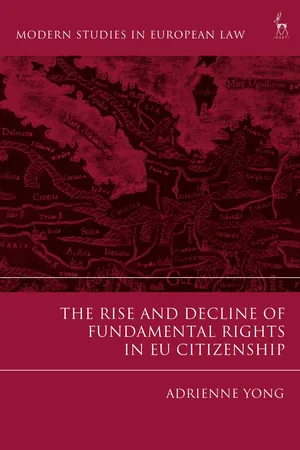
This book argues that there is an inherent relationship between EU fundamental rights and EU citizenship: they both have the same objective of guaranteeing protection for the individual. This is underpinned by the development of case law in the field by the Court of Justice of the EU (CJEU). Here, however, the author proposes that that relationship has weakened in recent years as the CJEU has entered increasingly sensitive territory in regard to the protection of citizenship rights and fundamental rights.
Writing in the post UK–EU referendum environment, the author argues that this decline is attributable to increasing Euroscepticism, which has worsened since the Eurozone crisis and even more so in light of Brexit, and arguments made that leaving the EU would reduce immigration. This argument is particularly important to note given the rising fears of immigration that underlie much of the dissatisfaction with the EU project: a feeling prevalent not only in the UK. The chapters look at the rights of migrant EU citizens in Member States other than their own, and the guarantees that exist as a matter of protecting their fundamental human rights, which are present alongside rights enjoyed as part of being an EU citizen.
- 248 pages
- English
- ePUB (mobile friendly)
- Available on iOS & Android
eBook - ePub
The Rise and Decline of Fundamental Rights in EU Citizenship
About this book
Information
1
Examining EU Citizenship and its Relationship with EU Fundamental Rights
I.Introduction
The European Union (EU) introduced the legal, social and political concept of EU citizenship in the Treaty of Maastricht in 1993.1 Since its inception, a significant number of cases have been heard by the (now) Court of Justice of the European Union (CJEU – hereinafter ‘the Court’)2 relating to EU citizenship, and there has been heated discussion and debate in the literature on citizenship. Establishing a European status of citizenship was one of the most prominent non-economic concepts introduced into the EU in the Treaty of Maastricht. This book is a contribution to the expanse of literature on EU citizenship, but is one that adopts a different focus from that currently existing. It is the intention of this study to follow the development of EU citizenship from its origins, prior to its formal introduction in the Treaty of Maastricht, to its current status today, a heated and uncertain time in which the UK seeks to withdraw from the EU entirely and where the interpretation of the enjoyment of citizens’ rights is under heavy scrutiny. This analysis will be carried out through an assessment of the Court’s case law,3 with a particular emphasis on the influence of EU fundamental rights throughout. This approach is chosen in order to demonstrate that there has been a rise in the consideration of fundamental rights protection in the Court’s case law on citizenship since Maastricht, although now there are signs of a decline in the influence of these fundamental rights. A judicial model for this potential integration will be presented, supported by constitutional developments in fundamental rights protection. However, its limits are also acknowledged, and this is where the political effects are arguably most prominent. It will be argued that the judicial inconsistencies rife in the development of the concept of EU citizenship are linked to the unstable political environment of the EU itself and that this has affected the Court’s interpretation of integrating EU fundamental rights into EU citizenship law. This, it will also be argued, will help protect the rights of EU citizens in the UK after its imminent withdrawal from the EU.
The question of an inherent link between EU fundamental rights and EU citizenship law is not a novel one.4 Because EU citizenship was introduced as a non-economic concept with evident social and political elements, it was compared to other prominent non-economic guarantees in EU law, including the protection of fundamental rights, which is a general principle of EU law.5 There are inherent similarities between the two concepts. Both are intended to protect interests of the individual, and the effects of the legal principles that guide this also overlap.6 However, there is a striking difference that is difficult to reconcile. EU fundamental rights derive from a universal foundation of equality,7 whilst EU citizenship rights are only available upon having exclusive membership to the community.8 This book will discuss this divergence in the context of the case law in order to examine how the Court managed to interpret this to the benefit of the claimants: citizens of the EU. It will be argued that bringing the scope of EU citizenship law closer to that of EU fundamental rights protection was how this was achieved. However, the law has now more recently retreated to a position more akin to the one that existed at the outset of the introduction of EU citizenship status, somewhat compromising fundamental rights protection in the process. It will be argued that this is normatively and legally inconsistent with the constitutional trajectory that this book will outline. However, it will also be acknowledged that such liberalism as argued for here is hindered by increasingly sensitive politics that influences the legal culture of the Court. This cannot continue, especially in the wake of Brexit, as it risks significantly undermining EU citizenship status, which is supposedly fundamental.9
Considerable attention will turn to the political situation facing the EU today – that is, the withdrawal of the UK from the EU. The considerable uncertainty surrounding the effects of Brexit in all areas is particularly damning for citizens’ rights, as the UK is also in the midst of its negotiations as to the status of EU citizens within its territory to remain and retain rights after withdrawal.10 The argument to be made here is in favour of protecting and enhancing EU citizenship rights because they are inherently founded upon and linked to fundamental rights protection. This reasoning can be applied to this scenario, and this book intends to provide some clarity to the muddied situation. The argument remains that EU citizenship status is premised upon a wider, more universal level of protection of fundamental rights and that though the UK may be leaving the EU, these safeguards deriving from EU citizenship status are in place to protect the EU citizen. This argument feeds into the current negotiations on the UK joining the single market, and its unwillingness to also commit to the free movement of persons.11
EU citizenship, the European construction of a political concept that ordinarily relates to the nation state,12 was originally found in Article 8 of the Treaty Establishing the European Economic Community (EEC). Citizenship of the EU was established as a status that was granted to: ‘Every person holding the nationality of a Member State.’13 Article 8a EEC then set out the primary substantive rights that citizens would enjoy as part of the privilege of being an EU citizen, including the right to move and reside freely within the EU, amongst other political privileges.14 It is widely accepted that an EU citizenship status was not a consideration on the minds of the negotiators of the original Treaty of Paris when it was agreed in 1951.15 It was thus something of a novelty when after over 40 years of focusing on building a common market, a political concept like EU citizenship was introduced into the EU’s economic framework.
Whether the introduction of EU citizenship would have the intended effect of uniting the community by providing a status that all individuals in the EU would relate to and understand would inevitably be a struggle at the outset, given the lack of precedent in this regard. The EU was not originally established to fulfil such aims.16 One of the biggest obstacles still troubling the concept of EU citizenship today derives from the Treaty. The Member States, when drafting the Treaty, made EU citizenship dependent on first having the nationality of an EU Member State.17 This meant that EU citizenship was not a free-standing status on its own, which not only had legal implications for the conferral of citizenship rights, but also implications for EU legitimacy and solidarity because it maintained the distinction between Member State nationality and EU citizenship.18
On the other hand, the Court introduced EU fundamental rights to the case law as early as 1969.19 They were originally presented as secondary to the principles governing the internal market. It was not until a year later when the Court declared that fundamental rights were general principles of EU law that they were afforded any formal status in the EU.20 It made the EU’s commitment to non-economic rights official, but did not make fundamental rights as found in the Charter of Fundamental Rights of the EU (hereinafter ‘the Charter’) fully legally effective.21 Subsequent case law made clear that the EU was not founded on or solely influenced by human rights considerations,22 and recent case law has further confirmed that it would be unlikely to ever be exclusively concerned with human rights.23 This was despite fundamental rights being codified in the Charter and made equal in status to the Treaties themselves.24 However, it did not diminish the importance or relevance of fundamental rights. The development of fundamental rights case law has steadily widened the scope ratione materiae and ratione personae since the EU began,25 and began to overlap with EU citizenship as a result. Given that fundamental rights are inclusive and indiscriminately applicable by their very nature, this was to be expected. For EU citizenship, this expansion was more difficult to acknowledge, despite the concept’s scope ratione materiae and ratione personae also being broadened.26
The inherent similarities between EU fundamental rights and EU citizenship rights demand attention. Both share a similar objective – to enhance the protection of an individual’s rights as they exist within the context of the EU. However, the nature of citizenship compared to fundamental rights makes this connection contentious. Whilst Heater stated that ‘[t]he principle of equality cannot, in truth, be discounted in any consideration of the nature of citizenship’, it nevertheless ‘lies in a tangle of reservations and contradictions’.27 These contradictions can be traced back to Ancient Greece, where Aristotle’s polis of citizens was identified as the subject of one of the first concepts of citizenship. He originally reserved all rights and membership of his notion of a polis to a specific group of individuals.28 Though citizenship has now evolved to encompass the community beyond the polis into the nation state, this initial emphasis on exclusivity was at odds with fundamental rights. This is because fundamental rights are inherently available to all individuals and are intended to be universal as the EU’s manifestation of human rights are today. The question remains as to whether EU citizenship was conceived with this relationship in mind and, if not, why EU citizenship’s relationship with human rights in today’s EU legal order matters.
II.Linking EU Citizenship and Fundamental Rights
This book will examine the relationship between fundamental rights in the EU and the concept of EU citizenship through an examination of the Court’s case law. In order to do so, it will map the development of fundamental rights, codified in the binding Charter, alongside EU citizenship, whose provisions are found in Articles 20–21 of the Treaty on the Functioning of the European Union (TFEU).29 The similarities between the two concepts of rights – EU fundamental rights and EU citizenship rights – cannot be ignored. Both concepts relate to the protection of the individual and seek to achieve a higher level of protection for them. The promotion of equal treatment of citizens also underpins both concepts. The interaction between the two concepts of rights has seen instances where the Court invoked fundamental rights under the guise of the EU citizenship provisions in order to achieve a coinciding level of protection.30 The timing of significant developments in both areas also indicated potential for a deeper interaction between the two – in 2009, the Lisbon Treaty made the Charter legally binding in Article 6 of the Treaty on Euro...
Table of contents
- Cover
- Title Page
- Foreword
- Acknowledgements
- Contents
- Abbreviations
- Table of Cases
- 1. Examining EU Citizenship and its Relationship with EU Fundamental Rights
- 2. The Progressive Empowerment of EU Citizens through Judicial Instruments and Fundamental Rights
- 3. The Growing Potential of EU Citizenship’s Relationship with Fundamental Rights
- 4. The Constitutional Crisis of EU Citizenship and Fundamental Rights
- 5. Fundamental Rights and EU Citizenship in a Eurosceptic EU
- 6. The Unfolding Story of EU Citizenship and Fundamental Rights in Brexit Britain
- 7. Concluding Thoughts
- Bibliography
- Index
- Copyright Page
Trusted by 375,005 students
Access to over 1.5 million titles for a fair monthly price.
Study more efficiently using our study tools.
Frequently asked questions
Yes, you can cancel anytime from the Subscription tab in your account settings on the Perlego website. Your subscription will stay active until the end of your current billing period. Learn how to cancel your subscription
No, books cannot be downloaded as external files, such as PDFs, for use outside of Perlego. However, you can download books within the Perlego app for offline reading on mobile or tablet. Learn how to download books offline
Perlego offers two plans: Essential and Complete
- Essential is ideal for learners and professionals who enjoy exploring a wide range of subjects. Access the Essential Library with 800,000+ trusted titles and best-sellers across business, personal growth, and the humanities. Includes unlimited reading time and Standard Read Aloud voice.
- Complete: Perfect for advanced learners and researchers needing full, unrestricted access. Unlock 1.5M+ books across hundreds of subjects, including academic and specialized titles. The Complete Plan also includes advanced features like Premium Read Aloud and Research Assistant.
We are an online textbook subscription service, where you can get access to an entire online library for less than the price of a single book per month. With over 1.5 million books across 990+ topics, we’ve got you covered! Learn about our mission
Look out for the read-aloud symbol on your next book to see if you can listen to it. The read-aloud tool reads text aloud for you, highlighting the text as it is being read. You can pause it, speed it up and slow it down. Learn more about Read Aloud
Yes! You can use the Perlego app on both iOS and Android devices to read anytime, anywhere — even offline. Perfect for commutes or when you’re on the go.
Please note we cannot support devices running on iOS 13 and Android 7 or earlier. Learn more about using the app
Please note we cannot support devices running on iOS 13 and Android 7 or earlier. Learn more about using the app
Yes, you can access The Rise and Decline of Fundamental Rights in EU Citizenship by Adrienne Yong in PDF and/or ePUB format, as well as other popular books in Law & International Law. We have over 1.5 million books available in our catalogue for you to explore.