The ever-growing interaction between member States and international organisations results, all too often, in situations of non-conformity with international law (eg peacekeeping operations, international economic adjustment programmes, counter-terrorism sanctions). Seven years after the finalisation of the International Law Commission's Articles on the Responsibility of International Organisations (ARIO), international law on the allocation of international responsibility between these actors still remains unsettled. The confusion around the nature and normative calibre of the relevant rules, the paucity of relevant international practice supporting them and the lack of a clear and principled framework for their elaboration impairs their application and restricts their ability to act as effective regulatory formulas.
This study aims to offer doctrinal clarity in this area of law and purports to serve as a point of reference for all those with a vested interest in the topic. For the first time since the publication of the ARIO, all international responsibility issues dealing with interactions between member States and international organisations are put together in one book under a common approach. Structured around a systematisation of the interactions between these actors, the study provides an analytical framework for the regulation of indirect responsibility scenarios. Based on the ideas of the intellectual fathers of international law, such as Scelle's 'dédoublement fonctionnel' theory and Ago's 'derivative responsibility' model, the book employs old ideas to add original argumentation to a topic that has been dealt with extensively by recent commentators.
eBook - ePub
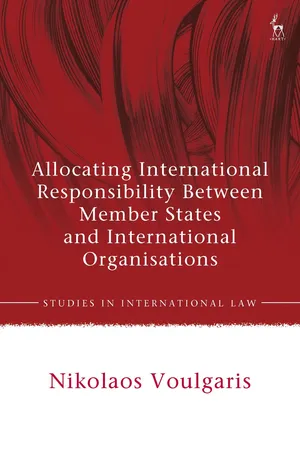
Allocating International Responsibility Between Member States and International Organisations
- 264 pages
- English
- ePUB (mobile friendly)
- Available on iOS & Android
eBook - ePub
Allocating International Responsibility Between Member States and International Organisations
About this book
Information
1
Introduction
I.INTRODUCTION
International Organisations have emerged in the United Nations era as prominent actors in the international arena. Within a very limited time-span, they have grown considerably in number but also in size and scope. But as their competences augment, so do their obligations. The transformation of International Organisations is so evident that the remark of the United Nations International Law Commission (ILC) that ‘it must not be forgotten that, by their very nature, international organizations normally behave in such a manner as not to commit internationally wrongful acts’ hardly reflects the present state of affairs.1 Nevertheless, International Organisations coexist and interact with other subjects of international law and mainly with States who are (to a great extent) their members.
International Organisations are all the more frequently accused of behaving in a manner inconsistent with their international obligations and such behaviour more often than not impacts their member States. Recent international practice abounds with relevant examples. UN Nepalese peacekeepers admittedly were the source of a cholera outbreak in Haiti in 2010 that afflicted nearly a tenth of the country’s population and may have caused over 9,000 deaths.2 The International Monetary Fund (IMF)’s engagement with the euro area, focusing on its surveillance and crisis management in Greece, Ireland and Portugal, had a major impact on human rights standards in those States. The list grows to cover illegal conduct during military operations where NATO participates, and recommendations by the World Health Organization (WHO) proven to be harmful and without significant clinical effect that are followed by its member States. Given the gravity of such situations, it is only pertinent to ask whether international law possesses the necessary normative toolkit to address such scenarios.
To pose in other words the research question I will endeavour to answer in this book: how does international law regulate (if at all) the international responsibility of both the members States and the International Organisation of which they are members when these two subjects interact? And in case international law leaves the matter unsettled or unregulated, how is this potential gap in international law to be filled? So, this book is essentially a law-identification exercise. Overall, I do not aim just to identify international law, but also to suggest, where the law is not yet formed, how it should be developed, how its content should be determined.
The ILC purported to answer these questions in its Articles on the Responsibility of International Organisations (ARIO).3 Within its mandate to codify and progressively develop international law,4 the Commission produced this set of Articles that contains two Chapters directly relevant for present purposes: namely, Chapter IV of Part Two entitled ‘Responsibility of an international organization in connection with the act of a State or another international organization’ and Part Five entitled ‘Responsibility of a State in connection with the conduct of an international organization’. Since the ARIO constitute the most authoritative text to date on the matter but also lay the essential background for integrated answers, it is only pertinent to ask how the ILC should have drafted the provisions that regulate the international responsibility of both the member States and the International Organisation of which they are members in scenarios when these two subjects interact.
When drafting the ARIO, the ILC faced a considerable challenge: the paucity of relevant international practice, be it judicial or institutional.5 The precedents are rare and poorly documented (eg unreported institutional documentation or unpublished case law) and this was underlined by the ILC itself,6 the Special Rapporteur7 and several International Organisations which commented during the drafting process.8 Consequently, the Commission concluded that most provisions incorporated in the ARIO constitute progressive development of the law, rather than its codification.9 This lack of relevant State and International Organisation practice is a prominent feature of all provisions that will be examined throughout this book, and address the issue of interaction between member States and International Organisations.10 I hold the view that the provisions under examination do not form part of customary international law and the intention of the Commission when drafting them was to reflect the progressive development of the law. Having proven this, I intend to assess whether the relevant ARIO provisions, in the way they are drafted, indeed provide for the progressive development of the law. If this is not the case, I will examine how the law has developed and therefore to what extent the provisions deviate from the development of the law.
As a caveat, I should stress that I intend to confine my study to the level of establishment of international responsibility, irrespective of its implementation, since this is what the ILC had in mind when drafting the relevant ARIO provisions. And by implementation it is not necessarily meant enforcement through the courts or through the settlement of claims (while this will most often be the case), but any type of enforcement of international responsibility against the responsibility bearer.11 While the two have been mixed up by some theorists,12 the former is completely independent of the latter. This is so, because these two aspects of international responsibility operate at different levels.13 For many decades, for example, no means were put in place to enforce within the international legal system a violation of the prohibition of genocide. This does not ipso facto mean that international responsibility for such violations was not established before a competent tribunal could render a relevant finding.14 While they remain distinct, the two aspects are undoubtedly related, for a robust implementation of international responsibility can only depend upon clear and coherent rules regulating its establishment. The lack of enforcement through the courts is, it has been suggested, the main obstacle preventing accountability of International Organisations in general.15 I agree that this is a problem that merits deep reflection, but it exceeds the remit of the present study.
II.INTERACTION BETWEEN INTERNATIONAL ORGANISATION AND MEMBER STATES
Interaction between member States and the International Organisation of which they are members is addressed by Chapter IV of Part Two and Part Five of the ARIO. For present purposes, interaction involves the establishment of international responsibility by virtue of a particular relationship between two subjects of international law. Given that the victim is by definition not involved in the establishment of international responsibility, interaction in these provisions is reflected in the relationship between the perpetrator of wrongful conduct and the responsibility bearer. This is evident from the titles of both ARIO Chapters; Chapter IV regulates the responsibility of an International Organisation ‘in connection with the act of a State or another international organisation’, while Part V the corresponding responsibility of a State ‘in connection with the conduct of an international organization’.
Throughout the book, I distinguish between two types of such interaction. The criterion that separates one from the other is the basis on which this interaction occurs. In the first type, interaction occurs on the basis of the particular member State-International Organisation relationship (or on the basis of membership), while in the second it occurs outside this relationship. In the latter case, the two subjects interact as independent subjects of international law.
First, member States interact with International Organisations on the basis of membership. This mode of interaction is in place when two conditions are present: first, member States exercise competence that lies with the International Organisation; and second, member States do so in accordance with the rules of the International Organisation. This is the case, for example, when a State exercises its right to vote within decision-making procedures of an International Organisation. ARIO, Articles 58(2), 59(2) and 62 capture this type of interaction. Unsurprisingly, they have no corresponding provision within the United Nations’ Articles on State Responsibility (ASR).16 Only when both these conditions are present, member States will act as members of the International Organisation. The main feature of this mode of interaction is that member States disappear behind the international personality of the International Organisation – or ‘under the organisational veil’ – and, as a result, do not bear international responsibility for internationally wrongful acts even when they contributed to their causation.
On the other hand, member States interact with the International Organisation of which they are members as independent subjects of international law in every case that does not fulfil both the aforementioned conditions. Throughout this book, I examine instances where one of the two conditions is present, ie when member States exercise competences that originate from the International Organisation but lie with member States in a particular instance (eg the request by a domestic court to the Court of Justice of the European Union for a preliminary ruling), and instances where member States operate within procedures of the International Organisation but not in accordance with its rules (eg exercise of political influence over decision-making procedures). In none of these scenarios do member States and International Organisations interact on the basis of their particular relationship.
On these occasions, member States act as States, do not disappear ‘under the organisational veil’ and thus their international responsibility can be established. The three provisions on ‘aid or assistance’, ‘direction and control’ and ‘coercion’ incorporated in ARIO, Articles 14, 15, 16, 58(1), 59(1) and 60, address this type of interaction. These provisions were transposed into the ARIO ‘lock, stock and barrel’ from the corresponding Chapter IV of the ASR and they capture all the possible ways in which two independent subjects may interact. Further, an analysis of the scope of application of ARIO, Articles 17 and 61 that have no corresponding ASR provision clearly demonstrates that they fall under the second type of interaction too.
It is the use of competence on a particular instance that points to the type of interaction in play, and the criterion that separates one from the other is purely functional. In this sense, the two bases of interaction are mutually exclusive. At the same time, the second type is broad enough to encompass all instances of interaction that do not fall under the first type and hence these two cover all possible interaction scenarios.
III.A DESCRIPTION OF THE PROBLEM
The provisions of ARIO, Chapter IV and Part Five, and the ASR, Chapter IV provisions which they replicate, possess certain characteristics that set them apart from other ILC provisions dealing with international responsibility (in both the ASR and the ARIO). They differ in their scope of application but also in the way international responsibility is established in these cases.
First, they are applicable to scenarios involving three legal actors. Generally, responsibility concerns only the relationship between a wrongdoer and a victim.17 Such cases will be referred to as involving ‘direct responsibility’. ARIO, Chapter IV and Part Five provisions, however, deal with situations in which, between the wrongdoer and the victim, a third intermediate legal subject is placed who is in some way linked to the wrongdoer.18 While the ILC refers to such triangular relationships as involving ‘derived responsibility’,19 I will use the term ‘indirect responsibility’ instead, not only because of the presence of the intermediate subject, but also as an antithesis to the situation of ‘direct responsibility’.20
Second, the establishment of international responsibility in cases covered by indirect responsibility is considered to arise in an exceptional way. The establishment of international responsibility in direct responsibility is dependent upon the objectively determined conditions of breach and attribution.21 Under ARIO, Chapter IV and Part Five, the establishment of responsibility depends on the presence of subjective requirements such as knowledge or intent.22 The introduction of such notions is prima facie in contrast with the ILC’s two projects, which intend to confine the establishment of international responsibility to objectively determined prerequisites.23 What is more, there is general consensus that indirect responsibility norms, in contrast to the rest of the international responsibility provisions, provide directly for the attribution of responsibility24 without the prior attribution of conduct.
Due to the aforementioned features, indirect responsibility provisions have been perceived to be ‘anomalies’ or exceptions within the law of international responsibility.25 The absence of a solid doctrinal background in the ASR for those provisions has been perpetuated in the ARIO, with Special Rapporteur Gaja opting to follow the indirect responsibility approach of the ASR and thus failing to bridge this doctrinal gap.26 Since the problematic features of the indirect responsibility provisions have not been adequately explained, they appear to cause incoherence within the law of international responsibility. It has been argued that this incoherence, in turn, is detrimental to the validity and prestige of the international responsibility edifice as a whole.27 Thus, it is questioned whether i...
Table of contents
- Cover
- Title Page
- Foreword
- Acknowledgements
- Contents
- List of Abbreviations
- Table of Cases
- Table of Treaties and Unilateral Acts
- 1. Introduction
- 2. The Function and Nature of International Responsibility
- PART I: MEMBER STATE-INTERNATIONAL ORGANISATION INTERACTION ON THE BASIS OF THE PARTICULAR MEMBER STATE-INTERNATIONAL ORGANISATION RELATIONSHIP
- PART II: MEMBER STATE-INTERNATIONAL ORGANISATION INTERACTION AS INDEPENDENT SUBJECTS OF INTERNATIONAL LAW
- PART III: INTERACTIONS INTERTWINED
- Appendix
- Bibliography
- Index
- Copyright Page
Trusted by 375,005 students
Access to over 1.5 million titles for a fair monthly price.
Study more efficiently using our study tools.
Frequently asked questions
Yes, you can cancel anytime from the Subscription tab in your account settings on the Perlego website. Your subscription will stay active until the end of your current billing period. Learn how to cancel your subscription
No, books cannot be downloaded as external files, such as PDFs, for use outside of Perlego. However, you can download books within the Perlego app for offline reading on mobile or tablet. Learn how to download books offline
Perlego offers two plans: Essential and Complete
- Essential is ideal for learners and professionals who enjoy exploring a wide range of subjects. Access the Essential Library with 800,000+ trusted titles and best-sellers across business, personal growth, and the humanities. Includes unlimited reading time and Standard Read Aloud voice.
- Complete: Perfect for advanced learners and researchers needing full, unrestricted access. Unlock 1.5M+ books across hundreds of subjects, including academic and specialized titles. The Complete Plan also includes advanced features like Premium Read Aloud and Research Assistant.
We are an online textbook subscription service, where you can get access to an entire online library for less than the price of a single book per month. With over 1.5 million books across 990+ topics, we’ve got you covered! Learn about our mission
Look out for the read-aloud symbol on your next book to see if you can listen to it. The read-aloud tool reads text aloud for you, highlighting the text as it is being read. You can pause it, speed it up and slow it down. Learn more about Read Aloud
Yes! You can use the Perlego app on both iOS and Android devices to read anytime, anywhere — even offline. Perfect for commutes or when you’re on the go.
Please note we cannot support devices running on iOS 13 and Android 7 or earlier. Learn more about using the app
Please note we cannot support devices running on iOS 13 and Android 7 or earlier. Learn more about using the app
Yes, you can access Allocating International Responsibility Between Member States and International Organisations by Nikolaos Voulgaris in PDF and/or ePUB format, as well as other popular books in Droit & Droit international. We have over 1.5 million books available in our catalogue for you to explore.