eBook - ePub
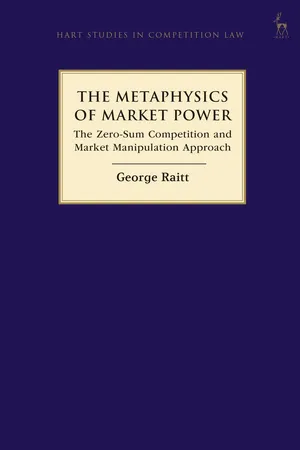
The Metaphysics of Market Power
The Zero-sum Competition and Market Manipulation Approach
- 328 pages
- English
- ePUB (mobile friendly)
- Available on iOS & Android
eBook - ePub
The Metaphysics of Market Power
The Zero-sum Competition and Market Manipulation Approach
About this book
Australian competition law has just emerged from a significant period of reform which has seen controversial changes to the legal test to distinguish between normal competitive conduct and conduct that should be condemned. The controversy continues, arguably because the traditional legal conception of market power does not provide a useful standard in real world markets. This important new book offers a radical interpretation of market power, based on the power to manipulate. Seeing it in this way allows for positive and normative standards within which to frame a legal theory of liability for misuse of that power. The book provides suggestions to improve the forensic assessment of conduct that should be condemned as misuse of market power.
Information
PART I
The Theoretical Framework
1
Market Power in Economics and Law
I.Introduction
It appears that despite the attention given to ‘law and economics’ in the US and elsewhere since the 1970s, key questions remain unsettled. Australian thinking about market power appears largely untouched by these developments. Thus, our conception of market power is that traditionally derived from US thinking of the 1950s and is defined as the ‘ability to give less and charge more’ or the ‘ability to behave differently than a competitive market would enforce’. For example, in its expert’s report in the 2014 merger authorisation case Re Application for Authorisation of Acquisition of Macquarie Generation by AGL Energy Ltd,1 Frontier Economics uses the first definition, which dates from 1955 and was adopted by the ACT in Re Queensland Co-operative Milling Association Ltd.2 The second definition, which dates from 1959, has also been adopted by the High Court in Queensland Wire Industries Pty Ltd v The Broken Hill Proprietary Company Ltd.3 Alternative economic theories of market power, eg, ‘strategic market power’, have been canvassed in the literature in Australia, but have not been adopted by the courts.4 Since the Harper Review did not raise any issue with the conventional conception of market power, the traditional definitions remain unquestioned in Australia. This monograph does not enter into the debate concerning alternative economic theories. In any event, since there is no threshold for the power to manipulate the market, ie, all firms have it to some degree, the market manipulation approach proposed in this monograph may well address the concerns raised by proponents of alternative economic theories of ‘strategic market power’.
The first edition of Richard Posner’s book Economic Analysis of Law5 was published only shortly before the enactment of the Trade Practices Act 1974 (Cth) and so did not enter into Australian thinking at the time. In a 1981 article, William Landes and Richard Posner argue that a key determinant of market power is the responsiveness of demand to price changes (‘elasticity of demand’, which is not directly measurable) and suggest improvements to US judicial approaches of inferring market power from market shares.6 Landes and Posner approach the issue as one of evidence and proof. Frontier Economics states that elasticity can be estimated if there is historical data available.7 This is a significant proviso, which has so far proved problematic in Australia for the purposes of litigation8 and for studies of the economic effects of, eg, bundling in the petrol and grocery markets.9 Roger Blair and Celeste Carruthers in 2010 published a similar study to Landes and Posner, showing that elasticity of demand has a key role to play in the analysis of market power.10 However, I suggest that the implications for the legal conceptualisation of ‘market power’ have not been fully explored.
US thinking since the 1970s regarding ‘law and economics’ does not appear to have made a significant impact on Australian jurisprudence. Indeed, former Chief Justice Anthony Mason has expressed the view that economic theory has a limited role in the judicial application of statute law in Australia, ie, determining rights and liabilities of parties by reference to past events.11 Mason considers that a deep understanding of economics is not necessary to interpret competition legislation, though an understanding of economics may be of assistance in the application of the legislation, which requires consideration of economic data, expert opinion and economic analysis.12 With respect, I suggest that Mason is correct: any law must adapt concepts from other disciplines in order to frame rules that are legally and forensically determinate, ie, so that the application of the law to the facts of the case can be determined by courts according to principle. Thus, the outcome should be certain and predictable. Outcomes that are matters on which opinions can reasonably differ could be perceived to be capricious and thus undermine confidence in the rule of law. However, some economists may well consider that the law directly adopts economic principles. The Hilmer Report of the early 1990s noted ‘a degree of dissatisfaction with the current court procedures for the utilisation of economic material’13 and considered it worthwhile that further consideration be given to measures to address the situation, including ‘arrangements for increasing the specialisation of judges involved in competition matters’.14 The High Court in Melway stated that economic analysis may be consistent with the purposes of section 46 ‘if it can be undertaken with sufficient cogency’ and observed that ‘in some cases, a process of inference, based upon economic analysis, may be unnecessary’.15 The Antitrust Modernisation Commission in 2007 said much the same thing when it suggested that ‘bright-line legal rules’ that business can easily follow are to be preferred over rules that depend on the often-conflicting views of economists.16 However, we do not yet have ‘bright-line rules’. The ACT in Qantas Airways Ltd expressed some dissatisfaction with economics experts who see their role as advocates for an outcome rather than as truly independent experts informing the tribunal about the applicable economic principles.17 We will see in Part II of this monograph that the courts are often faced with conflicting opinions proffered by economic experts, which ultimately are of little assistance in deciding contested cases.
Judicial attitudes towards economics, or more particularly the opinion evidence of economists, may demonstrate McMahon’s point that judicial decisions mask underlying worldviews.18 The opposed perspectives of lawyers and economists are probably based on mutual misunderstanding. Neither law nor economics is a value-free science: both require a framework, or view of the world, within which to make sense of both the positive and the normative. Of particular interest to this study is the way in which legal and policy thinking has used economics. FM Scherer suggests that the choices made by regulators and courts in reading ‘what economics has to say; that is, on which among conflicting propositions they have placed emphasis and which ones they have downplayed … depend importantly upon the values [of] the decision-makers’,19 ie, their view of the world. By interrogating such choices, we may elucidate underlying worldviews. This is not merely a matter of identifying such worldviews, which Robert French considers to include the ‘vision of a better world’ achieved through ‘social engineering of commercial behaviour’.20 Thus, when economic models set out assumptions (which are not satisfied in the real world) under which certain outcomes would be possible, we could infer that the models express a view about how the world should be, ie, a normative view. The approach in this monograph is to critically analyse the assumptions of the models to see if an alternative set of assumptions assists us in developing norms more relevant to real-world conditions. I suggest that the paradigm of zero-sum competition as defined in this monograph embodies assumptions more reflective of the real world. We also need to consider whether competition law can achieve the ‘better world’ to which some theorists aspire (and, if not, we need to look for other more effective policy levers that would have to be engaged in order to pursue that objective should the community wish to do so).
Accordingly, this study will consider how competition law has used neoclassical economic models in developing the legal theory of liability, in our case set out in section 46 of the CCA. However, this study does not critique the models themselves or consider in detail the comparative merits of other approaches, eg, the Schumpeterian dynamic approach. However, we will see that zero-sum competition, and its implications for efficiency, may elucidate Schumpeter’s concept of ‘creative destruction’ and its application to dominant firm conduct.21 Tony Freyer argues that firms adopt a variety of strategies to ameliorate the risk of creative destruction, from diversification through mergers to various anticompetitive strategies.22 I suggest that we need to find a benchmark for conduct that is not determined by the assumptions of a model, and that economic efficiency could be adapted to provide a legal benchmark. An economic model’s assumptions simplify the real world, and if we are to understand the implications of the model for the real world, the assumptions must be investigated (eg, by selectively relaxing assumptions, the effects on the model can be better understood). If we treat a model’s assumptions as an acceptable approximation to the real world, such assumptions may become a ‘blind spot’ in our thinking. A key blind spot, or gap, in the neoclassical models that will be pursued in this study is how firms self-select for entry to or exclusion from the market. Before turning to this, with a thought experiment regarding incumbent response to new entry, it is useful to briefly review the controversy about the objectives of competition law, which will be relevant to our analysis of efficiency and its relationship to misuse of market power. Differing views about the objectives of competition law affect the extent to which efficiency may be regarded as a defence to misuse of market power.23
My purpose in this monograph, and in particular in this chapter, is not to propose any new theory of economics, but to critically assess conceptual and forensic problems that the law encounters in ‘using’ or adapting economic principles in the legal theory of liability in present and proposed versions of section 46 of the CCA. This discussion is used as a point of departure to develop a new legal theory, not any new economic theory.
II.Policy Objectives and Concepts of Efficiency
Hovenkamp argues that the policy objective of antitrust is to ‘make the economy work better’ and to do this, one must not only be able to identify ‘wrongs’, but also to produce ‘suitable remedies’.24 By the latter we may infer that he means remedies which improve the working of the economy. Stating this policy objective another way, Hovenkamp argues that ‘intervention is justified only in the relatively few cases where the judiciary can fix the problem more reliably, more cheaply, or more quickly than the market can fix itself’.25 As will be apparent in the discussion of his analysis below, it is doubtful in many cases that the ‘wrong’ and ‘remedy’ are sufficiently determined in economics and law.
Hovenkamp describes capitalism as a free market ideology, ie, it adopts the thesis that ‘the uncontrolled, apparently chaotic, and completely self-interested behaviour of businesspersons actually produces more welfare than governmental command and control’.26 It is right to de...
Table of contents
- Cover
- Title Page
- Foreword
- Preface
- Acknowledgements
- Contents
- Abbreviations
- Table of Cases
- Table of Legislation
- List of Figures and Tables
- Introduction
- Part I The Theoretical Framework
- Part II Testing Market Manipulation and Efficiency Approaches
- Part III Conclusion
- Appendix: Text of the Old and New Versions of Section 46 of the CCA
- Bibliography
- Index
- Copyright Page
Trusted by 375,005 students
Access to over 1.5 million titles for a fair monthly price.
Study more efficiently using our study tools.
Frequently asked questions
Yes, you can cancel anytime from the Subscription tab in your account settings on the Perlego website. Your subscription will stay active until the end of your current billing period. Learn how to cancel your subscription
No, books cannot be downloaded as external files, such as PDFs, for use outside of Perlego. However, you can download books within the Perlego app for offline reading on mobile or tablet. Learn how to download books offline
Perlego offers two plans: Essential and Complete
- Essential is ideal for learners and professionals who enjoy exploring a wide range of subjects. Access the Essential Library with 800,000+ trusted titles and best-sellers across business, personal growth, and the humanities. Includes unlimited reading time and Standard Read Aloud voice.
- Complete: Perfect for advanced learners and researchers needing full, unrestricted access. Unlock 1.5M+ books across hundreds of subjects, including academic and specialized titles. The Complete Plan also includes advanced features like Premium Read Aloud and Research Assistant.
We are an online textbook subscription service, where you can get access to an entire online library for less than the price of a single book per month. With over 1.5 million books across 990+ topics, we’ve got you covered! Learn about our mission
Look out for the read-aloud symbol on your next book to see if you can listen to it. The read-aloud tool reads text aloud for you, highlighting the text as it is being read. You can pause it, speed it up and slow it down. Learn more about Read Aloud
Yes! You can use the Perlego app on both iOS and Android devices to read anytime, anywhere — even offline. Perfect for commutes or when you’re on the go.
Please note we cannot support devices running on iOS 13 and Android 7 or earlier. Learn more about using the app
Please note we cannot support devices running on iOS 13 and Android 7 or earlier. Learn more about using the app
Yes, you can access The Metaphysics of Market Power by George Raitt in PDF and/or ePUB format, as well as other popular books in Droit & Théorie et pratique du droit. We have over 1.5 million books available in our catalogue for you to explore.