- 288 pages
- English
- ePUB (mobile friendly)
- Available on iOS & Android
eBook - ePub
About this book
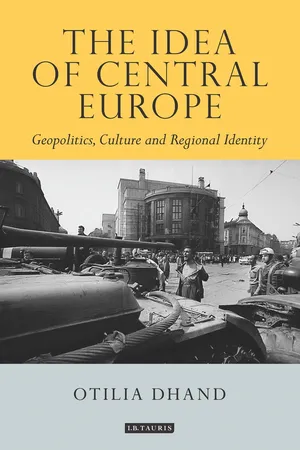
Central Europe is one of the key notions of classical geopolitics yet it has always been a somewhat elusive concept. Originally perceived as a plan for a German dominated political and economic union, it subsequently emerged to threaten leaders in the East and West in a variety of forms. Otilia Dhand provides a critical examination of the concept of Central Europe, from its early inception to the present day. Making extensive use of archival material, she shows how successive manifestations of Central Europe - of whatever vintage - have failed to bring about their intended changes on the international structure, and how customary claims about Central Europe are not supported by the original source material. The result is a work of outstanding scholarship that advances our understanding of regionalism and geopolitics in Europe.
Information
1Introduction:
The Puzzle of
Central Europe
The Puzzle of
Central Europe
Something is not right with ‘Central Europe’. It is not like Africa or India – something you can outline on a map. It is more like the Orient, or the West. Instead of being a mundane double-page component of world atlases, Central Europe is a notion that appears in books on geopolitics and geostrategy. It is a key component – dare we say, a pivot – of classical grand schemes of how the world works and how great powers clash, underlined by the deterministic nature of geography.
Central Europe is not a place. It is an idea. But an idea of what?
THE EMERGING PUZZLE
In 1986 Timothy Garton Ash made a proclamation: ‘Central Europe is back.’1 A rather unimposing quotation at first sight. However, in the context of the strict geopolitical bi-polarity of 1986, it stands out rather starkly.
In the 1980s, Ash was one of the foremost Western observers of Eastern bloc societies. His research on, as well as contacts with, Eastern bloc dissidents led him to the conclusion that imminent changes were brewing under the thick cover of authoritarian regimes.2 He took a primary role in the debate printed on the pages of the New York Review of Books, which indicated that the abstract notion of ‘Central Europe’ was shaping among the dissidents as an antithesis to the existing ‘East European’ regimes. Central Europe was emerging as a synonym for humanistic values, liberalism and freedom – ‘anti-politics’ in the context of a repressive Communist system. Dissent behind the Iron Curtain was growing stronger just as the myth of the superiority of Communist regimes was crumbling alongside their political legitimacy. Their collapse was for many a question of ‘when’ not ‘if’. The term ‘Central Europe’ was tiptoeing back into the dictionaries of daily parlance on both sides of the strict East–West divide of Cold War Europe, as a bridge between minds that thought alike.
The phrase ‘Central Europe is back’ takes on a whole new dimension if placed within the context of changes brewing under the cover of seemingly stable state-bureaucratic socialism.3 The return of the ‘myth of Central Europe’ signalled not only the coming earthquake in the political geography of Europe, but also the fact that conceptualization of the approaching geopolitical future was well under way – and that at least some observers already had a relatively clear idea of what it would bring for the borderlands of the Iron Curtain.
Those who sensed the imminent change, started to hypothesize what might follow. Obviously, Ash was not the first to invoke the notion of Central Europe in the late Cold War period. The discussion started with ‘The Tragedy of Central Europe’, the now famous essay of Milan Kundera, a Czech émigré novelist, published in the New York Review of Books in April 1984.
His emotionally charged piece depicted ‘an uncertain zone of small nations between Russia and Germany’ as a ‘kidnapped West’ – a region which lay ‘culturally in the West, politically in the East’.4 In vivid prose, Kundera presented the Western reader with a doomed picture of tragically fated, culturally Western nations that had suffocated under the heavy handed rule of an alien power, desperately seeking a political comeback within their native cultural orbit. He sought to depict an independent and essentially Western cultural and civilizational identity for these, to counter the usual context for the study of the region amid ‘footnotes of Sovietology’.5 And, to a great degree, he succeeded; for, understandably, Western audiences were only too willing to embrace the states emerging from Soviet domination.
On the other side of the Cold War divide, Václav Havel, a Czech dissident playwright, started to embellish his political essays with references to Central Europe. Similar to Kundera, he used ‘Central Europe’ as a means of cultural approximation to the values of the West. Havel characterized it as a ‘spiritual, cultural and intellectual phenomenon … mysterious, a bit nostalgic, often tragic and even at times heroic’.6 For Havel, Central Europe was a term tied to spiritual rather than physical territory. It did not have boundaries defined by features of physical geography but, rather, by a claimed common cultural and artistic heritage.
Gyorgy Konrád, a Hungarian novelist and sociologist, went even further and devised an ‘alternative history’ of Central Europe, which had ‘a thousand years ago … taken out a Western option’ but was prevented from exercising it first by the Ottoman, then by the Austro-Hungarian, and later by the Soviet empires.7 Ignoring many obvious facts of history and geography, Konrád cast Central Europe as a discrete entity that had been prevented from fulfilling its predetermined fate as part of the West by the machinations and invasions of foreign empires. Now a historically repressed Central Europe was once again calling for help to be relocated in its historically correct geopolitical orbit.
Many other prominent dissident writers were drawn into developing this tragic myth of a deprived Central Europe – a fascinating ahistorical narrative of mystical, heroic nations struggling to break the shackles of alien dictatorship to return into the extended embrace of their freedom- and democracy-loving Western family. This depiction of the history of Central Europe, its characteristics and values, was more an expression of desire than fact, but it captivated the imagination of as many in the West as in the East. Central Europe was back. It was an intellectual project that those who wished the Iron Curtain to disappear subscribed to.8
Did it work its magic? Yes, some authors would claim; and in more than one way. The problems of countries emerging from Soviet domination were manifold and fundamental. The complexity of their envisaged transition was not comparable with previous transitions of authoritarian regimes from Latin America and Southern Europe, which provided the empirical basis for the theoretical tenets of the nascent sub-discipline of transitology. The only thing that was clear was the proclaimed direction of transition – towards the West was, in every sense, meant to be taken figuratively.9
The transition meant nothing less than the complete rejection and disowning of the very building blocks of society – the system of economic exchange, social hierarchies, political system, the security and economic cooperation structures and, in some cases, the states themselves. Trying to counter the risk of potential relapse back into the Russian sphere of influence, transitive countries raced to establish their Western credentials. The concept of Central Europe, as a kidnapped West ‘returning to Europe’, presented an ideal means to vocalize their ambitions to be taken swiftly under the aegis of Western economic and security structures.
The idealist character of dissident conceptions of Central Europe that was presented to Western audiences towards the end of the Cold War greatly aided the use of this notion in the early 1990s. It conveyed the idea that the long-suppressed true identity of these countries was finally being translated into their political institutions, society, foreign policy, etc. A recent work of Merje Kuus observes that the Central European narrative was ‘extraordinarily consistent’10 across the region and built on the repetition and reinforcement of themes of Western identity, a chronic existential threat, and the resultant need for integration with the West.
Taking on a shade of tautology, the notion of Central Europe became increasingly identified with the group of countries that was on a shortlist for EU and NATO accession, a vocabulary that promised the candidate countries a good chance for speedy admission. In itself, this fuelled the efforts of the transitive countries to be perceived as Central European to the degree that Ash glossed: ‘Tell me your Central Europe, and I will tell you who you are.’11 Indeed, Central Europe became a self-fulfilling prophecy and the countries typically associated with the notion would become full members of the EU and/or NATO within less than 15 years of the break-up of the Eastern bloc.
But Central Europe was not only a narrative of foreign policy. In fact, it was a genuine point of self-identification for many transitive countries and their respective populations. Transitions were neither easy nor painless, and the belief in their own Western credentials and promise of destiny helped to justify and bear the pain of the often difficult adjustments in transitive countries.
If the characteristics they wished to forget – authoritarianism, a centrally planned economy, foreign rule and occupation – were identified with the ‘East’, the institutions they strove to build – democracy, market economy, freedom, full sovereign independence – were identified with the ‘West’. And, of course, the ‘semantic division of labour’,12 between the negatively contextualized ‘Eastern Europe’ of old and the new positively associated ‘Central Europe’, was visible in the works of dissident writers well before the transitions started. Central Europe was thus a ready made point of identity for those who wanted to distance themselves from the negativity of the ‘East’ and approximate themselves to the ideals of the ‘West’. In sum, for many transitive countries and their populations, being Central Europe was the second best thing after being part of the ‘West’. It was a kind of ‘waiting room’ for becoming the West.13
Finally, many authors, statesmen and organizations once again began to characterize Germany and Austria as Central European countries, too. Many in Austria were looking for a way to escape Austria's peripheral status by casting it as a natural leader of the emerging region. The West German government employed the concept in a new phase of rapprochement with East Germany, conveying a common regional identity for the two German states.
And this is where the story gets interesting … because the original version of the notion of Central Europe was actually the German expression Mitteleuropa, which was very far from being a universally acclaimed concept associated with freedom and democracy. Quite the contrary ….
***
The notion of Mitteleuropa had first appeared loosely in German writings during the second half of the nineteenth century, whilst more elaborated definitions began to emerge in the 1880s.14 Detailed study of these early conceptualizaions unveils a high degree of disunity among authors as regards the positioning, boundaries and characterization of Central Europe. However, what these conceptualizations had increasingly in common was the belief in a leading role for the German nation in Europe and an underlying drive for conceptualization of the area it should ‘naturally’ dominate.
This effort found its expression in the seminal work of Joseph Partsch, a renowned German geographer. His Central Europe was published in London in 1903 as part of ‘The Regions of the World’ series edited by Sir Halford Mackinder and became one of the early classics of traditional geopolitics. He positioned Central Europe between the Alpine ridges and the northern seas15 and insisted that in this area Germans not only comprised 51 per cent of the total population but were also the standard bearers of culture, knowledge and progress for other nations within the region. In order to ‘reach greatness’, Central European nations had to unify on the common basis provided by German language and culture.16 Partsch reckoned that Central Europe ‘consciously or unconsciously, willingly or unwillingly, belongs to the sphere of German civilisation’.17 Only unification under German leadership held the potential to safeguard it from Russian expansionism and British hegemonic ambitions, thereby delivering the promise of peace and prosperity.18
Partsch's work introduced some of the main themes that would be carried forward in subsequent conceptualizations of Central Europe in the German tradition: the uniqueness of the German nation and its culture; the need for unification of all areas inhabited by German-speaking populations; the righteous historical mission to rise to greatness; ‘natural’ German domination of the said area. The notion of Mitteleuropa gradually became a synonym for the hegemonic pursuits taken to the extreme by Nazi Germany. It was far from being the notion associated with democracy and an overt Western foreign policy orientation developed from the 1980s onwards. Rather, it was an expression that became part and parcel of German attempts to dominate smaller nations inhabiting the same area.
In sharp contrast to this notion, there was the conception of Central Europe emanating from the Paris Peace Conference, which directly contested Partsch's vision. Sir Halford Mackinder's ‘Middle Tier’19 materialized in the form of the successor states to Austria-Hungary. Was this an inverted power notion of Central Europe, displaying the preference of the world powers for dismemberment of the ailing Austro-Hungarian Empire? Was it the fear of a strong Central Europe under German domination – not to mention a potential alliance with Russia – that led, more than anything else, to the creation of the successor states? Or was it really the result of another reactionary model of Central Europe – the one preferred by Thomas G. Masaryk, the first president of Czechoslovakia, advocating the right of self-determination for small nations – that would storm the age-old structures of Europe? After all, this synchronized fully with the Wilsonian idealism of the day.
One way or the other, the Mitteleuropa concept inspired a strong adverse response among the non-German nations, focused attention upon German ambitions for domination of the area and, ulimately, probably contributed to there being little effective resistance to the fall of the Austro-Hungarian Empire.
This book therefore poses a question: How did this understanding of classical notions of Central Europe arise, and what does it have in common with the version being promoted from the end of the twentieth century? Perhaps nothing at all … in which case how did the same notion come to mean two fundamentally different things in the span of less than a hundred years? How has the meaning of Central Europe been formulated? What were the main factors influencing this process in these two divergent periods? What happened with this notion in between? And above all: What were the implications of these changes?
THE PIVOT OF GEOPOLITICS?
The problem of Central Europe is virtually inscribed into the ‘birth certificate’ of classical geopolitics in the shape of Sir Halford John Mackinder's enigmatic treatises, The Geographical Pivot of History20 and Democratic Ideals and Reality.21 Mackinder's work combined the geostrategic thinking of Admiral Alfred Thayer Mahan22 with applied geographic determinism, aiming to identify potential threats to the interests of the British Empire. The result was Mackinder's controversial Heartland theory.
Even though in 1904 Mackinder identified Russia (‘Heartland’) as the main threat to th...
Table of contents
- Front Cover
- Editorial Board
- Title Page
- Copyright
- Contents
- List of Figures
- Preface
- 1 Introduction: The Puzzle of Central Europe
- 2 Germany: Mitteleuropa – Realm of the German Nation
- 3 Austria-Hungary: Pan-German Paper Dreams
- 4 Britain and the United States: What the Enemy Covets
- 5 Central Europe 1880–1918: Unsuccessful Exercises in Geopolitics
- 6 Variations in Time and Space
- 7 Conclusions: Central Europe and Beyond
- 8 Postscript: Beyond Central Europe
- Appendix 1 ‘Tshirschky to Bethmann-Hollweg’, 1 September 1914
- Notes
Trusted by 375,005 students
Access to over 1.5 million titles for a fair monthly price.
Study more efficiently using our study tools.
Frequently asked questions
Yes, you can cancel anytime from the Subscription tab in your account settings on the Perlego website. Your subscription will stay active until the end of your current billing period. Learn how to cancel your subscription
No, books cannot be downloaded as external files, such as PDFs, for use outside of Perlego. However, you can download books within the Perlego app for offline reading on mobile or tablet. Learn how to download books offline
Perlego offers two plans: Essential and Complete
- Essential is ideal for learners and professionals who enjoy exploring a wide range of subjects. Access the Essential Library with 800,000+ trusted titles and best-sellers across business, personal growth, and the humanities. Includes unlimited reading time and Standard Read Aloud voice.
- Complete: Perfect for advanced learners and researchers needing full, unrestricted access. Unlock 1.5M+ books across hundreds of subjects, including academic and specialized titles. The Complete Plan also includes advanced features like Premium Read Aloud and Research Assistant.
We are an online textbook subscription service, where you can get access to an entire online library for less than the price of a single book per month. With over 1.5 million books across 990+ topics, we’ve got you covered! Learn about our mission
Look out for the read-aloud symbol on your next book to see if you can listen to it. The read-aloud tool reads text aloud for you, highlighting the text as it is being read. You can pause it, speed it up and slow it down. Learn more about Read Aloud
Yes! You can use the Perlego app on both iOS and Android devices to read anytime, anywhere — even offline. Perfect for commutes or when you’re on the go.
Please note we cannot support devices running on iOS 13 and Android 7 or earlier. Learn more about using the app
Please note we cannot support devices running on iOS 13 and Android 7 or earlier. Learn more about using the app
Yes, you can access The Idea of Central Europe by Otilia Dhand in PDF and/or ePUB format, as well as other popular books in History & German History. We have over 1.5 million books available in our catalogue for you to explore.