I.B.Tauris in association with the Institute of Ismaili Studies
Dedicated to the achievements of Farhad Daftary, the foremost authority in Ismaili Studies of our time, this volume gathers together a number of studies on intellectual and political history, particularly in the three main areas where the significance of Daftary's scholarship has had the largest impact - Ismaili Studies as well as Persian Studies and Shi'i Studies in a wider context. It focuses, but not exclusively, on the intellectual production of the Ismailis and their role in history, with discussions ranging from some of the earliest Ismaili texts, to thinkers from the Fatimid and the Alamut periods as well as relations of the Fatimids with other dynasties. Containing essays from some of the most respected scholars in Ismaili, Shi'i and Persian Studies (including Patricia Crone, M A Amir-Moezzi, C Edmund Bosworth and Robert Gleave), the book makes a significant contribution to wider scholarship in philosophical theology and medieval Islam. The contributors include: I. Afshar, H. Algar, M. A. Amir-Moezzi, S. J. Badakhchani, C. Baffioni, C. E. Bosworth, D. Cortese, P. Crone, D. De Smet, R. Gleave, H. Haji, I. Hajnal, A. H. Hamdani, C. Hillenbrand, A. C. Hunsberger, H.
Landolt, L. Lewisohn, W. Madelung, A. Nanji, A. J. Newman, I. K. Poonawala and P. E. Walker.
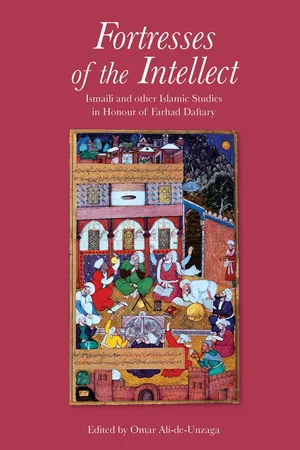
eBook - ePub
Fortresses of the Intellect
Ismaili and Other Islamic Studies in Honour of Farhad Daftary
- 624 pages
- English
- ePUB (mobile friendly)
- Available on iOS & Android
eBook - ePub
Fortresses of the Intellect
Ismaili and Other Islamic Studies in Honour of Farhad Daftary
About this book
Information
1
Introduction: A Biographical Sketch1
Omar Alí-de-Unzaga
Farhad Daftary is the world’s foremost authority in Ismaili studies. With an impressive record of publications, his scholarship has become the main reference for those conducting research into the historical trajectory of the Ismailis and their imams, as well as into the religious doctrines and philosophical traditions developed in the Ismaili Shiʿi interpretation of Islam. Farhad Daftary’s singular contribution to scholarship is to have organised the history of a whole community, its leaders and its doctrines, from materials which were previously scattered and confused, often marred with prejudice and surrounded by legends, into a coherent narrative. He has done this by building a comprehensive historical framework in which Ismaili history and thought not only can be situated in their entirety, but also expressed in a sophisticated yet unpretentious style that unravels complex religious ideas in a clear, fluid and coherent narrative and with an objectivity that is based on the most precise historiographical approaches. Not an Ismaili himself, he has nevertheless had the opportunity to study, observe and engage with both the complexities of documenting the Ismaili past as well as the communities of the present day. A large portion of Farhad Daftary’s scholarship consists of disentangling history from myth, of discerning the facts when working with conflicting sources (often only polemical), and above all of setting the record straight on the history of the Ismailis.
He lives in London with his wife Fereshteh (not to be confused with his sister Dr Fereshteh Daftari, an art curator and author based in New York), with whom he has been happily married for more than thirty years.
Family background
A truly cosmopolitan figure, Farhad Daftary was born in Belgium, brought up in Iran and later studied in Italy, England and the United States. A word on his family background is in order. He hails from a very old, aristocratic family in Iran, who have held public office since the eighteenth century. On his paternal side, his ancestry can be traced seven generations back, when his ancestors were mostly in charge of the public finances of the country, under the title (laqab) of Mustawfī al-Mamālik,2 conferred by the Qājār monarchs on individual members of the family. The name of the family, however, originates in the calling of Mīrzā Hidāyat Allāh Vazīr Daftar (d. 1892) and his son Mīrzā Muḥammad Ḥusayn Vazīr Daftar (d. 1912), Farhad’s great-great-grandfather and great-grandfather respectively, both of whom served successively as what today would be called Ministers of Finance with the title Vazīr Daftar in the second half of the nineteenth century and the early years of the twentieth. Subsequently, in the early Pahlavī era, this title developed into the family name Daftari (also Daftary) when family names were adopted for the first time in Iran. The first member of the family to have used the surname as we know it was Farhad’s grandfather, Maḥmūd Khān Daftarī (d. 1939), who earlier had been given the title ʿAyn al-Mamālik by Muẓaffar al-Dīn Shāh Qājār (r. 1896–1907). He acted as his father’s deputy in the Ministry of Finance before holding high ranks in Iran’s reformed judiciary system in the time of Riḍā Shāh Pahlavī (r. 1925–1941). Farhad’s father, Mohammad Daftary (1904–1983), was educated in France, graduating from the famous military academy of Saint Cyr in 1928, and then pursued a military-diplomatic career. It was during one of his postings that Farhad was born, in Brussels on Friday 23 December 1938. Amongst the various distinctions bestowed on Mohammad Daftary, he was notably made a Commander of the Légion d’Honneur by the President of the French Republic in 1950. In the Qājār and Pahlavī eras, the family produced several prime ministers under a variety of names derived from other individual titles. To give but one example, Muḥammad Ḥusayn Vazīr Daftar’s younger brother Muḥammad Khān Muṣaddiq al-Salṭana (1882–1967), the future Dr Mohammad Mosaddeq, became Iran’s prime minister during 1951–1953 and nationalised the country’s oil industry.
Farhad’s mother, Farideh née Agha Khani (1914–2010), hailed from another prominent family that can be traced to mediaeval times. She was the great-granddaughter of Sardār Abu’l-Ḥasan Khān (d. 1880), son of Shāh Khalīl Allāh (d. 1817) and the younger brother of Ḥasan ʿAlī Shāh (d. 1881), the spiritual leader of the Nizārī Shiʿi Muslims who was given the title Āghā Khān (Aga Khan) by Fatḥ ʿAlī Shāh Qājār (r. 1797–1834). Sardār Abu’l-Ḥasan Khān had helped his brother when the latter was engaged in military conflicts with the Qājār establishment which eventually resulted in his permanent settlement in India. Sardār himself led military expeditions in the early 1840s and seized parts of Balūchistān before being finally defeated in 1846 by a Qājār army and taken to Tehran. There he remained under house arrest until he was pardoned by Nāṣir al-Dīn Shāh Qājār (r. 1848–1896) and married Mihr-i Jahān Khānum, a Qājār princess. Sardār Abu’l-Ḥasan Khān’s son, Mīrzā Ismāʿīl Khān (1854–1928), titled Iʿtibār al-Salṭana, who was Farhad’s maternal great-grandfather, spent a large part of his early life in the entourage of Aga Khan I in Bombay, where he was known as the Ḥājji Ṣāḥib, for having made the pilgrimage to Mecca. Then in the 1870s, he returned to Iran, received his title and subsequently (after the Constitutional Revolution, 1905–1911) became a member of the Majlis (Parliament), elected from the province of Kirmān, where the family had deep roots. Daftary’s maternal grandfather was Iʿtibār al-Salṭana’s son Nāṣir Qulī Khān (1873–1941), with the title Mukhbir al-Sulṭān bestowed upon him in 1899 by Muẓaffar al-Dīn Shāh. Mukhbir al-Sulṭān’s mother was the daughter of ʿAlī Qulī Khān Mukhbir al-Dawla (d. 1897) of the eminent Hidāyat family, who were traditionally in charge of the country’s Ministry of Post and Telegraph and produced several noted historians and literary figures. Starting with the historian and poet Riḍā Qulī Khān Hidāyat (d. 1871), this family was also closely affiliated to the Dār al-Funūn, an academy of learning founded in Tehran in 1851, marking the beginning of modern education in Iran. Mukhbir al-Sulṭān himself was a graduate of this academy. Farhad Daftary’s own earliest memories go back to his grandfather Mukhbir al-Sulṭān, whom he can remember meeting when he was three years old. Mukhbir al-Sulṭān had also inherited a part of this family’s collection of manuscripts, documents and photographs, which eventually became incorporated into Farhad’s library.
Early life and education
As mentioned above, Farhad Daftary was born in Europe. Following the outbreak of the Second World War, when he was about two years old, however, his family moved back to Tehran. He attended the Qāʾim-maqām Madrasa for his primary education (1945–1950) and then the Dabīristān-i Alborz (Alborz Secondary School). Founded as the American College by Presbyterian missionaries in 1873 on the outskirts of Tehran, it changed its name to Alborz College in the early 1930s in deference to the Persianisation of foreign names. The American College had been for several decades (until 1940) under the direction of the eminent educator Dr Samuel L. Jordan (d. 1952). By the time Farhad was a pupil at the college, it had become incorporated into the network of schools overseen by Iran’s Ministry of Education and was under the direction of the famous Iranian educator Dr Mohammad-Ali Mojtahedi (d. 1997).3 There Farhad completed the first cycle of his secondary education (1951–1953). In 1954, Farhad moved with his family to Rome, not to return to Iran for nearly twenty years. He spent two years (1954–1955) finishing his secondary studies at the Overseas School of Rome (which was also known as the American School) in Via Cassia. During his adolescent years, he also devoted a great deal of time to studying the piano, at which he excelled. While in Rome, he studied with a teacher from the Santa Cecilia Academy of Music as well as with the Austrian-born Italian Conte Antonio di Monteforte, whose own teacher had been a student of the renowned Hungarian composer and pianist Franz Liszt. The Count had connections with Iran through his father who, at the invitation of Nāṣir al-Dīn Shāh Qājār, had organised a modern police force in Tehran.
In 1956, at the age of 17, Farhad was sent to England where he stayed for two years at Concord College in Tunbridge Wells, Kent, and then at a private tutorial establishment (Eaton and Wallis) in London studying for his General Certificate of Education (GCE). Meanwhile, he had continued to take piano lessons with Ippolit Motchaloff at the Wigmore Hall Studios in London.
However, his life was to take another course. Pursuing his family’s traditional involvement in state financial administration, and perhaps as a natural progression of his education in American schools, in 1958, at the age of nineteen, Farhad Daftary moved to the United States where he pursued his higher education in the field of economics for some thirteen years until 1971. He first enrolled at the American University in Washington DC, where he took a BA degree (1958–1962) and then stayed for a fifth year, receiving his MA in 1963. Deciding to continue his postgraduate studies, in 1964 he enrolled at the University of California at Berkeley, where he initially obtained a second Master's degree.
The choice of Berkeley was in line with Daftary’s academic record. He had excelled in his studies, always obtaining straight A-grades in all the courses he took. Berkeley’s prestige in the mid-1960s, with its economics department ranking first amongst all American universities, was partly due to the fact that it had a high concentration of Nobel Prize winners on its academic faculty. Farhad Daftary was on various occasions ranked among the top ten Iranian students in the US (out of the several thousand of his compatriots then studying there). He was even awarded a ‘Special Citation’ by Iran’s Ministry of Education. As a result, the University of California granted him fellowships and graduate scholarships for several years to pursue his doctoral studies, which he started in 1964 and completed seven years later in 1971, somewhat prolonged due to his evolving interest in Ismaili studies. When the time came to choose a specialisation, Farhad opted for economic development. At UC Berkeley he had the privilege to be taught by a number of distinguished professors, among whom was the young (and future Nobel laureate) Amartya Sen, who taught economic development as a visiting professor. Amongst his other famous teachers, mention may be made of Tibor Scitovsky and Abba Lerner, whilst two more of his younger teachers, Daniel McFadden and Peter A. Diamond, would also become Nobel laureates. It was also at Berkeley that he made the acquaintance of Hamid Algar, who had then just joined the Near Eastern Studies Department after completing his doctoral studies at Cambridge University. Daftary’s Ph.D. dissertation was entitled ‘Economic Development and Planning in Iran’, with a detailed analysis of the country’s modern economic history.
Ismaili studies as a hobby: a largely unexplored field
It was during his years at Berkeley that Farhad developed a deep interest in Ismaili studies. Through the maternal line of his family he had always seen photographs and documents related to the Aga Khans, but it was at Berkeley that for the first time, he had access to modern studies on Islam and the Ismailis. It was Daftary’s interest in economic history, as well as the history of Iran and Shiʿi Islam, that led to his new interest in the history of the Ismailis residing in the Middle East and elsewhere. It was in this way that Farhad the economist would be transformed into an authority on Ismaili studies.
From the mid-1960s, Daftary developed and systematically pursued his intense curiosity about the history of the small and often misunderstood community of the Ismailis. He set himself the goal of acquiring copies of any available material on them. Access to old and new publications on the subject was crucial. Berkeley proved an excellent location to be based at, because it had a world-class library with a vast Islamic collection. He embarked on an ambitious project to photocopy all the classical articles in European languages related to Ismailism that he could get his hands on in an extremely methodical way. When he had finished collecting everything he needed, he had all the articles bound, and ended up with more than thirty volumes of Ismaili-related articles. After that, he systematically collected all the articles of a few more recent authors in the field. He talks with delight about how he did all this before the idea of publishing the collected articles of an author, or a variorum series, had entered Islamic studies. Thus, Farhad had collected his own copies of the articles of Paul Kraus (1904–1944), Ḥusayn Hamdānī (1901–1962), Wladimir Ivanow, Marius Canard (1888–1982), Asaf A. A. Fyzee (1899– 1981), Samuel M. Stern (1920–1969), and all of the Ismaili articles of the prolific Henry Corbin (1903–1978), as well as the entire vast corpus of the Cambridge Iranologist Edward G. Browne (1862–1926), who made seminal contributions to the literary history of Persia and the various Shiʿi communities which had flourished there.
The field of modern Ismaili studies was then still new and emerging, but it already included the oeuvre of a towering figure, Wladimir Alekseevich Ivanow (1886–1970), who had made significant contributions to it. Ivanow had devoted a major part of his life to the recovery, editing and translation of Ismaili texts, especially those produced by the Nizārī branch. It must be said that this was a crucial time in generational terms: On the one hand, Ivanow was approaching his eightieth year and was at the end of his pioneering career. On the other hand, there were younger scholars, such as Marshal G. S. Hodgson, at Chicago, and Samuel Miklos Stern, at Oxford, still very active and in the prime of their academic careers. Both represented a new generation of scholars and were (and are still considered today) two of the leading authorities in modern Islamic studies in the West. Both also had a special interest in the intellectual history of the Ismailis on which they published extensively. Tragically, both died prema-turely: Hodgson in 1968, at forty-six, and Stern the following year, in 1969, at forty-eight. These losses presented a turning point in the field and Farhad now became keenly aware that the historical momentum should not be lost and that, although a good start had been made, Ismaili studies still remained a largely unexplored field.
W. Ivanow as a role model
During his doctoral studies Farhad Daftary had the opportunity to correspond with and meet Ivanow in Tehran (where the latter had been living since 1959) in the course of a summer vacation not long before Ivanow’s death. Farhad’s communications with Ivanow on the state of Ismaili studies spurred on his interest in the subject. He remembers that he always had more questions than the old master could answer.
Of all the modern pioneers of Ismaili studies, Ivanow was to have by far the greatest influence on Farhad Daftary. He was curious to know what had made a Russian orientalist and a cataloguer of Islamic manuscripts at the Asiatic Museum in St Petersburg before the Russian Revolution become interested in the history and intellectual heritage of this scattered Shiʿi community. He discovered that it had been Ivanow’s love of manuscripts that had led him to the Ismaili texts, opening up a new chapter in his life. It had also introduced him to Sir Sultan Muhammad Shah, Aga Khan III (1877–1957), the 48th Ismaili Imam, who had facilitated Ivanow’s intellectual journey. He settled in Bombay where he acquired many Ismaili friends from amongst both Khoja (Nizārī) and Bohra (Ṭayyibī) branches of the community.
Farhad Daftary takes pleasure in recounting Ivanow’s achievements. He had made available much unknown material, of which his editions of Persian Nizārī texts are the most enduring element. Other scholars were working on the Arabic sources, but Ivanow devoted himself to the Nizārī texts which were almost exclusively, except for some texts of Syrian provenance, in Persian and which had be...
Table of contents
- Cover
- Title page
- Copyright
- The Institute of Ismaili Studies
- Contents
- Foreword
- List of Illustrations
- List of Contributors
- 1. Introduction: A Biographical Sketch
- 2. Bibliography of the Works of Farhad Daftary
- 3. Persian, the Other Sacred Language of Islam: Some Brief Notes
- 4. Sunni Claims to Imam Jaʿfar al-Ṣādiq
- 5. The Kitāb al-Rusūm wa’l-izdiwāj wa’l-tartīb Attributed to ʿAbdān (d. 286/899): Edition of the Arabic Text and Translation
- 6. Abū Tammām on the Mubayyiḍa
- 7. The Ikhwān al-Ṣafāʾ: Between al-Kindī and al-Fārābī
- 8. Ibdāʿ, Divine Imperative and Prophecy in the Rasāʾil Ikhwān al-Ṣafāʾ
- 9. Some Aspects of the External Relations of the Qarāmiṭa in Baḥrayn
- 10. A Distinguished Slav Eunuch of the Early Fatimid Period: al-Ustādh Jawdhar
- 11. Al-Qāḍī al-Nuʿmān and his Refutation of Ibn Qutayba
- 12. The Risāla al-Mudhhiba Attributed to al-Qāḍī al-Nuʿmān: Important Evidence for the Adoption of Neoplatonism by Fatimid Ismailism at the Time of al-Muʿizz?
- 13. Cosmos into Verse: Two Examples of Islamic Philosophical Poetry in Persian
- 14. Early Evidence for the Reception of Nāṣir-i Khusraw’s Poetry in Sufism: ʿAyn al-Quḍāt’s Letter on the Taʿlīmīs
- 15. A Dream Come True: Empowerment Through Dreams Reflecting Fatimid–Sulayhid Relations
- 16. From the ‘Moses of Reason’ to the ‘Khiḍr of the Resurrection’: The Oxymoronic Transcendent in Shahrastānī’s Majlis-i maktūb…dar Khwārazm
- 17. Poems of the Resurrection: Ḥasan-i Maḥmūd-i Kātib and his Dīwān-i Qāʾimiyyāt
- 18. Further Notes on the Turkish Names in Abu’l-Faḍl Bayhaqī’s Tārīkh-i Masʿūdī
- 19. A Book List from a Seventh/Thirteenth-Century Manuscript Found in Bāmyān
- 20. What’s in a Name? Tughtegin – ‘the Minister of the Antichrist’?
- 21. Safavids and ‘Subalterns’: The Reclaiming of Voices
- 22. Compromise and Conciliation in the Akhbārī–Uṣūlī Dispute: Yūsuf al-Baḥrānī’s Assessment of ʿAbd Allāh al-Samāhījī’s Munyat al-Mumārisīn
- Bibliography
Trusted by 375,005 students
Access to over 1.5 million titles for a fair monthly price.
Study more efficiently using our study tools.
Frequently asked questions
Yes, you can cancel anytime from the Subscription tab in your account settings on the Perlego website. Your subscription will stay active until the end of your current billing period. Learn how to cancel your subscription
No, books cannot be downloaded as external files, such as PDFs, for use outside of Perlego. However, you can download books within the Perlego app for offline reading on mobile or tablet. Learn how to download books offline
Perlego offers two plans: Essential and Complete
- Essential is ideal for learners and professionals who enjoy exploring a wide range of subjects. Access the Essential Library with 800,000+ trusted titles and best-sellers across business, personal growth, and the humanities. Includes unlimited reading time and Standard Read Aloud voice.
- Complete: Perfect for advanced learners and researchers needing full, unrestricted access. Unlock 1.5M+ books across hundreds of subjects, including academic and specialized titles. The Complete Plan also includes advanced features like Premium Read Aloud and Research Assistant.
We are an online textbook subscription service, where you can get access to an entire online library for less than the price of a single book per month. With over 1.5 million books across 990+ topics, we’ve got you covered! Learn about our mission
Look out for the read-aloud symbol on your next book to see if you can listen to it. The read-aloud tool reads text aloud for you, highlighting the text as it is being read. You can pause it, speed it up and slow it down. Learn more about Read Aloud
Yes! You can use the Perlego app on both iOS and Android devices to read anytime, anywhere — even offline. Perfect for commutes or when you’re on the go.
Please note we cannot support devices running on iOS 13 and Android 7 or earlier. Learn more about using the app
Please note we cannot support devices running on iOS 13 and Android 7 or earlier. Learn more about using the app
Yes, you can access Fortresses of the Intellect by Omar Ali-de-Unzaga in PDF and/or ePUB format, as well as other popular books in Theology & Religion & Middle Eastern History. We have over 1.5 million books available in our catalogue for you to explore.