In warzones, ordinary commercially-available drones are used for extraordinary reconnaissance and information gathering. They can also be used for bombings - a drone carrying an explosive charge is potentially a powerful weapon. At the same time asymmetric warfare has become the norm - with large states increasingly fighting marginal terrorist groups in the Middle East and elsewhere. Here, Nicholas Grossman shows how we are entering the age of the drone terrorist - groups such as Hezbollah are already using them in the Middle East. Grossman will analyse the ways in which the United States, Israel and other advanced militaries use aerial drones and ground-based robots to fight non-state actors (e.g. ISIS, al Qaeda, the Iraqi and Afghan insurgencies, Hezbollah, Hamas, etc.) and how these groups, as well as individual terrorists, are utilizing less advanced commercially-available drones to fight powerful state opponents.
Robotics has huge implications for the future of security, terrorism and international relations and this will be essential reading on the subject of terrorism and drone warfare.
eBook - ePub
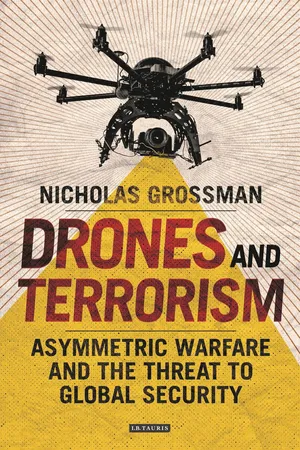
Drones and Terrorism
Asymmetric Warfare and the Threat to Global Security
- 240 pages
- English
- ePUB (mobile friendly)
- Available on iOS & Android
eBook - ePub
About this book
Information
CHAPTER 1
How to Fight an Unfair War
We are living in an age of asymmetric warfare. Nuclear weapons and mutual assured destruction, economic interdependence, and other factors have kept the world’s most powerful countries from going to war with each other. With greater resources and more advanced technology, they have imposed their will on weaker states. Since the end of the Cold War, their most formidable opponents in armed conflict have been terrorists and insurgents.
In the twenty-first century, the United States suffered the largest mainland attack by a foreign entity since the War of 1812 at the hands of a transnational terrorist group rather than a state; easily defeated two governments in Afghanistan and Iraq, but had difficulty suppressing the subsequent insurgencies; and engaged in a global campaign against Al Qaeda, ISIS and their affiliates. The “War on Terror” is more than 15 years old, and shows no sign of ending.
Other nuclear powers’ post-Cold War experience is remarkably similar. Russia, China, the UK, France, India, Pakistan, and Israel have avoided military confrontation with symmetric adversaries, defeated or coerced weaker states, engaged in difficult conflicts against insurgencies, and lost civilians to terrorist attacks.
Russia easily won a war against Georgia in 2008 and took Crimea from Ukraine in 2014, but has not defeated insurgencies in the Caucuses, and lost 186 children in the September 2004 Beslan school massacre.1 The UK quickly deposed Saddam Hussein’s government in 2003 as part of the American-led coalition in Iraq, but faced considerably more military casualties in a six-year fight against the Iraqi insurgency and over ten years fighting insurgents in Afghanistan, while losing more civilians in a terrorist attack on London’s transportation system in 2005 than in any international conflict since World War II.
India mostly avoided violent confrontation with its longstanding rival Pakistan, losing more soldiers to insurgents in Kashmir, while an attack on Mumbai by Lashkar e Taiba in November 2008 killed 164 and injured 308.2 Similarly, Pakistan mostly avoided confrontation with India while fighting ongoing conflicts with various militant groups in the Federally Administered Tribal Areas along its northwest border with Afghanistan. For comparison, Pakistan lost 1,174 soldiers in its most recent major engagement with India, the 1999 Kargil War,3 but in the twenty-first century suffered over 6,000 military fatalities and over 21,000 civilian deaths fighting terrorist and insurgent networks.4
Israel cooperated with former adversary Egypt to blockade the Gaza Strip, destroyed a nuclear reactor in Syria with no repercussions,5 and avoided direct confrontation with Iran while carrying out covert action aimed at delaying Iran’s nuclear program.6 However, Israel failed to achieve its goals in a war against Hezbollah in the summer of 2006; and in three Gaza wars from 2008–2014, Israel lost 79 soldiers and killed thousands of Palestinians, without ever achieving decisive victory. Since 2001, Hamas and other Gaza-based Palestinian resistance networks have fired thousands of rockets fired into Israel, killing 28 civilians, including four children.7
The quantity and quality of personnel and equipment are probably the most important factors in warfare. However, a brief glance at history shows they are not the only factors that matter. If they were, the stronger side would always win.
GUERRILLA WARFARE, INSURGENCY, AND TERRORISM
Vietnamese general Vo Nguyen Giap defined guerrilla warfare as the strategy “of the people of a weak and badly equipped country who stand up against an aggressive army which possesses better equipment and technique.”8 Echoing earlier guerrilla theorists, Al Qaeda strategist Abd Aziz al Muqrin writes insurgency “is a war waged by a poor and weak party using the simplest methods and the cheapest means against a strong opponent who has a superiority in arms and equipment.”9 Given their material disadvantage, guerrillas must adopt a long-term view of the conflict, aiming to gradually defeat their enemies both politically and militarily. “Another fundamental characteristic of the guerrilla soldier” Che Guevara writes, “is his flexibility, his ability to adapt himself to all circumstances, and convert to his service all the accidents of the action.”10
Guerrilla warfare is based on counterstrategy, creatively employing whatever resources become available, acting underhanded, sneaky, and generally fighting dirty. Guerrillas do not wear uniforms or announce allegiances, allowing them to blend in with the civilian population and hide from retaliation, which Mao Zedong compared to fish swimming in a sea of people.11 They embrace surprise, sabotage, and assassination, designing hit-and-run raids to exploit enemy weaknesses. While traditional armies aim to capture and hold territory, guerrillas move constantly, harassing the enemy wherever possible.
To succeed in asymmetric warfare, writes international security scholar Andrew Mack, insurgents must first “refuse to confront the enemy on his own terms.”12 In symmetric conflicts, adversaries possess comparable levels of resources and similar military technologies. Though not perfectly equal, they have the resources for a fair fight—for example, in World War I, both sides had machines guns and artillery—which means they rely on superior mobilization, discipline, maneuver, and luck to succeed. By contrast, in asymmetric warfare, direct combat plays to the advantage of the more advanced military. In the late 1800s, when African forces lined up on a battlefield against European colonizers armed with machine guns, the natives got slaughtered.13
EVENING THE ODDS
The first step in winning a war against a more powerful enemy is avoiding direct confrontation. Then, having ensured survival, successful insurgents follow one of two main strategies:
(1)Acquire more power while wearing down the enemy’s capacity.
(2)Impose military, economic, and political costs until the enemy abandons its military campaign, withdraws forces, or alters a particular behavior.
Domestic conflicts typically classified as revolutions, civil wars, or guerrilla insurrections fit the first form, as revolutionaries intend to take over the state, like the Bolsheviks, or become the dominant governing force of a given geographical area, like the American Confederacy. These asymmetric conflicts end when the challenger to the government becomes the more powerful side and can use the state apparatus to crush opponents, or achieves relative symmetry and can fight with conventional military strategies—essentially, get strong enough to make it a fair fight, or so strong that it is unfair for the other side.
However, many terrorist and insurgent groups cannot plausibly become as powerful as their opponents, and must rely on the second strategy of compellence.14 This especially applies to nationalist insurgencies, like Vietnam or Iraq, that seek the withdrawal of foreign forces or a decrease of foreign influence, rather than control of the foreign state’s territory. Additionally, the second main strategy describes the early asymmetric phases of domestic conflicts that finish as symmetric, such as Mao and Che’s communist revolutions. The greater the material disadvantage, the more asymmetric the conflict, and the more restricted insurgents become to strategies that avoid the enemy’s strengths.
When, say, the IRA fights the United Kingdom, or Al Qaeda fights the United States, they will always be outgunned. But weapons are not the only factors in asymmetric warfare. Discussing guerrilla strategy, Mao argued “the enemy has advantages only in one respect … but shortcomings in all others,” while insurgents “have shortcomings in only one respect but advantages in all others.”15 This implies insurgents can overcome their resource disadvantage by exploiting non-material asymmetries. For example, Palestinian groups are much less powerful than Israel, which means when the two fight they suffer more casualties than they inflict. But that creates an opportunity for the Palestinians to highlight their underdog status to generate international sympathy, increasing political pressure on Israel to accept a ceasefire.
Resolve: Who Wants it More?
Security scholar Andrew Mack proposed that the weaker side has a greater interest in the conflict. The stakes in asymmetric warfare, he argues, are inherently higher for insurgents because the price of their defeat is the loss of independence or total destruction. The more powerful side wants to win, of course, but does not face an existential threat. When survival is at stake, as in the symmetric World Wars, or domestic revolutions, the war effort takes “automatic primacy above all other goals.”16 However, in international asymmetric conflicts, such as Vietnam, a powerful country like the United States has many interests besides the war, which allows for internal debates over the ideal allocation of resources, creating the political conditions that could lead to withdrawal.
This dynamic means state militaries often face greater political constraints when fighting insurgents than when fighting each other. As Mack writes, “when the survival of the nation is not directly threatened, and when the obvious asymmetry in conventional military power bestows an underdog status on the insurgent side, the morality of the war is more easily questioned.”17 As with the United States in Vietnam, or France in Algeria, domestic and international opposition to the war will grow due to moral outrage over the death and destruction caused by a powerful state asserting a less-than-vital interest. By contrast, when survival is at risk, as for the Allies in WWII, “the propensity to question and protest the morality of the means used to defeat the enemy is markedly attenuated.”18
By avoiding direct combat, where material advantage could prove decisive, guerrillas can force their opponents into a “protracted war.”19 According to Mao, denying the enemy victory extends the conflict, and creates a situation in which insurgents can slowly bleed powerful armies, imposing costs that weaken resolve. Given enough material advantage, a state will win any contest of force, which means insurgents can win only if they can make the conflict a contest of will. As Mack notes, in cases where the weaker side achieves its goal of political independence, such as Vietnam or Algeria, “success for the insurgents arose not from a military victory on the ground—though military successes may have been a contributory cause—but rather from the progressive attrition of their opponents’ political capacity to wage war.”20 The Algerian and Vietnam wars ended not because France and America lacked the military capacity to continue fighting, but because they decided the fight was no longer worth it.
Expectations: Who Thinks They Should Win?
States’ material advantage leads them to expect rapid, low-cost victory. Insurgents, on the other hand, face an overwhelmingly powerful foe, and do not expect the conflict to be easy or cheap. As conflicts drag on, the resource toll grows, creating political debates in states with multiple interests, or as Mao put it, “contradictions within the enemy’s camp.”21 The more a state expects a quick and easy victory, the more protracted conflicts and their accompanying resource drain lead to anti-war movements, and arguments to shift resources to other prioriti...
Table of contents
- Cover
- About the Author
- Title Page
- Dedication
- Contents
- List of Illustrations
- Acknowledgments
- Introduction
- 1. How to Fight an Unfair War
- 2. The Robotics Revolution
- 3. Drone Strikes
- 4. Terrorists and Insurgents, Armed with Drones
- 5. The Smart SWARM Strategy
- Conclusion Anticipating Future Risks
- Notes
- Bibliography
- Index
- eCopyright
Trusted by 375,005 students
Access to over 1.5 million titles for a fair monthly price.
Study more efficiently using our study tools.
Frequently asked questions
Yes, you can cancel anytime from the Subscription tab in your account settings on the Perlego website. Your subscription will stay active until the end of your current billing period. Learn how to cancel your subscription
No, books cannot be downloaded as external files, such as PDFs, for use outside of Perlego. However, you can download books within the Perlego app for offline reading on mobile or tablet. Learn how to download books offline
Perlego offers two plans: Essential and Complete
- Essential is ideal for learners and professionals who enjoy exploring a wide range of subjects. Access the Essential Library with 800,000+ trusted titles and best-sellers across business, personal growth, and the humanities. Includes unlimited reading time and Standard Read Aloud voice.
- Complete: Perfect for advanced learners and researchers needing full, unrestricted access. Unlock 1.5M+ books across hundreds of subjects, including academic and specialized titles. The Complete Plan also includes advanced features like Premium Read Aloud and Research Assistant.
We are an online textbook subscription service, where you can get access to an entire online library for less than the price of a single book per month. With over 1.5 million books across 990+ topics, we’ve got you covered! Learn about our mission
Look out for the read-aloud symbol on your next book to see if you can listen to it. The read-aloud tool reads text aloud for you, highlighting the text as it is being read. You can pause it, speed it up and slow it down. Learn more about Read Aloud
Yes! You can use the Perlego app on both iOS and Android devices to read anytime, anywhere — even offline. Perfect for commutes or when you’re on the go.
Please note we cannot support devices running on iOS 13 and Android 7 or earlier. Learn more about using the app
Please note we cannot support devices running on iOS 13 and Android 7 or earlier. Learn more about using the app
Yes, you can access Drones and Terrorism by Nicholas Grossman in PDF and/or ePUB format, as well as other popular books in History & Military & Maritime History. We have over 1.5 million books available in our catalogue for you to explore.