
- 336 pages
- English
- ePUB (mobile friendly)
- Available on iOS & Android
eBook - ePub
About this book
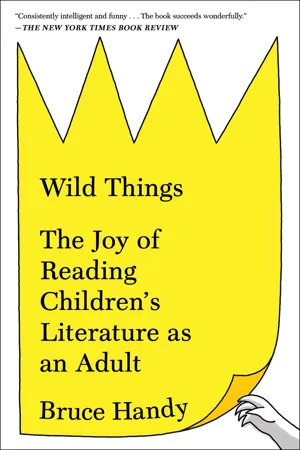
An irresistible, nostalgic, insightful—and “consistently intelligent and funny” (The New York Times Book Review)—ramble through classic children’s literature from Vanity Fair contributing editor (and father of two) Bruce Handy.
The dour New England Primer, thought to be the first American children’s book, was first published in Boston in 1690. Offering children gems of advice such as “Strive to learn” and “Be not a dunce,” it was no fun at all. So how did we get from there to “Let the wild rumpus start”? And now that we’re living in a golden age of children’s literature, what can adults get out of reading Where the Wild Things Are and Goodnight Moon, or Charlotte’s Web and Little House on the Prairie?
A “delightful excursion” (The Wall Street Journal), Wild Things revisits the classics of every American childhood, from fairy tales to The Very Hungry Caterpillar, and explores the back stories of their creators, using context and biography to understand how some of the most insightful, creative, and witty authors and illustrators of their times created their often deeply personal masterpieces. Along the way, Handy learns what The Cat in the Hat says about anarchy and absentee parenting, which themes are shared by The Runaway Bunny and Portnoy’s Complaint, and why Ramona Quimby is as true an American icon as Tom Sawyer or Jay Gatsby.
It’s a profound, eye-opening experience to re-encounter books that you once treasured decades ago. A clear-eyed love letter to the greatest children’s books and authors from Louisa May Alcott and L. Frank Baum to Eric Carle, Dr. Seuss, Mildred D. Taylor, and E.B. White, Wild Things is “a spirited, perceptive, and just outright funny account that will surely leave its readers with a new appreciation for childhood favorites” (Publishers Weekly).
The dour New England Primer, thought to be the first American children’s book, was first published in Boston in 1690. Offering children gems of advice such as “Strive to learn” and “Be not a dunce,” it was no fun at all. So how did we get from there to “Let the wild rumpus start”? And now that we’re living in a golden age of children’s literature, what can adults get out of reading Where the Wild Things Are and Goodnight Moon, or Charlotte’s Web and Little House on the Prairie?
A “delightful excursion” (The Wall Street Journal), Wild Things revisits the classics of every American childhood, from fairy tales to The Very Hungry Caterpillar, and explores the back stories of their creators, using context and biography to understand how some of the most insightful, creative, and witty authors and illustrators of their times created their often deeply personal masterpieces. Along the way, Handy learns what The Cat in the Hat says about anarchy and absentee parenting, which themes are shared by The Runaway Bunny and Portnoy’s Complaint, and why Ramona Quimby is as true an American icon as Tom Sawyer or Jay Gatsby.
It’s a profound, eye-opening experience to re-encounter books that you once treasured decades ago. A clear-eyed love letter to the greatest children’s books and authors from Louisa May Alcott and L. Frank Baum to Eric Carle, Dr. Seuss, Mildred D. Taylor, and E.B. White, Wild Things is “a spirited, perceptive, and just outright funny account that will surely leave its readers with a new appreciation for childhood favorites” (Publishers Weekly).
Frequently asked questions
Yes, you can cancel anytime from the Subscription tab in your account settings on the Perlego website. Your subscription will stay active until the end of your current billing period. Learn how to cancel your subscription.
No, books cannot be downloaded as external files, such as PDFs, for use outside of Perlego. However, you can download books within the Perlego app for offline reading on mobile or tablet. Learn more here.
Perlego offers two plans: Essential and Complete
- Essential is ideal for learners and professionals who enjoy exploring a wide range of subjects. Access the Essential Library with 800,000+ trusted titles and best-sellers across business, personal growth, and the humanities. Includes unlimited reading time and Standard Read Aloud voice.
- Complete: Perfect for advanced learners and researchers needing full, unrestricted access. Unlock 1.4M+ books across hundreds of subjects, including academic and specialized titles. The Complete Plan also includes advanced features like Premium Read Aloud and Research Assistant.
We are an online textbook subscription service, where you can get access to an entire online library for less than the price of a single book per month. With over 1 million books across 1000+ topics, weâve got you covered! Learn more here.
Look out for the read-aloud symbol on your next book to see if you can listen to it. The read-aloud tool reads text aloud for you, highlighting the text as it is being read. You can pause it, speed it up and slow it down. Learn more here.
Yes! You can use the Perlego app on both iOS or Android devices to read anytime, anywhere â even offline. Perfect for commutes or when youâre on the go.
Please note we cannot support devices running on iOS 13 and Android 7 or earlier. Learn more about using the app.
Yes, you can access Wild Things by Bruce Handy in PDF and/or ePUB format, as well as other popular books in Literature & Literary Biographies. We have over one million books available in our catalogue for you to explore.
Information

1
New Eyes, New Ears: Margaret Wise Brown and Goodnight Moon
At his daughter Chelseaâs high school graduation, in 1997, then-president Bill Clinton addressed the assembled students and parents. âIndulge your folks if we seem a little sad or act a little weird,â he told the graduates. âYou see, today we are remembering your first day in school and all the triumphs and travails between then and now.â Being Bill Clinton, he then went for the emotional jugular. âA part of us longs to hold you once more as we did when you could barely walk, to read to you just one more time from Goodnight Moon, or Curious George, or The Little Engine That Could.â Poor Chelsea. She must have died inside, while her classmates likely rolled their eyes, but I bet at least half the parents started sniffling. Bill, so expert at reading crowds and delivering the goods, knew exactly what he was doing in name-dropping those books, all so evocative of bedtime and blankies, sippy cups and night-night. On the other hand, if he was trying to imply an artistic equivalence among the three titles, I would argue that the former president is nuts. Curious George and The Little Engine That Could have their moments, but Goodnight Moon is a transcendent masterpiece.
There isnât anything else quite like it in American letters. Moby-Dick, The Adventures of Huckleberry Finn, The Great Gatsby, and Beloved might all stake a claim to being the mythical Great American Novel, but Goodnight Moon stands alone as the totemic picture book of American babyhood. Here I give it a clear edge over Eric Carleâs The Very Hungry Caterpillar, its equally popular and brilliant board book rival, because Goodnight Moon, suffused with tenderness, joy, and mystery, is in no small sense about babyhood, though kudos to Eric Carle for creating his own transcendent masterpiece about a bug.
For many children, Margaret Wise Brownâs deceptively simple little volume, with its illustrations by Clement Hurd, is their first exposure to something approaching narrative, and by dint of its sheer ubiquity, Goodnight Moon is surely one of the most formative influences on young American lives, up there with Sesame Street and the Disney princesses. More than that: from a parentâs point of view, itâs essential, like Balmex, Pampers, pacifiers, a stroller; itâs gear. As happens with many new parents, my wife and I received multiple copies of Goodnight Moon (three, if memory serves) when our daughter was born. First published in 1947 to modest success, the book didnât take off until the 1960s and â70s, when, while no one was looking, its popularity seemingly grew overnight, like kudzu. As of 2016, according to the agent for Brownâs estate, it had sold 26 million copies in various editions, which might make it the most popular picture book in America, pushing it past the longtime champion, the inexplicably beloved The Poky Little Puppy. Every year Goodnight Moon sells another 600,000 to 800,000 copiesâwhich means, in a good year, there is roughly one Goodnight Moon purchased for every five births in America. It has been translated into twenty languages.5
For its author, it was just another book. Brown published more than sixty in her abbreviated lifetimeâshe died at the age of forty-two, in 1952âand Goodnight Moon wasnât even mentioned in her New York Times obituary. No one seems to know why it became her preeminent work, but like all of her books it is grounded in a profound empathy for the very young. She is the only author I deal with at length in this book who formally studied to be a writer for children, yet she was also a natural with an intuitive sense of how to speak to them. In one of her earliest stories, âThe Shy Little Horseâ (from a 1938 collection, The Fish with the Deep Sea Smile), she writes that the title character âhad brand new eyes and brand new ears, and he heard and saw everythingââwhich was also Brownâs gift, to experience the world like a child, as if both she and it were just off the griddle. This brief excerpt from her poem âFall of the Yearâ (also collected in The Fish with the Deep Sea Smile) sings with that senses-open freshness:
All in one day
Darkness came before the night
The air grew cold enough to bite
âHer genius came from her extraordinary memory of feelings and emotions way back to her earliest years,â Clement Hurd, who aside from Goodnight Moon illustrated seven other books of Brownâs, wrote in a remembrance for the Horn Book years after her death. Brown herself described her gift as succinctly and evocatively as she did most things. âThe first great wonder at the world is big in me,â she once wrote to a lover, trying to explain the source of her creativity. That wonder infuses Goodnight Moon with an underlying delight, and even awe. It is there in the bookâs very first words:
In the great green room
There was a telephone
And a red balloon
And a picture ofâ
[here we turn the page]
The cow jumping over the moon.
A less interesting and less intuitive writer might have started out with something like, âThere once was a little bunny who was going to sleep in his little bunny bedroom.â Instead, by offering a simple, almost liturgical accounting of the room and its furnishings, Brown instantly and gracefully gives the reader a childâs-eye view of things. (The listener, presumably, already has one.) The great green room: to a two-year-old, a bedroomâor any roomâis an epic space, a Monument Valley full of objects and details that glow with strange newness, having not yet acquired the dull patina of familiarity that allows older children and adults to get on with their responsibilities and not be stopped in their tracks by, say, the miracle of grass. (One of my own earliest memories is of waking from a nap and being fascinated for what now seems like hours by the play of dust motes in the slanting, late afternoon light. On some level, I believe, I go to movie theaters and museums still hoping to be mesmerized in the same way.)
Brownâs first great wonder is reinforced by Hurdâs illustrations, both in their sense of scaleâin the bookâs spreads the emphasis is on the great green room itself, a place for a childâs eye to explore, rather than on the bunny, a small figure tucked away in the corner of most of the drawingsâand in the bright, flat, unnatural color scheme, those electric greens and oranges and yellows rubbing against one another on the draperies and walls and floor to almost hallucinatory effect. Itâs easy to take Goodnight Moon for grantedâas I said, itâs practically gearâbut look at it with brand-new eyes and it dazzles.
⢠⢠â˘
I had always pictured Margaret Wise Brown as a kindly gray-haired woman with an ample lap; I think I pictured her as my grandmother, or maybe Goodnight Moonâs quiet old lady whispering hush. Certainly Margaret Wise Brown, as a name, is the equivalent of a comfy old sweater or a square meal heavy on the potatoes; it sounds grandmotherly. In reality, she was less kindly and ample than headstrong and zany, like a madcap heroine in a 1930s screwball comedy, a slender young woman who could have been played by Katharine Hepburn or Carole Lombard, the latter of whom she resembled.
In a 1946 profileâshe had forty-odd childrenâs books under her belt by thenâLife magazine described Brown this way: âShe is a tall, green-eyed, ash blonde in her early thirties [she was actually thirty-six] with a fresh outdoors look about her. People who meet her for the first time are likely to think she is extremely sophisticated, which is entirely true. Her striking appearance is usually punctuated by some startling accessory such as a live kitten in a wicker basket or a hat made out of live flowers.â Brown was the sort of person who thrived in cafĂŠ society, who was friendly with literary types such as Bennett Cerf, E. J. Kahn, and Leo Lerman; but she was also the sort of person who kept a dog, a cat, a goat, and a flying squirrel in her Greenwich Village apartment. Though she wasnât an heiress or a debutante, she had grown up with money and always had enough of it, along with a casual attitude toward finances: as Life observed, âExcept for clothes, champagne, and flowers, Miss Brown hasnât much interest in spending.â (Years earlier, she blew her first advance on an entire cart of flowers that she brought back to the apartment for a celebration; and she took a lowball $150 advance for another book because the fee coincided precisely with the cost of a wolfskin jacket she had decided she couldnât live without.) Full of schoolgirl enthusiasms, she had a deep reservoir of childhood memories and feelings that she drew on for her work. Ideas for books seemed to occur to her with ridiculous ease: âI finish the rough draft in twenty minutes,â she told Life, âand then spend two years polishing.â The magazine added that she was âcurrently polishing twenty-three books more or less simultaneously.â At the same time she worried that her talents denied her a place at the literary worldâs grown-up table. Yearning to write for adults, she never found homes for her âseriousâ short stories and poetry.
âMargaret was the most creative person, male or female, that I have ever known,â wrote Hurd.
âShe was almost overwhelmingly original,â the writer Naomi Bliven once told an interviewer. âNever for a moment did you feel she was lackadaisical about anything.â
âFor ten minutes I was enchanted by what she had to say, and by the eleventh minute I had the need to run away,â Blivenâs husband, Bruce Bliven Jr., remarked to the same interviewer. The Blivens were friends of Brownâs (he had written her Life profile), so presumably he was kidding around when he said this, but Iâd bet there was more than a grain of truth in it: Brown sounds as if she could be a handful.
⢠⢠â˘
Born in 1910, she had grown up on Long Island, where her father was an executive at the American Manufacturing Company, which made rope and twine and sacks, an enterprise so prosaic as to sound almost whimsically prosaic, like a business invented by Roald Dahl for the dull part of a book. Brown was herself a dreamer and a storyteller from the get-go, disappearing into âworlds of her own making,â as she later put it, and reading fairy tales to her younger sister while altering the plots to serve her own emotional needs. (In Brownâs improvisations, cruel older stepsisters transformed into heroines.) By the time she got to collegeâHollins, her motherâs alma materâshe was bursting with creative energy but not necessarily focus or discipline. An English composition professor simultaneously praised her and damned her as a âgenius without talent.â
She moved to New York after graduationâand after breaking off her engagement to a southern boy from a âgoodâ family. Settling into the city, she took some writing courses at Columbia and had a one-session flirtation with painting at the Art Studentsâ League. But she was adrift, pessimistic about a future as any kind of artist. Like many single women of her era, she wound up studying to become a teacher, having enrolled, somewhat ambivalently, at the Bureau of Educational Experimentsâ Cooperative School for Teachers, a temple of the progressive education movement then known informally (and now officially) as Bank Street, after its original address in Greenwich Village. (Full name: Bank Street College of Education.) Though Brown quickly decided she didnât want to teach, she discovered that she found children fascinating. She loved listening to them, to the inventive and unself-conscious ways they used language. âThey tell me stories and I write them down. Amazing. And also the pictures they paint. It must be true that children are born creative,â she wrote to a favorite literature professor at Hollins. When she took a course on writing for children she stumbled on her calling.
The class was taught by the schoolâs cofounder and chief administrator, Lucy Sprague Mitchell, an author herself, who sensed something unique in Brownââcrazy, penetrating, blind instincts and feeling for language,â Mitchell later saidâand took her under her wing.
Like seemingly everything else in the 1930s, the childrenâs book world was riven by absolutist ideologies. Mitchell was the leading proponent of what she called the Here and Now philosophy: the idea that stories drawn from real, everyday settings, informed by careful observations about how children perceive and respond to their environment, were the perfect nourishment for very little kids, for whom, after all, there is no such thing as been there, done that. Here and Nowâists frowned on fantasy, myths, fairy tales, and nursery rhymes, all the stuff of classic childrenâs literature, which they dismissed as inherently unwholesome, more suited to adultsâ cravings for the sensational and bizarre than to childrenâs simpler needs. For the youngest child especially, the thinking went, a story about a bird or a cup or a truck could be as fascinating as a tale about a fairy or a dragon, if not more so, and had the added benefit of being real and thus, in some sense, instructional. As Mitchell put it in the introduction to the Here and Now Story Book, a collection of her own work published in 1921: âIt is only the jaded adult mind, afraid to trust the childâs own fresh springs of imagination, that feels for children the need of the stimulus of magic.â (The italics are Mitchellâs.) What this meant in practice was stories with titles such as âThe Room with the Window Looking Out on the Garden,â âPedroâs Feet,â âMarni Gets Dressed in the Morning,â and âBoris Takes a Walk and Finds Many Kinds of Trains.â
Alison Lurie, for one, received a copy of the Here and Now Story Book for her fifth birthday and was not impressed:
[It] was a squat volume, sunny orange in color, with an idealized city scene on the cover. Inside I could read about the Grocery Man (âThis is Johnâs Mother. Good morning, Mr. Grocery Manâ) and How Spot Found a Home. The children and parents in these stories were exactly like the ones I knew, only more boring. They never did anything wrong, and nothing dangerous or surprising ever happened to themâno more than it did to Dick and Jane, whom my friends and I were soon to meet in first grade.6
Mitchell wasnât immune to such criticism. As she wrote in the preface to Another Here and Now Story Book, published in 1937 (with editing and contributions from Brown): âIf the stories in this book are less lovely than Cinderella or Little Red Riding Hood or Pandoraâs Box, it is because we lack the requisite artistry, not because we do not value loveliness. The great writer for the young children of the âhere and nowâ period is still to come.â
Brown would prove to be that writer. Her first book, When the Wind Blew, published in 1937 when she was twenty-seven, was praised by the New York Timesâin terms that would apply to most of her workâfor its âpoetic quality, color, and rhythm.â From there she was off, editing and writing for W. R. Scott, a small experimental publisher associated with Bank St...
Table of contents
- Cover
- Dedication
- Epigraph
- Introduction
- 1. New Eyes, New Ears: Margaret Wise Brown and Goodnight Moon
- 2. Runaways: Family Drama in Picture Booksâand Well Beyond
- 3. Once upon a Time and In and Out of Weeks: Fairy Tales and Maurice Sendak
- 4. Why a Duck? The Uses of Talking Animals from Aesop to Beatrix Potter to Olivia the Pig
- 5. You Have to Know How: Dr. Seuss vs. Dick and Jane
- 6. Kids Being Kids: Ramona Quimby, American Pest
- 7. God and Man in Narnia
- 8. One Nation: Washingtonâs Cherry Tree, Rosa Parksâs Bus, and Oz
- 9. Going on Seventeen (Or Not): Little Women, Little Houses, and Peter Pans
- 10. The End: Dead Pets, Dead Grandparents, and the Glory of Everything
- Afterword
- Acknowledgments
- Appendix
- About the Author
- Bibliography
- Index
- Copyright