Mary Shelley
eBook - ePub

Mary Shelley

  1. 704 pages
  2. English
  3. ePUB (mobile friendly)
  4. Available on iOS & Android
eBook - ePub

Mary Shelley

About this book

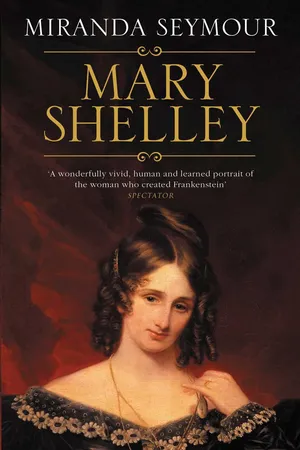
'The most dazzling biography of a female writer to have come my way for a decade…' – Financial Times 'To be savoured for its vivid and sympathetic recreation of the tragic life and brilliant times of the gifted Mary Shelley' – Times Literary Supplement ' Brilliant and enthralling' – Independent On Sunday 'Wonderfully vivid' – Spectator The definitive and richly woven biography of Mary Shelley, in celebration of the 200th anniversary of Frankenstein The creator of the world's most famous outsider became one herself... There is no more dramatic scene in literary history than the stormy night by Lake Geneva when Byron, Claire Clairmont, Polidori and the Shelleys met to talk of horror and the unexplained. From that emerged Frankenstein, a monster who has haunted imaginations for two hundred years. Miranda Seymour illustrates the rich and unexplored life of Mary Shelley. Everything from her childhood to her tempestuous relationship with Percy Shelley; Seymour brings to life the brilliant mind that created Frankenstein through unexplored and intriguing sources. The Mary Shelley we meet here is a woman we can engage with and understand. Her world, so rich in its settings and its cast of characters, seems drawn from a novel. She, at its centre, is flawed, brave, generous, and impetuous, a woman whose dark and brilliant imagination gave us a myth which seems ever more potent in our own era.
Tools to learn more effectively

Saving Books

Saving Books

Keyword Search

Keyword Search

Annotating Text

Annotating Text

Listen to it instead

Listen to it instead

Information

APPENDIX I
image

AN ACCOUNT OF THE BURIAL OF SHELLEY’S HEART

The following note was written by E. Gambier Parry at the end of his personal copy of Trelawny’s Records of Shelley, Byron and the Author. The details given in this text modify the usual account of the burial of Shelley’s heart. The Canon St John referred to here is a member of the family of Lady Shelley’s first husband.
Shelley’s Heart
My old friend Canon Ferdinand St John (Canon of Gloucester Cathedral) told me that he was Trustee of the Shelley family, Lady Shelley then living at Boscombe. St John paid Lady Shelley periodical visits, and on one of these occasions he came to see me at Sou[th]bourne, where we then were owing to Tom’s illness. Our conversation turned on Shelley, & I referred to the fact that his, St John’s, brother Canon at Gloucester, Canon Harvey, had been Shelley’s fag at Eton. St John said – ‘Yes, & I buried Shelley’s heart! Lady Shelley had it, & it was enclosed in a silver case. She asked me what she had better do with it, & I said – “bury it.” So it was arranged that this should be done: The heart in its case was conveyed to Christchurch Abbey, where it was duly buried, and I read the Service.’
E Gambier Parry [undated]
APPENDIX 2
image

SOME UNPUBLISHED LETTERS

To John Murray from Mary Shelley
11 Bartholomew Place Kentish Town
13 January 1827
Sir,
I have heard that you contemplated endeavouring to purchase the copy-right of a selection of Mr Shelley’s works – and that you even applied to my father-in-law Sir Tim. Shelley on the subject. I write merely to say that these copy-rights are mine and that if you still wish to make such a purchase I should be happy to enter into a negotiation with you upon it.
I am, Sir,
Your ob[edien]t servant
Mary Shelley*
To Constantine Henry Phipps, First Marquis of Normanby from Mary Shelley
Layton House Putney
8 December 1839
Dear Lord Normanby
It was a great comfort & relief to me, that Lord Melbourne was good enough to give the sum in question to Mrs Godwin. I am grateful to you for the kindness you express; you have ever shown a munificent spirit with regard to deserving literary persons.
I have told the Bookseller to send you some volumes which I think will please you. We can none of us forget that you too are an author* & one we delight to read –
With many thanks, I am
Ever Yrs truly
Mary Shelley
To Joseph Severn from Mary Shelley, n.d.
Mr Hogg is a friend of Leigh Hunt, of Mr Shelley, and many others of your circle in England. Permit me, therefore, to introduce him to your acquaintance.
T. J. Hogg to Richard Monckton Milnes, incorporating Hogg’s copy of a letter to him from Lady Shelley
London 12 September, 1859
Dear Sir,
I have placed in the hands of some of my friends, who take an interest like yourself, in ‘The Life’, the letter of which I send you a copy, for I think you ought to see it, & you may make any use of it you please. The least painful refutation of the extraordinary statements contained in the Preface to the ‘Memorials’ is to be found in the belief, that there was a touch of madness in the Editor’s race: they were rather low people, & moreover somewhat crazy. I will consent therefore to the humane Verdict, ‘Not Guilty, on the ground of Insanity’.
I am just about to start for the North, doomed to wander, like an unburied ghost, over the county of Northumberland, until the end of October. If you should desire further information I shall be happy to supply it; in that case address me as below.
I am ever, Dear Sir, faithfully yours,
T Jeffn. Hogg,
Revising Barrister, to the care of Mr John Elliot, Clerk of the
Peace, Newcastle upon Tyne
[copied out in TJH’s hand: Lady Shelley to TJH]
‘For the last three days, Dear Dah, you have never been out of my thoughts, & I am very glad to sit down in my own Sanctum to write & tell you, how grieved I was to have caused you so severe a disappointment.
Hellen [Shelley] promised to tell you this, & she seemed to think, when she left us, that she had comforted us all. I have read the book three times since then, & I find that merely the letters H.G. [Harriet Grove] in the margin of some of those letters without date make all the difference in the world. But for some of these letters, & the way in which he spoke occasionally of his father, I think the book is all we could wish; & many a good laugh it gave me, even in the midst of my distress. You know, dear Dah, that even the very sight of this long desired book put me in a horrible state of agitation, & the first reading of course was very different to both Percy & myself, than it could possibly be to anyone else. I had been so unwell too for a long time, that my brain once set to work seemed to be on fire: – my distress too to grieve you was very great. I want to know when you think you can come to us. In three weeks again I must go to town, to see my doctor, who is making me quite well & strong; but after that, I think, you might settle your own time within the next two months. We shall probably have the house full of people, somehow or another, but you won’t dislike that. Let me hear from you very soon; neither Percy, nor myself, can be quite happy & comfortable until we do. Believe me always, Dear Dah, very affectionately yours, Wrennie.
Percy says – “Do say to Dah how sorry I was to flurry him with my note, but then you know, Nin, you were in such a way that I did not know what to do!”
By the bye – Shd I get you a better bedroom candlestick? – for the stern hour of ten, when Chips & every other attraction fails to keep womankind from their beds & a scurvy bedroom candlestick.
Postmark. Christchurch, April 15 1858)’*
Byron to Mary Shelley, Genoa, 1823, n.d.
Dear Mrs Shelley
I have received the enclosed notice through Murray from London – which I can’t help feeling a little premature as well as public. It was not my intention to make my name stand forth so dramatically; will you ask Hunt whether he has any news from England on the subject? – I have h[ad] a long letter from M[urray] complaining bitterly about Mr John H[unt] whose behaviour he [says was] very rude to him. Have you anything on y[our] affairs?

* The last sentence only has been previously cited in The Letters of Mary W. Shelley, ed. Frederick L. Jones (University of Oklahoma Press, 1944) and The Letters of Mary Wollstonecraft Shelley, ed. Betty T. Bennett (Johns Hopkins University Press, 1980), vol. 1.
* Mary Shelley’s grateful tone can be explained by the fact that Lord Normanby’s name often appeared on subscription lists for Godwin. She also, by 1839, knew him as a cousin of her late friend, Lord Dillon. She had read Lord Normanby’s The English in Italy (1825) without guessing the author’s identity. It is ‘very clever amusing & true’, she wrote to Leigh Hunt on 12 August 1826, adding that since she had also seen books about Italy by Lady Oxford and by Lady Charlotte Bury (the same Lady Charlotte who had a child by Aubrey Beauclerk), she thought she would review them in a single article. ‘The English in Italy’, published without signature in the Westminster Review that October, discussed Lord Normanby’s work together with Mrs Jameson’s Diary of an Ennuyée and the anonymous Continental Adventures: A Novel. Normanby also published two companion volumes, The English in France (1828) and The English at Home (1830). Matilda: a Tale of the Day was published in 1825 and has nothing in common with Mary’s then unpublished novel, Matilda. Lord Normanby also occasionally contributed to the Keepsake albums.
Extract cited in a sale of autographs and letters advertised by John Weller, bookseller, 1871. Despite the reference to Shelley as though he was still alive, this was evidently written by Mary when Hogg was about to make his first visit to Italy in 1825. Severn was then living at Rome. Hogg reached Rome that autumn and was dismayed to find that Teresa Guiccioli knew all about his affair with Jane Williams and that Jane was still a married woman: ‘without telling her an actual untruth, I induced her to believe that was a mistake, & that you were free,’ Hogg reported. In the same letter, written from Naples on 6 December, he told Jane that he had met Severn. ‘Mr Severn has finished the portrait of Trelawny; it is said to be a good likeness; I will not forget it.’ On 6 January 1826, he confirmed that he had collected Severn’s portrait and was bringing it back to England ‘safe in my bag’. (After Shelley: The Letters of Thomas Jefferson Hogg to Jane Williams, ed. Sylvia Norman (Oxford, 1934).)
* This letter, printed with the kind permission of the Wren Library, Trinity College, Cambridge, is in the Houghton Papers, 12/37. It was probably one of several which Hogg wrote after Lady Shelley’s attack on him in the Shelley Memorials. It certainly suggests that the Shelleys had decided to take a conciliatory attitude, perhaps because they knew that Hogg had already completed the material for further volumes which they wished to secure, and because they were eager to retrieve the letters which Hogg had been loaned. The mystery of what happened to the rest of Hogg’s work has never been solved. Hogg, if he retained it, would surely have decided to publish and be damned. It is not impossible that Lady Shelley obtained possession of the manuscript by this show of friendship, and then destroyed it.
This unpublished letter is now in the library of the University of Pisa, Ms 775.232. It was displayed as part of the ‘Paradise of Exiles’ exhibition at Pisa in 1985 and has been printed by Mario Curreli in Una certa Signora Mason (Edizioni ETS, 1997). Byron’s discomfort seems to have concerned the fact that his name was being pushed to the top of advertisements for the Liberal. The letter shows how heavily Byron depended on Mary to act as a go-between in his dealings with Leigh Hunt, and that he felt able to tre...

Table of contents

  1. Cover
  2. Epigraph
  3. Illustrations
  4. Preface
  5. I A Motherless Child
  6. II Freedom
  7. III Italy
  8. IV A Woman of Ill Repute
  9. V Keeper of the Shrine
  10. Appendix 1: An Account of the Burial of Shelley’s Heart
  11. Appendix 2: Some Unpublished Letters
  12. Appendix 3: Portraits of Mary Shelley
  13. Acknowledgements
  14. Notes
  15. Bibliography
  16. Index
  17. Copyright

Frequently asked questions

Yes, you can cancel anytime from the Subscription tab in your account settings on the Perlego website. Your subscription will stay active until the end of your current billing period. Learn how to cancel your subscription
No, books cannot be downloaded as external files, such as PDFs, for use outside of Perlego. However, you can download books within the Perlego app for offline reading on mobile or tablet. Learn how to download books offline
Perlego offers two plans: Essential and Complete
  • Essential is ideal for learners and professionals who enjoy exploring a wide range of subjects. Access the Essential Library with 800,000+ trusted titles and best-sellers across business, personal growth, and the humanities. Includes unlimited reading time and Standard Read Aloud voice.
  • Complete: Perfect for advanced learners and researchers needing full, unrestricted access. Unlock 1.4M+ books across hundreds of subjects, including academic and specialized titles. The Complete Plan also includes advanced features like Premium Read Aloud and Research Assistant.
Both plans are available with monthly, semester, or annual billing cycles.
We are an online textbook subscription service, where you can get access to an entire online library for less than the price of a single book per month. With over 1 million books across 990+ topics, we’ve got you covered! Learn about our mission
Look out for the read-aloud symbol on your next book to see if you can listen to it. The read-aloud tool reads text aloud for you, highlighting the text as it is being read. You can pause it, speed it up and slow it down. Learn more about Read Aloud
Yes! You can use the Perlego app on both iOS and Android devices to read anytime, anywhere — even offline. Perfect for commutes or when you’re on the go.
Please note we cannot support devices running on iOS 13 and Android 7 or earlier. Learn more about using the app
Yes, you can access Mary Shelley by Miranda Seymour in PDF and/or ePUB format, as well as other popular books in Literature & Literary Essays. We have over one million books available in our catalogue for you to explore.