Elizabeth Taylor's electrifying performance in Who's Afraid of Virginia Woolf? The milkshake scene in There Will be Blood. Leonardo DiCaprio's turn as Arnie in What's Eating Gilbert Grape? What makes these performances so special?
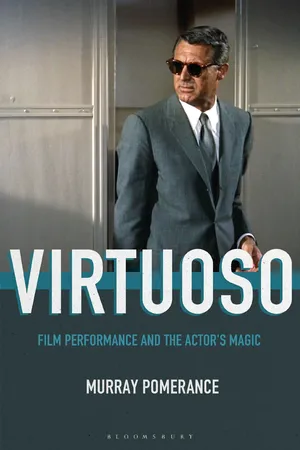
Eloquently written and engagingly laid out, Murray Pomerance answers the tough question as to what makes an exceptional, or virtuosic performance. Pomerance intensively explores virtuosic performance in film, ranging from classical works through to contemporary production, and gives serious consideration to structural problems of dramatization and production, actorial methods and tricks, and contingencies that befall performers giving stand-out moments.
Looking at more than 40 aspects of the virtuosic act, and using an approach based in careful meditation and discursion, Virtuoso moves through such themes as showing off, effacement, self-consciousness, performative collapse, spontaneity, acting as dream, acting and femininity, virtuosity and torture, secrecy, improvisation, virtuosic silence, and others; giving special attention to the labors of such figures as Fred Astaire, Johnny Depp, Marlene Dietrich, Basil Rathbone, Christopher Plummer, Leonardo DiCaprio, Alice Brady, Ethel Waters, James Mason, and dozens more. Numerous scenic virtuosities are examined in depth, from films as far-ranging as Singin' in the Rain and The Bridge on the River Kwai, and My Man Godfrey. As the first book about virtuosity in film performance, Virtuoso offers exciting new angles from which to view film both classical and contemporary.
- 368 pages
- English
- ePUB (mobile friendly)
- Available on iOS & Android
eBook - ePub
About this book
Information
1
A Brief History of the Virtuosic Moment
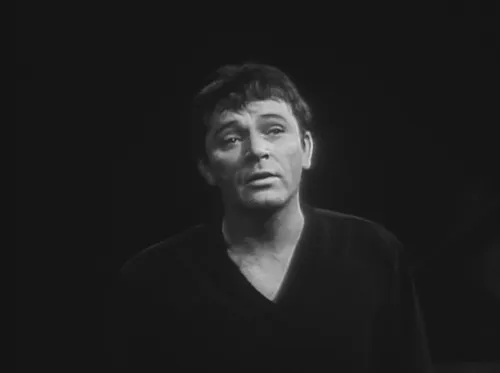
FIGURE 1 Richard Burton in John Gielgud’s production of Hamlet (taped in Electronovision) (Theatrofilm, 1964). Digital frame enlargement.
Writing about the hand in culture, Frank Wilson reflects on prodigy: “Musical skill provides the clearest example and the cleanest proof of the existence of a whole class of self-defined, personally distinctive motor skills with an extended training and experience base, strong ties to the individual’s emotional and cognitive development, strong communicative intent, and very high performance standards” (207). Some notes about these standards and this class:
First, acting works like musical performance (moving as they do through harmonic space and across rhythmic time, actors are musicians1). And secondly, as Wilson himself notes, “very high performance standards” are a relatively modern addition to the repertory of an artist’s strengths. With both music and acting, the professionalism we associate with extreme levels of performative articulation followed long periods of less intensive, amateur activity (activity deriving from enthusiasm), in which people made music and occupied the stage—the “stage”: a specialized area summoning concentrated attention—because they loved to do so, or felt a calling (a vocation), or needed a moment of expression, but in any event for fluid, personal and unorganized, possibly religious reasons. If Greek drama was impressively declamatory, requiring vocal strength for long projection in an open-air odeon, it was also practiced by citizens who had not necessarily developed body and personality, through struggle and training, for the challenge of wearing the mask. The audience required only sufficient clarity of projection for the voices and postures to be received and interpreted straightforwardly; the prodigy of the drama lay in a text spoken, however it was spoken. When Oedipus Rex was played, Sophocles was the virtuoso: “Count no man happy until he has passed the final boundary of his life secure from pain.”
The major cultural change in music, Wilson tells us, came with Franz Liszt (1811–1886), who, living and working at the same time as Charles Darwin, was similarly concerned with competition and life experience. Both saw the elaboration of technique as vital to success. “Where do we find the selection pressure,” Wilson wonders, “that explains the descent of musicians?” and, with Liszt and those who followed him, explicitly the descent of brilliant musicians who beyond interpreting a score could put on a show by reading it in a spectacular fashion. To Liszt, Wilson reminds us, is attributed the exclamation, “Le concert, c’est moi!” From the brilliant musician it is but a short leap to the brilliant performer onstage or onscreen, who also declaims, “L’acte, c’est moi!” Before Liszt, the celebrated actor was in service of the script; afterward, with the invention of virtuosity in performance, the script could be seen as serving the performer.2
No natural wellspring, the artistic prodigy had endured “specialized educational practices” (Wilson 228) geared to strengthen certain sinews, attune certain sensitivities, focus the mind on delicate muscular manipulations, and the like. Here is grounded the startling aplomb of Sarah Bernhardt, the magical transformations of John Barrymore, the noble gracility of John Gielgud3 and flamboyance of Laurence Olivier, the cagey concentration of Derek Jacobi and his pupil Kenneth Branagh, the high-cheeked flush of Edith Evans, and the ineffable sadness of Laurette Taylor, whose playing of Tennessee Williams’s The Glass Menagerie on Broadway in 1945 so stunned audiences, but especially actors who paid over and over to see her, that her moments endured for them as eternal memories of greatness. According to accounts, she simply was, on the stage; no affectation.
To distinguish the script from the speech, one might note Hamlet’s too famous self-mocking “To be or not to be” and its many orators. Gielgud’s Hamlet differed from Richard Burton’s and Laurence Olivier’s and Maxine Peake’s. One thinks of Gielgud’s voice as having quaver and resonance, like a great organ, his intonation sepulchral and secret, a phantasm’s; so that when with this great soliloquy Hamlet wanders through the forest of his mortality we feel we are in some stark, whispered privacy with him, perhaps inside his soul. Olivier used facial muscles, knowing that his Hamlet would be seen in close-up, so that the shifting eyes, the relaxing and tensing lips, the hollowed cheeks when the head was turned would all sum to neurotic sensibility losing its way. Burton had been gifted with a voice like cut diamond, and when he spoke (I saw his performance in a theater of 3,500 souls, where the words swam in the air before me) one could hear something akin to a trumpet being played in all its registers, softly or with force, and with unbounded power to shift moods even in the middle of a syllable. This Hamlet sang his pain, was an undiscovered artist whose fate darkened because of his artistic power. Peake used a clipped matter-of-fact tone, drawing the audience to her as friends, but also staccato pauses to gain attention.
Professional artistic culture, suggests Wilson, “created its own archaeological context for defining and then reciprocally redefining the fitness” of the performer (216). The performer’s fitness, for both audience attention and the special illumination of the stage or cinema, became an issue for criticism. Francisque Sarcy, a theater critic for both L’Opinion nationale and Le Temps, adjudicated Bernhardt: “She carries herself well and pronounces with perfect precision. That is all that can be said about her at the moment” (Skinner 37; my emphasis); the virtuosity she promised apparently required more still. And reviewing the same Burton performance I saw (more or less, because now the cast, including Hume Cronyn as Polonius, Alfred Drake as Claudius, Eileen Herlie as Gertrude, Linda Marsh as Ophelia, as well as George Voskovec, George Rose, and Barnard Hughes, had moved to the Lunt-Fontanne Theatre in New York) the New York Times was overwhelmed by its capacity and girth: “Richard Burton dominates the drama, as Hamlet should. For his is a performance of electrical power and sweeping virility. But it does not burst the bounds of the framework set for it by John Gielgud’s staging. It is not so much larger than life that it overwhelms the rest of the company. Nor does it demand attention so fiercely for itself that the shape and poetry of the play are lost to the audience” (Taubman). Two essential provisos for brilliant performance: (1) do not overwhelm your circumstances; (2) do not obfuscate the script. “It is clear early on that Mr. Burton means to play Hamlet with all the stops out—when power is wanted. . . . I do not recall a Hamlet of such tempestuous manliness.” With all the stops out: the reviewer is showing himself experienced, has seen acting with “stops left in,” has heard tones muted but here and now made sonorous and deep.
Prior to Gielgud’s modern-dress staging with Burton, fifty-nine productions of Hamlet had found their way to Broadway, perhaps most famous the 1922 John Barrymore offering, which, if it also stunned the Times, created, it seems, a more ethereal, even ghostly effect. Barrymore also possessed an orchestral sound, although of the two voices Burton’s was the jewel with more carats:
The atmosphere of historic happening surrounded John Barrymore’s appearance last night as the Prince of Denmark; it was unmistakable as it was indefinable. It sprang from the quality and intensity of the applause, from the hushed murmurs that swept the audience at the most unexpected moments, from the silent crowds that all evening long swarmed about the theatre entrance. It was nowhere—and everywhere. In all likelihood we have a new and a lasting Hamlet.
Mr. Barrymore disclosed a new personality and a fitting one. . . . This youth was wan and haggard, but right manly and forthright—dark and true and tender as befits the North. The slender figure, with its clean limbs, broad shoulders and massive head “made statues all over the stage,” as was once said of Edwin Booth.
Vocally, the performance was keyed low. Deep tones prevailed, tones of a brooding, half-conscious melancholy. The “reading” of the lines was flawless—an art that is said to have been lost. The manner, for the most part, was that of conversation, almost colloquial, but the beauty of rhythm was never lost, the varied, flexible harmonies of Shakespeare’s crowning period in metric mastery (Corbin).
If the virtuosity of Burton was operatic,4 the virtuosity of Barrymore’s Hamlet had a cousinly charm, that of a handsome young articulate who chatted his lines, watched his rhythms, posed with sculptural grandeur. Burton, by contrast, was terrifying, slouching in his open-necked jet-black work shirt.5
Even when she is enunciating a deeply meaningful and very poetic script, the body and presence of the performer enunciate themselves with special force in virtuosic acting, just in the way that, before the performance began, they had promised to do (leading strangers to pay good money for the experience of catching a view). If in music, during the Romantic era,6 artists effectively competed with one another by giving public performances of the same “classic” (read, canonical) concertos—the Grieg A minor (1868), the Tchaikowsky B-flat minor (1875), the Brahms D minor (1858), any of the five Beethovens (1795–1810), the Lizst No. 2 (1861)—so that what the listening audience finally received was an idiosyncratic version of a text already known, similarly onstage Hamlet was an already known score, and the competitive performativities that lent themselves to it were taking opportunity to show personal, often entirely quirky ways of saying words and phrases everyone knew other performers had already said, in their own ways. Which words or syllables would gain emphasis? Where would pauses be inserted? Where stage business undertaken? What gestures of the face and limbs might express emotion? In the early 1990s I attended an enchanting lecture by the great British actor Ian Richardson,7 about Shakespeare’s soliloquies. He made it quite plain that as far as he was concerned the way to do it was to read the exact text, with five stressed beats to the line, counting silently to oneself and doing business whenever a line had fewer than five iambs. He demonstrated and, indeed, his logic was flawless. Other performers, of course, enjamb the lines, pause in mid-line, raise their pitch on eccentric syllables, often try to divine the meaning of the text so as to convey it to the listener rather than assuming the text has the meaning already and the listener will hear.
Once the age of virtuosity has dawned, writers and composers begin to design materials ideal for the display of a performative self: rich meaty verbs (Joe Pesci in Goodfellas [1990]: “Fuck you, you fuck!”), character action strange enough to seduce the eye (in Woman of the Year [1942], Katharine Hepburn trying hopelessly to cook breakfast for Spencer Tracy). Scripting in both stage work and film attends rigorously to performative possibilities: eccentric and highly visualized action (Sam Shepard’s Operation Sidewinder [Vivian Beaumont Theatre, Lincoln Center, 1970] had a small tribe of Native Americans, in full regalia, literally disappear from center stage); fabulously unpredictable language (Olivier in toga to almost naked Tony Curtis in Spartacus [1960]: “Do you eat oysters?”); marvelous choreography (the cattle shoot in Hud [1963], in which Melvyn Douglas gives an unforgettable virtuosic turn by standing stock still in defeated silence). Materials produced much earlier, for less ostentatious display or display with an entirely different kind of ostentation—Shakespeare’s plays, Dickens’s novels—are reinterpreted with new, self-declarative voices: Ethan Hawke doing a slacker Great Expectations (1998), Helen Mirren playing Prosper(o)a in Julie Taymor’s The Tempest (2010). Dramatic renovations offer almost unlimited opportunity for virtuosic playing, since the presence of unexpected personnel has the capacity to make every tiny gesture seem significant, enriching, and special (as, between April 19, 1979, and June 28, 1981, with David Bowie taking over the lead in Bernard Pomerance’s The Elephant Man from Philip Anglim, at Broadway’s Booth Theatre).
“Musicians had always spoken to and for people’s feeling,” writes Wilson, but “the Lisztian declaration—a new formula for survival—profoundly transformed the relationship between musicians and audiences, and in so doing transformed the definition of musical skill” (215). What was the “new formula” wedding actors to audiences, then?: formal audiences who might sit in vast swathes in the darkness or smaller audiences, who might torment the privacy of the dressing room or hotel suite? Here is Sarah Bernhardt’s (1844–1923) own reflection, my added italic drawing emphasis to her hyperbolically repeated hyperbole even as she remembers the virtuosic feelings of a moment long past:
When I arrived at [New York’s] A...
Table of contents
- Cover
- Half-Title
- Title
- Dedication
- Contents
- Acknowledgements
- Overture
- 1 A Brief History of the Virtuosic Moment
- 2 Showing Off
- 3 Effacement and Allure
- 4 Follow the Money
- 5 “I Am Acting”
- 6 “I Am On Show”
- 7 Charisma as Commodity
- 8 Outstanding
- 9 Virtuosity Superimposed
- 10 Spontaneity
- 11 In Dreams Awake
- 12 A Feminine Mystique
- 13 Tortures
- 14 Secret Virtuosity
- 15 (In)credible Belief
- 16 Touched by the Camera
- 17 Improvise
- 18 Breathe
- 19 Director/Virtuoso
- 20 Heimlichkeit
- 21 Collapse
- 22 Bigger Than Life
- 23 The Spectacle of Things Falling Apart
- 24 Limping On
- 25 The Eternal Return
- 26 Borders
- 27 Facing
- 28 Magnitude
- 29 Virtuosity Classical
- 30 Near Misses
- 31 Discounts
- 32 Virtuosic Silence
- 33 Virtuosic Support
- 34 Control
- 35 Virtuosic Play-Within-Play
- 36 Upstairs Downstairs
- 37 Lost in the Stars
- 38 Virtuosity Pianissimo Virtuosity Forte
- 39 Virtuosity as Event
- 40 Indelibles
- 41 Virtuosity and “the Virtuoso”
- 42 Negative Virtuosity
- 43 Virtuosic Slippage
- 44 The End or “End” of Virtuosic Performance
- CODA: A Thought of Conclusion
- References
- index
- Copyright
Trusted by 375,005 students
Access to over 1.5 million titles for a fair monthly price.
Study more efficiently using our study tools.
Frequently asked questions
Yes, you can cancel anytime from the Subscription tab in your account settings on the Perlego website. Your subscription will stay active until the end of your current billing period. Learn how to cancel your subscription
No, books cannot be downloaded as external files, such as PDFs, for use outside of Perlego. However, you can download books within the Perlego app for offline reading on mobile or tablet. Learn how to download books offline
Perlego offers two plans: Essential and Complete
- Essential is ideal for learners and professionals who enjoy exploring a wide range of subjects. Access the Essential Library with 800,000+ trusted titles and best-sellers across business, personal growth, and the humanities. Includes unlimited reading time and Standard Read Aloud voice.
- Complete: Perfect for advanced learners and researchers needing full, unrestricted access. Unlock 1.5M+ books across hundreds of subjects, including academic and specialized titles. The Complete Plan also includes advanced features like Premium Read Aloud and Research Assistant.
We are an online textbook subscription service, where you can get access to an entire online library for less than the price of a single book per month. With over 1.5 million books across 990+ topics, we’ve got you covered! Learn about our mission
Look out for the read-aloud symbol on your next book to see if you can listen to it. The read-aloud tool reads text aloud for you, highlighting the text as it is being read. You can pause it, speed it up and slow it down. Learn more about Read Aloud
Yes! You can use the Perlego app on both iOS and Android devices to read anytime, anywhere — even offline. Perfect for commutes or when you’re on the go.
Please note we cannot support devices running on iOS 13 and Android 7 or earlier. Learn more about using the app
Please note we cannot support devices running on iOS 13 and Android 7 or earlier. Learn more about using the app
Yes, you can access Virtuoso by Murray Pomerance in PDF and/or ePUB format, as well as other popular books in Media & Performing Arts & Film & Video. We have over 1.5 million books available in our catalogue for you to explore.