This book centralizes the narratives of adult English language learners, teachers, and trainee teachers in the development of a humanistic language pedagogy; their strengths, concerns, and stories inform this practical guide to adult literacy development and English language-culture learning and teaching. The author sets the need to educate the whole person, and to focus on the adult learner's strengths and assets, against a background of rigorous research and practical experience. This book combines evidence-based pedagogy with a passionate belief in the centrality of the learner and the importance of education and will be invaluable to all those involved in teaching and training related to adult English language learners.
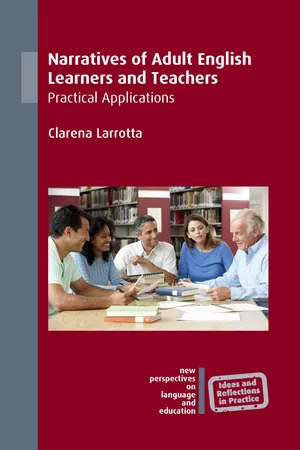
eBook - ePub
Narratives of Adult English Learners and Teachers
Practical Applications
- English
- ePUB (mobile friendly)
- Available on iOS & Android
eBook - ePub
About this book
Information
Topic
EducationSubtopic
Adult Education1Introduction and Supporting Theories
Narratives of ESL Learners and Teachers
The focus of the book is on language pedagogy useful to graduate students and practitioners in the fields of adult education, adult literacy and English as a Second Language (ESL), regardless of their teaching experiences (e.g. novice, experienced teachers). Specific sections of the book address relevant topics such as setting learning goals, assisting students to enjoy reading, forming strategies to move students from oral language to print, boosting adult learners’ confidence and ESL student motivations to mention a few. Through storytelling, the author presents her point of view and invites the reader to reflect on their beliefs and practices regarding adult learning and teaching.
What sets this book apart is its overarching focus on language pedagogy and a humanistic approach to adult literacy development and ESL learning and teaching. The book presents language as functional and interactive, as a tool to express ideas and accomplish goals for having a satisfying life. Through language individuals create and maintain relationships with other human beings, even if they do not share the same point of view on a topic. Thus, language serves as a tool to develop human capital and participate in democracy. Through language, people negotiate and request services and express satisfaction or dissatisfaction to advocate for civil rights and human rights. When teaching a language, then, the focus should be on educating the whole person and envisioning the learners from an assets point of view. In this way, the focus is on their strengths and talents rather than their flaws or deficiencies. Therefore, the nurturing and creation of human relationships are of crucial importance in Teaching English to Speakers of Other Languages (TESOL).
The main goal of this book is to honor the work of language learners and TESOL practitioners and to share highlights from their journeys. This book can benefit advanced undergraduate and graduate students majoring in TESOL as well as instructors and practitioners in the fields of Adult Education, Adult Literacy and English as Second or Foreign Language. When planning for the content and format of this book, the need to rely on the wisdom of adult learners and practitioners and place their learning journeys at the center of this book became evident. The narratives come from actual English learners, teacher-learners and practitioners with whom I have collaborated on several projects. The data utilized to build the different case studies presented in this book come from different research projects examining literacy and TESOL instruction and learning.
Book Content
Each chapter has the same sections, starting with an, explanation of main concepts, stories narrated by learners and teachers, conclusion, recommendations for practice, and discussion questions. An appendix with relevant terms and acronyms utilized throughout the book appears at the end followed by a list of references cited in the different chapters. The theory supporting the case studies is interwoven in the content of each chapter to illustrate the connection between theory (abstract knowledge) and practical application (classroom). In addition, the cases are split into two parts: Part 1 presents learners’ voices in Chapters 2–5; and Part 2 presents teachers’ voices in Chapters 6–9. None of the names of people or places that appear in this book are real names. This conforms to the confidentiality agreement between the researcher and the participants in the narratives.
Learners’ voices
Chapter 2 highlights Alberto, who struggled with reading because he believed it was boring and made him fall asleep. His story illustrates the point that adults can, in fact, discover that reading is an integral but fun part of an adult’s daily routine. Chapter 3 describes the case of Doña Inés and provides suggestions on how to assist adults with low literacy skills to engage in learning and participation. Chapter 4 addresses the case of a group of parents learning by using intergenerational reading practices. It illustrates how these practices can boost adults’ confidence to use English to communicate in public. Chapter 5 presents two case studies documenting adult learners’ motivations for attending ESL classes through community-based programs. Their narratives reveal motivations unique to their identities and individual stories as immigrants and learners.
Teachers’ voices
Through narratives provided by Janet, Sarah and Mary, Chapter 6 describes the work of two religious organizations offering ESL and literacy instruction to immigrants. The chapter describes an ESL program housed at a Catholic Church and a federally funded refugee program run by a religious organization. Chapter 7 posits public libraries as learning spaces that benefit all types of adults in the community and promote the development of literate communities. Here, Daisy, an ESL and GED (General Education Development) instructor, librarian and coordinator of adult education programs at a public library, shares her point of view. Chapter 8 illustrates an engaged scholarship approach to training ESOL teacher-learners. It portrays the learning experiences of ESOL teacher-learners and their reflections participating in observation, tutoring, conversation and internship as teacher-training events. Chapter 9 narrates the story of Abby, an experienced ESL instructor. It presents her work setting and a description of how she negotiates the curriculum to develop trusting and caring relationships with adult learners.
Conclusion chapter
Chapter 10 briefly summarizes the content of the different chapters and discusses the emergent themes from the case studies presented in this book. Then it addresses theoretical connections, suggestions for future research and concluding thoughts.
Conceptual Framework
More research documenting how second languages are learned/acquired, the factors that influence this process, and effective teaching practices to teach ESL and literacy to adults is still needed. Therefore, the author situates this book in a conceptual framework that views teaching and research as shaped by engaged scholarship, Freirean pedagogy, and second language acquisition theory. This framework informs the author’s beliefs that:
(1)Teaching, research, and service are interconnected practices. Constant and reciprocal collaboration for learning should be established between university instruction and the community education needs.
(2)Critical reflection and dialogue are crucial to learning and the professional socialization of ESOL teacher-learners.
(3)Second language acquisition theory serves as a lens to present the narratives of English learners and TESOL instructors as case studies worthy of consideration.
(4)L2 is both learned and acquired, but learners and teachers should center on language acquisition practices. Communication should be the focus for learning and teaching a language.
(5)Students should participate in learning activities that promote the acquisition of knowledge first-hand through projects and direct contact with the communities outside the classroom.
Engaged scholarship
Engaged scholarship requires university faculty to create a reciprocal partnership with the community. It is interdisciplinary and integrates teaching, research and service (Boyer, 1990, 1996). The practice of engaged scholarship requires a basic reconceptualization of university faculty involvement in community-based work (O’Meara & Rice, 2005). It invites faculty to make the conscious decision to look for opportunities to work with local communities, to take the students out of the classroom to apply their learning in the real world where theory becomes relevant (Boyer, 1996; Lebeau & Bennion, 2014; Udall et al., 2015). This is then a call for collaborative research, where all participants have a voice and find benefits.
Engaged scholarship entails the collaboration between academics and individuals outside the academy for the mutually beneficial exchange of knowledge and resources in a context of partnership and reciprocity (Boyer, 1996; Elwell & Bean, 2001; Lebeau & Bennion, 2014; Udall et al., 2015). More than just providing a service to the community, through engaged scholarship, university students gain knowledge and benefit from learning with and from community members such as TESOL instructors who are more experienced and their adult learners. These are learning experiences that cannot be provided by just discussing theory in the university classroom (Udall et al., 2015). The participation of non-academics enhances and broadens involvement and consideration about major social issues inside and outside the university, such as the literacy and ESL education for adults in the local communities.
Specifically, as illustrated in this book, the practice of engaged scholarship opens doors to work with community-based organizations dedicated to serving immigrants and economically disadvantaged adults and families in need of ESL and literacy instruction. In training TESOL instructors, all university courses should have at least one assignment in which they interact, learn and provide a service to the adult learners in the community. Through participation in engaged scholarship projects, graduate students acquire practical knowledge that they could simply not have access to by staying confined in the university classroom (Elwell & Bean, 2001; Udall et al., 2015). The goals should be to create, support and document possibilities for change informed by community members and their actual needs. In this way, researching partners (i.e. practitioners in the community and their learners) can inform and dictate what is best for their learning and teaching contexts.
Freirean pedagogy
Utilizing a Freirean approach to research and teaching allows focus on real issues in the lives of adult English learners and their families (Freire, 1970). In such an approach, pedagogy is a process that focuses on individual learners as they interact within a social context and within a specific community (their work environments, neighborhoods, cities, their children’s schools, etc.). In listening to the learners, the teacher learns to speak with them (Freire, 1998: 106). Through dialogue, teacher and learner engage in identifying problems, asking questions and developing strategies for transformation. Freire (1998) argued that listening is a permanent attitude on the part of those involved in dialogue and implies ‘being open to the word of the other, the gesture of the other, and the differences of the other’ (1998: 107). Thus, listening is a requirement for successful dialogue. Freire (1998) reminded educators and learners that true listening does not diminish the right to disagree, to oppose or to take a position. Thus, dialogue is a means for teachers and learners to communicate and learn from each other. They ‘can speak engagedly and passionately about their own ideas and conditions precisely because they are able to listen’ (Freire, 1998: 107). Freire envisioned learning as a never-ending activity giving purpose to human existence. He equally believed that teaching and learning are inseparable: ‘Teaching, which is really inseparable from learning, is of its very nature a joyful experience’ (Freire, 1998: 125). He described education as a ‘situation where the teacher and the students both have to be learners, both have to be cognitive subjects’ (Freire, 1987: 33). In this view, teachers and learners are required to keep an open mind and become active participants in learning.
As exemplified in this book, when teaching adult English learners and training TESOL instructors, dialogue takes the form of critical reflection and collegial conversation. The role of the teacher is that of an equal partner who engages in dialogue with learners in the spirit of democratic inquiry and solidarity (Freire, 1970). Through keeping a reflective journal and discussing learning, university students identified new learning, pointed out areas for improvement, asked questions and pondered solutions to education issues and social problems. As Freire (1970) stated, ‘The word is more than just an instrument which makes dialogue possible … Within the word we find two dimensions, reflection and action … A true word is to transform the world’ (1970: 87). The written and spoken word were the tools for the instructor, learners and practitioners to communicate with each other. In this two-way meaningful dialogue, we constructed and reconstructed reality together in the university classroom and the reflection journal served as a springboard to talk as academic individuals and as people. This dialogue was based on reflection, negotiation of ideas and communication. This practice allowed for discussion and conversation about issues selected by the teacher-learners and topics relevant to them.
Second language acquisition
Second language acquisition (SLA) is the study of how second languages are learned and the factors that influence this process (Moss & Ross-Feldman, 2003). SLA research focuses on ‘the developing knowledge and use of a language by individuals who already know at least one other language’ (Spada & Lightbown, 2010: 108). SLA is a complex process involving a wide range of factors such as the learner’s characteristics and experiences, the social and cultural environment, the structure of both L1 and L2, opportunities to practice with L2 speakers, access to form-focused instruction and constructive feedback (Lightbown & Spada, 2013: 212...
Table of contents
- Cover-Page
- Half-Title
- Series
- Title
- Copyright
- Contents
- Figures and Tables
- Acknowledgements
- 1. Introduction and Supporting Theories
- Part 1: Learners’ Voices
- Part 2: Teachers’ Voices
- Appendix
- References
- Index
Trusted by 375,005 students
Access to over 1.5 million titles for a fair monthly price.
Study more efficiently using our study tools.
Frequently asked questions
Yes, you can cancel anytime from the Subscription tab in your account settings on the Perlego website. Your subscription will stay active until the end of your current billing period. Learn how to cancel your subscription
No, books cannot be downloaded as external files, such as PDFs, for use outside of Perlego. However, you can download books within the Perlego app for offline reading on mobile or tablet. Learn how to download books offline
Perlego offers two plans: Essential and Complete
- Essential is ideal for learners and professionals who enjoy exploring a wide range of subjects. Access the Essential Library with 800,000+ trusted titles and best-sellers across business, personal growth, and the humanities. Includes unlimited reading time and Standard Read Aloud voice.
- Complete: Perfect for advanced learners and researchers needing full, unrestricted access. Unlock 1.5M+ books across hundreds of subjects, including academic and specialized titles. The Complete Plan also includes advanced features like Premium Read Aloud and Research Assistant.
We are an online textbook subscription service, where you can get access to an entire online library for less than the price of a single book per month. With over 1.5 million books across 990+ topics, we’ve got you covered! Learn about our mission
Look out for the read-aloud symbol on your next book to see if you can listen to it. The read-aloud tool reads text aloud for you, highlighting the text as it is being read. You can pause it, speed it up and slow it down. Learn more about Read Aloud
Yes! You can use the Perlego app on both iOS and Android devices to read anytime, anywhere — even offline. Perfect for commutes or when you’re on the go.
Please note we cannot support devices running on iOS 13 and Android 7 or earlier. Learn more about using the app
Please note we cannot support devices running on iOS 13 and Android 7 or earlier. Learn more about using the app
Yes, you can access Narratives of Adult English Learners and Teachers by Clarena Larrotta in PDF and/or ePUB format, as well as other popular books in Education & Adult Education. We have over 1.5 million books available in our catalogue for you to explore.