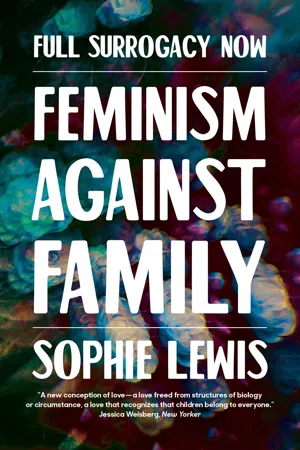
"Rooted in historical, site-based, narrative, and political accounts, Full Surrogacy Now is the seriously radical cry for full gestational justice that I long for. This kind of gestation depends on realizing the implications of knowing that we all actually, materially, make one another, and that this labor continues to be exploited, extracted, and alienated-unequally-at every turn in Capitalism and Patriarchy. Full of brilliant, generative, and also shamelessly biting critique of both bourgeois and communist tracts, feminist and otherwise, Lewis's voice is unique and bracing. I need it; it fills my whole self with reimagined possibilities for making oddkin who are not property. Lewis set out to write an immoderate, utopian, partisan, anti-authoritarian communist defense of surrogates and surrogacy in ramifying registers of meanings and practices, and she has succeeded. Lewis asks the necessary questions, 'Can we parent politically, hopefully, nonreproductively-in a comradely way?' Can we become full surrogates for and with each other? In a book full of fierce demystifications and sharp dissections of injustice masquerading as humanitarianism, nonetheless Lewis convincingly and radically affirms: 'Everywhere about me, I can see beautiful militants hell-bent on regeneration, not self-replication.'"
- Donna Haraway
- 224 pages
- English
- ePUB (mobile friendly)
- Available on iOS & Android
eBook - ePub
About this book
Information
Topic
Scienze socialiSubtopic
Storia e teoria politica1
Introduction
It is a wonder we let fetuses inside us. Unlike almost all other animals, hundreds of thousands of humans die because of their pregnancies every year, making a mockery of UN millennium goals to stop the carnage. In the United States, almost 1,000 people die while doing childbirth each year and another 65,000 “nearly die.” This situation is social, not simply “natural.” Things are like this for political and economic reasons: we made them this way.
Pregnancy undoubtedly has its pleasures; natality is unique. That is why, even as others suffer deeply from their coerced participation in pregnancy, many people excluded from the experience for whatever reason—be they cis, trans, or nonbinary—feel deeply bereft. But even so, and even in full recognition of the sense of the sublime that people experience in gestating, it is remarkable that there isn’t more consistent support for research into alleviating the problem of pregnancy.
The everyday “miracle” that transpires in pregnancy, the production of that number more than one and less than two, receives more idealizing lip-service than it does respect. Certainly, the creation of new proto-personhood in the uterus is a marvel artists have engaged for millennia (and psychoanalytic philosophers for almost a century). Most of us need no reminding that we are, each of us, the blinking, thinking, pulsating products of gestational work and its equally laborious aftermaths. Yet in 2017 a reader and thinker as compendious as Maggie Nelson can still state, semi-incredulously but with a strong case behind her, that philosophical writing about actually doing gestation constitutes an absence in culture.
What particularly fascinates me about the subject is pregnancy’s morbidity, the little-discussed ways that, biophysically speaking, gestating is an unconscionably destructive business. The basic mechanics, according to evolutionary biologist Suzanne Sadedin, have evolved in our species in a manner that can only be described as a ghastly fluke. Scientists have discovered—by experimentally putting placental cells in mouse carcasses—that the active cells of pregnancy “rampage” (unless aggressively contained) through every tissue they touch. Kathy Acker was not citing these studies when she remarked that having cancer was like having a baby, but she was unconsciously channelling their findings. The same goes for Elena Ferrante’s protagonist in The Days of Abandonment, who reports:
I was like a lump of food that my children chewed without stopping; a cud made of a living material that continually amalgamated and softened its living substance to allow two greedy bloodsuckers to nourish themselves.1
The genes that are active in embryonic development are also implicated in cancer. And that is not the only reason why pregnancy among Homo sapiens—in Sadedin’s account—perpetrates a kind of biological “bloodbath.” It is the specific, functionally rare type of placenta we have to work with—the hemochorial placenta—which determines that the entity Chikako Takeshita calls “the motherfetus” tears itself apart inside.2 Rather than simply interfacing with the gestator’s biology through a limited filter, or contenting itself with freely proffered secretions, this placenta “digests” its way into its host’s arteries, securing full access to most tissues. Mammals whose placentae don’t “breach the walls of the womb” in this way can simply abort or reabsorb unwanted fetuses at any stage of pregnancy, Sadedin notes. For them, “life goes on almost as normal during pregnancy.”3 Conversely, a human cannot rip away a placenta in the event of a change of heart—or, say, a sudden drought or outbreak of war—without risk of lethal hemorrhage. Our embryo hugely enlarges and paralyzes the wider arterial system supplying it, while at the same time elevating (hormonally) the blood pressure and sugar supply. A 2018 study found that post-natal PTSD affects at least three to four percent of birth-givers in the UK (the US percentage is likely to be far higher—especially among black women).4
No wonder philosophers have asked whether gestators are persons.5 It seems impossible that a society would let such grisly things happen on a regular basis to entities endowed with legal standing. Given the biology of hemochorial placentation, the fact that so many of us endowed with “viable” wombs are walking around in a state of physical implantability—no Pill, no IUD—ought by rights to be regarded as the most extraordinary thing. To be sure, it has been relatively straightforward in many parts of the world to stop gestating at the very beginning of the process, simply because an unremarkable—even unnoticed—miscarriage occurred, or because the gestator has had access (through a knowledgeable friend) to abortifacients. In 2008, Aliza Shvarts self-inseminated with fresh sperm and then “self-aborted,” over and over again, every month for nine months, by swallowing pills, as a kind of art project.6 I’m curious what that perverse start–stop labor experiment was like. Shvarts’s true, nondefensive thoughts on the matter are unfortunately obliterated by a wall of right-wing bellowing. Unsurprisingly, given that one would expect to feel good upon being extricated from a nonstop job one isn’t willing to do, in general the experience of termination generates feelings of relief and cared-for-ness. As Erica Millar evidences in Happy Abortions, sustained negative emotions are extremely rare in connection with having an abortion.7
Gestational Fix
Pregnancy has long been substantially techno-fixed already, when it comes to those whose lives really “matter.” Under capitalism and imperialism, safer (or, at least, medically supported) gestation has typically been the privilege of the upper classes. And the high-end care historically afforded to the rich when they gestate their own young has lately been supplemented by a “technology” that absorbs 100 percent of the damage from the consumer’s point of view: the human labor of a “gestational surrogate.” Surrogacy, as news media still report, began booming globally in 2011. Around 2016, the industry began suffering a series of setbacks: Thailand and Nepal banned surrogacy altogether for the foreseeable future, and other major hubs (India, Cambodia, and Mexico) legislated against all but “altruistic” heterosexual surrogacy arrangements. Nevertheless, there are still privately registered, profit-making “infertility clinics” on every continent, listing surrogates for hire who will remain, so they say, genetically entirely unrelated to the babies that customers carry away at the end of the process. For, just as the cannier commentators predicted, surrogacy bans do not halt but actually fuel the baby trade, rendering gestational workers far more vulnerable than before.8
Surrogacy bans uproot, isolate, and criminalize gestational workers, driving them underground and often into foreign lands, where they risk prosecution alongside their bosses and brokers, far away from their support networks. In July 2018, thirty-three pregnant Cambodians were detained and charged in Phnom Penh, together with their Chinese boss, for “human trafficking offences.”9 Separately, one Mumbai-based infertility specialist began recruiting surrogate workers from Kenya immediately after India’s Supreme Court decision against commercial and homosexual surrogacy. Through in vitro fertilization, he implants the Kenyans with embryos belonging to his gay clients. Pregnant, these contractors are flown back to Nairobi after 24 weeks’ monitoring in India. The babies are birthed in designated hospitals in Nairobi, where clients can pick them up. The doctor maintains that he has not broken Indian law, because he has not interacted with gay clients within that territory: all he has provided, technically, is IVF for Kenyan “health care” seekers. In other words, clinicians simply jump through legal loopholes by moving surrogate mothers across borders, exposing surrogate mothers to greater risks while expanding and diversifying their business partnerships worldwide.10
The trend toward commercial surrogacy does not constitute a qualitative transformation in the mode of biological reproduction that currently destroys (as those aforementioned mortality statistics show) so many adults’ lives. In fact, capitalist biotech does nothing at all to solve the problem of pregnancy per se, because that is not the problem it is addressing. It is responding exclusively to demand for genetic parenthood, to which it applies the logic of outsourcing. While the development remains uneven and tentative, it is clear that what capitalism is proposing by alienating and globalizing gestational surrogacy in this way is, as usual, an option involving moving the problem around. Pregnancy work is not so much disappearing or getting easier as crashing through various regulatory barriers onto an open market. Let the poor do the dirty work, wherever they are cheapest (or most convenient) to enroll.
And no wonder, given that the ground for such a development was already being laid as early as the late nineteenth century, when large swathes of the colonial, upper-class, frequently women-led eugenics movement in Europe and North America argued that the best way to realize pregnancy’s promise—namely, a thriving future “race” achieved through sexual “virtue” and white-supremacist “hygiene”—was for the state to economically discipline all sexual activity unconducive to that horizon.11 As good social democrats, these “feminist” progressives wanted a nation-state that was duty-bound to feed, shelter, clothe, educate, and train the gestational laborers present within its territory, and (especially) the products of that gestational labor.12 Since this was then, and remains now, a costly sounding proposition, a set of enduring ideas and policies were propagated around the turn of the century, according to which, as far as metropolitan proletarians were concerned, having babies spells financial irresponsibility and surefire ruin in and of itself—especially out of wedlock. The same discouragement applied, more or less, to non-white (Italian, Irish, Arab) immigrants on the eastern American seaboard. Lumpenproletarian populations in “the colonies” (notably India) faced more hands-on methods, including (famously) sterilization. Meanwhile, curiously, for families of the capitalist class, having babies represents a virtuous and vital investment guaranteeing their—and the very economy’s—good fortunes.
“That there is even a relationship between material well-being and childbearing is a twentieth-century, middle-class, and to some extent white belief,”13 historian Laura Briggs insists. Nevertheless, it’s been but a series of logical steps from that hegemonic notion of reproductive meritocracy to the beginnings of the pregnancy “gig economy” we can glimpse today. In unprecedentedly literal ways, people make babies for others in exchange for the money required to underwrite morally, as well as materially, their own otherwise barely justifiable baby-having. It’s not quite accurate, though, to say that the basic ideas of early eugenicist reproductive policy have resurfaced in late capitalism—or even to say that they’ve survived. Rather, as W. E. B. Du Bois lays out in Black Reconstruction in America, 1860–1880—or Dorothy Roberts in Killing the Black Body: Race, Reproduction, and the Meaning of Liberty—these interlocking logics of property and sub-humanity, privatization and punishment, form the template that organized capitalism in the first place and sustains it as a system.14 Dominant liberal-democratic discourses that hype a world of postracial values and bootstrap universality only serve to render dispossessed populations the more responsible for their trespass of being alive and having kids while black. Stratification is self-reproducing and not designed to be resolved.
It is still useful to call out contemporary iterations of eugenic common sense for their face-value incoherence; still legitimate to point out (the hypocrisy!) that even as urban working-class and black motherhood continues to come under attack, the barriers to black and working-class women’s access to contraception and abortion grow steadily more formidable. The positive “choice” to “freely invest” in having a baby is one that numerous laws are literally forcing many people to make, with dire and frequently fatal results. Obstetric care in India remains to this day among the most scant in the whole world—even though India exports and offers obstetric medical care to customers around the world—and the Indian clinic-factory is this book’s chosen reference point for this reason. Such contradictions, we know, are part and parcel of capitalist geopolitical economy, which needs populations to extinguish in the process of making others thrive. It’s not just life that is a sexually transmitted disease, as the old joke has it. Birth justice campaigners know, as indeed AIDS activists knew in the 1980s and 1990s, that it is death that sex spreads, simultaneously, in the context of for-profit health care.
However, this depressing state of affairs hasn’t ever been the whole story. From Soviet mass holiday camps for pregnant comrades, to Germany’s inventive (albeit doomed) “twilight sleep” methods— designed to completely erase the memory of labor pain—human history contains a plethora of ambitious ideologies and technological experiments for universally liberating and collectivizing childbirth. It’s admittedly an ambivalent record. Irene Lusztig, director of a beautiful 2013 archival film on this subject, has understandably harsh words for the various early-twentieth-century rest-camps and schools of childbirth she discusses. But, she suggests, you have to hand it to them—even the most wrongheaded of textbooks written a century ago at least stated the problem to be solved in uncompromising terms: “Birth injuries are so common that Nature must intend for women to be used up in the process of reproduction, just as a salmon dies after spawning.”15 Well if that’s what Nature intends, the early utopian midwives and medical reformers featured in The Motherhood Archives responded: then Nature is an ass. Why accept Nature as natural?16 If this is what childbirth is “naturally” like, they reasoned, looking about them in the maternity wards of Europe and America, then it quite obviously needs to be denatured, remade.17 Easier said than done. Pioneering norms of fertility care based on something like cyborg self-determination has turned out to be a moving target. The exceptionality and care-worthiness of gestation remains something that has to be forcibly naturalized, spliced in against the grain of a “Nature” whose fundamental indifference to death, injury, and suffering does not, paradoxically, come naturally to most of us.
Moreover, many of these efforts to emancipate humanity from gestational “Nature” have claimed the name of “Nature” for their cause, too. For instance, the turn to so-called “natural childbirth”— which earned such fiery contempt from Shulamith Firestone in 1970 for being bourgeois—more accurately stands for a regimen full of carefully stylized gestational labor hacks and artifices, a suite of mental and physical conditioning that may be billed as “intuitive” but which nevertheless take time and skill to master. Natural childbirth has never gone entirely out of fashion and is still extremely popular among diverse social classes.18 And while particular sub-doctrines of natural childbirth continue to come under well-justified fire wherever they stray into mystification, the broader free-birthing movement’s foundational critique of just-in-time capitalist obstetrics and its colonial-patriarchal history—whereby midwives, witches, and their indigenous knowledges were expelled from the gestational workplace—is hard to fault.19
Likewise, I have absolutely no quarrel with the trans-inclusive autonomist midwives and radical doulas, the ones lobbying for their work to become a guaranteed form of free health care.20 I have no quarrel with “full-spectrum” birth-work that supports people of all genders through abortion, miscarriage, fertility treatments, labor, and postpartum, often operating outside of biomedical establishments, spreading bottom-up mutual aid, disseminating methods geared toward achieving minimally (that is, suff...
Table of contents
- Cover Page
- Halftitle Page
- Title Page
- Copyright Page
- Contents
- Acknowledgments
- 1. Introduction
- 2. “But Aren’t You Against It?”
- 3. The World’s (Other) Oldest Profession
- 4. Dr. Patel Leans In
- 5. “She Did It for the Money”
- 6. Another Surrogacy Is Possible
- 7. Amniotechnics
- Note on Reproduction of Material
- Notes
- Index
Trusted by 375,005 students
Access to over 1.5 million titles for a fair monthly price.
Study more efficiently using our study tools.
Frequently asked questions
Yes, you can cancel anytime from the Subscription tab in your account settings on the Perlego website. Your subscription will stay active until the end of your current billing period. Learn how to cancel your subscription
No, books cannot be downloaded as external files, such as PDFs, for use outside of Perlego. However, you can download books within the Perlego app for offline reading on mobile or tablet. Learn how to download books offline
Perlego offers two plans: Essential and Complete
- Essential is ideal for learners and professionals who enjoy exploring a wide range of subjects. Access the Essential Library with 800,000+ trusted titles and best-sellers across business, personal growth, and the humanities. Includes unlimited reading time and Standard Read Aloud voice.
- Complete: Perfect for advanced learners and researchers needing full, unrestricted access. Unlock 1.5M+ books across hundreds of subjects, including academic and specialized titles. The Complete Plan also includes advanced features like Premium Read Aloud and Research Assistant.
We are an online textbook subscription service, where you can get access to an entire online library for less than the price of a single book per month. With over 1.5 million books across 990+ topics, we’ve got you covered! Learn about our mission
Look out for the read-aloud symbol on your next book to see if you can listen to it. The read-aloud tool reads text aloud for you, highlighting the text as it is being read. You can pause it, speed it up and slow it down. Learn more about Read Aloud
Yes! You can use the Perlego app on both iOS and Android devices to read anytime, anywhere — even offline. Perfect for commutes or when you’re on the go.
Please note we cannot support devices running on iOS 13 and Android 7 or earlier. Learn more about using the app
Please note we cannot support devices running on iOS 13 and Android 7 or earlier. Learn more about using the app
Yes, you can access Full Surrogacy Now by Sophie Lewis in PDF and/or ePUB format, as well as other popular books in Scienze sociali & Storia e teoria politica. We have over 1.5 million books available in our catalogue for you to explore.