The key to understanding technology lies not in the future--but in the past. That's the contention of Lizzie O'Shea's Future Histories, a grand tour through past and present to explore the practical--and sometimes revolutionary--possibilities of our digital age.
Searching for new ways to think about our networked world, O'Shea asks what the Paris Commune can tell us about the ethics of the Internet and finds inspiration in the revolutionary works of Thomas Paine and Frantz Fanon. She examines Elon Musk's futuristic visions only to find them mired in a musty Victorian-era utopianism. Instead of current-day capitalist visionaries, O'Shea returns us to the Romantic age of wonder, when art and science were as yet undivided, narrating the collaboration between Ada Lovelace--the brilliant daughter of Lord and Lady Byron--and polymath Charles Babbage, who together designed the world's first computer.
In our brave new world of increased surveillance, biased algorithms, and fears of job automation, O'Shea weaves a usable past we can employ in the service of emancipating our digital tomorrows.
eBook - ePub
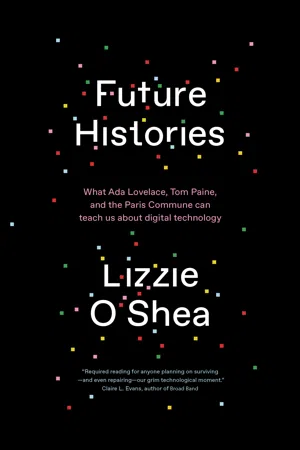
Future Histories
What Ada Lovelace, Tom Paine, and the Paris Commune Can Teach Us About Digital Technology
- 336 pages
- English
- ePUB (mobile friendly)
- Available on iOS & Android
eBook - ePub
Future Histories
What Ada Lovelace, Tom Paine, and the Paris Commune Can Teach Us About Digital Technology
About this book
Information
1
We Need a Usable Past for
a Democratic Future
A Spanish Prince’s Automaton and an
American Novelist’s Living History
Don Carlos was seventeen years old in April 1562 when he fell down the stairs and hit his head. He was the heir to the Spanish throne, studying at the university town in Alcalá de Henares. Depending on who you ask, he was either something of a lush lothario or an inbred oddball (his parents were half-siblings). One observer noted his “violent nature, his intemperate speech and his gluttony.” But the reports also indicate that he was well liked by the Spanish people, as a teenager at least. His whole life reads like the plot of a modern gothic fantasy television series: allegations of treachery, leading to solitary confinement at the hands of his father, an episode of bingeing and purging, and ultimately death, possibly by poisoning. His life was later the subject of Giuseppe Verdi’s great opera Don Carlos.
But all that drama was yet to come, when, while still a young man, engaged “possibly on an illicit errand,” as one scholar politely puts it, he tumbled down a disused flight of stairs and knocked himself out on a closed door.
In these early years of Don Carlos’s life, relations with the paterfamilias were still good, and the king was devastated by his eldest son’s misfortune. He was bedridden by his head injury. Numerous doctors flocked to his bedside, and Don Carlos was subjected to a variety of barbaric surgical procedures, including a misguided attempt to drill a hole in his skull. He eventually fell into a coma and was expected to die.
The local people were very upset by their prince’s malady. In an effort to help, they brought Don Carlos the century-old relics of a former member of the local Franciscan order of friars. Since they wanted this friar to be canonized, his body was presented to the prince in hopes of a miracle. The “desiccated corpse” was brought to the prince’s bedside, where, unable to open his eyes, he reached out to touch it, then drew his hands across his feverish face.
Suddenly Don Carlos made a remarkable recovery. By the following month, he was back to his usual self. His doctors were stunned. Reflecting on the brutality of his later life, it is unclear if his survival was a blessing or a curse. In any event, the desiccated friar was made a saint.
The prince’s own explanation for his recovery was that the figure of a man, “dressed in a Franciscan habit and carrying a small wooden cross,” came to his sickroom and assured him that he would recover. This, scholars suggest, was the inspiration for what must be one of the world’s most fascinating objects: an early automaton of a friar.
Today the automaton is held in the Smithsonian. In a history that reads more like a detective story than an academic article, this minor miracle of engineering is described by professor Elizabeth King in the following terms:
made of wood and iron, 15 inches in height. Driven by a key-wound spring, the monk walks in a square, striking his chest with his right arm, raising and lowering a small wooden cross and rosary in his left hand, turning and nodding his head, rolling his eyes, and mouthing silent obsequies. From time to time, he brings the cross to his lips and kisses it. After over 400 years, he remains in good working order.
The workings of the friar are concealed beneath his cloak, fashioned from wood, but the inner levers and cogs are beautifully made, though they were designed to be seen by no one but the maker. This shell gives the figure an air of ghostly mystery, inspiring fear and reverence in all who witness him move about without visible assistance, as if by magic.
No one really knows where the friar came from. King’s thesis is that the creator was Juanelo Turriano, an engineer who worked for King Philip. A prodigy from humble origins, he became a distinguished maker of astronomical clocks and other similar instruments, and even designed a system of waterworks for the city of Toledo. After his son’s impressive recovery, Turriano could well have been commissioned to build the contraption by King Philip in honor of the Franciscan friar, who was deemed responsible for this miracle.
King ascribes the creation of the automaton friar to what she terms an “ambitious impulse,” the ancient and abiding human desire to understand by imitation. She argues that it recalls Descartes’s thinking about the connection between body and mind—questioning whether we are driven from without or within. “The automaton forms an important chapter in the histories of philosophy and physiology,” writes King, “and, now, the modern histories of computer science and artificial intelligence.”
Objects like clocks and automatons are in many ways the predecessors to modern digital technology. You needed to be both an engineer and an artist to build these kinds of machines—technology was often entertaining, inspiring, frightening and useful, all at the same time. In this sense, the path to the modern networked computer was paved with excruciating care and dedication, as well as a little whimsy. It was a journey populated by experimentation with both functional and decorative objects, and those who work with equivalent kinds of advanced technology carry on this tradition today.
Examining this mechanical friar through twenty-first-century eyes, we recognize many themes of our history and our future, our excitement and misgivings about our current relationship with technology. The friar shows how stories from our past can shape our destiny. Our past tells us about our present—how it was just one of many possible futures claimed by those who came before. In this context, both the creation and use of technology express a kind of power relation. King writes about this, in summarizing conversations about the friar with the Smithsonian conservator, W. David Todd:
Would the measure of the monk’s power have come from the sight of a king setting him in motion? But Todd and I agree the power flows in the opposite direction, so that once the tiny man is seen to move independently, the operator’s status takes a leap, he becomes a kind of god. Either way there is a mutual transfer of authority and magic. Todd, jesting only a little, likens the possession of the monk to owning the pentium chip a couple of years ago. Who commands the highest technology possesses the highest power.
If we accept King’s hypothesis, the friar is a product of royal decree and religious fervor, serving as a tribute to divine intervention but made with a very human, highly material skill. Today the leading edges of technological development are occupied by similarly powerful individuals, who use technology to inspire loyalty and also to intimidate. The “magic” of modern technology implies that the trajectory of the digital revolution is objective and unassailable and that the people driving its development are great figures of history. Technological objects, even those that are or seem to be playful or diverting, are designed with a certain purpose in mind, and they can influence us in profound ways.
But Don Carlos’s automaton also tells us something about how technology is produced in contemporary society. The friar is a piece of craftsmanship that has lasted four centuries, whereas a comparable artifact today might be built in a Chinese factory, under appalling conditions, complete with planned obsolescence. Such a contrast demonstrates how technology is a field of creativity and skill, especially in its early, innovative stages. But when it is scaled up, it can become an industry of exploitation. The promise of technology has always relied on the meticulous efforts of people like Turriano; yet concealed in many beautiful objects that we see and handle every day is the brutal labor history of places such as Shenzen that testifies to the power of the process of commodification. Having replaced artisanal automatons with mass-produced robots, we start to treat others and feel like robots ourselves. Our current society reveres some kinds of labor and debases others, and the power of technology to improve our world and livelihood is not equally distributed.
The past lives on in memories and stories and in the objects we use and produce. The networked computer represents an exciting opportunity to reshape the world in an image of sustainable prosperity, shared collective wealth, democratized knowledge and respectful social relations. But such a world is only possible if we actively decide to build it. Central to that task is giving ordinary people the power to control how the digital revolution unfolds.
In the huddle of people attending Don Carlos, amid all the hubbub of miracles and reverence, one doctor did claim that his recovery was due to objective factors rather than divine intervention. “The cure was of natural origins,” he bravely argued,
only those [cures] are properly called miracles which are beyond the power of all natural remedies … People cured by resorting to the remedies of physicians are not said to have been cured by a miracle since the improvement in their health can be traced to those remedies.
This pert remark serves as one doctor’s message to the future, to those who would come after him. Seek evidence, speak honestly, he seems to be saying, try to shine a light of truth on the events to which you bear witness with integrity. Cause and effect exist in the real world, and humans can both observe this process and sometimes influence it with their agency. Do not be distracted by religious ardor or royal conceit.
We can still see the glimmers of this light, even four centuries later. Turriano created a marvelous and beautiful object that commemorated the recovery of Don Carlos, and he contributed to our collective technological knowledge, the legacy of which lives on in computing today. But his work was made to pay tribute to divinity rather than stand as a testament to human ingenuity and science. It is not hard to imagine how the formidable skills and creativity on display might be used to tackle some of the problems faced by humanity. But only if we take the power out of the hands of kings.
This is not a book about technology per se, nor is it about history or theory. Rather, it is an attempt to read these things together in fresh and revealing ways. The purpose is not to comprehensively or categorically define the nature of the problems we face in digital society or offer prescriptive solutions; it is to suggest ideas and identify points of conflict. Not to provide definitive or exhaustive histories of certain events or schools of thought but to start a conversation about how certain histories are critical to the task of designing our future. It is written for those who may be knowledgeable about technology but lack an understanding of radical and democratic political traditions, and for those who, while familiar with such theory and practice, are wary of or inexperienced with digital technology. My aim is to find a common language for a more sophisticated discussion about the future of both topics, which must be predicated on an agreed understanding of the past. I mean to anchor the present to the past for a specific purpose: to argue that democratic control of digital technology—building structures that give people more say and control over how digital technology is produced and developed—gives us the best chance of overcoming some of the problems we face today. It is about creating a “usable past” for digital technology, a concept that has its own little history.
Van Wyck Brooks was a writer and critic when American literature came of age in the early twentieth century, a person profoundly committed to literary practice and culture. His voice “exhort[ed] writers to meet their responsibility with courage and dignity—and with pride.” This led him, in 1918, to call for the creation of what he called a “usable past.” Speaking to his contemporaries in an intelligent and vivid essay, he outlined the need for history that creative minds could draw upon. “The present is a void,” he wrote, “and the American writer floats in that void because the past that survives in the common mind of the present is a past without living value.”
It is understandable that younger generations are eager to look forward. History can weigh like a millstone; archaic distinctions and practices can drag upon our freedom and agency. But detachment from the past has its own pitfalls. It means that the past that survives is a default genealogy, a mere reflection of the status quo, fixed and irrelevant. It loses its living value, its capacity to help the current generation actively shape a collective sense of self, leaving us isolated without a common sense of purpose or a forum to discuss these ideas. “The grey conventional mind casts its shadow backward,” Brooks observed. “But why should not the creative mind dispel that shadow with shafts of light?” For Brooks, the American literary history of the nineteenth century was important to document because it showcased the beauty, daring and distinction of American artists. It was a task to which he devoted years of his life, reading 825 books for his literary history The Flowering of New England (1936). This monumental task was part of his aspiration for “cultural centralization”—to create a communal language and bring to life a common culture and identity.
The purpose of a usable past is not simply to be a record of history. Rather, by building a shared appreciation of moments and traditions in collective history, a usable past is a method for creating the world we want to see. It is about “cutting the cloth” of history, as Brooks put it, to suit a particular agenda. It is an argument for what the future could look like, based on what kinds of traditions are worth valuing and which moments are worth remembering.
A century later, Brooks’s challenge to the American literary community retains its relevance in the age of digital technology. The digital revolution is creating experiences that are sometimes exciting, often horrifying, and routinely amazing. But present discussions about our digital future seem to float in a void. A whole set of assumptions about the past, static and dry, occupies our consciousness. It is as though digital technology sprang from nothing, invading private spaces and public life like a juggernaut. The merit of organizing our lives around screens is rarely questioned, and we wear objects that endlessly track our movements and sometimes literally get under our skin. A commitment to meritocracy saturates public debates about technology, and freedom is understood in atomized and commodified terms. There is tacit acceptance that governments and corporations will determine the evolution of digital technology. It is also widely accepted that it is easier to imagine the end of the world than the end of capitalism—an assumption that persists even during the most transformative moments in technological development.
Digital technology is treated as a force of nature, without an agenda, inevitable and unstoppable. The past that has survived in the minds of the current generation is one that reflects what has happened rather than what is possible. Society is often treated as an object, which digital technology does things to, rather than a community of people with agency and a collective desire to shape the future. “All our invention and progress seem to result in endowing material forces with intellectual life, and in stultifying human life into a material force,” declared Karl Marx. Nowhere in our current society is this observation more relevant than our personal and political engagement with digital technology.
For Brooks, the starting point was to ask: “What is important for us?” His focus was building a sense of identity among the American literary community, to find what was distinctive and valuable about the American voice. His starting point still has value. In the context of the digital age, what is important for us? What is distinctive and worthwhile about digital technology, and how can it be used to enable humanity to flourish?
Another world is possible, where society is collective and humans have agency over their digital futures. But to get there we need to create a past with living value.
In part, the motivation for this book comes from observing the ahistorical nature of discussions about technology. This has, at best, led to a benign yet thoughtless form of technological optimism. “When you give everyone a voice and give people power, the system usually ends up in a really good place,” declared Mark Zuckerberg back in the early days of Facebook, with an impressive combination of naiveté and disingenuousness. At worst, and dismayingly, this sees revolutionary moments recast as cultural shifts generated by disruptive thought leaders: history understood as the march of great entrepreneurial CEOs. This kind of thinking sees the future as defined by universal progress—rather than by a messy, contradictory struggle between different interests and forces—and never driven by the aspirations of those from below. It reduces the value of human agency to entrepreneurialism and empty consumerism.
History has a role in telling us about the present but not if we use a frame that valorizes those who currently hold positions of power. We need to reclaim the present as a cause of a different future, using history as our guide.
By stitching historical ideas and moments together and applying them to contemporary problems, it is possible to create a usable past, an agenda for an alternative digital future. In times gone by, early adopters, tinkerers and utopians may have wished for—even expected—a brighter and bolder future than where we find ourselves today, and I am keen to reclaim this possibility. This book will attempt to build bridges between technologists, activists, makers, and critical thinkers, to give shape to the “us” in the question “What is important to us?”
The histories in this book are stories of action, of revolutionary thinking but also revolutionary power in practice. They are also cautionary tales and stories of defeat, from which hope can spring eternal. “Knowing that others have desired the things we desire and have encountered the same obstacles,” Brooks argued, “would not the creative forces of this country lose a little of the hectic individualism that keeps them from uniting against their common enemies?” Such an aspiration might similarly be extended toward readers of this book. The point is to use history as a guide for organizing and pursuing digital democracy collectively. On this foundation, we can start to build alternative visions of politics, law and technology.
The phrase “digital revolution” captures something of the transformative nature of the time we find ourselves in, but rhetorically also conceals the commonalities we share with the past. For this reason, it warrants a little explanation. Technology is revolutioniz...
Table of contents
- Cover Page
- Halftitle Page
- Title Page
- Dedication
- Copyright Page
- Contents
- Acknowledgment of Country
- Preface to the Paperback Edition
- 1. We Need a Usable Past for a Democratic Future
- 2. An Internet Built around Consumption Is a Bad Place to Live
- 3. Digital Surveillance Cannot Make Us Safe
- 4. Technology Is as Biased as Its Makers
- 5. Technological Utopianism Is Dangerous
- 6. Collaborative Work Is Liberating and Effective
- 7. Digital Citizenship Is a Collective Endeavor
- 8. Automation Can Mean Less Work and More Living
- 9. We Need Digital Self-Determination, Not Just Privacy
- 10. The Digital World Is an Environment That Needs to Be Cared For
- 11. Protect the Digital Commons
- Conclusion: History Is for the Future
- Acknowledgments
- Notes
- Index
Trusted by 375,005 students
Access to over 1.5 million titles for a fair monthly price.
Study more efficiently using our study tools.
Frequently asked questions
Yes, you can cancel anytime from the Subscription tab in your account settings on the Perlego website. Your subscription will stay active until the end of your current billing period. Learn how to cancel your subscription
No, books cannot be downloaded as external files, such as PDFs, for use outside of Perlego. However, you can download books within the Perlego app for offline reading on mobile or tablet. Learn how to download books offline
Perlego offers two plans: Essential and Complete
- Essential is ideal for learners and professionals who enjoy exploring a wide range of subjects. Access the Essential Library with 800,000+ trusted titles and best-sellers across business, personal growth, and the humanities. Includes unlimited reading time and Standard Read Aloud voice.
- Complete: Perfect for advanced learners and researchers needing full, unrestricted access. Unlock 1.5M+ books across hundreds of subjects, including academic and specialized titles. The Complete Plan also includes advanced features like Premium Read Aloud and Research Assistant.
We are an online textbook subscription service, where you can get access to an entire online library for less than the price of a single book per month. With over 1.5 million books across 990+ topics, we’ve got you covered! Learn about our mission
Look out for the read-aloud symbol on your next book to see if you can listen to it. The read-aloud tool reads text aloud for you, highlighting the text as it is being read. You can pause it, speed it up and slow it down. Learn more about Read Aloud
Yes! You can use the Perlego app on both iOS and Android devices to read anytime, anywhere — even offline. Perfect for commutes or when you’re on the go.
Please note we cannot support devices running on iOS 13 and Android 7 or earlier. Learn more about using the app
Please note we cannot support devices running on iOS 13 and Android 7 or earlier. Learn more about using the app
Yes, you can access Future Histories by Lizzie O'Shea in PDF and/or ePUB format, as well as other popular books in Technology & Engineering & Cultural Policy. We have over 1.5 million books available in our catalogue for you to explore.