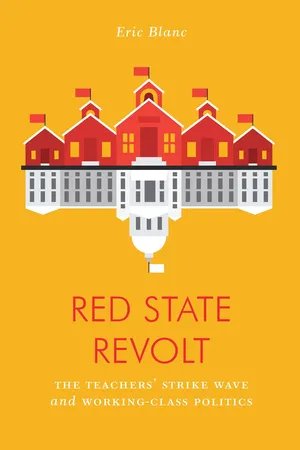
Thirteen months after Trump allegedly captured the allegiance of "the white working class," a strike wave-the first in over four decades-rocked the United States. Inspired by the wildcat victory in West Virginia, teachers in Oklahoma, Arizona, and across the country walked off their jobs and shut down their schools to demand better pay for educators, more funding for students, and an end to years of austerity.
Confounding all expectations, these working-class rebellions erupted in regions with Republican electorates, weak unions, and bans on public sector strikes. By mobilizing to take their destinies into their own hands, red state school workers posed a clear alternative to politics-as-usual. And with similar actions now gaining steam in Los Angeles, Oakland, Denver, and Virginia, there is no sign that this upsurge will be short-lived.
Red State Revolt is a compelling analysis of the emergence and development of this historic strike wave, with an eye to extracting its main strategic lessons for educators, labor organizers, and radicals across the country. A former high school teacher and longtime activist, Eric Blanc embedded himself into the rank-and-file leaderships of the walkouts, where he was given access to internal organizing meetings and secret Facebook groups inaccessible to most journalists. The result is one of the richest portraits of the labor movement to date, a story populated with the voices of school workers who are winning the fight for the soul of public education-and redrawing the political map of the country at large.
- 224 pages
- English
- ePUB (mobile friendly)
- Available on iOS & Android
eBook - ePub
About this book
Information
1
THE ROOTS OF REVOLT
In West Virginia during the strike, the capitol became flooded with national reporters. And the number one question they’d asked us was: How could something like this happen in Trump country? My responses went back and forth from confusion, to exasperation, to anger. People are desperate in West Virginia. But the national media hasn’t been paying attention to the conditions in our state that made the election of Donald Trump possible—the exact same conditions that made our strike possible.—West Virginia teacher Emily Comer
Class struggle has a remarkable way of puncturing political myths, and for those willing to learn, the recent education strikes reveal important truths about American politics. Not least of these is the superficiality of the red state/blue state paradigm.
According to Republican and Democratic leadership alike, the United States is fundamentally divided between coastal bastions of liberal cosmopolitanism and a heartland of bible-thumping conservatives. Republicans see themselves as the voice of a traditional Middle America solidly committed to God, Life, and Country above all else. For their part, Democratic elites tend to write off much of the country as racist dupes brainwashed by Fox News. Simultaneously, the Democratic Party establishment brandishes the electorate’s purported conservatism as justification for its refusal to embrace redistributionist policies such as taxing the rich to pay for health care, education, and other public services.
The 2016 presidential election seemed to vindicate these mirror images of bipartisan condescension. Despite the fact that most workers (white and otherwise) either abstained or voted for Hillary Clinton, it was largely the “white working class” that was held responsible for Trump’s election. Frenzied liberals lamented the inability of white workers to recognize their own self-interest; for instance, the Daily Kos declared, “Be happy for coal miners losing their health insurance. They’re getting exactly what they voted for.”1 Eminent liberal columnist Jonathan Chait was similarly blunt: “To watch Donald Trump and see a qualified and plausible president, you probably have some kind of mental shortcoming … What I failed to realize … is just how easily so many Republicans are duped.2
Commentators in the Nation concluded that “increasingly, class is simply not a meaningful dimension along which American politics is fought. Rather, the battle-lines are drawn around issues of racial identity and tolerance of diversity.”3 And in an essay titled “No Sympathy for the Hillbilly,” liberal op-ed columnist Frank Rich insisted that trying to win over white workers through populist economic policies was “wishful thinking” given their “blind faith” in Trump. “Let them reap the consequences for voting against their own interests,” he insisted. “Who are Democrats to stand in the way of Trump voters who used their ballots to commit assisted suicide?”4
In light of such assumptions about the cognitive abilities and political inclinations of Middle America, it should come as no surprise that the political establishment did not know what to make of the eruption of teacher walkouts in the heart of so-called Trumpland.
For their part, Fox News and the Republican Party did their best to ignore the strikes. In contrast, the representatives of official liberalism attempted periodically to provide an explanation for the walkouts. Their explanation was straightforward: Republican leaders imposed such low salaries that teachers were forced by circumstances to rise up. These work stoppages, put simply, were a spontaneous, collective response to particularly egregious conditions in a number of red states. As such, the strike wave was inherently limited in its geography (archconservative regions) and in its political goals (higher teacher salaries and the election of Democrats).
There are some grains of truth in this account. But on the whole, liberals have misidentified the key factors that made possible the 2018 education upsurge. To understand why these strikes erupted—and what they tell us about the obstacles and opportunities for labor militancy across the United States—we need to dig deeper.
Low Wages
Liberal analysts are right that the recent rebellions were in large part instigated by the dire conditions facing teachers. As sign-wielding strikers have made the nation aware, teacher pay in Arizona, Oklahoma, and West Virginia ranked, respectively, forty-seventh, forty-eighth, and forty-ninth in the nation.5
More than a few of these educators teeter on the edge of poverty. Nicole and Matt McCormick, for instance, are public school teachers in Mercer County, West Virginia, who have struggled for years to pay the rent without falling into debt. “We’ve got a constant fear of missing payments on our credit card and we’ve had real conversations about moving into a camper. We often have to feed our four kids at McDonalds, and sometimes it feels like my fault,” explained Nicole. “We’re white-knuckling ’til pay day—the worst is when students are selling something in class for a fundraiser that you can’t afford.” One of Matt’s viral Facebook posts on the eve of the walkout was a February 13 photo of his $1.14 bank balance, with the caption: “I call this portrait ‘Two days until payday on a teacher’s salary.’” Had the strike lost, the couple planned on immediately moving to another state. As Matt told me later, “We saw the strike as a last-ditch effort to stay in West Virginia.”
Many educators have to work multiple jobs to survive. Among them, Oklahoma teacher Mickey Miller’s experience is not atypical. During the day, Miller teaches at Booker T. Washington High School in Tulsa. After the school day is over, he works until seven thirty at the airport, loading and unloading bags from Delta airplanes. From there, he goes on to his third job, coaching kids at the Tulsa Soccer Club. “I have a master’s degree, and I have to work three jobs just to make ends meet,” he explained in April. “It’s very difficult to live this way.”
Each of the three states that experienced strikes in early 2018 is facing a severe shortage of teachers. Instead of attracting qualified educators by increasing pay and improving working conditions, districts have turned to hiring emergency-certified staff with no teaching degrees and little to no training. In Oklahoma, the number of such jobs for the 2017– 18 school year stood at roughly 2,000. Arizona’s shortage was even more serious, with 5,000 positions staffed by uncertified teachers.
Low wages are a central source of frustration. But contrary to the liberal account, the walkouts were not an automatic response by red state teachers to receiving the country’s worst salaries.
First of all, the crisis of teacher pay—and public education generally—is hardly limited to a few regions. Middle America isn’t a land apart; its problems are endemic to the country as a whole. To quote Arizona teacher Rebecca Garelli, “Everywhere is dealing with the same troubles. This isn’t a crisis of a few states; it’s nationwide. Teachers have been asked to do more with less for over ten years.”
When adjusted for inflation, average US teacher pay decreased by 4 percent during the ten years following the Great Recession of 2008–2009. Roughly one in five teachers has to work second jobs during the school year. Unsurprisingly, the teacher shortage is a truly national crisis. Particularly since student debt to pay for rising college costs has skyrocketed, young people are looking for employment in better-paid fields. As of fall 2017, unqualified instructors fill over 100,000 teaching spots, and 40 to 50 percent of new teachers quit within five years, making the US teacher attrition rate two to three times higher than that of countries like Finland and Singapore.6
Though it is understandable that red state strikers have highlighted their position at the bottom of the US pay scale, national salary-ranking systems actually obscure the fact that teachers receive similarly low wages across the country. On the face of it, the mean 2017 salary of $79,128 in second-ranked California appears to be almost double that of the $45,292 average in Oklahoma. Yet when adjusted for the cost of living, California drops to twenty-fifth, Oklahoma rises to thirty-fifth, and the pay gap between the two states plummets to less than $4,000. Recent studies show that most of the country actually converges in terms of real teacher pay, and that five of the bottom ten are blue states.7
Wage disparities would be even narrower if average salaries were disaggregated to particular school districts. Within many states, teacher pay—like per-pupil funding—differs dramatically between cites, as roughly half of school revenues comes from local property taxes. Astronomical housing costs in many blue cities make it next to impossible for many teachers to pay rent, let alone buy a home. Average rent in San Francisco is 700 percent more expensive than in Wichita, yet teacher pay is only 40 percent higher in the former. With 664 unfilled spots going into the 2016–17 school year, San Francisco Unified School District—employing only 3,600 teachers—came close to the 725 vacancies that West Virginia as a whole experienced last year.
Liberals overemphasize pay rankings because they misunderstand the roots of working-class struggle under capitalism. There’s a common conception that if workers are not resisting, it’s because they’re too well off. But more poverty doesn’t usually lead to more resistance. In the United States and across the world, workers with relatively better wages, job security, and working conditions have always tended to be overrepresented in labor struggles and organizations because they have greater power, resources, and confidence to resist their exploitation.
Labor grievances typically emerge not from absolute deprivation, but from relative deprivation: that is, from the gap between what working people believe they deserve and what they have. This gap is especially wide for teachers in the United States, who receive 20 to 30 percent less in pay than similarly educated workers—a far-greater disparity than in other industrialized countries. “Both me and my wife have higher education degrees,” explained Matt McCormick. “So getting paid what we do is a real slap in the face.”
The worst-off layers of the working class are rarely the most organized or most militant. Consider the differences in pay between striking teachers and other workers in their regions. The average yearly salary of a West Virginia teacher in 2016 was $45,240, while the median earnings in the state were $27,543. Disparities were similar in Arizona ($48,020 versus $30,096) and Oklahoma ($42,460 versus $29,038). As is usually the case, relatively better-off wage earners struck back first.
When it comes to working-class struggle, the idea of “the worse, the better” is neither politically, nor morally, justified. The recent work stoppages, for instance, arose once the economy started to rebound, not when conditions were at their absolute worse. Unlike in the immediate aftermath of the Great Recession, state revenue streams have improved somewhat between 2014 and 2018, providing public employees with hope that collective action could realistically deliver concessions.
And, as is generally the case with strike activity, low unemployment helped counter widespread fears that a walkout would result in mass firings. As one Oklahoma educator argued in a March 19 Facebook debate over the risks of striking: “Lose our jobs? They have no one to replace us with.”
Working and Learning Conditions
Most representatives of the status quo—including the corporate media, state governments, and the Democratic and Republican Parties—have done everything possible to frame the recent walkouts in the narrowest-possible light. By myopically emphasizing salary issues, these mainstream accounts of the struggle have largely overlooked the centrality of other social grievances in stoking collective resistance.
Opposition to the decimation of public education and the devaluation of teaching as a profession has been a central driving force of teacher resistance in red states and blue states alike. For instance, the 2012 Chicago teachers’ strike—a pivotal inspiration for radical leaders of the red state revolt—primarily concerned issues like class size, equity, standardized testing, and school closures. And in Oklahoma and Arizona, demands for increased school funding were at the very center of the 2018 walkouts. Salary demands were also decidedly secondary in West Virginia’s strike, where the movement arose primarily in response to proposed changes to the state’s public health insurance plan, the Public Employees Insurance Agency (PEIA).
It’s crucial to understand that teaching is much more than a job for many educators. They see their work as a calling—one that has been systematically undercut by politicians and bureaucrats, high-stakes testing, underfunding, and privatization. It was not mere rhetoric when strikers in each of these states chanted, “We’re doing it for the kids!” Teachers at rallies, in school meetings, and over Facebook denounced politicians for devaluing education standards by hiring uncertified and untrained individuals, cutting funding, raising class sizes, and imposing excessive standardized tests. To quote a March 19 post from Oklahoma’s main teachers’ Facebook group: “Pawnee is also in. It’s exciting to see the list [of districts agreeing to strike] get bigger! Fighting for the education of our students and the respect for the profession [fist emoji].”
Like most labor battles, these strikes were about winning respect as much as anything else. More often than not, fights around pay are simultaneously struggles for basic human dignity; economic demands are rarely only economic. In the words of one irate West Virginian teacher on the eve of the walkout, “We are human beings.” Azareen Mullins of Charleston, West Virginia, described the cynicism that came from years of work without respect, explaining how “most new teachers at [her] school don’t last through the fifth year.”
Mullins spoke for many teachers when she explained that there was also a gendered dimension to the strike: “One of the reasons that they have been able to keep our pay levels so low is that it’s a female profession, largely. If it were a male-dominated profession, I don’t think we’d be treated in the same manner. Looking in the sea of faces during the strike, it was mostly women. A lot of the activism we’ve seen is not necessarily feminist, but it’s female driven.”
What used to be treated as a middle-class profession has been steadily subjected to job intensification and deskilling. Studies consistently show that the most common reason for leaving teaching is not the lack of pay, but rather excessive testing and accountability measures, followed by dissatisfaction with school administration. For decades, the classroom autonomy and creativity that teachers need to provide quality education to students has been under steady bipartisan attack. In a recent Gallup poll, 93 percent of teachers affirmed that they should have “a great deal” or “a lot” of input in school decisions. Only 31 percent, however, feel that they have it.
Increased work for stagnating pay has become the norm in teaching, as it has in so many other sectors of the economy. Student enrollment has risen by close to 1.5 million in the decade following the recession, yet in 2017 there were 135,000 fewer public school employees than in 2008. Broader cuts to public services have put increased responsibilities on educators to act as de facto counselors, mental health advisors, and food pantry staff for students in need.
“Our teachers are so taken for granted, but they do so much for us, they really go out of their way to help,” noted Morgan Smith, a high school junior from Seth, West Virginia. “If students are going hungry, they’ll always try to help get them a bag full of food to take home.”
Charleston teacher Emily Comer described this dynamic from an educators’ vantage point: “As teachers we have a unique window into the entire economy of our communities, so every day we see the effects of the opioid crisis, poverty, students experiencing trauma. The worse the economy gets, the harder my job gets; it’s more stressful with more emotional burden on the teachers in my building, who are mostly women.”
Demands on behalf of students were especially prominent in Oklahoma and Arizona, where calls to restore school funding were by far the most central nonwage demands of the strikes. A decade of harsh austerity has devastated their already-underfunded public education systems. Between 2008 and 2017, per-pupil instructional funding was cut by 28 percent in Oklahoma and 14 percent in Arizona, ranking them as the forty-sixth and forty-ninth lowest-funded states in 2017. Like decreasing pay, these rollbacks are part of a national trend: twenty-nine states provided less per pupil in 2017 than they did in 2008.8
Due to budget cuts, many districts in Arizona and Oklahoma have been forced to reduce the school week to four days—in the latter, 18 percent of districts now follow this condensed schedule. Class sizes are often enormous, while textbooks are scarce and scandalously out of date. Innumerable arts, language, and sports programs have been eliminated. Broken desks, crumbling ceilings, chair shortages, and rodent infestations have become normal. For Christy Cox—a middle school teacher in Norman, Oklahoma, who has had to work the night shift at Chili’s to supplement her low wages—reversing these school cuts was her main motivation to walk out: “The kids aren’t getting what they need. It’s really crazy. Though the media doesn’t talk about this as much as salaries, I feel that funding our schools is the primary issue.”
Far from being inevitable, today’s funding crisis ...
Table of contents
- Cover Page
- Halftitle Page
- Title Page
- Copyright Page
- Contents
- Introduction
- 1. The Roots of Revolt
- 2. The Power of Strikes
- 3. The Militant Minority
- Epilogue: Looking Ahead
- Acknowledgements
- Notes
Trusted by 375,005 students
Access to over 1.5 million titles for a fair monthly price.
Study more efficiently using our study tools.
Frequently asked questions
Yes, you can cancel anytime from the Subscription tab in your account settings on the Perlego website. Your subscription will stay active until the end of your current billing period. Learn how to cancel your subscription
No, books cannot be downloaded as external files, such as PDFs, for use outside of Perlego. However, you can download books within the Perlego app for offline reading on mobile or tablet. Learn how to download books offline
Perlego offers two plans: Essential and Complete
- Essential is ideal for learners and professionals who enjoy exploring a wide range of subjects. Access the Essential Library with 800,000+ trusted titles and best-sellers across business, personal growth, and the humanities. Includes unlimited reading time and Standard Read Aloud voice.
- Complete: Perfect for advanced learners and researchers needing full, unrestricted access. Unlock 1.5M+ books across hundreds of subjects, including academic and specialized titles. The Complete Plan also includes advanced features like Premium Read Aloud and Research Assistant.
We are an online textbook subscription service, where you can get access to an entire online library for less than the price of a single book per month. With over 1.5 million books across 990+ topics, we’ve got you covered! Learn about our mission
Look out for the read-aloud symbol on your next book to see if you can listen to it. The read-aloud tool reads text aloud for you, highlighting the text as it is being read. You can pause it, speed it up and slow it down. Learn more about Read Aloud
Yes! You can use the Perlego app on both iOS and Android devices to read anytime, anywhere — even offline. Perfect for commutes or when you’re on the go.
Please note we cannot support devices running on iOS 13 and Android 7 or earlier. Learn more about using the app
Please note we cannot support devices running on iOS 13 and Android 7 or earlier. Learn more about using the app
Yes, you can access Red State Revolt by Eric Blanc in PDF and/or ePUB format, as well as other popular books in Politique et relations internationales & Relations de travail et relations industrielles. We have over 1.5 million books available in our catalogue for you to explore.