The success of Jeremy Corbyn's left-led Labour Party and Bernie Sanders's 2016 presidential campaign revived a political idea many had thought dead. But what, exactly, is socialism? And what would a socialist system look like today?
In The Socialist Manifesto, Bhaskar Sunkara, editor of Jacobin magazine, argues that socialism offers the means to achieve economic equality, and also to fight other forms of oppression, including racism and sexism. The ultimate goal is not Soviet-style planning, but to win rights to healthcare, education, and housing and to create new democratic institutions in workplaces and communities. The book both explores socialism's history and presents a realistic vision for its future. A primer on socialism for the 21st century, this is a book for anyone seeking an end to the vast inequities of our age.
eBook - ePub
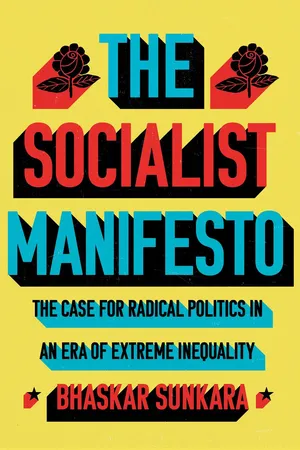
The Socialist Manifesto
The Case for Radical Politics in an Era of Extreme Inequality
- 288 pages
- English
- ePUB (mobile friendly)
- Available on iOS & Android
eBook - ePub
The Socialist Manifesto
The Case for Radical Politics in an Era of Extreme Inequality
About this book
Information
PART I
TWO
GRAVEDIGGERS
CAPITALISM SEEMS LIKE our destiny. Ever since we started beating animals to death with stones, we’ve been trading their furs. Adam Smith wrote about humanity’s “propensity to truck, barter, and exchange one thing for another.” We’ve been doing that in markets for millennia.
Have the seeds of capitalism always existed, not just in our societies but in our souls? A close look at the system’s rise reveals something else. Namely, that it was an accident.
In most accounts, capitalism appeared sometime between the fourteenth and sixteenth centuries, as our tendency to seek market opportunities finally saw people begin to break free of the shackles of feudalism, and as Florence, Venice, and other disruptive city-states traded and innovated Europe out of the muck of the Middle Ages. But this story isn’t right. Capitalism didn’t come about because markets grew to a certain point. Instead, what we understand as capitalism resulted from a societal shift, as we went from using markets from time to time to producing for the market as our all-consuming task.1
And capitalism didn’t start in the grand cities of the Italian Renaissance, but in some soggy fields on a backward island. England, by virtue of a few distinctive facts about its agriculture, became the world’s greatest power and later the first home of the industrial proletariat whom Marx and generations of socialists placed their faith in.2
Before capitalism, feudalism was the dominant system across much of the world. Under it, people were divided between the majority who worked the land to survive and the small minority who appropriated the majority’s labor through political coercion. Peasants had access to their own land, thus access to the means of their survival. However, lords used laws and force of arms to extract a portion of their yield. With these proceeds they purchased luxuries the producers couldn’t afford and expanded their military power. This helped them not only cement their standing in relation to other lords and their realm’s monarch but also fend off peasant revolt. The system didn’t encourage growth or innovation—peasants knew that if they produced more for exchange, much of it would go to their lords. They also mostly grew a variety of subsistence crops, rather than specializing in a cash crop.3
Feudalism faced periodic demographic crises, none more significant than the Black Death, which ravaged Eurasia in the 1300s. As much as 20 percent of the world’s population perished, and close to half of all people in Europe. As soon as it recovered, the continent plunged into warfare and revolt.4
The ruling class reasserted its control in Eastern Europe, where peasants had their autonomy stripped through an even more extreme system of feudalism, called serfdom, which by the mid-1600s bound them to estates and criminalized flight. In France, by contrast, the peasants managed to secure de facto ownership of their land and gave less of their yields to lords. The French lords themselves increasingly became functionaries of a centralized, absolutist state.
A middle ground prevailed in England. Peasants stopped their ruling class from extracting a greater surplus from them through brute force, but they failed to win legal land rights. English lords, searching for new ways to produce surpluses beyond exploiting the depleted peasantry, laid the groundwork for a shift from peasant-proprietor production to a tenant system. Tenants received one- or two-year leases and had incentives to be ever more productive, since they kept all the surplus after their rent was paid. Landlords had every reason to support these developments, which allowed them to create a market for land leases (the more productive the farmers, the higher the leases could go). Tenant farmers were compelled by the market to maximize production in a way peasants weren’t. These farmers, in turn, began hiring landless peasants and others as wage laborers.
It may sound like a small shift, but in fact it was an epochal transformation. More and more land in England came under this system. The process created a highly productive agriculture sector able to sustain a large population not engaged in farming. It also meant that there was a majority without property that could be essentially forced into wage labor and become a market for cheap consumer goods.5
For the first time in history, a society became subordinated to markets and elites ruled by, as Karl Marx put it, “the dull compulsion of economic relations” rather than political coercion. There had been markets before, indeed going back thousands of years, but early modern England was the world’s first market society. The old customs and obligations that held people together cracked, as did the stability that hereditary access to land and communal rights offered. Most people resisted their conversion to wage laborers, preferring even vagrancy to the odd new way of life. The state tried to cut off other avenues of survival by banning poaching, hunting, fishing, and foraging from formerly common lands. The 1744 Vagrancy Act offered stern punishment for those “who refused to work for the usual and common wages.” A series of Enclosure Acts privatized communal property, further eroding the possibility of living off the land.6
Spurred by the accident of capitalism, the English population increased sevenfold between 1520 and 1850, and the proletariat’s number multiplied by twenty-three. The losers in this process would in time be transformed into an industrial working class with incredible latent power.7
OTHER COUNTRIES SOON began to emulate England’s astonishing productivity increases. But it still had tremendous advantages over its competitors.
Even before the Industrial Revolution, England was home to major technological advances. Newcomen’s steam engine revolutionized mining, and in 1721 Lombe’s silk mill—Britain’s first factory—foreshadowed the radical shifts to come. The 1780s witnessed the start of what became known as the Industrial Revolution. New manufacturing methods emerged. Starting with mechanized spinning, the textile industry was one of the first to be transformed, processing raw cotton harvested by the Americas’ slaves. Eventually, hand production in other sectors gave way to machines.8
That Britain was at the helm of industrialization was never in doubt—in 1800 it produced ten million tons of coal, while its nearest rival, France, produced only one million. Even before the Industrial Revolution, more than half of Britain’s population was engaged in labor other than agriculture, but it took several more decades for the landscape to be truly transformed by railroads, steamships, and heavy industry. Capitalists used the new technologies to create great factories that required a disciplined, centralized workforce.9
But the would-be urban proletariat had to be lured to cities first. Fortunately for the capitalists, the agricultural revolution and consequent population boom left many in poverty. Fleeing the countryside for the city was one way out. Wage labor was just as unappealing for them as it was for the old peasantry, but the impoverished had little chance of survival otherwise. They were joined in the new factories by Irish immigrants fleeing the devastating Great Famine.
Once in cities workers had to be radically retrained. The capitalist clock was nothing like the seasonal labor many were used to in the countryside or the less methodical pace in artisanal workshops. Harsh discipline and low wages remolded humans—many of them women and children—into creatures who did little but labor. When not chained to machines for twelve-hour shifts, they lived amid smog and dust in cramped, disease-filled quarters.10
Visiting mid-nineteenth-century Manchester, a center of English industry, the French sociologist Alexis de Tocqueville remarked, “Here humanity attains its most complete development and its most brutish, here civilization works its miracles and civilized man is turned almost into a savage.” Around the same time, Friedrich Engels described an English capitalist (decent and respectful, a good husband with private virtues) who listened politely to complaints about workers’ conditions before replying, “And yet there is a great deal of money made here.”11
Engels was a figure every bit as remarkable as his famous collaborator, Karl Marx. He was born in 1820 to a wealthy merchant family and at seventeen was sent to Bremen—one of Germany’s largest commercial cities—to work as a business clerk. Engels rebelled against his father, a “fanatical and despotic” textile manufacturer, and sought to free himself through radical philosophy. When he later served in the Artillery Guards of Berlin, Engels proved to be a terrible soldier but a sharp and energetic mind. In the city’s beer halls, he associated with a rambunctious group of Young Hegelians and was drawn to a kind of democratic republicanism, Jacobin (which is to say, radical) in its spirit.12
His father endeavored to cure him of his political sentiments by condemning Friedrich to middle management at a textile mill he owned in Manchester. The city had recently risen to prominence as a hub of the Industrial Revolution. Without schooling or access to basic sanitation, the workers attracted to Manchester feared losing their jobs, knowing that utter destitution was never far away. Little of the great wealth they helped create went to them. For his part, Engels saw them as destined for something greater than poverty.13
From 1842 to 1844, he investigated firsthand the nature of capitalist production by day and at night explored the city’s underbelly. He “forsook the company and the dinner-parties, the port-wine and champagne of the middle-classes” and made genuine connections with workers by discussing their grievances and acting in solidarity with their struggles.14
Engels lived a double life in the sense that he had fine lodgings in a nice part of town but spent most of his time in rented rooms in working-class districts. His allegiances, however, were never in doubt. In Manchester, Engels met and fell in love with an Irish woman, Mary Burns, who had been doing factory work since she was a small child. Mary and other friends were his guides to the city’s south side, where tens of thousands of Irish workers lived, and to other neighborhoods few other bourgeois people even set foot in.
At just twenty-four, Engels wrote The Condition of the Working Class in England. The bland title did not convey that it was a work of both insight and anger: Even more than Charles Dickens, Benjamin Disraeli, and other social critics of the time, Engels captured the life of the industrial proletariat. He described a London slum’s living quarters, where “filth and tottering ruin surpass all description” and “no doors are needed, there being nothing to steal.” He wrote of garbage and ash, foul liquids oozing on the street, and residents “losing daily more and more of their power to resist the demoralizing influence of want, filth, and evil surroundings.” A clearly outraged Engels reminded readers that all this was taking place in “the richest city of God’s earth.” The same barbarity was evident in Liverpool, where forty-five thousand people lived packed into fewer than eight thousand badly ventilated cellars, and in the overwhelmingly working-class Glasgow. But the most vivid passages in the book concerned the horrors of Manchester, whose three hundred fifty thousand working people were “robbed of all humanity, degraded, reduced morally and physically to bestiality.” Inside the factory that made his family rich labored “women made unfit for childbearing, children deformed, men enfeebled, limbs crushed, whole generations wrecked, afflicted with disease and infirmity.”15
And yet Engels thought the stunted, oppressed class he came to know could have great political power. Not all workers were passive in the face of poverty and abuse. “Luddites,” the machine-breakers maligned in the popular imagination, fought against the acceleration of work, in the recognition that technological advance didn’t mean progress for them. In 1830, agricultural workers in Kent destroyed grain threshers and sent letters to local elites demanding wage increases under the ominous pseudonym “Captain Swing.” Less provocative but even more threatening to capitalists were early efforts at trade unionism and Chartism, a movement that arose in 1838 and sparked struggle for universal suffrage. Unrest simmered across much of Britain and was brutally put down by state authorities.
In January 1851, the Economist, a magazine founded to promote free trade, rhapsodized that it was “a happiness and a privilege to have had our lot cast in the first fifty years of this century,” a period that had “witnessed a leap forward in all the elements of material well-being such as neither scientific vision nor poetic fancy ever pictured.” The periodical’s assessment of the Industrial Revolution was partially true. But capitalism, that accident of history, had conjured a dangerous combination: immense, lucrative industries and a deprived and discontented class of people locked within them. This was the reality in which Marxist theory was first constructed.16
JORDAN AND PIPPEN, Sonny and Cher, Marx and Engels. One of history’s great partnerships was forged with a week of drinking and conversation in Paris. Like Engels, as a teenager Karl Marx wanted nothing more than to escape the boredom and conservatism of the Rhineland. He did have the advantage of a liberal father, who only offered mild rebukes of his brilliant son’s dueling and boozing. Though respected by his peers, Marx kept radical company at university, attracting the attention of Prussian authorities and sinking his chances at an academic career. He turned elsewhere, marrying the rebellious aristocrat Jenny von Westphalen and traveling to Paris to pursue a career in journalism.
Marx was fortunate enough to meet Engels in the French capital. Through his new friend he learned about the realities of industrial capitalism and shifted his attention away from philosophy and toward political economy. Even more important, Engels was willing to be his benefactor as he pursued writing and politics. Kicked out of Paris for their writings, they lived in Brussels between 1845 and 1848, where they joined the Communist League and organized German-speaking workers. They also continued quarreling with more prominent radicals, including Karl Grün, Pierre-Joseph Proudhon, Wilhelm Weitling, and the followers of Louis Auguste Blanqui. Marx and Engels consistently advocated for a democratic politics, driven by the mass of workers themselves, to the point that the day’s insurrectionists could call them moderates. Their talents, however, still commanded respect, and the pair was commissioned by the Communist League to write The Communist Manifesto, which was published on the eve of the 1848 Revolutions.
The final draft drew on the ideas of both men, but it was composed entirely by Marx. The bourgeoisie, the Manifesto argued, “has been the first to show what man’s activity can bring about. It has accomplished wonders far surpassing Egyptian pyramids, Roman aqueducts, and Gothic cathedrals; it has conducted expeditions that put in the shade all former Exoduses of nations and crusades.” Driven to expand and find new markets, the capitalists described by Marx are revolutionaries, dissolving “all fixed, fast-frozen relations, with their train of ancient and venerable prejudices and opinions.” (It’s a better description, perhaps, of what capitalism has accomplished by 2018 than of its record in 1848.)
For all their wonder at these new developments, Marx and Engels claimed that the system’s contradictions were only mounting as it matured. Along with modern industry, the bourgeoisie produced “its own grave diggers”—the proletariat. These workers had a reason to overthrow capitalism and replace it with a production system governed in their interests.
Though it has been debated and scrutinized like no other work since the Bible, The Communist Manifesto was a short document written on the eve of an international revolution to popularize a political program. Its most important legacy was in laying out definitions of capitalism and communism (“an association in which the free development of each is the condition for the free development of all”) and describing the working-class agent at the heart of future transformations. Prior socialisms had embraced the underclass, sought the philanthropy of elites, crafted utopian schemes, or gazed backward to the agrarian past. Marx and Engels instead proposed galloping forward alongside modernity.
Marx and Engels hoped that the Revolutions of 1848 would be “the immediate prelude to the proletarian revolution.” Unrest had started in France but quickly spread to Germany, then Italy, Hungary, and a half dozen other European countries. The contagion even reached Colombia and Brazil. But the “specter of communism” wasn’t haunting the capitalist world—radical republicanism was. Workers, artisans, and even some peasants demanded reforms such as minimum wages, suffrage, and state...
Table of contents
- Cover Page
- Halftitle Page
- Title Page
- Copyright Page
- Dedication
- Contents
- Preface
- One: A Day in the Life of a Socialist Citizen
- Part I
- Part II
- Acknowledgments
- Notes
- Index
Trusted by 375,005 students
Access to over 1.5 million titles for a fair monthly price.
Study more efficiently using our study tools.
Frequently asked questions
Yes, you can cancel anytime from the Subscription tab in your account settings on the Perlego website. Your subscription will stay active until the end of your current billing period. Learn how to cancel your subscription
No, books cannot be downloaded as external files, such as PDFs, for use outside of Perlego. However, you can download books within the Perlego app for offline reading on mobile or tablet. Learn how to download books offline
Perlego offers two plans: Essential and Complete
- Essential is ideal for learners and professionals who enjoy exploring a wide range of subjects. Access the Essential Library with 800,000+ trusted titles and best-sellers across business, personal growth, and the humanities. Includes unlimited reading time and Standard Read Aloud voice.
- Complete: Perfect for advanced learners and researchers needing full, unrestricted access. Unlock 1.5M+ books across hundreds of subjects, including academic and specialized titles. The Complete Plan also includes advanced features like Premium Read Aloud and Research Assistant.
We are an online textbook subscription service, where you can get access to an entire online library for less than the price of a single book per month. With over 1.5 million books across 990+ topics, we’ve got you covered! Learn about our mission
Look out for the read-aloud symbol on your next book to see if you can listen to it. The read-aloud tool reads text aloud for you, highlighting the text as it is being read. You can pause it, speed it up and slow it down. Learn more about Read Aloud
Yes! You can use the Perlego app on both iOS and Android devices to read anytime, anywhere — even offline. Perfect for commutes or when you’re on the go.
Please note we cannot support devices running on iOS 13 and Android 7 or earlier. Learn more about using the app
Please note we cannot support devices running on iOS 13 and Android 7 or earlier. Learn more about using the app
Yes, you can access The Socialist Manifesto by Bhaskar Sunkara in PDF and/or ePUB format, as well as other popular books in Politics & International Relations & Communism, Post-Communism & Socialism. We have over 1.5 million books available in our catalogue for you to explore.