The outbreak of the Korean War in June 1950 took the American military by surprise. Rushing to respond, the US and its allies developed a selective overflight program to gather intelligence. Silent Warriors, Incredible Courage is a history of the Cold War overflights of the Soviet Union, its allies, and the People's Republic of China, based on extensive interviews with dozens of pilots who flew these dangerous missions.
In 1954 the number of flights expanded, and the highly classified SENSINT program was born. Soon, American RB-45C, RB-47E/H, RF-100s, and various versions of the RB-57 were in the air on an almost constant basis, providing the president and military leadership with hard facts about enemy capabilities and intentions. Eventually the SENSINT program was replaced by the high-flying U-2 spy plane. The U-2 overflights removed the mysteries of Soviet military power. These flights remained active until 1960 when a U-2 was shot down by Russian missiles, leading to the end of the program. Shortly thereafter planes were replaced by spy satellites.
The overflights were so highly classified that no one, planner or participant, was allowed to talk about them—and no one did, until the overflight program and its pictorial record was declassified in the 1990s. Through extensive research of existing literature on the overflights and interviews conducted by Wolfgang W. E. Samuel, this book reveals the story of the entire overflight program through the eyes of the pilots and crew who flew the planes. Samuel's account tells the stories of American heroes who risked their lives—and sometimes lost them—to protect their country.
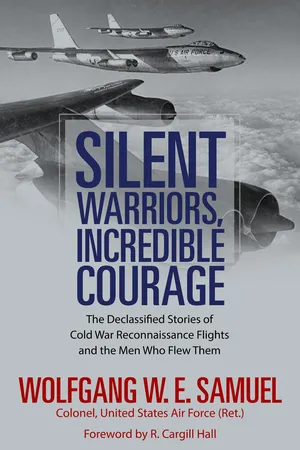
eBook - ePub
Silent Warriors, Incredible Courage
The Declassified Stories of Cold War Reconnaissance Flights and the Men Who Flew Them
- 312 pages
- English
- ePUB (mobile friendly)
- Available on iOS & Android
eBook - ePub
Silent Warriors, Incredible Courage
The Declassified Stories of Cold War Reconnaissance Flights and the Men Who Flew Them
About this book
Information
THE RB-57A-1 HEART THROB: A CHALLENGING PLANE TO FLY (1955–1956)
Ike was very cautious, but he was so intent to gain information on Soviet missile development that he approved a joint CIA/RAF operation in 1955. A stripped down Canberra flew at 55,000 feet, and photographed the secret test facility at Kapustin Yar. The Canberra was hit by ground fire and barely made it back to base. Years later, the CIA concluded that the operation had indeed been compromised by Kim Philby, who was a mole for the KGB.
—Ben Rich and Leo Janos, Skunk Works
Louis J. Picciano Jr. was one of a small group of RB-57A-1 flyers, including Joe Guthrie, Jim Bryant, and “Pappy” Hines, based at Yokota Air Base, Japan, a perennial reconnaissance hub for the US Air Force, a base from which in later years I flew many PARPRO missions in RB-47H reconnaissance aircraft. The RB-57A-1 Heart Throb was a modification of the B-57A, requiring 110 major modifications of the original British Canberra bomber to turn it into an RB-57A-1—and that didn’t mean that all of its peculiarities had been discovered or fixed. Lou Picciano and his fellow aviators rose to the challenge, but at times it was a close thing as each and every one of the four discovered.
“I became involved in the reconnaissance business before I even knew what the word meant,” recalled Lou Picciano in 2001 at the Early Cold War Overflights Symposium at DIA Headquarters in Washington DC. “I was just a few years out of the aviation cadet program in 1951, assigned to a ferrying squadron in Amarillo, Texas, flying C-119s around the world. I had a good squadron commander who ask for volunteers to ferry jet-powered B-57s. I was sent to San Antonio for five rides in the T-33 jet trainer to see if I was ‘adaptable for jets.’ When I tested well, I was sent to Shaw Air Force Base in South Carolina. Bill Gafford, who eventually led the Heart Throb contingent to Europe, was my B-57B instructor. It took several months to check out in the aircraft because of a low in commission rate. I finally finished and ended up back in Amarillo ferrying B/RB-57s from the Martin Company Middle River plant in Maryland to Robins Air Force Base in Georgia.
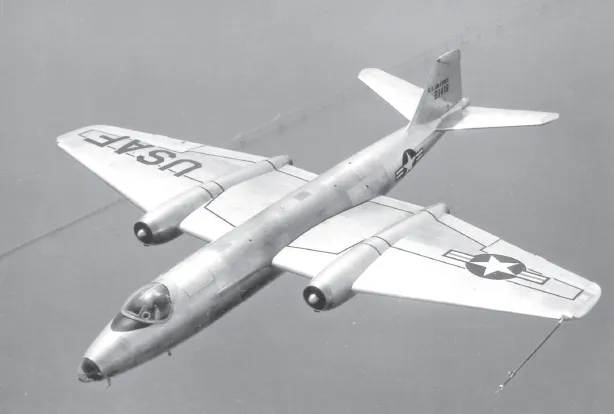
A Royal Air Force Canberra Mark 2, one of two Canberras delivered to the Martin company, bearing USAF insignia, left Northern Ireland on February 20, 1951, for Gander, Newfoundland, and landed in Baltimore on February 21. This was the first jet aircraft to complete an unrefueled flight across the Atlantic Ocean. On March 2, 1951, the air staff directed production of the B-57, eventually building a total of 403 of all models.34
“One day while at the Martin plant I ran into Bill Gafford again. ‘What are you doing up here?’ I asked him. Aren’t you supposed to be down at Shaw?’ He was evasive and said he couldn’t talk about it. I asked him if he would be interested in me joining his unit, whatever it was they were doing. He said, ‘Yes.’ Then told me that his unit would move to Europe and I might enjoy the assignment. I asked him to drop my name in the hat. Two weeks later I received orders to go to Wright-Patterson Air Force Base in Ohio, where I met Bill Gafford and Joe Guthrie. Gafford told me that there had been a mix-up and he couldn’t take me with him to Europe; instead, he said, Guthrie and I would be going to Japan. At Wright-Patterson we were measured for our partial pressure suits before departing again for Robins Air Force Base to pick up four sleek-looking RB-57A-1s. I still did not know what sort of a mission I had volunteered for. As I inspected the aircraft I could see they had no bomb bays, but they had little windows underneath. Probably for cameras, I figured. We flew all four to Hamilton Air Force Base in California, where we sat for quite some time waiting for favorable winds. Our names were painted on the airplanes. I was a lieutenant at the time, the other three were captains. You could see our names on the aircraft from a long way off.
“On August 25, 1955, we took off from Hamilton for Hawaii, then on to Johnson Island. I was Guthrie’s wingman, and next to me was another pilot, ‘Pappy’ Hines. Pappy was on Jim Bryant’s wing to the right of Guthrie. After we landed at Johnson Air Base, Guthrie told me he wanted me on his right wing in a formation takeoff. I was stunned. Because I had not flown in formation since training as an aviation cadet. I had never made a formation takeoff. While Jim Bryant and Joe Guthrie planned the next leg of our flight to Kwajalein and Guam, Pappy and I sat in the corner smoking. I think I had two cigarettes in my mouth at once. Nervously I asked Pappy, ‘Can you give me any tips on a formation takeoff?’ ‘Once your power gets stabilized,’ he replied, ‘make small throttle movements and stay close to Joel. You absolutely do not want to go off the right side of the runway and roll up in a fireball.’ I quickly put another cigarette in my mouth. I only had eight hundred hours flying time, total. Didn’t feel I was really up to snuff for this maneuver. As it turned out, the formation takeoff went great.
“After Pappy arrived at Yokota Air Base after his engine change in Kwajalein, we realized that none of us knew anything about reconnaissance. So we began ground school training. I still remember the formula: focal length over altitude equals scale. Once we had that information, we had to compute how much film it would take to cover the target. It was a good school and taught us most of the tricks of the trade. While still learning the nuts and bolts of aerial reconnaissance, Joe Guthrie would kick us out onto the tarmac to fly our planes. Every couple of weeks we would have to struggle into our suits and fly a mission we had worked out in reconnaissance school. I remember the mission Joe Guthrie flew to Sakhalin Island where he made a 360-degree turn. The group commander said, ‘Get that guy back to reconnaissance school. You don’t make 360s.’ What did we know?
“Everything was going well and I began to think this duty was going to be a piece of cake. Then things turned sour. I loved the RB-57A-1 Heart Throb airplane, but it was a one-way romance. The aircraft was tricky to fly and prone to strange behavior in flight. On one occasion, the left engine just quit on me. No problem. I came in on one engine and landed, hoping this was not a bad omen. Then Jim Bryant went out on his overflight mission, and one of his tip tanks failed to jettison and lodged up against the vent mast. When that happened, his airplane pitched up and stalled. When the cockpit armrest came out, it triggered the ejection sequence. Jim tried to put the pin in but couldn’t do it. He was sitting on a hot seat. All the violent movement sheered off some engine compressor blades, so that engine was gone and useless. Jim Bryant managed to deal with all of his problems, but it didn’t look good for us. The next time I went up I couldn’t get the landing gear to retract. I had three green lights, indicating the gear was down and locked. After burning some fuel I landed, rolled about 400 feet, then heard a ‘clunk, clunk, clunk’ as all three wheels retracted into the undercarriage. ‘You should have seen the sparks,’ one wide-eyed mechanic told me. I was beginning to wonder about this airplane.
“Joe Guthrie took my RB-57A-1 into the hangar, and he and Jim Bryant put it on jacks to examine the undercarriage. They were able to duplicate the problem I experienced in the air. When they picked up the airplane on the runway, they dropped and bent it a little bit. Now we had to fly it to Tachikawa, about ten miles away, where there was a repair depot. Joe Guthrie and Jim Bryant patched the plane up the best they could, and Joe flew it, gear and flaps down, to Tachikawa. There it stayed for four months until we got it back. I continued to have difficulties with this airplane. I was flying to Johnson Air Base, put the gear down, put the flaps down, and ‘boom’ straight down I went to about 1,000 feet. All of a sudden the aircraft recovered and flew normally. This airplane featured a flap-and-yoke-connected operation, I learned. When the flaps went down, the airplane tended to pitch up, then the yoke automatically moved forward to pitch it down. When the signal went to the yoke to move forward, the flaps did not come down right away, explaining my startling loss of altitude on approach to Johnson. I knew this airplane was out to get me.
“Joe Guthrie flew the first overflight mission. Jim Bryant flew the next one, followed by Pappy Hines. It was my turn with Joe Guthrie as my backup. Sometime that October I took off and immediately tested my cameras. There was no green light on the six-inch camera. I swapped the bulbs—that wasn’t the problem. I came back and called the tower, the signal for Joe to take off. The problem turned out to be a sheered camera film drive shaft. Somebody up there didn’t want me to fly that mission.
“Our overflight operations began to wind down, but for a reason we would never have suspected possible at the time. We had a young lieutenant named Ray Ramsey stationed with us, a little bitty guy who flew the RF-86. On one training flight over Japan, soon after he had finished his mission, he decided to see how high he could get the RF-86 to fly over Yokota Air Base. He kept going up, and up, and up to above 50,000 feet. He happened to look up and to his great surprise there was an aircraft flying over him to the east, toward Tokyo, at an even higher altitude. Alarmed, he immediately went into a dive and landed. He reported to Colonel Kaufman, our squadron commander, that he had seen a strange-looking airplane flying above him. Kaufman called Colonel Avery at Group Headquarters and reported the sighting. Avery in turn called 5th Air Force, and Ramsey was ordered to report immediately for interrogation. So, Ray did as he was told, and they showed him pictures of various Russian aircraft. Finally, they showed Lieutenant Ramsey a picture of a MiG-19, and he immediately recognized it. With the MiG-19 in the Russian inventory, they had the ability to intercept any of our reconnaissance aircraft over their airspace. This was not possible with the MiG-15 or MiG-17 fighters. The MiG-19 deployment to the Far East shut us down.” And of course the same was true in Europe, where the MiG-19 was deployed even earlier, before its deployment to the Pacific region of the USSR.
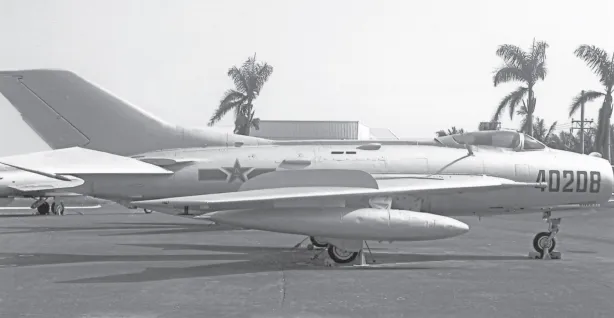
Mig-19C Farmer, reproduced by the PRC under license from the USSR, flown from the PRC by a defector to the ROCAF, Taiwan. Picture taken by Dr. Richard Hallion in 2010 while lecturing at the ROCAF Academy.
A P2V-7 NEPTUNE SURVIVING THE CZECHOSLOVAK BORDER (1956)
During flight training, two-plus years in VP-23, and almost two years on the staff of Fleet Air Wing Three, I flew first a PB4Y-2, then P2V-2, -3, -5, -5F, -6, and–7. They were a dream to fly after the -5 became a -5F and then a -7, both with jets, in addition to the Wright R-3350, a terrible engine.
—Lieutenant Commander Joe Grace
“I was born in 1928, and I always wanted to fly,” recalls Joseph “Joe” Grace. “I built lots of model planes as a kid, flew them and hung them from the ceiling in my room. I grew up in Tonowanda, New York. Just south of town there was a mile-square airfield of grass. One hangar, several Piper and Taylor Cubs. An operator offered ‘See Niagara Falls for $1.50.’ Two friends and I saved our dimes until we each had fifty cents, then rode our bikes out to the field. We didn’t have to climb very high before we could see the falls, about ten miles down the river. We weren’t so much impressed by the falls, but were thrilled to fly. In 1947 I received an appointment to the US Naval Academy in Annapolis, Maryland. Once I reported to the academy we received indoctrination flights in N3Ns—a beautiful biplane on floats.
“On graduation from the Naval Academy in 1951 I was assigned as a ship’s company officer on the training carrier USS Monterey (CV-26) at Pensacola, Florida. After one year, in 1952, I was finally entered into flight training. I managed to hold my own and not wash out, although many did. About a year after I started flight training it was time for our basic carrier qualification on the Monterey. We flew out to the carrier in a flight of six. I flew a beautiful ROGER pass on my first approach—only to have the LSO wave me off, instead of giving me a ‘cut.’ My second approach was the same—another ‘foul deck wave-off.’ The deck was not fouled. After the third wave-off in a row, I was getting mad. Finally, on my fourth approach, I got a ‘cut’ from the LSO permitting me to land. As the deck crew was freeing my tailhook from the arresting gear wire, the ship’s air boss announced on the radio and on the ship’s intercom: ‘This ship’s 57,000th landing has just been made by Lieutenant JG Joe Grace, former ship’s officer.’ They set me up. There was cake that night in the wardroom. We flew SNJs in training; the air force called them AT-6s.
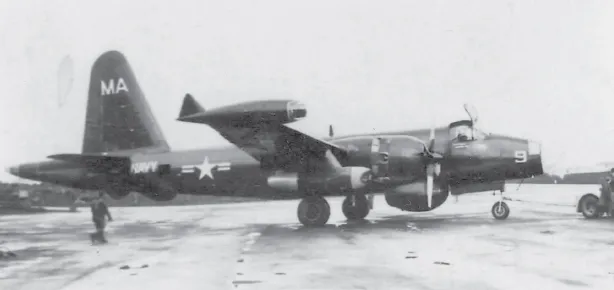
P2V-7 Neptune antisubmarine aircraft assigned to Patrol Squadron 23, VP-23, at Brunswick, Maine, while deployed to Keflavik, Iceland. Patrol plane commander, LTJG Joe Grace.
“After completion of flight training in 1953, I requested an assignment to Patrol Squadron 23 at Brunswick, Maine. I was serving as navigator on a crew of eight by 1954. We had a squadron officers party one Friday night, had a good time and went to bed early. At 0200 hours Sunday, our duty officer received a call, not from our boss, not from his boss, Fleet Air Wing Atlantic, or our operational boss, Commander Eastern Sea Frontier in New York, but from the duty navy captain at the Pentagon—‘Get your squadron in the air tomorrow morning. Fly to the municipal airport at San Juan, Puerto Rico, and find us a Russian ship running guns into Guatemala to start a revolution.’ We had two planes down for major checks planned for Monday morning. The night check crew came in and had them ready to go by 0700. The recall worked like a charm. Each of us got his call, and called three others, packed a bag, and were out at the air station by 0700. Soon thereafter we had twelve planes in the air, in formation and flew VFR, visual flight rules, just offshore to San Juan.
“Our crew, Lieutenant JG Bourke, pilot, Ed Cumie, copilot, and I as the ship’s navigator, were flying just offshore of the Dominican Republic, then very unfriendly to the United States under the dictatorship of General [Rafael] Trujillo. We had been briefed to stay outside their three-mile limit. The capital city, Ciudad Trujillo, could be seen just a few miles up the river from the coast. There, we spotted our quarry tied up to a pier in the city. We sent a FLASH contact report to Commander Caribbean Sea Frontier. There was no revolution in Guatemala that year.
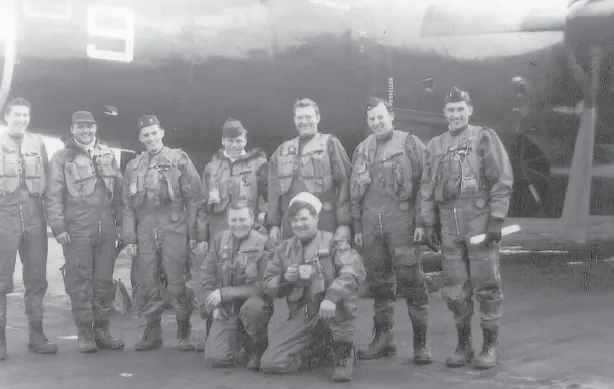
Joe Grace’s crew in front of their P2V-7 Neptune antisubmarine aircraft at Keflavik, Iceland, 1956. Standing, left to right: Aviation Radioman 2nd Class Brand; AD1 Joe Amaviska, plane captain; LTJG Art Detonnancourt, copilot; LTJG Joe Grace, patrol plane commander; AT3 Harry Harrison, radar operator; AT3 Nash, ECM operator; and Ensign Paul Sorenson, navigator. Kneeling, left to right: AO3 Meinoc, aviation ordnanceman; and AM3 Haulk, 2nd mechanic. The photo was taken by AO1 Wiebe, gunner, member of the crew.
“A couple of years later in 1956 I had made PPC, patrol plane commander, and had my own crew. While deployed to Keflavik, Iceland, we had a week-long deployment flying reconnaissance around northern Europe with a brand-new P2V-7 Neptune, with jets nonetheless. Wow. I remember flying into Fürstenfeldbruck Air Base near Munich. I shot three GCA approaches, but was still in the soup each time. I didn’t dare break minimums as a LTJG, lieutenant junior grade—first lieutenant in the army and air force—because our skipper, Commander Harvey Hop, had broken minimums to land just the week before and had been put on report by the air force. So we headed for our alternate, Frankfurt Air Base, adjacent to the Frankfurt civil airport.
“The airway out of Munich ran right alongside the Czechoslovak/East German border. We hadn’t been briefed to expect any trouble from the Russians, but they must have overheard our radio transmissions and knew we were not in familiar surroundings. I had put the navigator, Paul Sorenson, in the left seat and gone back to the aft station to have a cup of coffee with our gunner. When I came forward, Art [Detonnancourt], my copilot, was flying the plane heading for a radio beacon on the airway. I don’t have any idea why I looked at the bird-dog needle, but thank God I did. It kept trying to swing off to starboard, and Art was chasing it. I told him to ignore it and just fly the heading. In less than five minutes, the needle was sticking straight out to starboard, to the right, into Czechoslovakia. I am sure they were waiting for us there, less than five miles away. We had all heard of the VP-5 PB4Y-2 that had been shot down over the Baltic Sea in April 1950, but nothing since. So we came close to being just another incident in the Cold War. The next day we flew from Frankfurt back down to Fürstenfeldbruck; the weather was much better this time around. Took a train to the Third Army rest camp in Garmisch for a wonderful, but shorter-than-planned stay.”
It was a routine practice for the Russians and their satellites during the Cold War years to interfere with aerial navigation aids, such as radio beacons, to lure American aircraft, passing near their borders, over their territory—then shoot them down. It happened to a luckless American F-84 fighter as early as 1953, being s...
Table of contents
- Cover
- Title Page
- Copyright
- Dedication
- Contents
- Terms and Abbreviations
- Foreword
- Preface and Acknowledgments
- When Peace Came to America (1945)
- The Peace That Wouldn’t Take (1947)
- More Secret than the Manhattan Project (1952)
- To the Yalu River and Beyond (1950)
- “Honey Bucket Honshos” of the 91st Strategic Reconnaissance Squadron (1952)
- The 19th Tactical Reconnaissance Squadron (1955)
- The Incredible RF-86F Sabre Jet (1952–1955)
- Remembering Major Rudolph “Rudy” Anderson (1953–1955)
- The Last Hurrah of the “Wild Bunch” (1954–1955)
- The Short-Lived RB-57A “Heart Throb” Program (1955–1956)
- The RB-57A-1 Heart Throb: A Challenging Plane to Fly (1955–1956)
- A P2V-7 Neptune Surviving the Czechoslovak Border (1956)
- Franz Josef Land (1952)
- Teamwork: P2V and RB-50E (1952)
- Come the B/RB-47 Stratojet (1952)
- Challenging the Russian Bear (1954)
- Slick Chick RF-100As (1955–1956)
- Project Home Run: RB-47s over Siberia (1956)
- Fate Is the Hunter: The Shootdown of RB-47H 53-4281 over the Barents Sea (1960)
- The RB-57D That Killed the SENSINT Program (1956)
- The Cuban Missile Crisis through the Eyes of a Raven (1962)
- The Last Flight of RB-47H 53-4290 over the Sea of Japan (1965)
- An Unintentional Overflight of East Germany (1964)
- The Reasons Why (1948–1960)
- The Price We Paid (1945–1993)
- Notes
- Bibliography
Trusted by 375,005 students
Access to over 1.5 million titles for a fair monthly price.
Study more efficiently using our study tools.
Frequently asked questions
Yes, you can cancel anytime from the Subscription tab in your account settings on the Perlego website. Your subscription will stay active until the end of your current billing period. Learn how to cancel your subscription
No, books cannot be downloaded as external files, such as PDFs, for use outside of Perlego. However, you can download books within the Perlego app for offline reading on mobile or tablet. Learn how to download books offline
Perlego offers two plans: Essential and Complete
- Essential is ideal for learners and professionals who enjoy exploring a wide range of subjects. Access the Essential Library with 800,000+ trusted titles and best-sellers across business, personal growth, and the humanities. Includes unlimited reading time and Standard Read Aloud voice.
- Complete: Perfect for advanced learners and researchers needing full, unrestricted access. Unlock 1.5M+ books across hundreds of subjects, including academic and specialized titles. The Complete Plan also includes advanced features like Premium Read Aloud and Research Assistant.
We are an online textbook subscription service, where you can get access to an entire online library for less than the price of a single book per month. With over 1.5 million books across 990+ topics, we’ve got you covered! Learn about our mission
Look out for the read-aloud symbol on your next book to see if you can listen to it. The read-aloud tool reads text aloud for you, highlighting the text as it is being read. You can pause it, speed it up and slow it down. Learn more about Read Aloud
Yes! You can use the Perlego app on both iOS and Android devices to read anytime, anywhere — even offline. Perfect for commutes or when you’re on the go.
Please note we cannot support devices running on iOS 13 and Android 7 or earlier. Learn more about using the app
Please note we cannot support devices running on iOS 13 and Android 7 or earlier. Learn more about using the app
Yes, you can access Silent Warriors, Incredible Courage by Wolfgang W. E. Samuel in PDF and/or ePUB format, as well as other popular books in History & Military & Maritime History. We have over 1.5 million books available in our catalogue for you to explore.