![]()
CHAPTER 1
Introduction to Isotope Dilution Mass Spectrometry (IDMS)
1.1 THE ISOTOPIC NATURE OF THE ELEMENTS
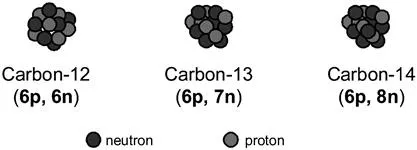
The nucleus of an element is formed by protons and neutrons (other subatomic entities will not be considered in this book). The chemical properties of the element depend on the number of protons in the nucleus, which is the same as the number of electrons surrounding it. Figure 1.1 shows the different types of carbon atoms occurring in nature. All atoms shown in Figure 1.1 are carbon atoms and behave chemically as carbon atoms. They all form CO2 when oxidised and can be present in organic compounds and biomolecules. Three types of carbon atoms differing in the number of neutrons in the nucleus occur in nature. The most abundant carbon atom is carbon-121 that accounts approximately for 99% of all carbon atoms. Then carbon-13, which contains 7 neutrons in the nucleus, accounts for approximately the remaining 1% of all carbon atoms. Carbon-12 and carbon-13 atoms are stable and do not suffer from radioactive decay. Carbon-14 is the only radioactive carbon atom observed in nature. It is formed in the troposphere by bombardment of nitrogen-14 with cosmic rays and it has an approximate abundance of 10−10%. Carbon-14 decays to nitrogen-14 (stable) by emission of a beta particle with a half-life of 5730 years. The incorporation of carbon-14 in biomolecules through the photosynthesis in plants is the reason for its use for dating organic archaeological remains. Due to its low abundance, the presence of carbon-14 in nature is normally not considered relevant for Isotope Dilution Mass Spectrometry.
The different forms of the atoms that contain a variable number of neutrons are called isotopes.2 All isotopes of one element show almost the same chemical properties but the mass difference between different isotopes allows the study of the isotopic composition of the elements by Mass Spectrometry. So, the objective of this book will be to describe the most relevant applications of the isotopic information contained in the elements and compounds when measured by Mass Spectrometry.
Figure 1.1 Types of carbon atoms occurring in nature (p – proton, n – neutron).
The existence of several isotopes of the elements in nature is more a rule than an exception. Table 1.1 shows the distribution of the elements of the periodic table as a function of the number of stable or very long-lived radioactive isotopes existing in nature. In this table we have not included the long-lived radioactive isotopes (>100 000 years half-life) created by mankind after ca. 1940 from nuclear fission or neutron capture (79Se, 93Zr, 99Tc, 107Pd, 135Cs, 129I, 236U, 237Np, 242Pu, etc.) as their overall contribution to the elemental and isotopic inventory is still negligible.
Table 1.1 Distribution of the elements of the periodic table as a function of the number of stable or very long-lived isotopes existing in nature.
| Number of isotopes | Element symbol |
| 10 | Sn |
| 9 | Xe |
| 8 | Cd, Te |
| 7 | Mo, Ru, Ba, Nd, Sm, Gd, Dy, Yb, Os, Hg |
| 6 | Ca, Se, Kr, Pd, Er, Hf, Pt |
| 5 | Ti, Ni, Zn, Ge, Zr, W |
| 4 | S, Cr, Fe, Sr, Ce, Pb |
| 3 | O, Ne, Mg, Si, Ar, K, U |
| 2 | H, He, Li, B, C, N, Cl, V, Cu, Ga, Br, Rb, Ag, In, Sb, La, Eu, Lu, Ta, Re, Ir, Tl |
| 1 | Be, F, Na, Al, P, Sc, Mn, Co, As, Y, Nb, Rh, I, Cs, Pr, Tb, Ho, Tm, Au, Bi, Th |
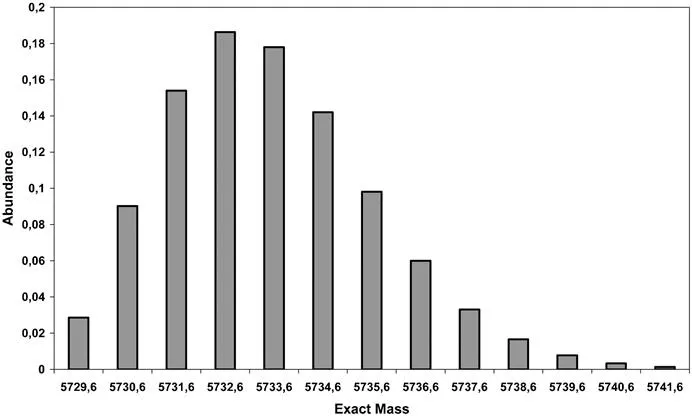
As can be observed in Table 1.1 most of the elements of the periodic table contain more than one isotope. Tin is the element with most existing isotopes (10 isotopes) while only 21 elements (Be, F, Na, Al, P, Sc, Mn, Co, As, Y, Nb, Rh, I, Cs, Pr, Tb, Ho, Tm, Au, Bi, Th) are monoisotopic. The fact that hydrogen, carbon, nitrogen, oxygen and sulfur, the main elements constituting most biomolecules, are all polyisotopic indicates that most organic compounds will show different isotopic forms in their molecules. For example, Figure 1.2 shows the calculated isotope distribution for bovine insulin (C254H377O75N65S6) taking into account the isotope distribution of their constituting atoms. The main isotopic form occurs at exact mass 5732.6 u and contains three carbon-13 atoms in the molecule. Of course, other isotopic combinations are also possible for the same nominal mass (13C217O, 13C18O, 13C215N, etc.) but at lower relative abundance in comparison to 13C3. The final low resolution distribution observed is the sum of all different isotope combinations at the same nominal mass. All organic compounds show different isotopic forms whose distribution can be measured by Mass Spectrometry normally after a chromatographic separation.
Figure 1.2 The theoretical isotope distribution of bovine insulin (C254H377O75N65S6).
In this book, isotope distributions will not be normalised to the percentage of the main peak as it is customary in organic Mass Spectrometry. The sum of all isotopic forms of a given compound will be 1, to use the same notation as for the isotope composition of the elements.
1.1.1 Radioactive and Stable Isotopes: Decay Series
Most isotopes present in nature are stable. Radioactive isotopes formed during the creation of the universe have decayed a long time ago to stable isotopes. However, there are still some very long-lived isotopes in nature that have not decayed completely and form what is known as “decay series”. For example, isotopes of uranium and thorium, particularly 235U, 238U and 232Th, decay to stable isotopes of lead (207Pb, 206Pb and 208Pb, respectively) after a series of alpha and beta disintegrations. That is why the isotope composition of lead is not constant in nature and depends on the source of the mineral. The natural variations in the isotope composition of lead have found applications in archaeology (sources of ancient artefacts) and in environmental research (sources of lead pollution). Other important decay series from long-lived isotopes are the decay of 87Rb to 87Sr or the decay of 147Sm to 143Nd. Those decay series, together with the U–Pb series, have found application in geochronology for the dating of minerals.
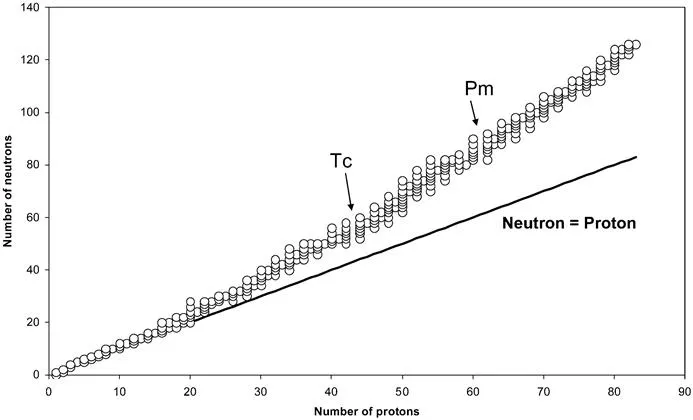
From hydrogen (z = 1) to bismuth (z = 83) there exist 281 stable or very long-lived isotopes in nature. The distribution of these isotopes between the different elements is shown in Figure 1.3. This graph shows the number of neutrons for each isotope as a function of the number of protons (z = atomic number). As can be observed, light elements up to z = 20 (calcium), contain approximately the same number of protons and neutrons. Heavier elements require a larger number of neutrons for nuclear stability. For example, mercury (z = 80) require approximately 1.5 neutrons for each proton to form stable nuclei. Elements with odd atomic numbers usually posses less-stable isotopes than close elements with even atomic numbers. This is very easy to see for the lanthanides. For example terbium (z = 65), holmium (z = 67) and thulium (z = 69) are all monoisotopic, while dysprosium (z = 66), erbium (z = 68) and ytterbium (z = 70) all contain 6 or 7 isotopes.
There are two important gaps in the isotope distribution of the elements. Technetium (z = 43) and promethium (z = 61) are constituted only by radioactive isotopes and have long decayed since the formation of the universe. These two elements did not exist in nature until very recently as they are fission products from uranium or plutonium fission. The radioactive isotopes 99Tc and 147Pm can be detected now in spent nuclear fuel samples both by Mass Spectrometry and radiochemical measurements.
Figure 1.3 The isotopes of the elements from H to Bi.
So, for the 81 elements existing in nature between hydrogen and bismuth there are 281 different isotopes with masses from 1 (1H) up to 209 (209Bi). As there are more isotopes than possible masses, some of these isotopes possess the same nominal mass (e.g.54Cr and 54Fe or 150Nd and 150Sm). These are called isobaric isotopes and need to be taken into account when studying the isotopic composition of the elements by Mass Spectrometry. In many cases, a chemical separation between elements containing isobaric isotopes is required to study their isotope composition without interferences.
1.1.2 Historical Perspective: Early Mass Spectrometry Experiments
The existence of the isotopes of the elements was suspected at the end of the 19th century on the base of the measurement of the atomic weights of some elements. The atomic weights of most light elements, such as hydrogen, carbon, nitrogen, oxygen and sodium are close to integer numbers (1, 12, 14, 16, 23) with the notable exception of chlorine (35.5). The atomic weight of lead was also another source of puzzlement. Lead samples obtained from different uranium or thorium minerals showed different atomic weights but the same chemical properties. The discovery of the isotopes is usually ascribed to J.J. Thomson at the beginning of the 20th century. The work of Thomson was based on previous developments by Goldstein in 1886 (discovery of positive ions in low pressure discharges) and Wien in 1898 (deflection of positive ions on electric and magnetic fields). The first experimental evidence of the existence of the isotopes was published in 1913 by J.J. Thomson. The study of the parabolic trajectories of positive ions of neon showed two traces at masses 20 and 22 with an intensity ratio of approximately 10:1 (a third subtle trace at mass 21 was discovered later). The term “isotope”, meaning “same place” in Greek was coined by Soddy to indicate that these different forms of the atoms occupied the same place in the periodic table. F.W. Aston, a student with J.J. Thomson, continued the work of Thomson an...