- 272 pages
- English
- ePUB (mobile friendly)
- Available on iOS & Android
eBook - ePub
About this book
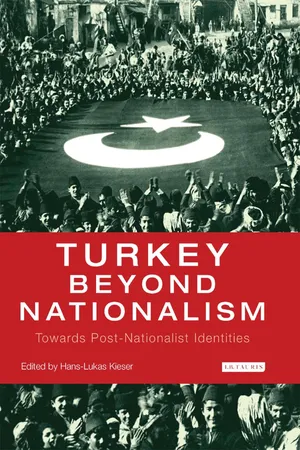
Nationalism was a defining characteristic of Turkey in the twentieth century and was a central driving force in Kemal Ataturk's foundation of the Republic in 1923. How did the prominence of Kemalist ways of political thinking affect its people and policies? Is Turkey making progress towards post-nationalism or post-Kemalism in the twenty-first century? To what extent has Turkey's EU candidature been a vehicle of transformation since 1999 and what would EU membership mean for modern Turkey? This book explores the historical impact of Turkish nationalism, anti- liberalism and Westernization and examines the conditions that have contributed to the country's evolution from a quasi-religious Kemalism. Tracing the development of nationalism from its founding period before the Young Turk Revolution of 1908 to Kemalism and the present AKP government- and analysing key factors such as the position of minorities in the Turkification process and the influence of religious politics-this strong and significant contribution casts a new light on a vivid international debate.
Information
PART I
TURKISH NATIONALISM:
THE IDEOLOGICAL WEIGHT OF THE FOUNDING PERIOD (1905-1938)
Chapter 1
Turkism and the Young Turks, 1889-1908
M. Şükrü Hanioğlu
The dominant explanation of the emergence of Turkish nationalism holds that it was a relatively late development, the origins of which lie in the Balkan Wars of 1912-13. According to this thesis, war in the Balkans exposed the bankruptcy of the worn-out ideology of Ottomanism, leading to an abrupt surge in nationalist sentiment among Ottoman intellectuals of Turkish decent. Despite numerous errors in theory and fact, this thesis has proved remarkably resilient. David Kushner’s path-breaking study of 1977 on the rise of Turkish nationalism between 1876 and 1908 should have been sufficient to finish off the thesis once and for all, but instead left only an insignificant dent in its armour.1
Twenty years later a popular historian of modern Turkey and the late Ottoman Empire could still maintain that “the vocabulary of nationalism scarcely existed in the Turkish [...] language of the [late Hamidian] period” and that the term millet in the pre-1908 Young Turk context still referred to “religious communities.”2
An important reason for the persistence of such easily refutable claims3 is their affinity to Turkish official ideology in the early years of the republic. Ideology entered scholarship in the 1920’s and ’30s through the pens of Turkish historians who fully accepted Republican verdicts on late Ottoman history. They reconstructed nationalist history in such a way as to ignore the Hamidian period entirely. Focusing instead on the Second Constitutional Period between 1908 and 1918, they drew a straight line back from the new ideology formulated by the founding fathers of the Turkish republic to its alleged origins under the rule of Ottoman Committee of Union and Progress (hereafter CUP).4
From a theoretical perspective, this approach has three major flaws. First, it treats nationalism as a spontaneous ideological and political phenomenon, thereby ignoring precursor, proto-nationalist movements and ideologies that prepare the ground for the emergence of nationalism. An examination of the official and the underground opposition press under Abdülhamid II leaves no doubt that a Turkist movement did emerge during the pre-revolutionary period – although it strove to stay within the bounds of Ottomanism by remoulding it. Second, the prevailing explanation approaches the concepts of Ottomanism and Turkism in a distinctly essentialist manner. As a consequence, it imagines a false competition between two discrete, monolithic, and unchanging ideologies: Ottomanism on the one hand and Turkism (or Turkish nationalism) on the other. In reality, however, these concepts possessed fluid, blurred boundaries even after the Balkan Wars. Moreover, Turkism often appeared as a new interpretation of Ottomanism rather than a clear-cut break with it; usually, this meant attributing a centrifugal role to the Turkish ethnic group within the Ottoman whole. Third, due to its retrospective approach to history, the dominant thesis perceives a teleological dissolution of Ottomanism into Turkish and other Ottoman nationalisms. But what seems inevitable in retrospect was not so at the time.
In this short article, I analyse the attitude of the Young Turks (and particularly the CUP) towards Turkism, trace its transformation into a nascent nationalist movement before the Young Turk Revolution of 1908, and demonstrate the significance of Turkism in the Weltanschauung of the CUP. The discussion focuses on elite perceptions of identity. There are two major reasons for this. For one, the debates recorded in historical sources took place largely between the literate few: intellectuals and political elites. Secondly, although the educated elite amounted to a small fraction of the population of the empire and their published journals were read only by the literate few, they stood at the forefront of the dramatic changes that took place in late Ottoman society. They exerted an influence on the shape of events that far outweighed the relative proportion of the elite in the population. Nevertheless, it is important to bear in mind that the overwhelming majority of the Ottoman populace, caught up in their local identities and concerns, remained largely unmoved by the grand ideals of Ottomanism, Turkism or Pan-Islamism.
The Evolution of Ottomanism as a Concept from the Tanzimat to the Young Turks
Several major factors compelled the Ottoman state to adapt its official ideology in the 19th century: the need to confront European modernity, the challenge of nationalist movements, the necessity of asserting central control over an enormous and fractious empire, and the desire to join the European Concert. The key change involved a redefinition of the concept of equality. The Islamic conception of respect for the rights of the unequal dhimmī was gradually replaced by a notion of equality derived from the French Déclaration des Droits de l’homme et du Citoyen. As Mahmud II is claimed to have said: “Je ne veux reconnaître désormais les musulmans qu’à la mosquée, les chrétiens qu’à l’église et les juifs qu’à la synagogue.”5 The Tanzimat statesmen strove to institutionalise this approach by producing universally applicable legal codes. The implications of legal equality for a social order defined by religion were revolutionary. The new emphasis on an Ottoman identity common to all citizens of the empire crowded out, at least in theory, the hitherto dominant sectarian identities. The “de-religionization” of official ideology and redefinition of a secular homo Ottomanicus was an extraordinarily difficult undertaking. Not only did Muslim resentment swell after 1856 (and with it support for the maintenance of Islam as a pillar of the state-caliphate), nationalism emerged as a powerful competitor to both the religious and the Ottoman orientations within all Ottoman communities. As nationalist separatism increasingly threatened to tear apart the multi-national empire, the remedy of equality between Muslims and non-Muslims (however much desired by the latter) no longer appeared adequate.
The attempts of the Tanzimat to reform the religious communities from within tipped the internal balance of power in favour of new laymen at the expense of the old clerical establishments. Even in the small Jewish community, lacking in clerical hierarchy, the reform proved ultimately unsuccessful when a revival of rabbinical influence produced a bitter clash between the two elements.6
In the Greek Orthodox Patriarchate the results were still more damaging, as non-Greek ethnic community leaders launched a struggle for their own independent churches. The influence of laymen within the various communities also gave rise to the development of new educational curricula that tended to foster nationalism. Thus a reform designed to weaken clerical communitarianism and enhance equality between communities ended up cementing a bond between ethnicity and religion, thereby reinforcing the very centrifugal ethno-nationalist forces it was meant to suppress.
Clearly, Ottomanism founded upon the notion of equality among religious communities was no panacea for the internal strife afflicting the Ottoman realm. In order to respond to the challenge of ethnic separatism, during the second half of the Tanzimat era Ottomanism was refashioned as an ideology promoting equality among Ottoman ethnic groups. However, just as the old Ottomanism never succeeded in erasing the traditional dominance of the Muslim millet, so too the new Ottomanism could not escape the preponderance of influence exercised by the Turkish element.
The intrusive demand of the imperial centre for a wholesale identity shift from ethnic and religious to supranational and secular, coupled with the push for rapid centralisation of the empire, could not fail to arouse the suspicion amongst non-Turkish ethnic groups that behind the stated goal of “Ottomanism” lay a more sinister aim of Turkification – a process ultimately aiming at suppressing their identities and privileges. Such suspicions were heightened by the increasing employment of Turkish symbols by the imperial centre. İsmail Kemal Bey (Ismail Qemali), a loyal servant of the leaders of the Tanzimat (who, as he put it, “would have done honour to any country in the world”) admitted that the reforms, coupled with the harsh measures adopted against recalcitrant communities, “concealed the perpetual desire of the Turkish chauvinists to bring about the unification of all the races of the empire.”7
It was no coincidence that during the last decade of the Tanzimat, the intellectuals known as the Young Ottomans, who sought to reconcile Islamic principles with European constitutionalism, in the final analysis advocated a version of Ottomanism grounded in the concept of citizenship and guaranteed by a constitution. Ottomanism, as the Young Ottomans (as well as the future architect of the Ottoman constitution, Ahmed Şefik Midhat Pasha) envisioned it, placed the individual’s identity as a citizen of the empire above all other affiliations. Such an interpretation, of course, also tended to reinforce the secular character of Ottomanism.
In fact, many non-Turkish proponents of Ottomanism demanded that government positions be open to all Ottomans. As the organ of the Bulgarian Ottomanists put it: “As long as a career in the state bureaucracy continues to be a birthright of sorts for the Muslims, as long as Christians are excluded from high government office and are barred from lower-level positions in all but rare circumstances, there is no reason whatsoever to hope that non-Muslims will want to study the [Ottoman] Turkish language to any great depth [...] We do not believe it will be possible for all citizens of the [Ottoman] empire to think of themselves as members of the same family until they all have equal access to government service.”8
Some Jews expressed similar sentiments in reaction to the government’s decision not to appoint a Jewish member to the new council of state, arguing that “wherever Israelites are settled they are invariably loyal and useful members of the community, especially in those countries where their rights are fully admitted as citizens.”9
Thus demands for rights of a secular character, such as equal opportunity employment in the bureaucracy, supplanted customary religious demands (e.g., the call for full implementation of religious equality promised in 1856).
The promulgation of the Ottoman constitution, and the subsequent convocation of a parliament, marked the high point of what might be termed “new Ottomanism”. The timing of the announcement – at the height of an international crisis and under heavy European pressure to grant privileges to the empire’s Christian communities – was, of course, no coincidence. Indeed, many Ottoman statesmen and intellectuals had come to view Ottomanism (founded upon citizenship) as a powerful tool to resist European demands for privileges for the non-Muslim communities of the empire.10 If legal distinctions between the religious communities were abolished, so the argument went, the logic behind European demands for equality would cave in. In the event, the implementation of new Ottomanism had to be postponed indefinitely, due to the prorogation of the parliament in February 1878, but at the time it was embraced by some intellectuals as a silver bullet with which to kill off separatism once and for all.
The régime of Abdülhamid II redefined Ottomanism once again, imbuing it with Islamic characteristics. Fearing that a strengthening of the common denominator of citizenship would lead to dangerous demands for representation and would ultimately accelerate separatist processes,11 the régime reintroduced a determining role for Islam in imperial identity. The return to Islam was also warranted by the demographic changes imposed by successive losses of Christian-populated territories in the wars of the 19th century, and particularly in the Russo-Ottoman war of 1877-78. By bringing religion back centre-stage, the régime reversed the trend towards the secularization of identity set in motion by the Tanzimat statesman. Moreover, in Hamidian Ottomanism, the boundaries between religious, ethnic, and supranational identities were deliberately blurred. The sultan saw his main mission as protection of the Caliphate; to fulfil it he sought to forge Pan-Islamism into a proto-nationalist force, one with which he could hold the Muslim elements of the empire together. Undoubtedly, Hamidian Ottomanism was most attractive to non-Turkish Muslims, such as Albanians, Arabs, and Kurds for whom it provided a real alternative to nationalist orientations. Islamic Ottomanism was naturally least attractive to non-Muslim ethnic groups, whom in practice it threatened with a diminution of status, theoretical legal rights notwithstanding.
The spread of Turkism during this period did not yet exert a marked influence on official ideology. But it was nourished by frustration with official policy. One of the distinguishing marks of the Hamidian régime was the prominence of Muslim Albanians, Arabs, and Kurds in the highest positions of the bureaucracy and court. This policy fuelled the surreptitious growth of Turkist sentiments. Beneath the surface of Hamidian censorship, resentment at the preferential treatment of non-Turkish Muslims – and the denial of just dues to Turks – was simmering. This was almost imperceptible at the time; Abdülhamid II did not tolerate any open discussion of identity. His successors, however, called him to task for spoiling individual Albanians, Arabs, and Kurds, and granting favours to the Muslim components of these communities. The surge of Turkist sentiment under Abdülhamid II reinforced the deleterious impact of the sultan’s own Pan-Islamic rhetoric on the bond between citizenship and identity.
Since both ideologies reached beyond the boundaries of the empire to noncitizen constituents, they could not fail to undermine the notion of Ottoman citizenship.
The Young Turks between Ottomanism and Turkism
The origins of the Young Turk movement can be traced back to the founding of the Ottoman Union Society (later renamed the Ottoman Committee of Union and Progress) at the Royal Medical Academy in 1889. Oddly enough, not one of the four founders was of Turkish descent. They did, however, represent a diverse cross-section of the other major Muslim communities of the empire – Albanians, Circassians, and Kurds. Consequently, in its early days the Committee – as evident from its name – leaned towards the régime’s new Ottomanism, which promoted union among Muslim Ottomans. Thus, it was strange but true that the sultan’s non-Turkish Muslim opponents (and his supporters within those communities) shared with him a common vision of the future of the state. As summarized by İshak Sükûtî, one of the original founders of the CUP, Albanians and Kurds, among others, must unite with the Turks against the West, for they shared a common goal: to d...
Table of contents
- Cover
- Title page
- Copyright page
- Contents
- Introduction
- Part I. Turkish nationalism: the ideological weight of the founding period (1905-1938)
- 1 Turkism and the Young Turks, 1889-1908
- 2 An ethno-nationalist revolutionary and theorist of Kemalism: Dr Mahmut Esat Bozkurt (1892-1943)
- 3 Kemalism, westernization and anti-liberalism
- Part II. Turkish nationalism: the trauma of unitarist Turkification and social engineering
- 4 The settlement policy of the Committee of Union and Progress 1913-1918
- 5 The politics of Turkification during the Single Party period
- 6 Depriving non-Muslims of citizenship as part of the Turkification policy in the early years of the Turkish Republic: The case of Turkish Jews and its consequences during the Holocaust
- 7 The exodus of Armenians from the Sanjak of Alexandretta in the 1930s
- 8 Turkish Nationalism and the Dönme
- 9 Claiming difference in an unitarist frame: the case of Alevism
- Part III. The historiographical challenge
- 10 Defining the parameters of a post-nationalist Turkish historiography through the case of the Anatolian Armenians
- 11 Facing responsibility for the Armenian genocide? At the roots of a discourse that legitimizes mass violence
- Part IV. Turkey in motion: today’s transformations and post-national challenges
- 12 The social grammar of populist nationalism
- 13 Religion: nation-building instrument of the state or factor of civil society? The AKP between state- and society-centered religious politics
- 14 Post-nationalist semiotics? The emblem of the Justice and Development Party AKP
- 15 The urgency of post-nationalist perspectives: “Turkey for the Turks” or an open society? On the Kurdish conflict
- Part V. Turkey in motion: the EU perspective
- 16 Turkey’s fragile EU perspectives since the 1960s
- 17 The non-Muslim minorities and reform in Turkey
- 18 National identity, asylum and immigration: the EU as a vehicle of post-national transformation in Turkey
- Notes
- Acknowledgments
- List of Contributors
Trusted by 375,005 students
Access to over 1.5 million titles for a fair monthly price.
Study more efficiently using our study tools.
Frequently asked questions
Yes, you can cancel anytime from the Subscription tab in your account settings on the Perlego website. Your subscription will stay active until the end of your current billing period. Learn how to cancel your subscription
No, books cannot be downloaded as external files, such as PDFs, for use outside of Perlego. However, you can download books within the Perlego app for offline reading on mobile or tablet. Learn how to download books offline
Perlego offers two plans: Essential and Complete
- Essential is ideal for learners and professionals who enjoy exploring a wide range of subjects. Access the Essential Library with 800,000+ trusted titles and best-sellers across business, personal growth, and the humanities. Includes unlimited reading time and Standard Read Aloud voice.
- Complete: Perfect for advanced learners and researchers needing full, unrestricted access. Unlock 1.5M+ books across hundreds of subjects, including academic and specialized titles. The Complete Plan also includes advanced features like Premium Read Aloud and Research Assistant.
We are an online textbook subscription service, where you can get access to an entire online library for less than the price of a single book per month. With over 1.5 million books across 990+ topics, we’ve got you covered! Learn about our mission
Look out for the read-aloud symbol on your next book to see if you can listen to it. The read-aloud tool reads text aloud for you, highlighting the text as it is being read. You can pause it, speed it up and slow it down. Learn more about Read Aloud
Yes! You can use the Perlego app on both iOS and Android devices to read anytime, anywhere — even offline. Perfect for commutes or when you’re on the go.
Please note we cannot support devices running on iOS 13 and Android 7 or earlier. Learn more about using the app
Please note we cannot support devices running on iOS 13 and Android 7 or earlier. Learn more about using the app
Yes, you can access Turkey Beyond Nationalism by Hans-Lukas Kieser in PDF and/or ePUB format, as well as other popular books in Politics & International Relations & 20th Century History. We have over 1.5 million books available in our catalogue for you to explore.