The history of U.S. diplomacy in the Middle East is marked by numerous stark failures and a few ephemeral successes. Jimmy Carter's short-lived Middle East diplomatic strategy constitutes an exception in vision and approach. In this extensive and long-overdue analysis of Carter's Middle East policy, Jorgen Jensehaugen sheds light on this important and unprecedented chapter in U.S. regional diplomacy. Against all odds, including the rise of Menachem Begin's right-wing government in Israel, Carter broke new ground by demanding the involvement of the Palestinians in Arab-Israeli diplomatic negotiations. This book assesses the president's `comprehensive peace' doctrine, which aimed to encompass all parties of the conflict, and reveals the reasons why his vision ultimately failed.
Largely based on analysis of newly-declassified diplomatic files and American, British, Palestinian and Israeli archival sources, this book is the first comprehensive examination of Jimmy Carter's engagement with the Palestinian-Israeli conflict. At a time when U.S. involvement in the region threatens to exacerbate tensions further, Arab-Israeli Diplomacy under Carter provides important new insights into the historical roots of the ongoing unrest. The book will be of value to Middle East and International Relations scholars, and those researching U.S diplomacy and the Carter Administration.
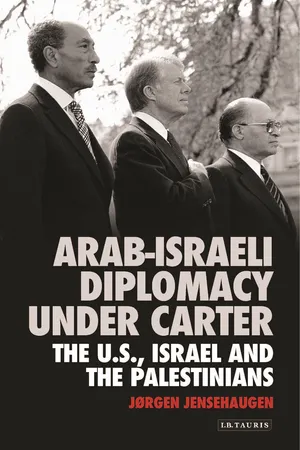
eBook - ePub
Arab-Israeli Diplomacy under Carter
The US, Israel and the Palestinians
- 312 pages
- English
- ePUB (mobile friendly)
- Available on iOS & Android
eBook - ePub
About this book
Information
CHAPTER 1
PRESIDENT CARTER AND THE
PALESTINIANS
PALESTINIANS
On 16 March 1977, US President Jimmy Carter publicly declared: ‘There has to be a homeland provided for the Palestinian refugees who have suffered for many, many years.’1 The statement, however, was off-script. Carter was responding to a question from a journalist and caught everybody off guard, including his own advisors. While this focus on the Palestinian issue was a cornerstone of President Carter's Middle East policy, it was almost revolutionary in a US context. For decades the Palestinians had either been ignored, treated as a humanitarian issue or viewed as terrorists. Under President Carter the Palestinians suddenly found themselves playing a central political role in the Middle East peace process. Carter made solving the Palestinian issue one of three cornerstones in solving the larger Arab–Israeli conflict; the other two were mutual recognition and the establishment of permanent borders.2 Still, slightly more than two years after coming to power, Carter helped Egypt and Israel sign a bilateral peace agreement, which pushed the Palestinian issue to the sidelines in all but name. Israel and Egypt continued conducting Palestinian autonomy negotiations for the remainder of Carter's term, but nothing came of them. Almost two decades later, however, the autonomy model would resurface in the Oslo negotiations.
Carter's presidential legacy in the Middle East, then, had little to do with the Palestinians. By failing to deliver on the Palestinian issue while securing an Egyptian–Israeli peace, Carter had reverted to the traditional US approach to the Arab–Israeli conflict. What had happened to the comprehensive peace and the call for a Palestinian homeland? Why were the Palestinians excluded from the negotiations, when Carter had insisted on their inclusion?
To answer these questions, we must start at the beginning. Jimmy Carter was an unlikely candidate to be the first US president to make the Palestinian question the centrepiece of US policy towards the Arab–Israeli conflict. He was a born-again Christian from the deep South – a peanut farmer who eventually became the governor of his home state of Georgia, and who had practically no foreign policy experience. As governor, he had visited Israel only once, arranged by the Israeli government, but he had never visited an Arab country and never met an Arab leader. Prior to becoming president he had never met any Palestinians, and he did not meet any while he was president either.3
The Palestinian issue was not the only area where he lacked political experience. In fact, Carter made it very clear that he was an outsider in Washington. This was important, because in the mid-1970s, Washington was tainted by Watergate and the Vietnam war. In one election commercial, Carter stated ‘There is one major and fundamental issue. And that is the issue between the insiders and the outsiders. I have been accused of being an outsider and I plead guilty.’4 He took great care to distance himself from what many considered the dishonesty that plagued US politics, and key-words in his campaign included ‘good’, ‘honest’ and ‘decent’.5 Carter's position as a political outsider helps explain both why he won the election and how he was able to think outside the box of traditional US foreign policy. He was not enmeshed in the Vietnam and Watergate imbroglios, and his mindset was not stuck on the idea that the Palestinians were either refugees or terrorists. As such, Carter brought a fresh perspective to Washington. Despite his lack of relevant experience, foreign policy played an unusually significant part in his election campaign.6 Carter came to power with a desire to change US foreign policy, insisting that he was the man for the job.
Unsurprisingly, Washington insiders disagreed. Secretary of State Henry Kissinger was dumbfounded by Carter's lack of foreign policy experience, complaining: ‘I don't know how you can have a President who knows nothing about foreign policy and a Secretary of State also.’7 This quote says more about Kissinger than it does about Carter. While Carter's choice for Secretary of State, Cyrus Vance, would play a central role in the Carter administration, Carter was going to make his own foreign policy. He would be a hands-on president if ever there was one.8
In a thinly veiled attack on his predecessors, Presidents Gerald Ford and Richard Nixon, Carter insisted: ‘The President is the one who makes foreign policy. I make the foreign policy. There have been Presidents in the past, maybe not too distant past, that let their Secretaries of State make foreign policy. I don't.’9 As Carter's national security advisor, Zbigniew Brzezinski, pointed out, ‘Carter wanted to be his own Secretary of State […] he would therefore be in control over foreign policy in the White House.’10 Giving his insistence on such a pronounced role in foreign policy, Carter's lack of experience could have been costly, but he was unusually smart and he appointed a competent and generally unified foreign policy team.11 Carter also decided to invest the bulk of his time in foreign policy issues. Carter has often been described as a naive moralist, but his Palestinian policy, as well as much of his other foreign policy, was actually based on a strategic and pragmatic evaluation of the global situation which he derived from the ideals of liberal internationalism.12
Until Carter started his presidency, the inclusion of the Palestinians in the peace process had been merly academic and had not led to a change in US policy towards the Palestinians. Many explanations have been put forth regarding Carter's decision to focus on the Palestinians, including his Christian faith, his focus on human rights in general and his experiences in the segregated South.13 While each of these explanations shed light upon part of the picture, particularly on an emotional level, they miss a central point: solving the Palestinian issue was considered a strategic necessity by Carter, his closest foreign-policy advisors, and both the CIA and the State Department. He entered the White House with a clear intention of taking the United States in a new direction, away from the ‘malaise’ which had descended upon the nation during Nixon's presidency and persisted during Ford's. Carter came to power with an approach based on ‘preventive diplomacy’, global interdependence and the pursuit of human rights.14
In addition to the post-Vietnam and post-Watergate political atmosphere, Carter had also inherited the aftermath of the international oil shock, a consequence of the Arab oil embargo which followed the 1973 Arab–Israeli war. Carter therefore thought it vital to secure stability in the Middle East, and reduce the potential for a new oil embargo.15 In terms of this peace-making, Carter had a radically different approach from the preceding presidents. Where Nixon and Ford, under Kissinger's guidance, had tried to solve parts of the conflict while always isolating the Soviet Union, Carter aimed to solve the whole conflict with the assistance of the Cold War rival, not in competition with it. This approach had been promoted by, amongst others, a 1975 Brookings Institution report titled Toward Peace in the Middle East, written by a study group which included Carter's national security advisor, Zbigniew Brzezinski, and Middle East advisor, William B. Quandt.16 The report is often cited as having provided the ‘blueprint’ for the Carter administration's approach to the Arab–Israeli conflict.17
While that may be an overstatement, the report was clearly influential, particularly because so many of its authors subsequently gained prominent positions within the Carter administration. The report was seen by many Americans as so radical and anti-Israeli that both Brzezinski and Quandt were targeted by pro-Israeli groups in the United States for being co-authors of the report. Appeals were even made exclude them from the Carter administration.18 This pressure on the report's signatories was a forewarning of the domestic tension which such a comprehensive approach would create in the United States. It was also particularly hard for Carter to sell domestically because it contradicted two of the most essential aspects of the well-established tradition of US Middle East policy: the exclusion of the Palestinians and the Soviet Union from the diplomatic process. Despite the evident controversy, Carter ultimately failed to grasp the importance of grounding his Middle East policy domestically. This oversight would weaken his ability to counteract domestic pressure.19
The British journalist and Middle East expert Patrick Seale neatly summed up Carter's incoming position:
the Bible and Brookings, the fear of another war and another energy crisis, a sense that Kissinger had left the peacemaking job half done, pity for the Palestinians under Israeli occupation – promoted the Middle East to the top of Carter's foreign policy priorities.20
Carter's comprehensive approach was, for better or worse, far more ambitious than Kissinger's step-by-step approach, which had preceded it. If it were to succeed, it would solve the Arab–Israeli conflict in its entirety. Rather than merely calm some areas and address some aspects of the conflict, the comprehensive approach sought to remove the possible reasons for the conflict to reassert itself.
As this book will show, Carter clearly sought such a comprehensive approach, but he was equally clearly unprepared for the resistance to it he would face. Carter was the first US president to talk of a Palestinian ‘homeland’. This was a radical stance for a US president to take. While the term ‘homeland’ was imprecise and non-binding, it recalled the language used by Lord Balfour when he made his promise to the Jews in 1917 – a declaration which became the frame of reference for the Zionist movement when it established Israel. The use of ‘homeland’ in relation to the Palestinians therefore made Carter highly unpopular in Israel, and amongst Israel's supporters in the United States. Carter's initial stance was generally supported by the Arab states and the Palestinians, though the latter wanted him to take a step further and support their demand for a Palestinian state under PLO (Palestine Liberation Organization) leadership. Such a step was unacceptable in the United States, however, and anathema to Israel.21 It was not a step, therefore, that Carter would take – while he sympathised with much of the Arab position, he found himself bound by domestic political structures and policies which strongly favoured the Israeli position. If Carter ventured within those bounds, he never directly crossed them.
During the whole presidency, then, the Carter administration manoeuvred between the Israeli criticism of going too far in supporting the Palestinians, and the Palestinian criticism of not going far enough. This bind was made even more difficult by the context in which the negotiations took place. The Arab states were divided; the United States did not talk directly to the PLO; and Israel's supporters in the United States applied persistent domestic pressure upon Carter. In practice, that is, many of the steps Carter took were seen as being far beyond the maximum of what Israel could give, yet below the minimum of what the Arab states and the Palestinians were demanding.22
As the Carter administration pushed forward with its approach to peace during the early months of 1977, it became clear that this initiative was a very tall order. Some would insist that it was impossible from the start. The Carter team, however, dove straight in. Secretary of State Cyrus Vance went on several tours of the Middle East, and Carter hosted most of the Middle East leaders in Washington. While the Carter administration refused to meet directly with the PLO, Carter went further than previous US administrations in lowering the bar for what would be needed to initiate such contact. Several back-channels were used to communicate with the PLO, and the PLO sent signals that it was heading in a more moderate direction and closing in on the type of formulation regarding UNSC Resolution 242, implying a recognition of Israel, which was demanded by the US administration to open any direct contact with the Palestinian national movement. At the same time however, the PLO was sending contradictory signals, implying that it was heading in what the United States considered to be the wrong direction, away from moderation.23
Meanwhile the Arab states were at odds, not only with Israel but also amongst themselves. Egypt was leaning towards a willingness to participate in a peace process through which it could make large concessions. Jordan had a similar stance, but, being the weak link in the Arab chain, it depended on Syria to move forward. Jordan also had a domestic problem, in that over half its population was of Palestinian origin. Making peace without Palestinian consent was therefore extremely difficult. Syria, for its part, was against entering any open-ended peace process. The PLO, then, was mired amongst these various Arab stances and, to complicate things further, was struggling with internal divisions of its own.24 When Carter tried to induce the PLO to make concessions so that it could be included in the peace process, he was not addressing a unified movement, and those groups within the PLO which opposed the moderate leadership's position could always use violence to spoil that leadership's ability to negotiate.
Just months after Carter came to power, Israel also underwent a political change which had, to that point, been considered inconceivable: the age of Labour ended with the Likud victory in the national elections in May 1977. Israel's new prime minister, Menachem Begin, was ideologically more hawkish and much more decisive than Yitzhak Rabin had been, though he did share Rabin's adamant opposition to the comprehensive approach.25 Israel, under both Rabin and Begin, did not want the Soviet Union on board; it did not want to negotiate with all the Arab states at once; and, most importantly, it found any engagement with the PLO to be unacceptable. Also, particularly after Begin came to power, it moved to take the West Bank and the Gaza Strip completely off the negotiating table.26 Carter would not fully grasp the ideological depth of Begin's commitment to keeping the West Bank and Gaza for Israel.27 What he treated as an Israeli bargaining position was in fact an Israeli red line. Had he realised this, he might have acted differently, but it is unlikely that he could have changed Begin's mind on the Palestinian territories.
In the end, of all the Arab leaders, Carter managed to please only Egyptian President Anwar Sadat. Sadat was a rather difficult leader to understand, with a decision-making style which might best be described as erratic and ‘enigmatic’.28 In terms of foreign policy, it would eventually become clear that Sadat primarily sought two things: a close alliance with the United States, and the return of the Sinai, which had been occupied by Israel since 1967.29 These goals were achieved upon the signing of the Egyptian–Israeli peace treaty. Beyond them, it was hard to sa...
Table of contents
- Front Cover
- Title Page
- Copyright
- Dedication
- Contents
- Acknowledgements
- 1. President Carter and the Palestinians
- 2. US Presidents and the Palestinians
- 3. The Comprehensive Approach
- 4. Clinging to Comprehensive Peace
- 5. The Jerusalem Bombshell
- 6. The Torturous Road to Camp David
- 7. Camp David and the Egyptian–Israeli Peace Treaty
- 8. Where do we Go Now, but Nowhere?
- 9. A Failed Ambition
- Notes
- Bibliography
Trusted by 375,005 students
Access to over 1.5 million titles for a fair monthly price.
Study more efficiently using our study tools.
Frequently asked questions
Yes, you can cancel anytime from the Subscription tab in your account settings on the Perlego website. Your subscription will stay active until the end of your current billing period. Learn how to cancel your subscription
No, books cannot be downloaded as external files, such as PDFs, for use outside of Perlego. However, you can download books within the Perlego app for offline reading on mobile or tablet. Learn how to download books offline
Perlego offers two plans: Essential and Complete
- Essential is ideal for learners and professionals who enjoy exploring a wide range of subjects. Access the Essential Library with 800,000+ trusted titles and best-sellers across business, personal growth, and the humanities. Includes unlimited reading time and Standard Read Aloud voice.
- Complete: Perfect for advanced learners and researchers needing full, unrestricted access. Unlock 1.5M+ books across hundreds of subjects, including academic and specialized titles. The Complete Plan also includes advanced features like Premium Read Aloud and Research Assistant.
We are an online textbook subscription service, where you can get access to an entire online library for less than the price of a single book per month. With over 1.5 million books across 990+ topics, we’ve got you covered! Learn about our mission
Look out for the read-aloud symbol on your next book to see if you can listen to it. The read-aloud tool reads text aloud for you, highlighting the text as it is being read. You can pause it, speed it up and slow it down. Learn more about Read Aloud
Yes! You can use the Perlego app on both iOS and Android devices to read anytime, anywhere — even offline. Perfect for commutes or when you’re on the go.
Please note we cannot support devices running on iOS 13 and Android 7 or earlier. Learn more about using the app
Please note we cannot support devices running on iOS 13 and Android 7 or earlier. Learn more about using the app
Yes, you can access Arab-Israeli Diplomacy under Carter by Jørgen Jensehaugen in PDF and/or ePUB format, as well as other popular books in History & Middle Eastern History. We have over 1.5 million books available in our catalogue for you to explore.