eBook - ePub
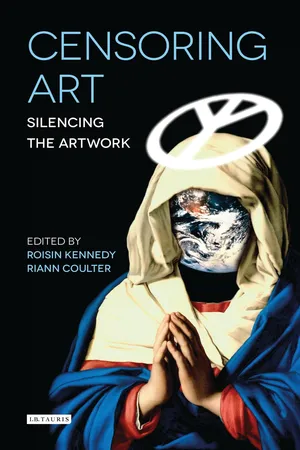
Censoring Art
Silencing the Artwork
- 208 pages
- English
- ePUB (mobile friendly)
- Available on iOS & Android
eBook - ePub
About this book
Art is continuously subjected to insidious forms of censorship. This may be by the Church to guard against moral degeneration, by the State to promote a specific political agenda or by the art market, to elevate one artist above another. Now, and in the last century, artwork that touches on ethnic, religious, sexual, national or institutional sensitivities is liable to be destroyed or hidden away, ignored or side-lined. Drawing from new research into historical and contemporary case-studies, Censoring Art: Silencing the Artwork provides diverse ways of understanding the purpose and mechanisms of art censorship across distinct geopolitical and cultural contexts from Iran, Japan, and Uzbekistan to Britain, Ireland, Canada, Macedonia, Soviet Russia, and Cyprus. Its contributions uncover the impact of this silent control of the production and exhibition of art and consider how censorship has affected art practice and public perceptions of artworks.
Information
1
Censorship in Disguise: Elusive Forms of Exclusion and the Examples of Cypriot Artists Socratis Socratous and Erhan Öze1
Elena Parpa
In November 2014, in what would later be described as an ‘unnecessary and repressive measure’, the Republic of Cyprus police raided an exhibition held at the Municipal Market in Nicosia and confiscated a number of works on display.2 The exhibition, titled Correction, was initiated by Accept-LGBT Cyprus and focused on photographs and videos by Greek artist and trans activist, Paola Revenioti.3 A number of the exhibits on view pictured male nudity, and the police, enforcing an obsolete law from the 1960s, withheld them as ‘offensive’ and arrested the president of Accept-LGBT on the grounds of enabling the display of ‘lewd content’.4 The incident provoked an instant reaction by artists, art organisations and activists who were concerned with interrogating the conditions of freedom in art and the rights of the LGBT community to free expression.5 Examining the whole episode, the official response to the police’s censoring act ranged from silence to bewilderment and attempts to make amends,6 as, within weeks, the photographs in question were returned, charges against the Accept-LGBT president dropped, and the police were reprimanded for ‘excessive zeal’.7
Although Revenioti’s case adds to the long list of censorship incidents related to LGBT content in art, it also represents a typical example of regulated censorship.8 A controlling subject – in this instance the police – assumed its position of authority to exert control over another subject in order to regulate what is shown in the public sphere. Yet, there is a weak link in this otherwise powerful chain constraining freedom of expression. The shadow it casts is visible, identifiable, and can be challenged.9 ‘Explicit forms of censorship are exposed to a certain vulnerability precisely through being more readily legible’, points out Judith Butler in her critical reflections on contemporary modes of curtailing free speech.10 What seems to have been fortunate, then, in this otherwise aggressive instance of regulating expression, was the explicitness of the censor’s actions, which instigated reactions. A recurring question, however, is whether censorship today is as traceable as this example allows us to assume. Indeed, is the figure of the policeman confiscating artworks an outmoded idea of the censoring agent in visual art?
In its popular perception, censorship corresponds to the ‘either/or’ modality.11 That is, a work is either suppressed or not. However, Butler cautions us that censorship can occur outside of the binary, in subtler and less detectable ways.12 Art practitioners and critics have agreed on this and have extended the argument to consider how censorship also operates under many guises that can be camouflaged as moral imperative, political correctness, built-in institutional mechanisms, economic arrangement or even as ‘an inevitable result of the impartial logic of the free market’.13 Recognising the prevalence of what has been described as a ‘domesticated version of the 1970s institutional critiques’, some voices question whether art today can ever challenge the clauses dictating its forms and means of production, circulation and display.14 For these critics, freedom of expression is consistent with what they call ‘artistic sovereignty’,15 which they understand as severely curtailed, thus calling for an urgent reconsideration of the conditions of art’s making.16
Similarly, in censorship discourse it is accepted that regulation of cultural activity does not necessarily occur after the act of expression, but can be manifest during the work’s production, either as self-censorship or as external intervention.17 The issue raised, however, when examining the phenomenon’s operational apparatuses relates to the quandary of equating severe violations of human rights, on the one hand, with less invasive practices, such as the refusal to fund a work, on the other.18 How can we account, then, for those instances of artistic regulation which, although intrusive, do not constitute extreme violations? More importantly, in what ways is artistic expression compromised when operations occur under the radar and in various guises?
With these questions in mind, this chapter addresses some of the intricacies relating to censorship and the regulation of expression within visual art today. Its point of departure includes two cases taken from the Cypriot paradigm. The first concerns the multifaceted installation Rumours (2009), by artist Socratis Socratous, presented at the 53rd Venice Biennale; the second involves Erhan Öze’s Extraterritorial Electromagnetic Interventions (2011), a project that was to be included in an exhibition in Nicosia, but was removed a day before the opening. This chapter investigates the reasons underlying the works’ denunciation and the mechanisms – overt or covert – mobilised for their regulation. It examines them in relation to the dominant rhetoric defining the ethno-political conflict in Cyprus and in relation to the risk-averse policies adopted by institutions in an increasing atmosphere of caution. In so doing, it argues that censorship can operate in disguise, under many pretexts, including that of ‘public safety’, ‘political correctness’ and the need to safeguard society’s ideological hypersensitivities.
However, it is important to make clear from the outset that, although both cases are from a Cypriot context, they are not discussed as testimony to a ‘conservative’ society that has allowed censorship to happen in contrast to other societies where censorship does not exist.19 To recognise, rather, the socio-historical specificity of these cases is to reinforce the argument that different types of censorship – extreme or moderate, explicit or implicit – exist and depend, to a large extent, on the context that surrounds them. Censorship is socially and culturally relative. Whether such a realisation may eventually lead to being more responsive to censorship’s guises, and therefore more instrumental in devising effective forms of resistance, remains a matter to be debated. This is discussed at the end of the chapter in relation to the practices developed both by Socratous and Öze in their attempt to counter limitations and negotiate margins.
Regulating Rumours
Before examining each artist’s confrontation with censorious forces, a brief overview of the contemporary history of Cyprus is necessary in order to comprehend the local ethno-political predicament that has functioned as background to both cases. Formerly part of the Ottoman and British Empires, Cyprus gained its independence in 1960, an outcome that its two main ethnic communities – the Greek and Turkish Cypriots – were reluctant to accept. During the previous decade, between 1955 and 1959, the Greek Cypriots had embarked on an armed insurrection against the British, demanding the island’s enosis (union) with Greece. The Turkish Cypriots, fearing their marginalisation in the case of a British departure, claimed their own political aspiration of taksim (partition). The new republic inherited its population’s internal divisions and as early as 1963/64 interethnic enmity escalated into violent clashes. In 1974, following a Greek Cypriot coup which was supported by the Greek junta, Turkey intervened militarily, taking control of the northern part of the island. The Turkish intervention imposed a de facto partition and until 2003, when the Turkish Cypriot leadership partly opened the checkpoints, the island was divided in two by a non-crossable ‘Dead Zone’. Today, the two communities continue to live separately, as peace talks fail to yield a result. The Greek Cypriot controlled Republic of Cyprus (R...
Table of contents
- Cover
- About the author
- Title Page
- Contents
- List of Figures
- List of Contributors
- Acknowledgements
- Introduction
- 1. Censorship in Disguise: Elusive Forms of Exclusion and the Examples of Cypriot Artists Socratis Socratous and Erhan Öze
- 2. Silenced Voices? The Censorship of Art in Iran
- 3. Art and Censorship in Stalin’s Russia in the 1930s
- 4. Sex, Art and Museums: On the Changing Institutional Censorship of Shunga
- 5. ‘Naked Ladies’: The Censorship of the Nude in Canadian Modern Art
- 6. Censorship in the Irish Free State and its Implications for Irish Art
- 7. Post-Soviet and Post-colonial Forms of Art Censorship in Central Asia
- 8. In the Shadow of Alexander the Great: Censorship, Ideology and Contemporary Art in Macedonia
- 9. The Contemporary Condition of Eilís O'Connell's The Great Wall of Kinsale
- 10. Corporate Censorship
- Selected Bibliography
- Index
- eCopyright
Trusted by 375,005 students
Access to over 1.5 million titles for a fair monthly price.
Study more efficiently using our study tools.
Frequently asked questions
Yes, you can cancel anytime from the Subscription tab in your account settings on the Perlego website. Your subscription will stay active until the end of your current billing period. Learn how to cancel your subscription
No, books cannot be downloaded as external files, such as PDFs, for use outside of Perlego. However, you can download books within the Perlego app for offline reading on mobile or tablet. Learn how to download books offline
Perlego offers two plans: Essential and Complete
- Essential is ideal for learners and professionals who enjoy exploring a wide range of subjects. Access the Essential Library with 800,000+ trusted titles and best-sellers across business, personal growth, and the humanities. Includes unlimited reading time and Standard Read Aloud voice.
- Complete: Perfect for advanced learners and researchers needing full, unrestricted access. Unlock 1.5M+ books across hundreds of subjects, including academic and specialized titles. The Complete Plan also includes advanced features like Premium Read Aloud and Research Assistant.
We are an online textbook subscription service, where you can get access to an entire online library for less than the price of a single book per month. With over 1.5 million books across 990+ topics, we’ve got you covered! Learn about our mission
Look out for the read-aloud symbol on your next book to see if you can listen to it. The read-aloud tool reads text aloud for you, highlighting the text as it is being read. You can pause it, speed it up and slow it down. Learn more about Read Aloud
Yes! You can use the Perlego app on both iOS and Android devices to read anytime, anywhere — even offline. Perfect for commutes or when you’re on the go.
Please note we cannot support devices running on iOS 13 and Android 7 or earlier. Learn more about using the app
Please note we cannot support devices running on iOS 13 and Android 7 or earlier. Learn more about using the app
Yes, you can access Censoring Art by Roisin Kennedy, Riann Coulter, Roisin Kennedy,Riann Coulter in PDF and/or ePUB format, as well as other popular books in Politics & International Relations & Art Theory & Criticism. We have over 1.5 million books available in our catalogue for you to explore.