eBook - ePub
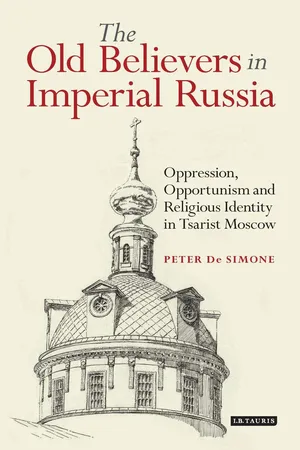
The Old Believers in Imperial Russia
Oppression, Opportunism and Religious Identity in Tsarist Moscow
- 288 pages
- English
- ePUB (mobile friendly)
- Available on iOS & Android
eBook - ePub
The Old Believers in Imperial Russia
Oppression, Opportunism and Religious Identity in Tsarist Moscow
About this book
'Two Romes have fallen. The third stands. And there will be no fourth.' So spoke Russian monk Hegumen Filofei of Pskov in 1510, proclaiming Muscovite Russia as heirs to the legacy of the Roman Empire following the collapse of the Byzantine Empire. The so-called 'Third Rome Doctrine' spurred the creation of the Russian Orthodox Church, although just a century later a further schism occurred, with the Old Believers (or 'Old Ritualists') challenging Patriarch Nikon's liturgical and ritualistic reforms and laying their own claim to the mantle of Roman legacy. While scholars have commonly painted the subsequent history of the Old Believers as one of survival in the face of persistent persecution at the hands of both tsarist and church authorities, Peter De Simone here offers a more nuanced picture. Based on research into extensive, yet mostly unknown, archival materials in Moscow, he shows the Old Believers as versatile and opportunistic, and demonstrates that they actively engaged with, and even challenged, the very notion of the spiritual and ideological place of Moscow in Imperial Russia.Ranging in scope from Peter the Great to Lenin, this book will be of use to all scholars of Russian and Orthodox Church history.
Information
CHAPTER 1
OLD BELIEVERS AND
THE OPPORTUNITIES OF
IMPERIAL RUSSIA
THE OPPORTUNITIES OF
IMPERIAL RUSSIA
Introduction
In the century following the raskol, the Old Rite movement spread throughout the Russian Empire, with many Old Believers hoping to find refuge from persecution in Russia's vast wilderness. However, other Old Believers remained in some of Russia's major cities, primarily because of the significant number of merchants who adhered to the Old Rite and desired to maintain their family businesses. Moscow, in particular, remained home for many Old Believers of both the priestly and priestless sects with many prominent Moscow merchants and shopkeepers as part of their community. By the mid-eighteenth century, many Moscow Old Believers continued to flourish thanks to the state's increased efforts since the time of Peter the Great to utilize the many economic niches Old Rite members claimed, such as their influence among urban merchants.
During this period, the Moscow Old Believers found themselves in a particularly advantageous position in a new era of opportunity beginning with the reigns of Peter III and Catherine the Great. While Peter's reign remained brief before his overthrow by Catherine, both attempted to institute the first efforts of what could be called minor toleration of the Old Rite. This “toleration” more reflected Catherine's larger efforts to introduce some social reform as part of her Enlightened Despotism. In any case, Old Believers did find new opportunities to express themselves and organize their communities more freely.
The Moscow Old Believers utilized the new opportunities of Catherine's early reign to their advantage to expand their influence. However, the devastation of the Moscow Plague of 1770–1 provided the Moscow Old Believers the first true opportunity to establish their own communities that embodied their Old Rite ideals. In an effort to provide care for both Old Believers and other victims of the plague, Moscow Old Believers petitioned tsarist authorities for approval to establish gated, quarantined communities to prevent the further spread of plague and to provide burials for their community members. The petitioners offered to create and administer medical facilities and supervise quarantines for victims of the plague, both healthy and sick; and most important, they maintained religious structures and cemeteries to ensure that Old Believer victims received proper burial services in the Old Rites. Approved by tsarist authorities in Saint Petersburg, the Moscow Old Believers received permission to build two communal religious complexes, Rogozhskoe Cemetery for priestly Old Believers and Preobrazhenskoe Cemetery for the priestless Old Believers. Using this major opportunity, the Rogozhskoe Old Believers built their ideal spiritual and physical manifestation of an Old Rite community devoted entirely to their ideological worldview.1
The Rogozhskoe Old Believers' early history witnessed two key moments that influenced the physical and ideological understanding of their new Holy Moscow. The first was the community's founding in the devastating Moscow plague in 1771. In the aftermath of the plague, the Rogozhskoe Old Believers quickly established themselves as a successful and well-respected community in Moscow, in the Old Rite throughout the empire, and even with authorities back in Saint Petersburg. In the decades that followed, the Rogozhskoe Old Believers quickly set out to make Rogozhskoe Cemetery a physical embodiment of their idealized Orthodox society and even challenged the many restrictions in place against the Old Rite.
Rogozhskoe's second critical moment arose in the aftermath of Moscow's destruction at the hands of Napoleon's invasion and the Moscow Fire of 1812. Many opportunities for spiritual and ideological growth appeared for Rogozhskoe Cemetery, which quickly gained renown for Rogozhskoe's charitable efforts to help rebuild the city and reestablish normal commerce in the region. The opportunities in this period allowed Rogozhskoe to flourish. Rogozhskoe earned even more respect with Moscow and tsarist authorities alike as a model community; however, at the same time its sterling reputation inspired severe jealousy in those who viewed the community's success as a direct threat to the mainstream Russian Orthodox Church.
Opportunity Arises
The greatest advantage and opportunity for the Old Rite by the early eighteenth century was that the movement made up a significant, but ultimately unknown, percentage of Russia's population.2 The fact that the tsarist state continuously struggled to find a means to distinguish Old Believers from “acceptable” Russian society ultimately became the primary means of survival for the movement. While targeted for persecution, many Old Believers utilized two effective methods to escape detection and defend their faith. The first option for Old Believers was to escape into Russia's vast wilderness and live on the periphery of the empire, out of the reach of state and Church intervention. The second option for Old Believers was to hide in plain sight and present themselves officially as members of the Russian Orthodox Church, while they observed the Old Rite in the privacy of their homes and communities. Both options presented the Old Believers with the opportunity to practice their faith with minimal threat from the state or Church authorities, as long as they remained undiscovered. Yet in the case of some Moscow priestly and priestless Old Believers, the urbaites among them chose to remain visible as merchants, shopkeepers, and textile manufacturers; consequently they became one of the most public and successful populations of Old Believers throughout Russia.
The history of the Rogozhskoe Old Believers and their interactions with the Russian state places them prominently in the larger history of the relationship between religious minorities and the tsarist state. Old Believers comprised only one group living within the multi-ethnic, multi-confessional Russian Empire, in which tsarist authorities willingly allowed minorities to contribute to the benefit of the empire.3 Often historians, other scholars, and analysts in other disciplines portrayed tsarist Russia as staunchly unmoving and oppressive toward minority groups. While various periods in Russian history did witness such oppression, it does not make up the whole picture. Specifically, when placing the interaction between the Old Rite and Tsarist Russia into the larger history of other European states' approaches toward Christian minorities, Tsarist Russia's flexibility toward the Old Rite surprisingly sets this interplay apart from some of the far more intolerant approaches to religious dissent in Western Europe in the Early Modern Era.
One such comparative example appears in Catholic France's approach toward the Huguenots, by far one of the least accommodating interactions between a state and a Christian minority group in the aftermath of the Protestant Reformation. Like the Old Rite in Russia a century later, the Huguenots attracted followers from all levels of French society for various religious and political reasons. However, because of their faith, the Huguenot minority found themselves brutally targeted by state authorities and the Catholic population. Unlike the Old Believers in Russia, however, the Huguenots and French Catholics could not establish a meaningful, flexible coexistence. Rather, as both sides claimed to be the sole path toward God's salvation, violence or outright extermination became the sole means for either Catholics or Huguenots to define their understanding of divine truth.4
Like the Old Rite, Huguenotism claimed to represent the one, true Christian faith. However, in the French historical context, the Huguenots became distinctly different from mainstream Catholic French society; whereas the Old Rite still presented itself as part of Russian society. The French Catholic state's inability to accept religious pluralism thereby required an extermination of Huguenotism. To Catholic France, toleration for the Huguenots became synonymous with weakness.5 Inability to accept a duality of French culture and society thereby encouraged French Catholics across all classes to view any toleration of the Huguenots as undermining France itself regardless of Huguenots potential economic and social influences.6 Louis XIV's revocation of the Edict of Nantes in 1685 in favor of the Edict of Fontainebleau illegalized Protestantism, and thus cemented France's approach to religious pluralism. Huguenots therefore only had the options to accept conversion or face punishment at the hands of the state; consequently many Huguenots sought asylum outside of France.7
While Tsarist Russia did persecute and punish religious dissent, particularly toward Orthodox dissenters like the Old Believers, Russia's ultimate goals with their approach toward religious policies appear more flexible by comparison witih policies throughout Western Europe. Over the course of the eighteenth century, the Russian Empire took a particularly “tolerable” approach toward the many religious minorities out of the “imperatives of empire building.”8 Therefore, although religious minorities' conversion to Russian Orthodoxy remained the preferred goal for tsarist and Church officials alike, authorities adapted their policies to allow minorities to contribute to the state economically and socially and at the same time maintain their traditional faith.
This particular approach of the state to interaction with the Old Rite began under Peter the Great and his model of absolutism. Peter broke with many of his predecessors' traditions, among them his view of religious matters, both in his personal spirituality as well as in his approach to the Russian Orthodox Church. In the Russian mindset, as previously seen in Vasili II's rejection of the Council of Florence, the position of the Tsar embodied the spirituality of the entire people and required the Tsar to be the first defender of Orthodoxy. However, Peter shattered the perception of the Tsar's “natural piety,” in his many seemingly questionable actions; for example, smoking, his favoritism toward foreign customs and cultures, and most notably the well-known frivolous acts he committed with his “All Drunken Council of Fools and Jesters.”9 Peter's debauchery not only encouraged the rise of many enemies throughout Russia, but also encouraged critics, such as the Old Believers, to proclaim Peter as the Antichrist.
The Russian Orthodox Church counted itself among Peter's detractors, viewing Peter's antics with concern as he criticized the Church as an entity based on superstition. Presumably an Orthodox believer, Peter chose to approach religion with more rationalism than his predecessors.10 More specifically, Peter saw the Orthodox Church as a compliant tool in his empire and under his rule as Tsar. Ultimately, Peter's creation of the Most Holy Synod in 1721 firmly placed the Russian Orthodox Church under state control. Peter's efforts officially ended the office of Patriarch of Moscow, which remained vacant until 1917; thus he made the Church completely subservient to the State.11 By making the Church a tool of state authority rather than allowing it to remain a completely autonomous entity, Peter created the groundwork for a more flexible relationship between religious minorities and the state, whose economic and social priorities now took precedent over religious conformity.
Beginning with Peter the Great, and throughout the first half of the eighteenth century, authorities enacted laws both to identify Old Believers and to make their devotion to the Old Rite profitable to the state. The most well-known legislation targeting Old Believers came from Peter's infamous beard taxes, dress taxes, and double poll tax.12 This policy toward the Old Rite served two purposes: create legislation to identify Old Believers based on their adherence to traditional Russian culture, and to use their devotion to their faith to bring in new sources of revenue for Peter's state. From Peter's efforts, the state saw such legislation as only beneficial. Either, Old Believers provided taxes for the state, or hopefully convert to the Russian Orthodox Church and abandon the Old Rite to avoid taxation.
However, Peter's legislation faced immediate problems. The most notable issue lay in the fact that Old Believers remained ardent adherents to traditional Russian culture, particularly in appearance and dress. With no distinguishing physical features to separate Old Believers from the majority of Russia's peasant and commoner population, Old Believers could often escape targeting under the new legislation. Thanks to their ability to hide in plain sight, Peter's taxes could never work as intended since most Old Believers simply blended in with the dominant Russian peasant culture.
The primary target, then, for legislation such as Peter's became the most visible bastions of the Old Rite, Old Believer merchants and communities in urban and production centers. However, even without the ability to camouflage themselves among the rest of Russia's population, wealthy Old Rite families and communities could often circumvent taxation and any other restrictions placed on them. In particular, one of the most successful and easiest methods, bribery of state and Church officials, became common to avoid registration for things such as the double tax.13 Yet tsarist Russia proved flexible in its approach to Old Rite communities if they could contribute, primarily economically, to the state. For example, in order to encourage increased economic growth with mining of raw materials, increased production of manufactured goods, and creation of means to trade, tsarist authorities and some Old Believers established mutually beneficial relationships. Two such examples of this symbiosis in practice can clearly be found in the case of the Vyg Old Believer community and the special treatment for the Demidov metallurgical empire in the Urals, which played a critical role in Russian iron production.14
Because of this new approach, and even while identified as religious dissenters, Old Believers used these opportunities to maintain and expand their businesses, trades, and industries throughout the Russian Empire. Moscow in particular benefited from the relaxed approach toward the Old Rite. The economic foundations of Old Rite communities in Moscow stretched back to the raskol and into ...
Table of contents
- Front Cover
- Title Page
- Copyright
- Dedication
- Contents
- List of Illustrations
- Transliteration and Dates
- List of Abbreviations
- Acknowledgements
- Introduction
- 1. Old Believers and the Opportunities of Imperial Russia
- 2. Faith and Identity Under Siege, 1822–56
- 3. Rogozhskoe in the Reform Era, 1856–1905
- 4. A New Beginning, 1905–17
- Epilogue and Conclusion Tragedy and New Challenges
- Notes
- Bibliography
Trusted by 375,005 students
Access to over 1.5 million titles for a fair monthly price.
Study more efficiently using our study tools.
Frequently asked questions
Yes, you can cancel anytime from the Subscription tab in your account settings on the Perlego website. Your subscription will stay active until the end of your current billing period. Learn how to cancel your subscription
No, books cannot be downloaded as external files, such as PDFs, for use outside of Perlego. However, you can download books within the Perlego app for offline reading on mobile or tablet. Learn how to download books offline
Perlego offers two plans: Essential and Complete
- Essential is ideal for learners and professionals who enjoy exploring a wide range of subjects. Access the Essential Library with 800,000+ trusted titles and best-sellers across business, personal growth, and the humanities. Includes unlimited reading time and Standard Read Aloud voice.
- Complete: Perfect for advanced learners and researchers needing full, unrestricted access. Unlock 1.5M+ books across hundreds of subjects, including academic and specialized titles. The Complete Plan also includes advanced features like Premium Read Aloud and Research Assistant.
We are an online textbook subscription service, where you can get access to an entire online library for less than the price of a single book per month. With over 1.5 million books across 990+ topics, we’ve got you covered! Learn about our mission
Look out for the read-aloud symbol on your next book to see if you can listen to it. The read-aloud tool reads text aloud for you, highlighting the text as it is being read. You can pause it, speed it up and slow it down. Learn more about Read Aloud
Yes! You can use the Perlego app on both iOS and Android devices to read anytime, anywhere — even offline. Perfect for commutes or when you’re on the go.
Please note we cannot support devices running on iOS 13 and Android 7 or earlier. Learn more about using the app
Please note we cannot support devices running on iOS 13 and Android 7 or earlier. Learn more about using the app
Yes, you can access The Old Believers in Imperial Russia by Peter T. De Simone in PDF and/or ePUB format, as well as other popular books in Historia & Historia rusa. We have over 1.5 million books available in our catalogue for you to explore.