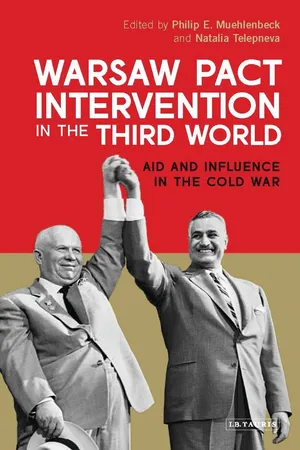
It was long assumed that the Soviet Union dictated Warsaw Pact policy in Africa, Asia, the Middle East and Latin America (known as the 'Third World' during the Cold War). Although the post-1991 opening of archives has demonstrated this to be untrue, there has still been no holistic volume examining the topic in detail. Such a comprehensive and nuanced treatment is virtually impossible for the individual scholar thanks to the linguistic and practical difficulties in satisfactorily covering all of the so-called 'junior members' of the Warsaw Pact. This important book fills that void and examines the agency of these states - Czechoslovakia, the German Democratic Republic, Poland, Hungary, Bulgaria and Romania - and their international interactions during the 'discovery' of the 'Third World' from the 1950s to the 1970s. Building upon recent scholarship and working from a diverse range of new archival sources, contributors study the diplomacy of the eastern and central European communist states to reveal their myriad motivations and goals (importantly often in direct conflict with Soviet directives).
This work, the first revisionist review of the role of the junior members as a whole, will be of interest to all scholars of the Cold War, whatever their geographical focus.
eBook - ePub
Warsaw Pact Intervention in the Third World
Aid and Influence in the Cold War
- 368 pages
- English
- ePUB (mobile friendly)
- Available on iOS & Android
eBook - ePub
Warsaw Pact Intervention in the Third World
Aid and Influence in the Cold War
About this book
Information
PART I
THE RE-DISCOVERY OF THE THIRD WORLD
CHAPTER 1
ULBRICHT, NASSER AND
KHRUSHCHEV: THE GDR'S
SEARCH FOR DIPLOMATIC
RECOGNITION AND THE SUEZ
CRISIS, 1956
KHRUSHCHEV: THE GDR'S
SEARCH FOR DIPLOMATIC
RECOGNITION AND THE SUEZ
CRISIS, 1956
Lorena De Vita
On 7 October 1949, following the official proclamation of the foundation of the German Democratic Republic (GDR) in the eastern part of Germany, Soviet leader Joseph Stalin congratulated the East German leadership, praising the significance of this political development for the ‘history of Europe’.1 Two days later, the newly unanimously elected East German president, Wilhelm Pieck, addressed the East German Volkskammer (literally ‘People's Chamber’, i.e., the GDR's Parliament) promising that he would look on his task as that of a ‘trustee for the interests of the whole of the German people’, and that he would work to forge a ‘great, rich and luminous’ future for the country.2 Four-and-a-half months earlier, celebrating the foundation of the Federal Republic of Germany (FRG) in the West, Chancellor Konrad Adenauer had made a similar point. A fierce competition, between East and West Germany, had officially begun. From a West German perspective, this struggle concerned which state should be considered the legitimate representative of the German people. On the other hand, East Berlin's less ambitious goal was to demonstrate that the GDR, too, was a legitimate German state, capable of being recognized internationally. The competition sharply intensified in 1955. In March 1954, the Soviets had announced the normalization of their relations with the GDR, proclaiming East Germany's ‘full sovereignty in its internal and external affairs’.3 They reiterated the message in September 1955, during the visit of an East German delegation to the USSR. While in Moscow, Prime Minister Otto Grotewohl signed a document declaring that relations between the Soviet Union and the GDR would be ‘based on complete equality of rights, mutual respect of sovereignty, and non-interference in domestic affairs’ – a move which evidently undermined the West German claim of being the sole representative for the whole of Germany (Alleinvertretungsanspruch).4 In response to this, and in order to prevent other countries from establishing relations with the GDR, in December 1955 the West German Government released a statement declaring that from then onwards Bonn would interpret any recognition of the GDR as an ‘unfriendly act’ – a stance later known as the ‘Hallstein Doctrine’.5 East German efforts at gaining recognition from so-called Third World countries, and the relentless West German campaign to ensure that this would not happen, characterized German–German competition on the global stage throughout the 1950s and 1960s.
The year 1955 also saw a series of momentous developments in the Middle East. These included the establishment of a Western-sponsored military alliance, the Baghdad Pact, signed between Turkey and Iraq in February, and later joined by Pakistan, Iran and Great Britain. Amongst those who viewed this development as a serious threat to the stability of the Middle East was Gamal Abdel Nasser. By 1955, Nasser had affirmed himself as a leading political figure in Egypt as well as in the Arab and non-aligned world. At home, he had emerged victorious from the internal rivalries amongst the Free Officers who had ousted the Egyptian monarchy following the 1952 revolution, becoming the leading political figure in Egypt. Nasser's references to the problems of the Egyptian people as problems of the Arab peoples, and his emphatic support for the Palestinian cause, allowed him to attract the admiration of not only much of the Egyptian population but also of large sections of the public opinion within the Arab world.6 In 1955, Nasser's anti-Israeli rhetoric harshened to an unprecedented level, especially following a very heavy attack waged by the Israeli Defense Forces in February–March in order to curb fedayeen infiltrations into Israeli territory from Gaza, which at that time was under Egyptian military control. The attacks re-ignited the humiliation suffered by Egypt and the Arab coalition on occasion of the 1948–9 war against Israel, in which Nasser himself had fought and which was still very much alive as a burning defeat in the collective memory of the Arab peoples.7 In April 1955, the Egyptian leader established himself as one of the dominant personalities at the Bandung Conference, a meeting of 29 heads of state and government from Asian and African countries, which took place in Indonesia and aimed to assist the potential emergence, within the Cold War, of a non-aligned bloc of Third World states.8 US Secretary of State John Foster Dulles remarked that under the current international political climate claiming neutrality was an ‘immoral’ policy.9 Nasser's presence at Bandung, however, and his contribution to the eventual creation of the Non-Aligned Movement (NAM), allowed him to project his political allure onto the international stage.10
In the mid-1950s, the Arab Middle East became the main testing ground for East German experiments in dealing with Third World countries and with the new leaders that emerged from them. The importance of the Middle East for understanding East German foreign relations with Third World countries has mainly to do with chronology. Indeed, the area was the first in which the GDR managed to gain some kind of international network, having already signed a series of trade deals with the countries of the region by the first half of the 1950s. However, this also meant that for the first time when dealing with Middle Eastern countries, East German representatives confronted issues that would arise again and again over the following decades when dealing with nations in other areas of the non-aligned world. In the mid-1950s, projecting the GDR's appeal beyond the socialist bloc in an attempt to gain international recognition proved to be a challenging exercise. It was, however, one that East German leader Walter Ulbricht knew could be crucial for the survival of the GDR.
Egypt was the very first Third World country to sign an economic deal with the East German Government, in 1953. From then on, relations between the two countries assumed ever greater importance for the East German leadership.11 So much so that in 1956, while the cohesion of the Soviet bloc was threatened by uprisings in Poland and Hungary, and the precarious stability of the East German state itself was at risk, Ulbricht became preoccupied with the necessity of reaching out to the Arab Middle East. This was also thanks to Nasser's understanding – before that of any other Third World leader – of how fruitful it could be to use one Germany to gain concessions from the other. Learning to deal with Nasser led Ulbricht to clash with his comrades at home, reviving old rivalries amongst East German communists, as well as with his Soviet masters in Moscow. Indeed, Ulbricht would learn a great deal from the frustration experienced in 1956. First, from his frustration with Nasser, who seemed not to be keeping his word, he would come to appreciate how much there was still to do to render the GDR at least economically if not politically attractive vis-à-vis Third World leaders. Second, he learned from his experience with the Soviets, who theoretically should have supported East German endeavours in the Third World but in fact were deeply concerned by the implications that Ulbricht's dynamism abroad might have for the socialist bloc. Ulbricht would come to appreciate the contradictions typical of the relationship between the GDR and its superpower. The picture that emerges from this analysis of the run-up to, and immediate aftermath of, the Suez Crisis is one of a constant pushing and pulling between East Berlin and Moscow in the summer of 1956 – the former eager to reach out to the countries of the Levant; the latter convinced that such initiatives would quickly backfire.
Chasing Sovereignty, German-Style
Nasser's charismatic political persona appealed to many, in Egypt and beyond. However, this in turn unleashed a series of political jealousies that would characterize intra-Arab politics for more than a decade to come.12 And, in the West, the Eisenhower administration and the Eden government looked on the Egyptian President's political dynamism at both national and international level with increasing dislike. In an attempt to curb his political allure, in quick succession and with little advance notice the USA, the United Kingdom and the World Bank withdrew their offer to finance Nasser's most valued project, the building of a high dam at Aswan. Discussions about the project had begun shortly after the Free Officers ousted the monarchy, in 1952, although the planning of a high dam on the Nile dated back to the 1930s.13 For Nasser, the dam was crucial. Its construction would have allowed Egyptian agricultural output to multiply, providing more food for the country's fast-growing population and supporting Egypt's rural and urban electrification plans. Amongst the first to explore how to engineer and finance the dam were West German firms.14 However, in mid-1956 the news of the Soviet readiness to finance the works for the construction of the dam in Egypt led the USA to withdraw its offers of credit to Egypt – in the expectation that the project would put such a burden on the Soviet Union and its satellite states as to prove unfeasible for the Soviet bloc economy. In turn, this would guarantee facile Western propaganda victories in the Warsaw Pact countries while at the same time working as a warning to other Third World nations that might be toying with giving in to Soviet support offers.15 Secretary of State Dulles communicated the US decision to withdraw the funding of the high dam project on 19 July 1956. The British followed suit on 20 July, and so did the World Bank on 23 July. The sudden Anglo-American withdrawal of funds for the high dam marked one of the heaviest blows to Nasser's domestic political project. Three days later, Nasser announced the nationalization of the Suez Canal and, two months on, the Egyptian leader broke the news that his country had finalized a groundbreaking arms deal with Czechoslovakia.16 The new arms-procurement agreement between Cairo and Prague nullified the efforts of the US–British–French Near East Arms Coordinating Committee, which had attempted to control the flow of weapons to the region following the first Arab–Israeli war, and threatened to tilt the military balance in Egypt's favour. The deal further signalled that the Western position in the region was potentially at risk, and that the Soviets could and would militarily and economically penetrate the Middle East if given the chance to do so.
The West German secret services (Bundesnachrichtendienst, BND) suspected that the Czech–Egyptian arms deal could contain a secret clause binding Cairo to diplomatically recognize East Berlin.17 This suspicion was heightened by the fact that the GDR had, in the meantime, managed to conclude trade agreements with Lebanon (1953) and Syria (1955), and a payments agreement with Sudan (1955); establish a permanent trade mission in Egypt (1954); and sign a long-term trade agreement and lay the foundations for the establishment of respective consulates in Cairo and East Berlin (November 1955).18 East German propaganda emphatically claimed that these developments showed that the Hallstein Doctrine, and West German threats to third countries, made ‘obviously little impression abroad’.19 It was, however, an overstatement to claim, as East German propaganda did, that by the end of 1956 Egyptian leader Gamal Abdel Nasser would recognize the existence of two German states.20 Nonetheless, the treaties that East German representatives signed in the Middle East between 1953 and 1955 did represent a remarkable success for the GDR in international affairs.21 In order to capitalize on this success, and to discuss the upcoming goals linked to the GDR's engagement abroad, a conference of East German diplomats was organized in early 1956. T...
Table of contents
- Front Cover
- Title Page
- Copyright
- Contents
- List of Tables
- Preface
- Notes on Contributors
- Introduction
- PART I The Re-Discovery of the Third World
- PART II ‘Intermediaries’: Spies, Journalists, Doctors, Teachers and Diplomats in the Third World
- PART III Money and Influence: Diplomacy, Aid and Trade
- Conclusion
- Select Bibliography
Trusted by 375,005 students
Access to over 1.5 million titles for a fair monthly price.
Study more efficiently using our study tools.
Frequently asked questions
Yes, you can cancel anytime from the Subscription tab in your account settings on the Perlego website. Your subscription will stay active until the end of your current billing period. Learn how to cancel your subscription
No, books cannot be downloaded as external files, such as PDFs, for use outside of Perlego. However, you can download books within the Perlego app for offline reading on mobile or tablet. Learn how to download books offline
We are an online textbook subscription service, where you can get access to an entire online library for less than the price of a single book per month. With over 1.5 million books across 990+ topics, we’ve got you covered! Learn about our mission
Look out for the read-aloud symbol on your next book to see if you can listen to it. The read-aloud tool reads text aloud for you, highlighting the text as it is being read. You can pause it, speed it up and slow it down. Learn more about Read Aloud
Yes! You can use the Perlego app on both iOS and Android devices to read anytime, anywhere — even offline. Perfect for commutes or when you’re on the go.
Please note we cannot support devices running on iOS 13 and Android 7 or earlier. Learn more about using the app
Please note we cannot support devices running on iOS 13 and Android 7 or earlier. Learn more about using the app
Yes, you can access Warsaw Pact Intervention in the Third World by Philip E. Muehlenbeck, Natalia Telepneva, Philip E. Muehlenbeck,Natalia Telepneva in PDF and/or ePUB format, as well as other popular books in History & 20th Century History. We have over 1.5 million books available in our catalogue for you to explore.