eBook - ePub
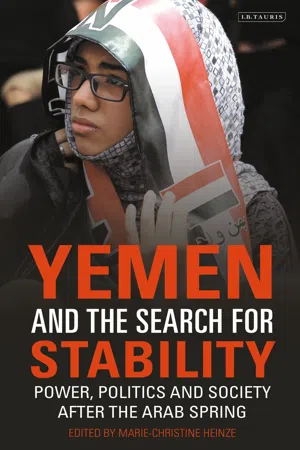
Yemen and the Search for Stability
Power, Politics and Society After the Arab Spring
- 360 pages
- English
- ePUB (mobile friendly)
- Available on iOS & Android
eBook - ePub
Yemen and the Search for Stability
Power, Politics and Society After the Arab Spring
About this book
The attacks and blockade on Yemen by the Saudi-led multinational coalition have killed thousands and triggered humanitarian disaster. The longstanding conflict in the country between the Huthi rebels and (until December 2017) Salih militias on the one side and those loyal to the internationally recognized government and many other groups fighting for their interests on the other are said to have evolved into a proxy war between Saudi Arabia and Iran. In 2011, however, thousands of Yemenis had taken to the streets to protest for a better future for their country. When President Ali Abdullah Salih signed over power in the aftermath of these protests, there were hopes that this would signal the beginning of a new period of transition. Yemen and the Search for Stability focuses on the aspirations that inspired revolutionary action, and analyzes what went wrong in the years that followed. It examines the different groups involved in the protests - Salih supporters, Muslim Brothers, Salafis, Huthis, secessionists, women, youth, artists and intellectuals- in terms of their competing visions for the country's future as well as their internal struggles. This book traces the impact of the 2011 upheavals on these groups' ideas for a `new Yemen' and on their strategies for self-empowerment. In so doing, Yemen and the Search for Stability examines the mistakes committed in the country's post-2011 transition process but also points towards prospects for stability and positive change.
Information
PART I
Competing Visions:
Yemen's Imagined Futures
Yemen's Imagined Futures
CHAPTER 1
Scepticism among Emerging
Public Intellectuals in
Post-Revolution Yemen
Public Intellectuals in
Post-Revolution Yemen
Abdulsalam al-Rubaidi1
Fill your cup with uncertainty,
And in the midday reflect on your shadow;
For it is perhaps your shape seen by the light.
Khalid al-ʿAbsi, a contemporary Yemeni poet and
linguist (2015: 48)
linguist (2015: 48)
INTRODUCTION
Since the revolution of 2011 in Yemen, emerging public intellectuals have begun to express fundamentally new ideas. The common feature of these intellectuals is that they have given prominence to discussing the most sensitive Yemeni issues in a radically critical fashion and to presenting paradigmatic alternatives to the established religious, social and political norms. By that, these new intellectuals represent a “scepticism” which has become a new feature within Yemeni society. For the sake of this chapter, I define the term “scepticism” as the critical questioning of taken-for-granted values, ideas and practices that were part of the dominant discourse of the pre-revolution regime. On the religious level, this definition of scepticism would necessarily include secular criticism and blasphemy (utterances against what has been collectively and historically thought to be “Islamic”) and can also include what some might define as heresy. On the political and social level, scepticism can connote any intellectual interrogation of the well-established normative order, for instance tribal values or gender politics. This emergence of a generation of new public intellectuals was on the one hand possible because of the breakdown of the traditional authorities, which in the past have enforced the normative order; and on the other hand due to new media, which provided alternative spaces for intellectuals to spread and discuss their new ideas, giving rise to new publics.
In the context of the revolution of 2011 and its aftermath, the triad of traditional authority – the religious authority, the social authority, and the militarized political authority – gradually broke down. With hundreds of thousands of Yemenis across the country protesting against the centralized traditional elite, the well-established normative order, that is the structure of society including gender roles, the way Islam is to be understood and practised, or the way the political order is to be interpreted, began to be questioned. According to Chalmers Johnson, it is in this juncture of the revolutionary process when the authoritarian regime loses its control over the society and that the people become able to express their suppressed positions. In the case of Yemen, generally speaking, the revolutionary individuals and movements have not only challenged the existence of the political regime but also its discursive and normative claims. According to conjunction theorists of revolutions, “political structures that over centralise power and isolate people are conducive to social movements that must, for structural reasons, challenge the very validity of the normative order” (Johnson 1989: 182). Although the traditional elite signed the internationally sponsored GCC Initiative in an attempt to uphold their own symbolic and material interests, such as positions within the military or government as well as business interests, the subsequent transition process contributed to their deconstruction (see Transfeld 2015). While the Sunni Islamists and the Huthi Zaydi Shiʿis were debating at the negotiating table of the National Dialogue Conference (NDC), they were at the same time engaged with each other in deadly fighting (see Brandt's contribution in this volume for the sectarian conflicts and the parallel negotiations).With the aim of regaining the power they perceived to have lost, the tribal federations became engaged in conflict with(in) each other, with the state, and with other political groups, which dramatically weakened social authority on a tribal, political and religious level.
It was this triad of authorities that upheld social, religious and political norms, ultimately representing the very base of the centralized authority held by former President Salih. The constant re-enactment of these norms in society has given them the form of rigid structures that seem to defy historical transformations. The revolution in Yemen was thus a historical response to what had been believed by many Yemenis to be outside the realm of possible human action. In other words, the revolutionary discourse of 2011 began to address the unaddressable and question the unquestionable humanly designed fatalism. These intellectuals found in the revolution their historical chance to make their dissenting voices heard and to deconstruct the accumulated intellectual capital that was wielded by the traditional elite. Against the backdrop of the transitional process that was initiated in the country since ʿAli ʿAbd Allah Salih signed the GCC Initiative in November 2011, the respective writers embarked upon a deconstructive–constructive enterprise that puts forward rational secularism (or rather freedom of conscience) versus totalitarian religiosity; a democratic political model versus an oligarchic model; and liberal social thought versus dogmatic social fideism. Hence, they opted for challenging a multifaceted power apparatus wherein religious authority is combined with the highly centralized authority of the military - tribal elite. Thus, those resentful intellectuals embarked on the difficult mission to fight the established normative order in its entirety and to further revolutionize the revolution itself by challenging the common understanding of the revolution as being an act of changing the political regime only. It can be gleaned from their writings and oral contributions that the real revolution was to change our idealized image of the past and the present. Hence, their questioning targeted the Islamic culture in general and the prevailing convictions about history, identity and traditional mores.
What distinguishes these new public intellectuals from critical voices heard before 2011 is that their controversial writings became the subject of wide debate and accordingly wielded greater influence. Most of these intellectuals were not very widely known before 2011; they were relatively young in contrast to the age of the authoritarian regime itself and had only recently been recognized in the cultural and political scene. Their promotion and recognition did not come from the official governmental institutions connected to the traditional authorities, but mostly they were symbolically empowered by their readers and followers who themselves belonged to the opponent social and political movements. This was enabled by social media that gained traction in Yemen in the context of the 2011 uprising. In the Arab world, these new online media with their different possibilities have been a powerful alternative tool of challenging the existing conservative media owned by the traditional elite (Woo-Young 2005: 925). E-participation, according to Woo-Young, is characterized by convenient access to detailed information; free expression and exchange of opinions; online activism led by politicized agenda; and active formation of cyber groups (ibid.). In the case of Yemen, the aforementioned elements became the features of the revolutionary discussions in cyberspace resulting in the fact that in 2011 and after cyberspace had become a fertile land for planting new values and for changing the normative order in the country.
Taking into consideration the explosion of participation in new communication technologies in the urban areas in the aftermath of the revolution 2011 in Yemen,2 the audience of these writers and poets increased and the impact of their ideas became tangible. It is evident from the comments of their Facebook followers that the audience (mainly urban youth) had become interested in the writings of the newly emerging sceptics; thus, since 2011, their voices have been competing with the conservative voices in the intellectual arena of the country.
The traditional elites could not suppress these voices. This was not only because the traditional elites were weakened and because there was a preoccupation with the power struggle on the national level: it was also due to the fragmented nature of this large group of alternative intellectuals, and due to the elusive, fluid character of the space provided by social media. New media spaces offered new, open and wide alternatives for the closed qat sessions.3 Every social media user, whether in the country or outside, could contribute her or his opinion without fearing the authorities. The sense that one is expressing her or his opinion in a virtual space and is part of a large virtual community gave many the psychological security for saying what one really believes. In the case of Yemen during the transition process, the groups and virtual alliances on Facebook can be understood as an alternative to the partisan groupings in the parallel physical spaces.
As a result of the political crises and the open moment for expressing themselves, ordinary Yemenis became more outspoken in expressing their doubtful sentiments towards the elites in a way long unseen in this conservative country. In short, since the advent of the change movement, Yemeni society experienced an earthquake of its well-established values and norms. Inspired by the ongoing social mobilization, the sceptics in question dared to question the unquestionable in contemporary Yemeni thought. In doing so, these intellectual sceptics did not necessarily make up a homogeneous group; rather, they often conflicted with each other in their opinions. Yet, at bottom, they all shared the same revolutionary vision.
Based on these premises, a number of selected argumentative theological, literary, and political texts published by the emerging public intellectuals will be investigated here. Of the three aforementioned authorities, this chapter focuses on writers challenging the dominant conservative discourse in the realm of religious (and to a lesser extent social) values and norms. Here, we can differentiate between two major orientations of scepticism: on the one side, an orientation with roots in Islamic discourse that go back to the early sceptical tendencies among traditional Muslim intellectuals; and on the other side, one that leans towards secularism in its modern sense. While the first one aims to change religious discourse in Yemen from within and is thus more compromising, the second is more confrontational in its aim to ensure freedom of belief and freedom of conscience.
CHALLENGING RELIGIOUS NORMS AND VALUES FROM WITHIN
The first orientation can also be referred to as a revisionist trend. Within this strand of discourse, revisionist intellectuals have taken great pains to make it clear that their critical writings are neither against Islam nor, more particularly, against its scriptures, but rather against the ahistorical understandings of Islam as brought forward by influential scholars in Yemen. They also maintain that the critical tradition of ijtihad, which they seek to advocate, is a traditional tool of Islamic jurisprudence and thus a legitimate Islamic way of reasoning. Opponents of this attitude maintain that their arguments and critical writings are against Islam itself. Thus, in order to avoid clashing with the opposing fundamentalists4 (i.e. individuals, sub-groups, or groups, mainly of Salafi background, who believe that they have the right to protect shariʿa norms), religious sceptics adopt compromising argumentative strategies to alleviate any aggressiveness in their discourse that might provoke religious sentiments. One of these strategies, for example, is to make frequent references to Islamic history in order to support their arguments, which are as much political as they are religious.
A good example of this strategy is the fatwa (legal opinion) of Husayn bin Shuʿayb5 on the permissibility of secessionist movements in Islam (bin Shuʿayb 2012). Shaykh Husayn bin Shuʿayb, a Salafi shaykh originally from Hadhramawt, sees the “so-called Yemeni unity” (ibid.) as a sheer mythical claim. Both on a religious and historical basis, bin Shuʿayb deconstructs the dominant narrative of an inherently and naturally unified Yemen. This narrative had long been endorsed by both regimes of the South as well as the North, and had become part of the principle elements of the socialization of any Yemeni born after the revolutions that resulted in two separate Yemen republics in the 1960s. The fatwa of the shaykh is inconsistent with the deep-seated Salafi conviction about the Islamic notion of the united umma, i.e. the community of all Muslims worldwide. According to this view, Muslim unity, regardless of details, is an obligatory goal (al-Imam 2012).6
Moreover, bin Shuʿayb's fatwa reinterprets the famous Qurʾanic verse quoted annually at the beginning of the anniversary celebrations of Yemeni unification, which states:
And hold fast, all together, by the rope which Allah (stretches out for you), and be not divided among yourselves; and remember with gratitude Allah's favor on you; for you were enemies and He joined your hearts in love, so that by His grace, ye became brethren; and ye were on the brinks of the pit of fire, and he saved you from it. Thus doth Allah make His signs clear to you: that ye may be guided. (The Holy Qurʾan, sura Al ʿImran, verse 103)
Bin Shuʿayb argues that evoking this verse as evidence that Yemenis are one nation is untenable, as throughout history different dynasties and states have appeared in what constitutes Yemen today. He further argues that the metaphor of “holding God's rope” does not denote what people in Yemen understand as unification. In this verse, according to bin Shuʿayb, God does not talk about unification but rather about “God's religion” and the Qurʾan itself that every Muslim is required to uphold.
Shaykh bin Shuʿayb, who is a fairly new scholar-cum-activist in the South and known as mufti (jurisconsult) of the Southern Movement, has dared to challenge one of the main central Islamic notions, i.e. the umma, by arguing that Yemen was always divided. He seeks to dismantle the dominant discourse about Yemeni unity, which is perceived by the Southern Movement as a tool to legitimize the domination of the Northern regime and its monopolization of Southern resources. In order to do so, bin Shuʿayb employs epistemic mechanisms of the traditional Islamic usul al-fiqh (Islamic jurisprudence), namely ʿurf (custom), a method of reasoning that judges any behaviour of contemporary Muslims according to the historical practices of Muslims. In this line of reasoning, what has been historically known as “the South” is considered distinct in its state and identity, and hence different from the North.
One of the most salient paradigms of the Salafi school of thought is its inclination towards literalist interpretations of Islamic scriptures, i.e. its rejection of prioritizing legal reasoning such as ijtihad or raʿy (personal opinion) over the canonical scriptures. In the case of bin Shuʿayb, however, the tracing of historical e...
Table of contents
- Front Cover
- Title Page
- Copyright
- Dedication
- Contents
- Acknowledgements and Note on Transcription
- List of Abbreviations
- Introduction: Yemen and the Search for Stability
- Part I: Competing Visions: Yemen's Imagined Futures
- Part II: Transition and Its Discontents: Visions and Strategies of Yemen's Political Actors
- Part III: Socio-Cultural Upheavals: Yemen Before and After the Arab Spring
- About the Authors
Trusted by 375,005 students
Access to over 1.5 million titles for a fair monthly price.
Study more efficiently using our study tools.
Frequently asked questions
Yes, you can cancel anytime from the Subscription tab in your account settings on the Perlego website. Your subscription will stay active until the end of your current billing period. Learn how to cancel your subscription
No, books cannot be downloaded as external files, such as PDFs, for use outside of Perlego. However, you can download books within the Perlego app for offline reading on mobile or tablet. Learn how to download books offline
Perlego offers two plans: Essential and Complete
- Essential is ideal for learners and professionals who enjoy exploring a wide range of subjects. Access the Essential Library with 800,000+ trusted titles and best-sellers across business, personal growth, and the humanities. Includes unlimited reading time and Standard Read Aloud voice.
- Complete: Perfect for advanced learners and researchers needing full, unrestricted access. Unlock 1.5M+ books across hundreds of subjects, including academic and specialized titles. The Complete Plan also includes advanced features like Premium Read Aloud and Research Assistant.
We are an online textbook subscription service, where you can get access to an entire online library for less than the price of a single book per month. With over 1.5 million books across 990+ topics, we’ve got you covered! Learn about our mission
Look out for the read-aloud symbol on your next book to see if you can listen to it. The read-aloud tool reads text aloud for you, highlighting the text as it is being read. You can pause it, speed it up and slow it down. Learn more about Read Aloud
Yes! You can use the Perlego app on both iOS and Android devices to read anytime, anywhere — even offline. Perfect for commutes or when you’re on the go.
Please note we cannot support devices running on iOS 13 and Android 7 or earlier. Learn more about using the app
Please note we cannot support devices running on iOS 13 and Android 7 or earlier. Learn more about using the app
Yes, you can access Yemen and the Search for Stability by Marie-Christine Heinze in PDF and/or ePUB format, as well as other popular books in History & Middle Eastern History. We have over 1.5 million books available in our catalogue for you to explore.