eBook - ePub
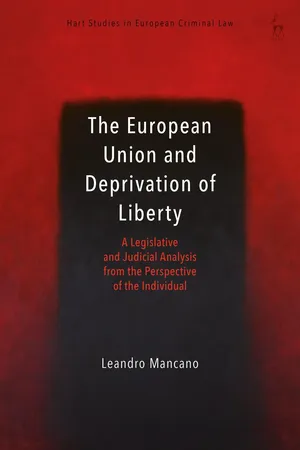
The European Union and Deprivation of Liberty
A Legislative and Judicial Analysis from the Perspective of the Individual
- 272 pages
- English
- ePUB (mobile friendly)
- Available on iOS & Android
eBook - ePub
The European Union and Deprivation of Liberty
A Legislative and Judicial Analysis from the Perspective of the Individual
About this book
The European Union and Deprivation of Liberty examines the EU legislative and judicial approach to deprivation of liberty from the perspective of the following fundamental rights and principles: the principle of legality and proportionality of penalties; the right to liberty; and the principle that criminal penalties must aim for the social reintegration of the offenders. The book measures the relevant EU law against those rights; this constitutes the very core of the relationship between public powers and individual liberty. The analysis shows that the ultimate goal of the Union is the creation and preservation of the EU as a borderless area. The holistic approach adopted in the book explains how different legal phenomena connected to deprivation of liberty have come into being in EU law. It also shows that those phenomena call for solutions suitable for the peculiarities of the EU legal order.
Information
PART I
Free Movement and Deprivation of Liberty in EU Law
1
Free Movement and Deprivation of Liberty. Paradigm, Genesis, Laboratory
I.Free Movement and the Origins of Deprivation of Liberty in EU Law
EU law is not just a framework of coexisting watertight areas. Quite the opposite, it is a ‘whole’ whose constituent parts are highly connected and influence each other. As time has gone by, the connection has been strengthened, with the CJEU playing a major role in this respect. While criminal law and immigration detention are now part and parcel of the Union’s approach to detention, EU law and deprivation of liberty is a story that started in the context of free movement. The plot of the book is placed in the context of the EU as a polity mainly developing around the dynamic integration-fundamental rights protection. This chapter presents free movement (and the construction of the Union as an area without internal frontiers) in its threefold role of paradigm, genesis and laboratory of EU law involvement in the deprivation of liberty.
This follows from the holistic approach adopted in this book. Interdependence is an inherent feature in the EU, where interaction takes place not only among the different areas of Union law, but also between the latter and national systems. Deprivation of liberty is a case in point. Rulings on the Member States’ use of custodial penalties in the context of the internal market have led the CJEU to state and develop principles which then become the bread and butter of EU criminal law.
Three different expressions of interaction can be seen here.1 Firstly, the impact of EU law on Member States’ law has concerned the infringement of EU law provisions punished with imprisonment at national level, where the CJEU has set aside those rules that limited the rights established by EU law in a disproportionate manner.2
Secondly, the use of criminal penalties has been upheld by the EU as a tool in maintaining the effectiveness of EU law. The Greek Maize case is the landmark judgment in this respect.3 The ruling concerned an episode of fraud against the Community’s financial interests. Maize had been exported to Belgium from Greece. Although the maize had previously been imported from the former Yugoslavia, it was sold as having Greek origin. The fraud was facilitated by Greek civil servants, and perpetrated to avoid paying levies due to the Community because of the initial import from a third country into a Community Member State.
The Court, by founding its reasoning on the principle of loyal cooperation,4 established the principle of assimilation. Here the obligations are for Member States to treat comparable violations of Community and national law with analogous means, for Member State reactions to amount to effective, proportionate and dissuasive penalties, and for these to be enforced with the same diligence as those applied to national situations. The Court did not mention a specific type of sanction – although it referred to the Greek authorities’ failures to ‘institute criminal or disciplinary proceedings’ against the persons involved in the fraud.5
Over the years, the obligations ensuing from the Greek Maize case have developed considerably. At first, the Court referred to the Member States’ obligation to punish an infringement of EU law through criminal penalties in subsequent judgments.6 Secondly, the Greek Maize ‘formula’ – requiring effective, proportionate and dissuasive sanctions – was used in instruments of substantive EU criminal law, and progressively accompanied by an explicit obligation for states to impose penalties involving deprivation of liberty.
In the third type of interaction, national law principles (especially in the area of criminal law) have been regarded as general principles of EU law, particularly in order to ensure the application of Union law in compliance with the principles of legal certainty and non-retroactivity in criminal proceedings.7 In all these cases, interaction has arisen between states’ (mis)use or (non)use of custodial penalties in areas covered by the law of free movement.
The expansion of the Union’s competence in the area of criminal law and migration and asylum has only increased the likelihood of interaction between free movement and deprivation of liberty. This is even more the case since the Treaty of Lisbon has demolished the pillar-based structure of the EU and ‘communitarised’ areas of EU law such as the former third pillar.
Broadly speaking, the interplay between deprivation of liberty and free movement has increased at the EU level over the years, with two broad fronts of interaction emerging in particular. On the one hand, we have seen the use of the legal rules, and their interpretation by the CJEU, where deprivation of liberty is overtly resorted to. In the Area of Freedom, Security and Justice (AFSJ), detention is explicitly used in EU instruments since the Union has specific competences in this respect. On the other hand, until recently the use of deprivation of liberty was not part of the Union’s project, which was mainly concerned with construction of the internal market and exercise of the fundamental freedoms. In this way rules involving detention have been put under the spotlight by the interaction between EU and national laws, with the Court (mainly) deliberating on the role attached to Member States’ custodial penalties.
The high relevance of the interaction between fundamental freedoms (or, more broadly, Union law) and deprivation of liberty has been extensively analysed.8 Indeed, free movement has been, and is, the core of EU law since the Community was born, though many other areas have been gaining ground over the years. Right from the establishment of the EU, national provisions involving deprivation of liberty have been increasingly covered by the law of the four freedoms (consisting of the Treaty and secondary law). Thereby, the chance for both kinds of rules (national and EU) to interact has significantly heightened. Such dynamics have triggered many interpretative dilemmas, the resolution of which has been referred to the CJEU by national judges. In these contexts, the CJEU has been asked to find an equilibrium between economic freedoms and state sovereignty. Two fundamental questions arise in this respect: is deprivation of liberty (mainly in the form of custodial penalties) restricting, or capable of restricting, a fundamental freedom; and if so, may such a restriction be allowed?
Many studies have focused on the use of general principles by the CJEU to increase protection of individual rights,9 also with regard to the use of deprivation of liberty by Member States. This first chapter illustrates the relevance of free movement to EU law and deprivation of liberty: genesis, paradigm and laboratory, and objective. Firstly, the following pages show that the story told in this book has originated primarily in the context of the internal market. They also highlight that such an interaction has resulted in the elaboration of principles that have then found application in other areas. The twofold function of the internal market as origin and laboratory features a bright side – use of EU law to limit states’ coercive powers – and a dark side, with the connection between deprivation of liberty and free movement relied on to adopt measures involving detention at EU level. Secondly, the chapter discusses how the creation of an area without internal frontiers has facilitated the spread of cooperation against criminals, so requiring a joint effort by the Member States through further integration and cooperation in the fight against transnational crime. Thirdly, and relatedly, it points to the (safe) exercise of free movement – again, creation and preservation of a borderless area – as the main horizon of the incremental use of deprivation of liberty in EU law.
The chapter is structured into two main sections. Firstly (in section II), the case-law where the interaction has materialised is presented in two main scenarios. Here, the discussion focuses on the role of free movement as genesis and laboratory of the Union’s involvement in deprivation of liberty. The first scenario concerns the use of the principle of proportionality, and its application to the cases of Skanavi10 and Awoyemi.11 They examine exactly the same situation (driving in a host Member State with a non-recognised licence) and the same penalty (criminal sanctions, in particular imprisonment and a fine). The only difference lies in that Mrs Skanavi was an EU national, while Mr Awoyemi was not. Therefore, these two decisions are jointly read to contrast the differences between the proportionality test applied by the Court to an EU citizen, and that applied to a third-country national (TCN). They are paradigmatic examples of the double-edged nature of the EU’s uniqueness when it comes to deprivation of liberty. On the one hand, the connection to free movement and the use of proportionality proved a valid tool to enhance individual rights. On the other, it is shown how that same link to the Union’s very DNA may create a vacuum of legal protection, and confusion as to the content and meaning of principles in different contexts (eg proportionality in EU, and criminal, laws).
The second scenario deals with the Berlusconi12 and Caronna13 rulings. These cases confirm the role of the internal market as a laboratory for principles then applied elsewhere and currently translated into the Charter. The cases form part of a consistent case-law of the CJEU, according to which criminal liability cannot be directly determined or aggravated by EU law, without a national law of implementation. Therefore, the Court seems to allow the possible non-compliance of national law with EU secondary law.14 It does so by arguing that the implementation of the latter might cause the infringement of a general principle or a fundamental right. At stake in particular was the principle of legality now enshrined in Article 49 CFREU. The first reason for choosing these cases is that the CJEU backed up its argument by explicitly referring to a general principle (as in the case of Berlusconi) or a fundamental right of criminal law (Article 49 Charter in Caronna). It is argued that the rationale behind the decisions in the second scenario provides EU criminal law with an important tool to better protect fundamental rights in the context of mutual recognition.
Section III discusses free movement as a trigger and objective of the increased engagement of EU law in deprivation of liberty. The abolition of internal frontiers has led to increased cooperation amongst Member States, which in most cases took the shape of measures involving deprivation of liberty. The main objective of those measures remained the secure exercise of free movement of Union citizens and business, and higher effectiveness of Union law. The conclusions retrace the first steps of EU law in deprivation of liberty told in this chapter, and prepare for the next Parts of the story.
II.EU Law and Deprivation of Liberty. The Internal Market as a Laboratory
A.Custodial Penalties and Exercise of Free Movement. The Case of Driving Licences
The two main scenarios show how the internal market is the area where the Union not only started engaging with the use of deprivation of liberty, but has also stated principles that might find application somewhere else. The first scenario concerns the connection between the use of custodial penalties and exercise of free movement, and is discussed through two cases on driving licences: Skanavi and Awoyemi.
The question in the Skanavi arose in the context of criminal proceedings against Mrs Skanavi and her husband, Mr Chryssanthakopoulos, who were charged with driving without a licence. According to German law, the condu...
Table of contents
- Cover
- Dedication
- Title Page
- Foreword
- Acknowledgements
- Contents
- Table of Cases
- Prologue
- PART I: FREE MOVEMENT AND DEPRIVATION OF LIBERTY IN EU LAW
- PART II: SUBSTANTIVE EU CRIMINAL LAW
- PART III: PROCEDURAL CRIMINAL LAW AND MUTUAL RECOGNITION
- PART IV: ASYLUM AND IMMIGRATION DETENTION
- PART V: DEPRIVATION OF LIBERTY AND EU CITIZENSHIP
- Epilogue
- Index
- Copyright Page
Trusted by 375,005 students
Access to over 1.5 million titles for a fair monthly price.
Study more efficiently using our study tools.
Frequently asked questions
Yes, you can cancel anytime from the Subscription tab in your account settings on the Perlego website. Your subscription will stay active until the end of your current billing period. Learn how to cancel your subscription
No, books cannot be downloaded as external files, such as PDFs, for use outside of Perlego. However, you can download books within the Perlego app for offline reading on mobile or tablet. Learn how to download books offline
Perlego offers two plans: Essential and Complete
- Essential is ideal for learners and professionals who enjoy exploring a wide range of subjects. Access the Essential Library with 800,000+ trusted titles and best-sellers across business, personal growth, and the humanities. Includes unlimited reading time and Standard Read Aloud voice.
- Complete: Perfect for advanced learners and researchers needing full, unrestricted access. Unlock 1.5M+ books across hundreds of subjects, including academic and specialized titles. The Complete Plan also includes advanced features like Premium Read Aloud and Research Assistant.
We are an online textbook subscription service, where you can get access to an entire online library for less than the price of a single book per month. With over 1.5 million books across 990+ topics, we’ve got you covered! Learn about our mission
Look out for the read-aloud symbol on your next book to see if you can listen to it. The read-aloud tool reads text aloud for you, highlighting the text as it is being read. You can pause it, speed it up and slow it down. Learn more about Read Aloud
Yes! You can use the Perlego app on both iOS and Android devices to read anytime, anywhere — even offline. Perfect for commutes or when you’re on the go.
Please note we cannot support devices running on iOS 13 and Android 7 or earlier. Learn more about using the app
Please note we cannot support devices running on iOS 13 and Android 7 or earlier. Learn more about using the app
Yes, you can access The European Union and Deprivation of Liberty by Leandro Mancano in PDF and/or ePUB format, as well as other popular books in Law & International Law. We have over 1.5 million books available in our catalogue for you to explore.