- 224 pages
- English
- ePUB (mobile friendly)
- Available on iOS & Android
eBook - ePub
The Referendum and Other Essays on Constitutional Politics
About this book
Until recently, referendums were little used. After the Scottish independence and Brexit referendums, they have come to the fore as a mechanism with the potential to disrupt the status quo and radically change political direction. This book looks at the historical development of the referendum, its use in different jurisdictions, and the types of constitutional questions it seeks to address. Written in an engaging style, the book offers a clear, objective overview of this important political and constitutional tool.
Information
Part I
Referendum
1
The Referendum
Non basta più
What is a rebel? It is a man who says no: but whose refusal does not imply a renunciation … A slave who has taken orders all his life, suddenly decides that he cannot obey some new command. What does he mean by saying ‘no’? He means, for instance, that ‘this has been going on for too long’, ‘so far but no farther’, you are going too far, or again ‘There are certain limits beyond which you shall not go’. In other words, his ‘no’ affirms the existence of a borderline.
Albert Camus1
Non basta più – roughly translated – ‘enough is enough’, said the Roman taxi driver as we drove up Via Pietro Roselli towards the American University of Rome. He was not, he said, a ‘populist’, but he had voted against the proposal for a reformed constitution put forward by Prime Minister Matteo Renzi in 2016. Not, the man told me, ‘because he was against the welfare state or the EU’, but simply to send a message to la classe politica. In short, non basta più. His was a signal to the elected politicians that there were certain limits to what they could get away with; that immigration was perceived to be out of control; that growing inequality was unacceptable; and that he disapproved of cuts to healthcare spending.
Some might view these utterances as examples of irrationality, just as many saw the Brexit vote in Britain in 2016 and the Colombian voters’ rejection of the peace plan in the same year as indications of democracy gone amok; as conclusive proof that government by the people, should mean representative government; that too many referendums is a folly. There are, of course, examples of referendums that threatened and discriminated against minorities. But the often unquestioned faith in the ‘elected aristocracy’ – to use Rousseau’s term2 – is on closer inspection in need of revision.
While politicians by and large are able to deliberate, there are a fair number of Acts of Parliament which, at the very least, question the sagacity of elected representatives. In the United Kingdom, the Dangerous Dogs Act 1991 and the Local Government Finance Act 1988 (introducing the Community Charge or ‘Poll Tax’) are examples of ill-considered legislation that reached the Statute Book.
It is to avoid such legislation that it can sometimes be necessary to complement representative democracy with mechanisms that allow the voters to say non basta più – and the referendum is, perhaps, the most appropriate means of doing so.
Populism can be crude and its proponents can be rude and obnoxious but often they are a symptom of an underlying malaise. In the 1890s, the original Populists urged the introduction of referendums that allowed the people to veto laws passed by legislatures and initiatives that could force recalcitrant politicians to introduce legislation that was opposed by big business. And they were often successful. The Populists were denounced as socialists when they proposed to introduce anti-trust legislation. The Los Angeles Times predicted that ‘radical legislation would result and business and property rights would be subject to constant turmoil at the hands of the agitators’.3
In reality this legislation, perhaps, saved capitalism from itself and made sure that the monopolies – that Karl Marx had predicted in Das Kapital4 – never emerged, and that America did not experience the extreme ideological battles that characterised countries with mechanisms for direct legislation by the people or ‘people’s vetos’ through referendums.
As I began to studying the previous examples of Non basta più, a kind of pattern began to emerge, namely one of a self-confident elite defending an abstract ideal which was opposed by ‘ordinary people’, whose everyday experiences were out of sync with the prevailing scientific orthodoxy. Economics professors, senior civil servants and business leaders would tell the voters that ‘you cannot stop progress’ and would denounce popular movements that called for lower taxes or opposed nuclear power stations.
Sometimes, as these groups were on the centre-right, as in the case of the Californian Proposition 13 anti-tax revolt or in the case of the similar movement in Norway, where Anders Lange’s Party for Considerable Reduction in Taxation and Public Intervention (Anders Langes Parti til sterk nedsettelse av skatter, avgifter og offentlige inngrep) won representation in the Stortinget (Parliament) in 1974.
Like his counterpart in America, 40 years later, Mr Lange was unpolished, expressed extreme views in an uncompromising language. Yet, he had a point. Soon, more mainstream political parties took notice and nudged their policies towards lower taxation. They did not follow the more extreme proposals of Mr Lange, but they adjusted their policies – and soon after support for the radical anti-tax party withered away. To paraphrase Friedrich Schiller’s play, the ‘the anti-tax movement had done its duty. The anti-tax movement could go’.5
In the same way, the referendum on nuclear power in Austria in 1978. The Conservative Österreichische Volkspartei (ÖVP) and the Freiheitliche Partei Österreichs (FPÖ), then in opposition, were opposed to the opening of the Zwetendorf nuclear power station. Sensing that the issue was controversial with a year to go before the next parliamentary election, the Social Democrat Chancellor, Bruno Kreisky, decided to hold a referendum on the subject. He did not need to do so, as his party had a majority in the Nationalrat (the lower house), but he sensed that it was necessary for political reasons. Kreisky narrowly lost the referendum but he did not resign. An issue that had the support of the ‘elite’ was denounced by the people. And, just as importantly, the consequence of the vote was not chaos. Normality soon returned. Kreisky won an absolute majority of the vote at the general election the following year and increased his party’s representation in the Nationalrat. One is tempted to agree with the conclusion drawn by Larry Bartels and Christopher Achen, ‘The historical record leaves little doubt that the educated, including the highly educated, have gone as wrong in their moral and political thinking as everyone else’.6
But this is very much a minority view – among commentators, that is. Examples of ‘ordinary people’ revolting against the elite on certain issues are not uncommon and are often denounced as ‘populist’. Indeed, there is a long tradition of lamentations about the supposed stupidity of the ordinary voters.
‘People in masses are like children, easy to influence and even easier to steer if the message is well-packaged and repeated’ wrote the French sociologist Gustave le Bon (1841–1931).7 Perhaps so for little children, but not for teenagers who are not easy to influence and certainly not easier ‘to steer’.
At this time in history we are witnessing the collective kind of adolescence in which large numbers of people – like youths on the threshold of adulthood – reject the diktat of their elders, in this case the political class. The referendum plays a key role in this but perhaps not in a way that most commentators appreciate. For referendums do not allow far-right or far-left demagogues to have free rein – though referendum can occasionally perform the role of a democratic safety valve.
This has even happened in Hungary – a country balancing on the brink of becoming a repressive and autocratic state. Yet, even in a country without a viable parliamentary opposition, the referendum has arguably been the only effective check on the semi-authoritarian rule by the Fidesz party. Thus, in 2016, Viktor Orbán failed to win support for his tough stance on immigration in a referendum on the matter as ‘the turnout was only 41.32 % and the poll … thereby invalid’.8 But more importantly, opposition groups also utilised the provisions in the constitution for citizens’ initiatives to halt Orbán in his tracks. For example, a ‘sudden strong public support for a referendum [led] to the cancellation in 2017 of Budapest’s bid to host the 2024 Olympic Games after the new opposition group collected 266,000 signatures for a referendum’.9 Used in this way, the referendum is a shield against populists and a safeguard against rulers.
But the problem with referendums is that they are a heterogenous category. When initiated by the people or by opposition groups, the institution can be a check on power. However, when a referendum can be called by the president or the head of government, it is a different story. In this case the referendum has the potential to be used as a plebiscitary instrument that gives the government carte blanche to enact policies with little or no deliberation – especially if the head of government is a popular figure.
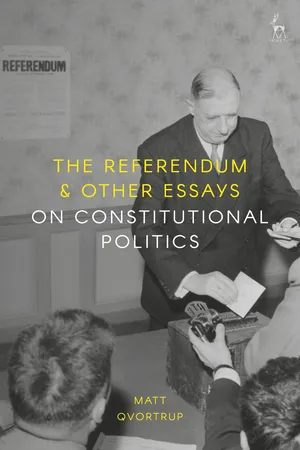
This is the way the referendum was often used by Charles de Gaulle (who adorns the cover of this book). The former French President (and war hero), stated that he was convinced the ‘sovereignty belongs to the people, provided they express themselves directly and as a whole’. For this reason, he went on, ‘I introduced the referendum system, made the people decide that henceforth its direct approval would be necessary’.10 But what de Gaulle failed to add was that he was to decide when this ‘direct approval’ was ‘necessary’.
There can be no doubt that a referendum can make a decision legitimate and that a direct appeal to the voters can be a way of overcoming parliamentary opposition. Charles de Gaulle used the referendum when he was unable to win approval of controversial policies (such as the direct election of the president in 1962). He was not the first French executive to do so. A century before, Napoleon III had done the same. On that occasion, Karl Marx noted that the president was in a stronger position and this was why he could use (and abuse) the appeal to the people:
While the votes of France are splintered to pieces upon the 750 members of the National Assembly, they are here, on the contrary, concentrated upon one individual. While each separate Representative represents only this or that party, this or that city, this or that dunghill … the President, on the contrary, is the elect of the nation, and the act of his election is his trump card, that the sovereign plays out every four years. The National Assembly stands in a metaphysical relation to relation to the nation; the President stands in a personal relation to the nation.11
Giovanni Sartori – the eminent Italian political scientist – thus concluded that the ‘more patent usurping of presidential powers has occurred with referendums’.12 While the referendum could be justified as a tie-break (as in the case of the Danish referendum on the Single European Act in 1986), Sartori maintained that ‘the line that separates use and abuse is – in the case of referendums – a very fine line. Though, he went on, ‘the Frenc...
Table of contents
- Cover
- Title Page
- Preface
- Contents
- PART I: REFERENDUM
- PART II: CONSTITUTIONAL POLITICS
- Index
- Copyright Page
Trusted by 375,005 students
Access to over 1.5 million titles for a fair monthly price.
Study more efficiently using our study tools.
Frequently asked questions
Yes, you can cancel anytime from the Subscription tab in your account settings on the Perlego website. Your subscription will stay active until the end of your current billing period. Learn how to cancel your subscription
No, books cannot be downloaded as external files, such as PDFs, for use outside of Perlego. However, you can download books within the Perlego app for offline reading on mobile or tablet. Learn how to download books offline
Perlego offers two plans: Essential and Complete
- Essential is ideal for learners and professionals who enjoy exploring a wide range of subjects. Access the Essential Library with 800,000+ trusted titles and best-sellers across business, personal growth, and the humanities. Includes unlimited reading time and Standard Read Aloud voice.
- Complete: Perfect for advanced learners and researchers needing full, unrestricted access. Unlock 1.5M+ books across hundreds of subjects, including academic and specialized titles. The Complete Plan also includes advanced features like Premium Read Aloud and Research Assistant.
We are an online textbook subscription service, where you can get access to an entire online library for less than the price of a single book per month. With over 1.5 million books across 990+ topics, we’ve got you covered! Learn about our mission
Look out for the read-aloud symbol on your next book to see if you can listen to it. The read-aloud tool reads text aloud for you, highlighting the text as it is being read. You can pause it, speed it up and slow it down. Learn more about Read Aloud
Yes! You can use the Perlego app on both iOS and Android devices to read anytime, anywhere — even offline. Perfect for commutes or when you’re on the go.
Please note we cannot support devices running on iOS 13 and Android 7 or earlier. Learn more about using the app
Please note we cannot support devices running on iOS 13 and Android 7 or earlier. Learn more about using the app
Yes, you can access The Referendum and Other Essays on Constitutional Politics by Matt Qvortrup in PDF and/or ePUB format, as well as other popular books in Derecho & Derecho público. We have over 1.5 million books available in our catalogue for you to explore.