The rise of populism in the West and the rise of China in the East have stirred a rethinking of how democratic systems work—and how they fail. The impact of globalism and digital capitalism is forcing worldwide attention to the starker divide between the “haves” and the “have-nots,” challenging how we think about the social contract.
With fierce clarity and conviction, Renovating Democracy tears down our basic structures and challenges us to conceive of an alternative framework for governance. To truly renovate our global systems, the authors argue for empowering participation without populism by integrating social networks and direct democracy into the system with new mediating institutions that complement representative government. They outline steps to reconfigure the social contract to protect workers instead of jobs, shifting from a “redistribution” after wealth to “pre-distribution” with the aim to enhance the skills and assets of those less well-off. Lastly, they argue for harnessing globalization through “positive nationalism” at home while advocating for global cooperation—specifically with a partnership with China—to create a viable rules-based world order.
Thought provoking and persuasive, Renovating Democracy serves as a point of departure that deepens and expands the discourse for positive change in governance.
eBook - ePub
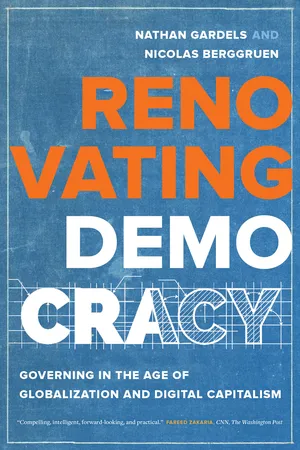
Renovating Democracy
Governing in the Age of Globalization and Digital Capitalism
- 248 pages
- English
- ePUB (mobile friendly)
- Available on iOS & Android
eBook - ePub
Renovating Democracy
Governing in the Age of Globalization and Digital Capitalism
About this book
Information
Publisher
University of California PressYear
2019Print ISBN
9780520303607
Edition
1eBook ISBN
9780520972766
CHAPTER 1
Behind the Populist Surge
Donald Trump demonstrated in the 2016 US presidential election that a campaign of “alternative facts” and xenophobic invective against the world outside and perceived enemies within delivered over the latest direct-access technology—Twitter—can be the path to the top of the world’s most powerful nation.
Fortunately, American civil society is among the most diverse and robust anywhere. And while it remains to be seen what Donald Trump’s administration accomplishes (or is allowed to demolish), the alarm has sounded.
This situation has not emerged in a vacuum, but out of the decay of democracy itself in the past several decades. The lesson is clear for the United States and elsewhere: when an unresponsive elite forsakes average citizens in a system legitimated by popular sovereignty, demagogues who fashion themselves as tribunes of the people ride the rage to power. They inevitably end up wrecking what has been painstakingly built. Most damaging of all, and most difficult to repair, is the lost trust in the practices and institutions that enable sound government and constrain the use of power.
“Belief in the corruptibility of all institutions leads to a dead end of universal distrust,” political scientist Francis Fukuyama warns. “American democracy, all democracy, will not survive a lack of belief in the possibility of impartial institutions; instead, partisan political combat will come to pervade every aspect of life.”1 And so it has. From a reading of history going back to ancient Rome, we know that this is the way republics unravel. That danger should be our uppermost concern today.
The populist wave, which spread from the 2016 Brexit and Trump elections to large constituencies across the Western democracies, has come at what is arguably one of the most promising times in human history. Prodigious leaps in technology, science, productive capacity, and global integration herald a future that humanity has only dreamt of in the past. Yet these ongoing great transformations seem to have triggered in their wake a great reaction among the multitude they have bypassed or threaten to uproot.
What is clear is that history is fast approaching an inflection point. We live either on the cusp of an entirely new era or on the brink of a return to an all-too-familiar, regressive, and darker past. How to reconcile these opposite trends is the daunting summons for governance in the decades ahead.
Governance is how communities invent and shape their destiny. It determines whether a society goes forward or backward. Like the homeostasis of all organisms, governance is the regulator, arbiter, and navigator of human affairs. It processes emotions through reason as the means by which societies not only survive but thrive by adapting to change.2
PERIL RESIDES WITHIN PROMISE
If we listen to our most visionary scientists and engineers, humanity is on the threshold of an age of health and abundance thanks to the convergence of such cutting-edge technologies as artificial intelligence, regenerative medicine, and the “internet of things.” If we embrace the persistent dreams of economic thinkers, globalization that ties us all together promises to lift up everyone in a win-win scenario. Bill Gates, among others, has forecast that, thanks to innovations ranging from new vaccines to smart phones and mobile banking, “the lives of people in poor countries will improve faster in the next 15 years than at any other time in history.”3 Particularly in the advanced nations, the automation of labor opens a path to the end of drudgery and a world where scarcity no longer defines the human condition. Technologies that exploit renewable energy sources herald a new era of low-carbon growth that can cool the fever of global warming.
Yet, without appropriate governance, a young person from any of the impoverished regions to which Gates refers will likely use that smartphone to navigate a hazardous path northward as a refugee. And the robots that so greatly boost productivity could just as well generate wealth only for the few and displace jobs that pay a living wage, creating even deeper social inequality. Absent the restraining hand of governance, climate change will disrupt life as we know it on earth.
Signs of splintering are all around us not only in polarized partisanship but also in revived nativism and nationalism, ardent religious wars, and the reappearance of geopolitical blocs. In 2014 Pope Francis even declared that we are living through a “piecemeal Third World War.”4 Applied historians these days keep raising the analogy to 1914, when world war suddenly broke out after the “long peace” of the first globalization, during which nations were nearly as integrated through trade and investment as they are now. The historian and strategic thinker Walter Russell Mead has gone so far as to ask whether today “we are in a post-war or pre-war period.”5
And none of us can say for sure at this moment whether the likes of Malala or Islamofascists, democracy or autocracy, will define the path ahead.
To reach breakthrough before breakdown involves, first of all, grasping the dynamics of the underlying turmoil. The truth is not only that both realities exist simultaneously but that one is a condition of the other. The fearful and fearsome reaction against growing inequality, social dislocation, and loss of identity in the midst of vast wealth creation, unprecedented mobility, and ubiquitous connectivity is a mutiny, really, against globalization so audacious and against technological change so rapid that it can barely be absorbed by our incremental nature. Change takes place at a digital pace our analog capacities can’t process. In this accelerated era, future shock can feel like repeated blows in the living present to individuals, families, and communities alike. In this one world, it sometimes seems, a race is on between the newly empowered and the recently dispossessed.
This emergent world appears to us as a wholly unfamiliar rupture from patterns of the past that could frame a reassuring narrative going forward. Philosophers describe the new territory of the future as “plastic” or “liquid,” shapelessly shifting as each disruptive innovation or abandoned certitude washes away whatever fleeting sense of meaning was only just embraced. A kind of foreboding of the times that have not yet arrived, a wariness about what’s next, settles in. Novelists such as Jonathan Franzen see a “perpetual anxiety” gripping society.6 Similarly, Turkish novelist Orhan Pamuk, citing Wordsworth, speaks of “a strangeness in my mind,” the sense that “I am not of this hour nor of this place.”7
DISRUPTION, INSECURITY, AND IDENTITY
Philosophers and social thinkers have long noted the relationship between such anxiety or sense of threat and the reactive fortification of identity. The greater the threat—of violence, upheaval, or insecurity—the more rigid and “solitarist” identities become, as Amartya Sen noted in his seminal book Identity and Violence.8 Intense threats, or the perception of them, demote plural influences in the lives of persons and communities alike and elevate a singular dimension to existential importance. At the personal level this shift is experienced as a deficit of dignity. Conversely, stability, security, and inclusivity generate adaptive identities with plural dimensions.
We’ve seen this fearful impulse before. In the late nineteenth and early twentieth centuries, widespread optimism, manifested so magnificently by London’s Crystal Palace in 1851 and numerous subsequent world fairs and expositions, resulted from the great leaps in industrialization, urbanization, energy, communications, and transportation, as well as the transformation of the household with labor-saving appliances. But the surface sheen masked deep anxiety and resentment as settled patterns of life across the old empires of Europe were turned upside-down and uprooted. Elites and masses alike sought refuge in nationalism, racial solidarity, or class allegiance. Then, suddenly in the summer of 1914, it all burst to the fore in World War I, which ended with 16 million senseless deaths, only to lay the groundwork for the next calamity less than two decades later, which culminated in a shattered European continent, Auschwitz, the rape of Nanjing, and the nuclear devastation of Japanese cities.
LUTHER’S 95 THESES AND TWITTER’S 280 CHARACTERS
In history, breakdown has inevitably followed transformational technological breakthroughs and openings to other cultures, unless political institutions have adapted to the resulting power shift. Religious wars in the West, we recall, erupted in the wake of the invention of the Gutenberg press, which enabled the Christian scriptures to appear in vernacular languages, thus diminishing the authority of the Church in faraway Rome and empowering individuals and sects—the so-called Protestant “priesthood of all believers”—to interpret the scriptures by their own lights. Today’s 280 Twitter characters, posted in cyberspace by anyone and everyone, are no less disruptive than Martin Luther’s 95 Theses nailed to the Wittenberg Castle church door in 1517. In his study of hierarchies and networks, The Square and the Tower, historian Niall Ferguson credits the Reformation with not only laying the ground for the Scientific Revolution and the Enlightenment but also instigating the religious wars that spanned more than a century from 1524 to 1648. “The printing press,” which facilitated the Reformation’s spread, he writes, “has justly been called ‘a decisive point of no return in human history.’”9
Similarly, the spread of urbanization and industrialization during the eighteenth and nineteenth centuries disrupted the feudal hierarchies and traditional ways of life of predominantly rural societies, leading to the breakup of empires and, ultimately, world war. Today, the maturation of a globally integrated world replete with cross-cultural flows of people, goods, capital, and information, not to mention the perpetual disruptions of digital capitalism, all pose tough new challenges. Technology always speeds ahead of politics, but today it both closes some gaps and widens others at a swifter clip. The rapid opening of societies to one another through telecom-, high-tech-, and logistics-enabled global economic integration has brought a once-impoverished China of peasant villages face-to-face as an equal with the American superpower in the mere forty years since the end of Maoism, challenging the pride of place of the resentful old order.
The lesson here is that political and cultural logic, rooted in emotion, identity, and ways of life cultivated among one’s own kind, operates in a wholly different dimension than the rational and universalizing ethos of economics and technology. Far from moving forward in lock-step progress, when they meet, they clash.
Regrettably, historical experience has demonstrated over and over again that, when real or perceived threats abound, practical politics departs from rational discourse and centers on friends versus enemies; us versus them.10 It focuses on organizing the survival and sustenance of a community as defined by those who are not part of it. Politics, not least in the present wave of populism across the Western democracies, is rooted in the particular soil of place and not in the universal territory of humanity as a whole or the “common good.” Donald Trump, British prime minister Theresa May, and other leaders of the revolt against the cosmopolitan caste could not be clearer. “There is no such thing as a global anthem, a global currency, or a global flag,” Trump has said.11
Similarly, May has proclaimed, “If you believe you are a citizen of the world, you are a citizen of nowhere. You don’t know what citizenship means.”12 In his book The Road to Somewhere: The Populist Revolt and the Future of Politics, David Goodhart puts his finger on the divide between the “anywheres” of a rootless, mobile elite and the “somew...
Table of contents
- Title
- Copyright
- Contents
- Preface: There Is Something Wrong with the System
- Acknowledgments
- Introduction: Rethinking Democracy, the Social Contract, and Globalization
- 1. Behind the Populist Surge
- 2. Rethinking Democracy
- 3. Redrawing the Social Contract
- 4. Harnessing Globalization
- Epilogue: Our Image of the Future Shapes the Present
- Notes
- Index
Trusted by 375,005 students
Access to over 1.5 million titles for a fair monthly price.
Study more efficiently using our study tools.
Frequently asked questions
Yes, you can cancel anytime from the Subscription tab in your account settings on the Perlego website. Your subscription will stay active until the end of your current billing period. Learn how to cancel your subscription
No, books cannot be downloaded as external files, such as PDFs, for use outside of Perlego. However, you can download books within the Perlego app for offline reading on mobile or tablet. Learn how to download books offline
Perlego offers two plans: Essential and Complete
- Essential is ideal for learners and professionals who enjoy exploring a wide range of subjects. Access the Essential Library with 800,000+ trusted titles and best-sellers across business, personal growth, and the humanities. Includes unlimited reading time and Standard Read Aloud voice.
- Complete: Perfect for advanced learners and researchers needing full, unrestricted access. Unlock 1.5M+ books across hundreds of subjects, including academic and specialized titles. The Complete Plan also includes advanced features like Premium Read Aloud and Research Assistant.
We are an online textbook subscription service, where you can get access to an entire online library for less than the price of a single book per month. With over 1.5 million books across 990+ topics, we’ve got you covered! Learn about our mission
Look out for the read-aloud symbol on your next book to see if you can listen to it. The read-aloud tool reads text aloud for you, highlighting the text as it is being read. You can pause it, speed it up and slow it down. Learn more about Read Aloud
Yes! You can use the Perlego app on both iOS and Android devices to read anytime, anywhere — even offline. Perfect for commutes or when you’re on the go.
Please note we cannot support devices running on iOS 13 and Android 7 or earlier. Learn more about using the app
Please note we cannot support devices running on iOS 13 and Android 7 or earlier. Learn more about using the app
Yes, you can access Renovating Democracy by Nathan Gardels,Nicolas Berggruen in PDF and/or ePUB format, as well as other popular books in Politics & International Relations & Democracy. We have over 1.5 million books available in our catalogue for you to explore.