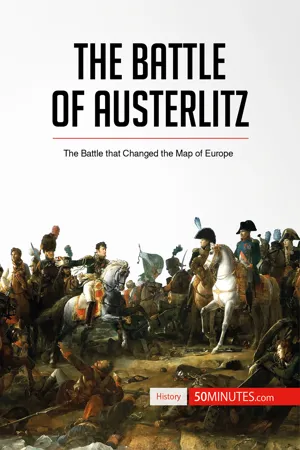
Keen to learn but short on time? Get to grips with the events of the Battle of Austerlitz in next to no time with this concise guide.
50Minutes.com provides a clear and engaging analysis of the Battle of Austerlitz. On the night of 1st December 1805, the armies of the French Emperor Napoleon I, the Emperor of the Holy Roman Empire, Francis II, and the Russian Tsar Alexander I, positioned themselves on the plains of Austerlitz, ready to fight in what would later become the infamous "Battle of the Three Emperors". The next morning, before the sun had fully risen, the conflict broke out and the map of Europe was henceforth changed forever.
In just 50 minutes you will:
• Understand the political and social context surrounding the battle and the different alliances formed within Europe
• Grasp the roles played by the battle's various commanders and leaders
• Analyse the outcome of the battle and how it affected the future of Europe
ABOUT 50MINUTES.COM | History & Culture
50MINUTES.COM will enable you to quickly understand the main events, people, conflicts and discoveries from world history that have shaped the world we live in today. Our publications present the key information on a wide variety of topics in a quick and accessible way that is guaranteed to save you time on your journey of discovery.
- English
- ePUB (mobile friendly)
- Available on iOS & Android
eBook - ePub
About this book
Information
Topic
HistoireSubtopic
Histoire du 19ème siècleCOMMANDERS AND LEADERS
NAPOLEON I, EMPEROR OF THE FRENCH
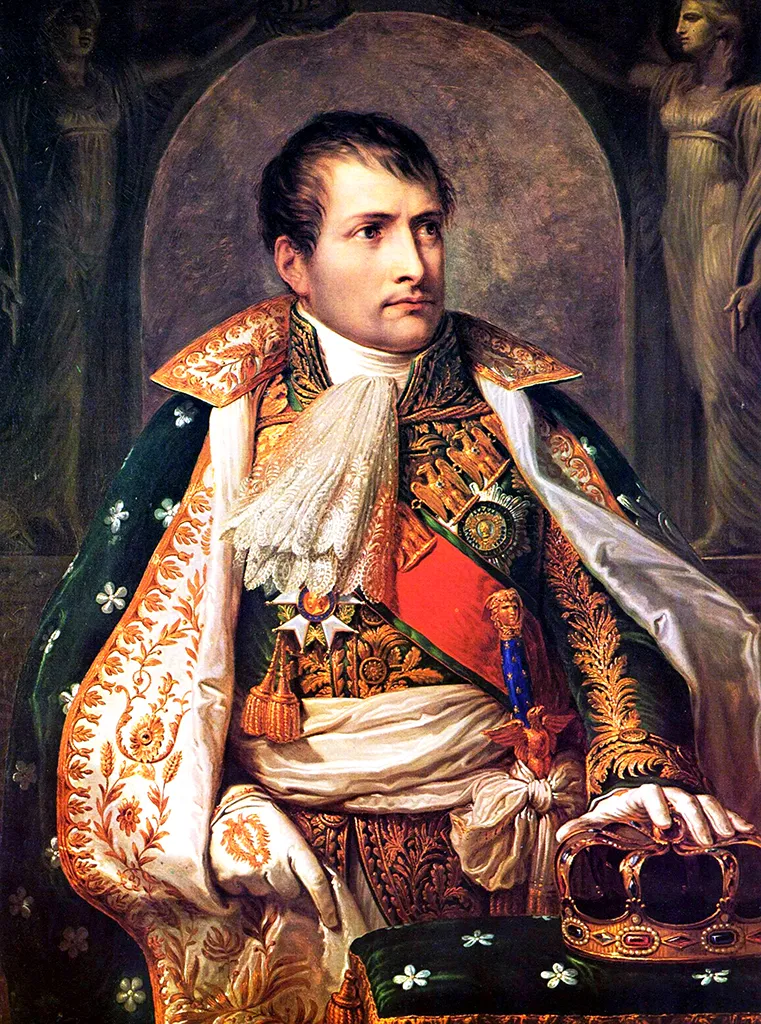
Napoleon I King of Italy by Andrea Appiani, 1805.
An early military career
Napoleon Bonaparte was born in Ajaccio on 15th August 1769. He was the second child of Maria Letizia Ramolino (1750-1836) and Charles Bonaparte (1746-1785). One of eight children, he would offer kingdoms to each of his siblings once he became emperor. Coming from the impoverished old Italian nobility, born on a former Genoese island that had just been passed on to the French, Napoleon Bonaparte very quickly left for the continent. Receiving a scholarship, he first studied at Autun College, before joining the military school of Brienne, then that of Paris. A reserved student, he made few friends but was a very good student, particularly enjoying math, as well as reading the works of philosophers and French literature.
He entered into the artillery in 1785 and remained there until 1791. During this period, he participated in the revolution led by Pascal Paoli in Corsica (Corsican politician, 1725-1807), before taking part in the first revolutionary showdowns: the repression of the federalists in Marseille and the re-capture of Toulon (19th December 1793), which earned him the rank of general.
In politics, he tried to ally himself with influential movements of the time. His links with the Jacobins, however, earned him some setbacks after the fall of Maximilien de Robespierre (French politician, 1758-1794). After being imprisoned for a few months, his friendships with the new leaders in place, such as Paul Barras (French politician, 1755-1829) and Jean-Lambert Tallien (French politician, 1767-1820), enabled him to join the topographic office, where he prepared plans for the future Italian campaign with Lazare Nicolas Marguerite Carnot (French politician and scientist, 1753-1823). Paul Barras, then the president of the Convention, ordered him to suppress the royalist insurrection of 13 Vendémiaire (5th October 1795).
In March 1796, he married Marie Josèphe Rose Tascher de La Pagerie, known as “Josephine” (1763-1814), and a few days later, he was given command of the armies of Italy. Despite the numerical inferiority of the French troops, Napoleon Bonaparte led a lightning campaign, accumulating many victories.
The popularity of Napoleon Bonaparte gave him a glimpse of a potential significant political career. However, the men of the Directory, also aware of this danger, sought to keep him away from power. So, when Napoleon Bonaparte offered to conquer the Mediterranean from the British, they accepted with relief. However, the Egyptian campaign (1798-1799), although marked by brilliant victories, did not succeed in weakening the British power.
When he returned to France, the Directory was in full rout. The conditions were ideal for a coup. In 18 Brumaire of the year VIII (9th November 1799), the country’s government was entrusted to three Consuls: Napoleon Bonaparte, Emmanuel Joseph Sieyès (French politician, 1748-1836) and Roger Ducos (French politician, 1747-1816).
The Consulate
In December, the Consul Bonaparte published the Constitution of the Year VIII, which designated him as the First Consul, concentrating the power into his hands. First Consul for ten years, he held the executive, judicial and military power. The two consuls appointed along with him, Jean-Jacques Regis de Cambaceres (French statesman and jurist, 1753-1824) and Charles-François Lebrun (French politician, 1739-1824) meanwhile held only advisory roles.
Despite the importance of his new title, Napoleon Bonaparte did not waive his role as a military leader. France was at war against the armies of the Second Coalition, and after the crossing of the Great-Saint-Bernard Pass and the victory of Marengo, he once again forced Austria to sign a peace treaty. He also managed to come to an agreement with Britain.
The popularity of the First Consul was reinforced by his actions consolidating what had been acquired during the Revolution, as well as the pacification and reunification of a France that had been torn apart by the Vendée wars. He signed a concordat with Pope Pius VII (1742-1823), reinstated religious freedom and reorganized the administration by creating the prefect function. He also developed a quality public education network and initiated the drafting of the Civil Code and the Penal Code. He also set up the Bank of France and a currency, the franc germinal. Demonstrating a takeover of power over all administrative bodies of the country, his work also involved rebuilding a nation unified by the fundamental principles of the Revolution.
However, Napoleon Bonaparte had to continually deal with both internal and external problems. Always in conflict with Great Britain, he also suffered two attempted attacks, one in December 1800 and another conducted in March 1804 by Georges Cadoudal (French chief and conspirator, 1771-1804), to which he responded violently. In March 1804, he had the Duke of Enghien, a prince of the house of Bourbon, guillotined, on the suspicion of having been involved in the conspiracy of Cadoudal, thus sparking anger among the European nations. Shortly after, the Senate proclaimed him Emperor of the French (18th May 1804) and he was crowned by Pope Pius VIII at Notre Dame in Paris on 2nd December of that year.
The Empire and the Napoleonic Wars
The Empire was marked by a series of campaigns against European country allied in successive coalitions. First basking in major victories (Ulm, Austerlitz, Jena, Friedland), and causing the disappearance of the Holy Roman Empire, the creation...
Table of contents
- The Battle of Austerlitz
- Political and social context
- Commanders and leaders
- Analysis of the battle
- Repercussions of the battle
- Summary
- Find out more
Trusted by 375,005 students
Access to over 1.5 million titles for a fair monthly price.
Study more efficiently using our study tools.
Frequently asked questions
Yes, you can cancel anytime from the Subscription tab in your account settings on the Perlego website. Your subscription will stay active until the end of your current billing period. Learn how to cancel your subscription
No, books cannot be downloaded as external files, such as PDFs, for use outside of Perlego. However, you can download books within the Perlego app for offline reading on mobile or tablet. Learn how to download books offline
We are an online textbook subscription service, where you can get access to an entire online library for less than the price of a single book per month. With over 1.5 million books across 990+ topics, we’ve got you covered! Learn about our mission
Look out for the read-aloud symbol on your next book to see if you can listen to it. The read-aloud tool reads text aloud for you, highlighting the text as it is being read. You can pause it, speed it up and slow it down. Learn more about Read Aloud
Yes! You can use the Perlego app on both iOS and Android devices to read anytime, anywhere — even offline. Perfect for commutes or when you’re on the go.
Please note we cannot support devices running on iOS 13 and Android 7 or earlier. Learn more about using the app
Please note we cannot support devices running on iOS 13 and Android 7 or earlier. Learn more about using the app
Yes, you can access The Battle of Austerlitz by 50minutes,50minutes in PDF and/or ePUB format, as well as other popular books in Histoire & Histoire du 19ème siècle. We have over 1.5 million books available in our catalogue for you to explore.