The must-read summary of Dan Roam's book: "The Back of the Napkin: Solving Problems and Selling Ideas with Pictures".
This complete summary of the ideas from Dan Roam's book "The Back of the Napkin" shows that visual thinking is a whole new way of looking at and discussing business. It is harnessing and applying our innate ability to use our eyes and our imagination to discover, develop and share ideas with others. In his book, the author explains how a simple drawing on the back of a napkin can be more effective in visualising the solution to some business problem than any Excel spreadsheet or PowerPoint presentation could ever be. This summary demonstrates that visual thinking is a better way of looking at problems and will teach you to find interesting or innovative solutions.
Added-value of this summary:
• Save time
• Understand key concepts
• Expand your knowledge
To learn more, read "The Back of the Napkin" and find out how you can change your way of thinking and find real solutions to business problems.
eBook - ePub
Summary: The Back of the Napkin
Review and Analysis of Roam's Book
- English
- ePUB (mobile friendly)
- Available on iOS & Android
eBook - ePub
About this book
Information
Subtopic
Business DevelopmentIndex
BusinessSummary of The Back Of The Napkin (Dan Roam)
1. Three basic tools
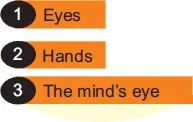
There are really only three tools you need to become great at solving problems with pictures: your eyes, your mind’s eye or imagination and a little eye-hand coordination. You don’t need any technology – this is a case where the hand is mightier than the mouse.
Visual thinking is the ability to draw pictures that illustrate the solutions to a business problem. The real power in this method lies in the fact you don’t need to use a computer to generate the drawings for you. Instead, you do them by hand using whatever materials are close at hand – even the paper napkins in a restaurant if that’s all you have available.
Note the pictures used to solve business problems or to explain ideas are not works of art. They are not line drawings of the Mona Lisa or anything of that caliber. Instead, visual thinking uses hand-drawn sketches that incorporate basic shapes, lines and arrows and stick drawings of people.
Hand-drawn pictures are better than those generated by computer because:
- People like to see what other people have drawn – they respond better to hand-drawn crude pictures drawn step-by-step than they ever do to polished graphics which are obviously computer generated.
- Hand sketches are quick to create – and therefore easy to start over if you need to change something. This encourages a certain degree of trial and error which is healthy and stimulating.
- Software often gives too many options – drawing packages generally offer a number of different ways to draw the same thing. Sometimes you can get so caught up in playing with these you lose track of what your original point was.
- This is a case where less is more – simple drawings gazump the impact of highly sophisticated drawings when you’re trying to get a point across.
Probably the most acclaimed success story of visual thinking was the establishment of Southwest Airlines. In 1967, Herb Kelleher was a New Jersey lawyer who had been hired by Rollin King to help him close King’s failed regional airline. At dinner one night, Rollin picked up a napkin and made a quick sketch:
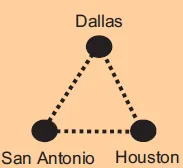
Rollins suggested that instead of creating an airline that tried to serve large cities like everyone else was doing, it would be better to run a small airline that served just the three biggest towns in Texas. All of the other airlines were operating a hub and spoke model – fly people to a central hub first, then to another hub and then to a smaller city. That meant people had to catch multiple flights to go from one city to another sometimes.
“Southwest legend says that Herb agreed with Rollin on two things: first, that the idea was crazy, and second, that the idea was brilliant. On its own, their simple map illustrated the fundamental operating principles of the company that Herb and Rollin agreed to start that evening: fly short routes between busy cities, avoid hubs, and where possible fly into smaller, secondary airfields. One napkin; one good idea; one profitable airline.”
– Dan Roam
Four years later in 1971, Herb Kelleher helped launch Southwest Airlines to serve the three cities specified on that napkin. By combining operating efficiencies, convenience, low prices, a zany corporate ethos and some very gung-ho marketing, Southwest became successful by focusing on just a very small group of cities. The company has gone on to grow from that early base and has managed to rack up one very impressive statistic – it has an unbroken record of thirty years of profitability. This is a feat never before achieved in the history of aviation. It just goes to show what sketching an idea on the back of a napkin can achieve.
The experience of Herb Kelleher and others illustrates perfectly the benefits of the visual thinking process – of trying to solve problems by drawing pictures. The advantages of this approach to business are:
- As you draw simple sketches, you can clarify what exists in your o...
Table of contents
- Title page
- Book Presentation
- Summary of The Back Of The Napkin (Dan Roam)
- About the Summary Publisher
- Copyright
Trusted by 375,005 students
Access to over 1.5 million titles for a fair monthly price.
Study more efficiently using our study tools.
Frequently asked questions
Yes, you can cancel anytime from the Subscription tab in your account settings on the Perlego website. Your subscription will stay active until the end of your current billing period. Learn how to cancel your subscription
No, books cannot be downloaded as external files, such as PDFs, for use outside of Perlego. However, you can download books within the Perlego app for offline reading on mobile or tablet. Learn how to download books offline
Perlego offers two plans: Essential and Complete
- Essential is ideal for learners and professionals who enjoy exploring a wide range of subjects. Access the Essential Library with 800,000+ trusted titles and best-sellers across business, personal growth, and the humanities. Includes unlimited reading time and Standard Read Aloud voice.
- Complete: Perfect for advanced learners and researchers needing full, unrestricted access. Unlock 1.5M+ books across hundreds of subjects, including academic and specialized titles. The Complete Plan also includes advanced features like Premium Read Aloud and Research Assistant.
We are an online textbook subscription service, where you can get access to an entire online library for less than the price of a single book per month. With over 1.5 million books across 990+ topics, we’ve got you covered! Learn about our mission
Look out for the read-aloud symbol on your next book to see if you can listen to it. The read-aloud tool reads text aloud for you, highlighting the text as it is being read. You can pause it, speed it up and slow it down. Learn more about Read Aloud
Yes! You can use the Perlego app on both iOS and Android devices to read anytime, anywhere — even offline. Perfect for commutes or when you’re on the go.
Please note we cannot support devices running on iOS 13 and Android 7 or earlier. Learn more about using the app
Please note we cannot support devices running on iOS 13 and Android 7 or earlier. Learn more about using the app
Yes, you can access Summary: The Back of the Napkin by BusinessNews Publishing in PDF and/or ePUB format, as well as other popular books in Business & Business Development. We have over 1.5 million books available in our catalogue for you to explore.