The must-read summary of Don Peppers and Martha Rogers' book: "Return on Customer: Creating Maximum Value from Your Scarcest Resource".
This complete summary of the ideas from Don Peppers and Martha Rogers' book "Return on Customer" presents their concept of the same name, which is a new business metric designed to measure the amount of value that a business creates by acquiring, retaining and then growing its customer base. In their book, the authors explain what causes your ROC (Return on Customer) to be negative, and how you can make changes to ensure that it is positive and value is being created. This summary provides readers with seven reasons why they should use Return on Customer as a management metric and the benefits this could bring for your business.
Added-value of this summary:
• Save time
• Understand key concepts
• Expand your business knowledge
To learn more, read "Return on Customer" and discover the new way to measure your business success and add value.
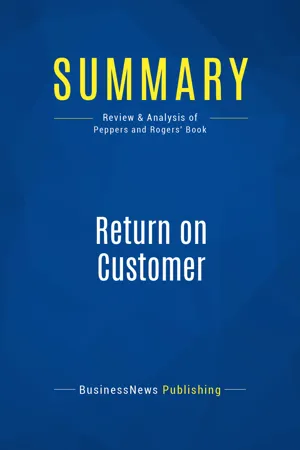
eBook - ePub
Summary: Return on Customer
Review and Analysis of Peppers and Rogers' Book
- English
- ePUB (mobile friendly)
- Available on iOS & Android
eBook - ePub
About this book
Information
Subtopic
Business StrategyIndex
BusinessSummary of Return On Customer (Don Peppers and Martha Rogers)
1. Scarcity
Customers are any company’s scarcest resource.
In this era of globalization, capital is exceptionally mobile and costs have been reduced as far as they can go. There is an excess of most products and most services. In today’s business environment, nothing is as scarce as customers.
In many markets and product categories, there are too many products chasing a finite pool of customers. Traditionally, it was assumed availability of capital was the limiting factor in growing an enterprise. Today almost anyone can get access to all the capital they need, and it is customers which are difficult to find and hard to keep. To remain competitive, businesses have to figure out:
- How to keep customers longer.
- How to grow small customers into bigger customers.
- How to make each customer more profitable.
- How to serve customers more cost effectively and efficiently.
- How to get more customers.
In essence, the key challenge in business today is to get customers to trust your firm. The more a customer trusts you will act in his or her best interests, the more business they will give you both in current-period transactions and likely future transactions. Traditional marketing treats each new customer transaction independently whereas in the real world, customers have long memories. Their future intentions are influenced heavily by how a company has treated them in the past. Trust is the glue which binds a customer to a firm, and makes those customers predisposed to do more business in the future.
Trust flourishes whenever a firm looks at its value proposition from the customer’s perspective instead of solely from its own point-of-view. This principle of reciprocity, sometimes described as “the Golden Rule”, in practical terms simply means firms should treat customers the way they would like to be treated if the roles were reversed. If you can be fair and honest with your customers and demonstrate you’re looking out for their interests in much the same way as you look out for your own, they will trust you and want to do more business in the future. Customers may even be inclined to tell their friends about their experience with your company as well.
Note that to earn and retain customer trust, you can’t just limit your recommendations to your own product or service. You also have to tell customers about how they can address their needs using the products and services provided by other parties. If you fail to do that, you’re in effect hiding your head in the sand and hoping your customers will do the same long enough to give you their money. This is not the way to earn the customer’s trust, or to make it more likely they will do more business with you in the future. Your objective should not be to “sell something” but instead to grow your firm in a sustainable manner by doing everything possible to maximize return on customer.
Sometimes it’s difficult to build customer trust. For example, airlines have very complex business models where passengers on the same flight can be paying a variety of different fares. This pricing flexibility is great for the airlines because of the fact their seats are perishable – an airline seat flying empty generates no revenue but is still subject to the airline’s high fixed costs. From a customer perspective, however, it’s confusing to try and find just what is the best deal. For this reason, airlines have a difficult job earning the customer’s trust.
To summarize, the biggest challenge in business today is to create the kind of culture which maximizes your value to your customers. If you do this, you also maximize the amount of customer trust, which in turn maximizes the amount of customer equity you create. This kind of culture is also a more satisfying place for your employees to work. Furthermore, this type of corporate culture also introduces some checks and balances into the management – it will be impossible for a firm to act unethically if everyone is focused on serving the best interests of customers, shareholders and employees.
“The only value your company will ever create is the value that comes from customers – the ones you have now and the ones you will have in the future. You can maximize the value your firm creates by maximizing your Return on Customer. But to increase the overall return generated by a customer (including long-term value as well as current profit), you must change the customer’s behavior, creating more value than was otherwise expected. To create value, you must put yourself in the customer’s shoes, understand the customer’s needs, and then act accordingly. Ultimately, this requires you to earn your customer’s trust.”
– Don Peppers and Martha Rogers
“For the last five decades, most thinkers have described business success in terms of competition. We talk about market share and competitive advantage, we use dozens of sports metaphors – all about winning and losing. The other line of thought – serving customers – has never had the intellectual cachet or hot press of the competition model. But the truth is, the customer serv...
Table of contents
- Book Presentation: Return On Customer by Don Peppers and Martha Rogers
Trusted by 375,005 students
Access to over 1.5 million titles for a fair monthly price.
Study more efficiently using our study tools.
Frequently asked questions
Yes, you can cancel anytime from the Subscription tab in your account settings on the Perlego website. Your subscription will stay active until the end of your current billing period. Learn how to cancel your subscription
No, books cannot be downloaded as external files, such as PDFs, for use outside of Perlego. However, you can download books within the Perlego app for offline reading on mobile or tablet. Learn how to download books offline
Perlego offers two plans: Essential and Complete
- Essential is ideal for learners and professionals who enjoy exploring a wide range of subjects. Access the Essential Library with 800,000+ trusted titles and best-sellers across business, personal growth, and the humanities. Includes unlimited reading time and Standard Read Aloud voice.
- Complete: Perfect for advanced learners and researchers needing full, unrestricted access. Unlock 1.5M+ books across hundreds of subjects, including academic and specialized titles. The Complete Plan also includes advanced features like Premium Read Aloud and Research Assistant.
We are an online textbook subscription service, where you can get access to an entire online library for less than the price of a single book per month. With over 1.5 million books across 990+ topics, we’ve got you covered! Learn about our mission
Look out for the read-aloud symbol on your next book to see if you can listen to it. The read-aloud tool reads text aloud for you, highlighting the text as it is being read. You can pause it, speed it up and slow it down. Learn more about Read Aloud
Yes! You can use the Perlego app on both iOS and Android devices to read anytime, anywhere — even offline. Perfect for commutes or when you’re on the go.
Please note we cannot support devices running on iOS 13 and Android 7 or earlier. Learn more about using the app
Please note we cannot support devices running on iOS 13 and Android 7 or earlier. Learn more about using the app
Yes, you can access Summary: Return on Customer by BusinessNews Publishing in PDF and/or ePUB format, as well as other popular books in Business & Business Strategy. We have over 1.5 million books available in our catalogue for you to explore.