The must-read summary of Gary Hamel and Bill Breen's book: "The Future of Management".
This complete summary of the ideas from Gary Hamel and Bill Breen's book "The Future of Management" demonstrates how the real fuel for long-term business success is never operational excellence, technology breakthroughs or even new business methods. Sooner or later, competitors will arrive who have superior operations, next-generation technology or even better business models. Instead, the key to sustained long-term business success is management innovation. In their book, the authors explain why it is time to imagine the future of management and become an active participant in the process of inventing the successful management practices of tomorrow.
Added-value of this summary:
• Save time
• Understand key principles
• Expand your management skills
To learn more, read "The Future of Management" and discover how you can start your own management revolution and ensure future success.
eBook - ePub
Summary: The Future of Management
Review and Analysis of Hamel and Breen's Book
- English
- ePUB (mobile friendly)
- Available on iOS & Android
eBook - ePub
Summary: The Future of Management
Review and Analysis of Hamel and Breen's Book
About this book
Information
Subtopic
Business SkillsIndex
BusinessSummary of The Future Of Management (Gary Hamel with Bill Breen)
1. Why management innovation matters
Management is at the heart of everything an organization does and achieves. It’s reasonable, therefore, to assume that in order for companies to thrive in the disruptive markets of the 21st-century, new and better ways of managing will be required. The only way to out think and out-invent upstarts and others will be for companies to find better ways to manage themselves. A new management paradigm is required.
Compared to the monumental changes which have occurred in the marketplace, the practice of business management almost seems locked in its own little “time warp”. Nothing much has changed since the early 20th-century - which is why CEOs can move from one company to another with such regularity.
In practical terms, what constitutes the work of management is now fairly widely standardized:

Yet despite this broad agreement on what management does, history shows whenevera company (or even a country) has been able to come up with a management innovation, it has been able to prosper at the expense of its less fortunate competitors. To take a few examples:
- General Electric introduced sound management into scientific discovery in the early 1900s. Over the first half of the 20th-century, GE won more patents than any other company in America.
- DuPont introduced the concept of calculating return-on-investment in 1903. This allowed the company to compare the performance of its different products enabling DuPont to become one of America’s industrial giants.
- Procter & Gamble formalized brand management in the early 1930s, thereby enabling the company to become a consumer brands powerhouse.
- Toyota used its ability to engage all employees in a relentless pursuit of efficiency which has driven the company to become the number one automaker in the world.
- Visa came up with the idea of building the world’s first “virtual” company - it is nothing more than a network which allows banks to compete for customers at the same time as they use a common infrastructure, standards and brand. Today, the Visa network processes more than $2 trillion every year.
Overall, it’s very clear management innovation matters and in many cases it matters a lot. It’s the most valuable type of innovation there is because:
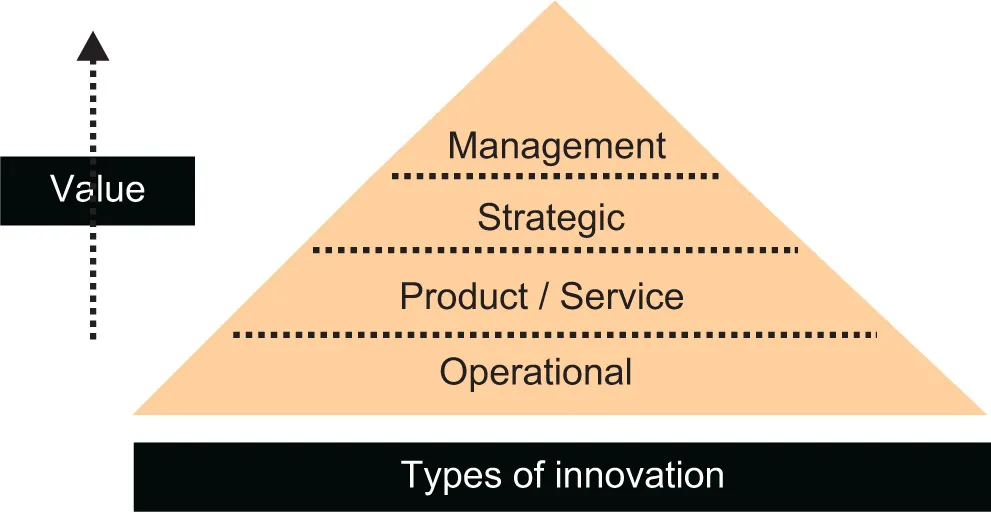
- Operational innovation tends to be derived from a better IT infrastructure but IT-based advantages are very difficult to sustain. Within a short period, everyone will tend to purchase the same IT equipment.
- Product innovation can lift companies out of obscurity rapidly but in the absence of patent protection, most products can be quickly cloned. Even worse, its often easy for upstarts to leapfrog yesterday’s pioneers.
- Strategy innovations typically involve new business models. Distinctive business models are great but can be decoded and then counteracted quite easily.
- Management innovation alone can create difficult-to-duplicate advantages. One genuinely radical management breakthrough can generate dividends which last indefinitely. Management innovations pay great dividends whenever they are:
- Systemic - they encompass a range of processes.
- Ongoing - part of a program rather than one off.
- Compounding - each building on what went before.
Despite all the obvious advantages of management innovation, surprisingly few companies today pride themselves on being successful management innovators. There are probably three main reasons for this phenomena:
- Managers don’t like to think of themselves as innovators -and instead leave that to the technologists. Most managers don’t even consider being innovative to be part of their job descriptions. Typically a manager sees his or her role as turning other people’s ideas into growth and profits.
- Many executives doubt bold management innovations are feasible or possible - and therefore they don’t even bother trying to look for the next big thing in management. They believe there are limits to what can be done so effort spent searching is wasted.
- The majority of managers see themselves as pragmatists rather than dreamers - which is perhaps understandable when you consider most managers are selected, trained and rewarded for what they do today, not what they visualize happening in the future.
The combined result of these three and various other factors is that a kind of “mana...
Table of contents
- Book Presentation: The Future of Management by Gary Hamel with Bill Breen
Trusted by 375,005 students
Access to over 1.5 million titles for a fair monthly price.
Study more efficiently using our study tools.
Frequently asked questions
Yes, you can cancel anytime from the Subscription tab in your account settings on the Perlego website. Your subscription will stay active until the end of your current billing period. Learn how to cancel your subscription
No, books cannot be downloaded as external files, such as PDFs, for use outside of Perlego. However, you can download books within the Perlego app for offline reading on mobile or tablet. Learn how to download books offline
Perlego offers two plans: Essential and Complete
- Essential is ideal for learners and professionals who enjoy exploring a wide range of subjects. Access the Essential Library with 800,000+ trusted titles and best-sellers across business, personal growth, and the humanities. Includes unlimited reading time and Standard Read Aloud voice.
- Complete: Perfect for advanced learners and researchers needing full, unrestricted access. Unlock 1.5M+ books across hundreds of subjects, including academic and specialized titles. The Complete Plan also includes advanced features like Premium Read Aloud and Research Assistant.
We are an online textbook subscription service, where you can get access to an entire online library for less than the price of a single book per month. With over 1.5 million books across 990+ topics, we’ve got you covered! Learn about our mission
Look out for the read-aloud symbol on your next book to see if you can listen to it. The read-aloud tool reads text aloud for you, highlighting the text as it is being read. You can pause it, speed it up and slow it down. Learn more about Read Aloud
Yes! You can use the Perlego app on both iOS and Android devices to read anytime, anywhere — even offline. Perfect for commutes or when you’re on the go.
Please note we cannot support devices running on iOS 13 and Android 7 or earlier. Learn more about using the app
Please note we cannot support devices running on iOS 13 and Android 7 or earlier. Learn more about using the app
Yes, you can access Summary: The Future of Management by BusinessNews Publishing in PDF and/or ePUB format, as well as other popular books in Business & Business Skills. We have over 1.5 million books available in our catalogue for you to explore.