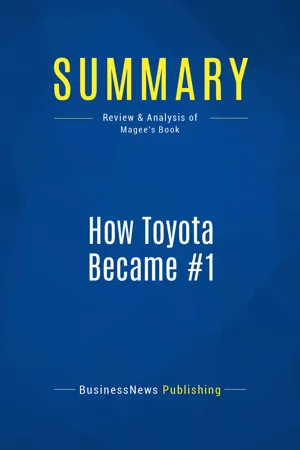
The must-read summary of David Magee's book: "How Toyota Became #1: Leadership Lessons from the World's Greatest Car Company"
This complete summary of the ideas from David Magee's book "How Toyota Became #1" shows that the criteria and qualities leading to Toyota's rise to the top had little to do with sales results or profit margins. This summary points out how Toyota has created such a successful corporate environment, and how others can emulate them. In fact, Toyota looks at new products from the perspective of what customers want, rather than what they are capable of making; managers have empowered even bottom-level employees to act for themselves. Factual information is treated as autocratic: it doesn't matter whether those facts come from senior management or lower down. Toyota is famous for having a production line that can be halted by anyone, because everyone is responsible for quality control. Executives don't have special parking spots, they are expected to work longer hours, and they walk the manufacturing floor regularly. In other words, Toyota's philosophy is based on mutual respect of all employees, and the willingness to prioritise the customer over procedural convenience. It's possible, no matter the market, for others to do the same.
Added-value of this summary:
• Save time
• Understand the key concepts
• Increase your business knowledge
To learn more, read "How Toyota Became #1" and create your own successful environment.
eBook - ePub
Summary: How Toyota Became #1
Review and Analysis of Magee's Book
- English
- ePUB (mobile friendly)
- Available on iOS & Android
eBook - ePub
About this book
Information
Subtopic
Business BiographiesIndex
BusinessSummary of How Toyota Became #1 (David Magee)
1. A Brief Corporate History of Toyota (…Thus Far)
- Toyota Motor Company Ltd. was registered as a Japanese corporation in 1937. The company’s founder was Kiichiro Toyoda who had no experience in automobile design or manufacture. Toyota produced its first prototype in 1935 and the AA went into production in 1936.
- Kiichiro Toyoda funded his new corporation by selling the Toyoda Automatic Loom Works, a highly successful machine making company established by his father Sakichi Toyoda who died in 1930. The sale gave Kiichiro Toyoda one million yen – the equivalent of about $20 million in today’s currency.
- When Kiichiro Toyoda set up Toyota in 1935, he established his father Sakichi Toyoda’s business principles as the operating principles for his new company. These five principles were:
- Be contributive to the development and welfare of the country by working together, regardless of position, in faithfully fulfilling your duties.
- Be ahead of the times through endless creativity, inquisitiveness, and pursuit of improvement.
- Be practical and avoid frivolity.
- Be kind and generous; strive to create a warm, homelike atmosphere.
- Be reverent, and show gratitude for things great and small in thought and deed.
- During the company’s first seven years in business, Toyota sold only about 1,500 cars. It did, however, have more success selling trucks.
- Toyota’s operations grew when the Japanese government mandated all automakers had to be majority-owned and controlled by Japanese citizens. This effectively ended the importation of U.S. vehicles into Japan.
- With the outbreak of World War II, Toyota was required to focus all its efforts on military production.
- After the war ended, the United States government allowed Toyota to begin making vehicles again in occupied Japan. Toyota released the Toyopet – its first affordable car for the masses – in 1947. Toyota sold more than 100,000 Toyopets in its first year of production.
- In 1950, Toyota struggled because a severe recession hit Japan. The company was forced to lay off employees and it recorded a financial loss. Impressively, this would be the only year Toyota would lose money as the company has never recorded a financial loss since then.
- In the late-1950s, Toyota sent three employees to the United States on a “go and see” mission. They returned enthusiastic and a small dealership was set up in Southern California. Imported Toyopet Crowns were sold through that dealership along with a couple of truck models. In 1957, the first year Toyota sold vehicles in the United States, only 300 were sold.
- In the 1950s and 1960s, the Big Three (General Motors, Ford and Chrysler) produced more than 90 percent of all the vehicles sold in the United States.
- Toyota’s sales were dismal until the company started designing and producing cars specifically for the U.S. market. The 1965 Corona was the first of these U.S. specific models and it started to sell well.
- In 1976, Toyota became the first nondomestic automaker to sell more than 100,000 units in a single year.
- In 1984, Toyota sold 800,000 vehicles in the United States, but none were produced domestically.
- In 1986, Toyota opened its first U.S. factory in Georgetown, Kentucky. That same year, Toyota sold one million vehicles, earning a 10 percent share of the domestic market. Most of the vehicles sold were imports.
- Toyota launched its Lexus brand in the United States in late 1989 with two models. Within two years, Lexus sold 70,000 units. By 2007, more than 300,000 Lexus branded vehicles would be sold each year making it the fourth largest brand in the world in terms of sales volume.
- By 2005, Toyota has opened plants in San Antonio, Texas, and Princeton, Indiana. More than 1.5 million Toyota vehicles were manufactured and sold in the United States.
- In 2007, Toyota recorded almost $200 billion in sales with an operating margin of more than 9 percent – triple the industry average. Toyota now has the production capacity to manufacture about two million vehicles per year at its four U.S. manufacturing facilities, with the newest being a green fields manufacturing facility built in Tupelo, Mississippi.
- Toyota becomes the world’s largest automaker by designing, producing and selling almost ten million vehicles around the globe in 2007.
“By 2007, few companies in the world were more talked about in business and media circles than Toyota. The company made headlines earlier that year when it announced an annual production and sales objective which, if met, would make the company the largest carmaker in the world. Attempting a double-jump leapfrog past longtime global giants Ford (the perennial number two) and General M...
Table of contents
- Title page
- Book Presentation
- Summary of How Toyota Became #1 (David Magee)
- About the Summary Publisher
- Copyright
Trusted by 375,005 students
Access to over 1.5 million titles for a fair monthly price.
Study more efficiently using our study tools.
Frequently asked questions
Yes, you can cancel anytime from the Subscription tab in your account settings on the Perlego website. Your subscription will stay active until the end of your current billing period. Learn how to cancel your subscription
No, books cannot be downloaded as external files, such as PDFs, for use outside of Perlego. However, you can download books within the Perlego app for offline reading on mobile or tablet. Learn how to download books offline
Perlego offers two plans: Essential and Complete
- Essential is ideal for learners and professionals who enjoy exploring a wide range of subjects. Access the Essential Library with 800,000+ trusted titles and best-sellers across business, personal growth, and the humanities. Includes unlimited reading time and Standard Read Aloud voice.
- Complete: Perfect for advanced learners and researchers needing full, unrestricted access. Unlock 1.5M+ books across hundreds of subjects, including academic and specialized titles. The Complete Plan also includes advanced features like Premium Read Aloud and Research Assistant.
We are an online textbook subscription service, where you can get access to an entire online library for less than the price of a single book per month. With over 1.5 million books across 990+ topics, we’ve got you covered! Learn about our mission
Look out for the read-aloud symbol on your next book to see if you can listen to it. The read-aloud tool reads text aloud for you, highlighting the text as it is being read. You can pause it, speed it up and slow it down. Learn more about Read Aloud
Yes! You can use the Perlego app on both iOS and Android devices to read anytime, anywhere — even offline. Perfect for commutes or when you’re on the go.
Please note we cannot support devices running on iOS 13 and Android 7 or earlier. Learn more about using the app
Please note we cannot support devices running on iOS 13 and Android 7 or earlier. Learn more about using the app
Yes, you can access Summary: How Toyota Became #1 by BusinessNews Publishing in PDF and/or ePUB format, as well as other popular books in Business & Business Biographies. We have over 1.5 million books available in our catalogue for you to explore.