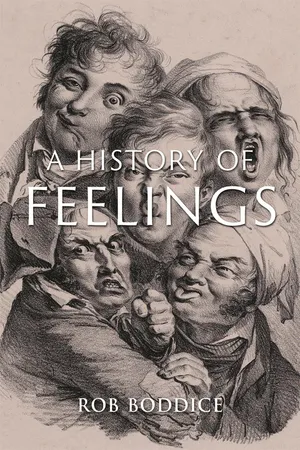
What does it mean to feel something? What stimulates our desires, aspirations and dreams? Did our ancestors feel in the same way to us? Historians have tried to make sense of our feelings, passions, moods, emotions and sentiments over the last decade in a wave of new research. For the first time, however, Rob Boddice brings together the latest findings to trace the complex history of feelings from antiquity to the present.
A History of Feelings is a compelling account of the unsaid – the gestural, affective and experiential. Rob Boddice argues that how we feel is the dynamic product of the existence of our minds and bodies in moments of time and space. Using a progressive approach that integrates biological, anthropological and social and cultural factors, he describes the evolution of emotional encounters and individual experiences across the globe. Written by one of the world's leading scholars of the history of emotions, this epic exploration of our affective life is essential reading for all those fascinated by our own well-being.
- English
- ePUB (mobile friendly)
- Available on iOS & Android
eBook - ePub
A History of Feelings
About this book
Information
Topic
HistoireSubtopic
Histoire du mondeREFERENCES
Introduction: Feeling for History
1 On the vagaries of empathy, see Susan Lanzoni, ‘Introduction: Emotion and the Sciences: Varieties of Empathy in Science, Art, and History’, Science in Context, XXV (2012), pp. 287–300; Lanzoni, ‘A Short History of Empathy’, The Atlantic, 15 October 2015. For some essential handwringing about the distinctiveness of something called empathy (Einfühlung), see Max Scheler, Wesen und Formen der Sympathie, 5th edn (Frankfurt, 1948). For a brief account of the ‘slipperiness’ of empathy, including a variety of neuroscientific angles, see Rob Boddice, The History of Emotions (Manchester, 2018), pp. 55–6, 124–8.
2 Richard Evans’s In Defence of History (London, 1997) carved out the response to the nadir of postmodernity, namely Keith Jenkins, Re-thinking History (London, 1991). More intellectually rigorous and useful approaches, such as those of Hayden White, seemed the more menacing in the light of Jenkins’s extremes. For the particular reference here, see Hayden White, ‘The Historical Text as Literary Artifact’, Tropics of Discourse: Essays in Cultural Criticism (Baltimore, MD, 1985), pp. 81–100.
3 Linda Connor, response to Paul Shankman, ‘The Thick and the Thin: On the Interpretative Theoretical Program of Clifford Geertz’, Current Anthropology, XXV (1984), pp. 261–80 (p. 271).
4 The notion of finding out how it felt to be there, then, is most clearly expressed in Lynn Hunt, ‘The Experience of Revolution’, French Historical Studies, XXXII (2009), pp. 671–8. Some historians of emotions have been reluctant to set this as their goal, seeing a fundamental barrier to experience in the historical record. I suppose this to be a lack of historical imagination in part, but a serious underrating of the capacity to see through reconstructed contexts, languages and gestures.
5 For other longue durée studies, see J. Liliequist, ed., A History of Emotions, 1200–1800 (London, 2013); Barbara Rosewein, Generations of Feeling: A History of Emotions, 600–1700 (Cambridge, 2016); Elena Carrera, ed., Emotions and Health, 1200–1700 (Leiden, 2013). A more theoretically engaging account, which focuses largely on rhetoric, is Daniel M. Gross, The Secret History of Emotion: From Aristotle’s Rhetoric to Modern Brain Science (Chicago, IL, 2006).
6 Boddice, History of Emotions.
7 Readers should refer to my History of Emotions for a full account of this, but more programmatic accounts, including their intellectual rationale, can be found in Rob Boddice, ‘The History of Emotions: Past, Present, Future’, Revista de Estudios Sociales, LXII (2017), pp. 10–15; Rob Boddice (with Daniel Lord Smail), ‘Neurohistory’, in Debating New Approaches in History, ed. P. Burke and M. Tamm (London, 2018).
8 Boddice (with Smail), ‘Neurohistory’.
9 Allusions to culture notwithstanding, this is the popular view espoused by Antonio Damasio, Self Comes to Mind: Constructing the Conscious Brain (New York, 2012); Damasio, The Feeling of What Happens: Body and Emotion in the Making of Consciousness (Orlando, FL, 1999). An essential critique was supplied by Gross, Secret History of Emotion.
10 A particularly fierce critique has been supplied by Roger Cooter, ‘Neural Veils and the Will to Historical Critique: Why Historians of Science Need to Take the Neuro-turn Seriously’, Isis, CV (2014), pp. 145–54. The threat of a new Dark Ages was uttered by Cooter in a paper presented at the Department of Social Studies of Medicine, McGill University, November 2017.
11 Jean-Paul Sartre, Sketch for a Theory of the Emotions, trans. Philip Mairet (London, 2002), pp. 11–14 (p. 10).
12 For example, Lisa Feldman-Barrett, ‘Are Emotions Natural Kinds?’, Perspectives on Psychological Science, 1 (2006), pp. 28–58.
13 See Daniel Lord Smail, On Deep History and the Brain (Berkeley, CA, 2008), pp. 147–8, 193–4.
14 For example, I.C.G. Waever et al., ‘Epigenetic Programming by Maternal Behavior’, Nature Neuroscience, VII (2004), pp. 847–54; R. K. Silbereisen and X. Chen, eds, Social Change and Human Development: Concepts and Results (London, 2010); E. Jablonka and M. J. Lamb, Evolution in Four Dimensions: Genetic, Epigenetic, Behavioural, and Symbolic Variation in the History of Life (Cambridge, MA, 2005).
15 For an example of the former, see Arne Öhman, ‘The Biology of Fear: Evolutionary, Neural, and Psychological Perspectives’, in Fear Across the Disciplines, ed. Benjamin Lazier and Jan Plamper (Pittsburgh, PA, 2012), pp. 35–50. The principal affect universalists are Paul Ekman and Silvan Tomkins: see, in particular, Silvan Tomkins, Affect Imagery Consciousness, 4 vols (New York, 1962–3, 1991–2); Paul Ekman and Wallace Friesen, Pictures of Facial Affect (Palo Alto, CA, 1976).
16 Defined in William Reddy, ‘Against Constructionism: The Historical Ethnography of Emotions’, Current Anthropology, XXXVIII (1997), pp. 327–51.
17 See in particular, Lisa Feldman-Barrett, ‘Solving the Emotion Paradox: Categorization and the Experience of Emotion’, Personality and Social Psychology Review, X (2006), pp. 20–46, and Feldman-Barrett, ‘Are Emotions Natural Kinds?’
18 This neatly accords with what practice theorists have been saying for some time. See Monique Scheer, ‘Are Emotions a Kind of Practice (and is that what makes them have a history)? A Bourdieuian Approach to Understanding Emotion’, History and Theory, LI (2012), pp. 193–220.
19 There have been some beginnings: M. Pernau et al., Civilizing Emotions: Concepts in Nineteenth-century Asia and Europe (Oxford, 2015); Paolo Santangelo, La rappresentazione della emozioni nella Cina tradizionale (Modena, 2014); Barbara Schuler, ed., Historicizing Emotions: Practices and Objects in India, China, and Japan (Leiden, 2018).
20 See, for example, Alan G. Fix, Migration and Colonization in Human Microevolution (Cambridge, 1999); Alex Mesoudi, ‘Pursuing Darwin’s Curious Parallel: Prospects for a Science of Cultural Evolution’, Proceedings of the National Academy of Sciences of the United States of America, CXIV (2017), pp. 7853–60.
21 This was the profound, though unsaid, implication of Charles Darwin’s On the Origin of Species (London, 1859). For the implications at the level of scientific practice, see Rob Boddice, The Science of Sympathy: Morality, Evolution and Victoria...
Table of contents
- Front Cover
- Half Title
- Title Page
- Copyright
- CONTENTS
- INTRODUCTION: FEELING FOR HISTORY
- ONE: ARCHAIC AND CLASSICAL PASSIONS
- TWO: RHETORICAL AND BODILY FEELINGS
- THREE: MOTIONS AND MACHINATIONS
- FOUR: THE AGE OF UNREASON
- FIVE: SENSELESSNESS AND INSENSIBILITY
- SIX: THE MINISTRY OF HAPPINESS
- CONCLUSION: THE VALUE OF EXPERIENCE
- REFERENCES
- SELECT BIBLIOGRAPHY
- ACKNOWLEDGEMENTS
- PHOTO ACKNOWLEDGEMENTS
- INDEX
Trusted by 375,005 students
Access to over 1.5 million titles for a fair monthly price.
Study more efficiently using our study tools.
Frequently asked questions
Yes, you can cancel anytime from the Subscription tab in your account settings on the Perlego website. Your subscription will stay active until the end of your current billing period. Learn how to cancel your subscription
No, books cannot be downloaded as external files, such as PDFs, for use outside of Perlego. However, you can download books within the Perlego app for offline reading on mobile or tablet. Learn how to download books offline
Perlego offers two plans: Essential and Complete
- Essential is ideal for learners and professionals who enjoy exploring a wide range of subjects. Access the Essential Library with 800,000+ trusted titles and best-sellers across business, personal growth, and the humanities. Includes unlimited reading time and Standard Read Aloud voice.
- Complete: Perfect for advanced learners and researchers needing full, unrestricted access. Unlock 1.5M+ books across hundreds of subjects, including academic and specialized titles. The Complete Plan also includes advanced features like Premium Read Aloud and Research Assistant.
We are an online textbook subscription service, where you can get access to an entire online library for less than the price of a single book per month. With over 1.5 million books across 990+ topics, we’ve got you covered! Learn about our mission
Look out for the read-aloud symbol on your next book to see if you can listen to it. The read-aloud tool reads text aloud for you, highlighting the text as it is being read. You can pause it, speed it up and slow it down. Learn more about Read Aloud
Yes! You can use the Perlego app on both iOS and Android devices to read anytime, anywhere — even offline. Perfect for commutes or when you’re on the go.
Please note we cannot support devices running on iOS 13 and Android 7 or earlier. Learn more about using the app
Please note we cannot support devices running on iOS 13 and Android 7 or earlier. Learn more about using the app
Yes, you can access A History of Feelings by Rob Boddice in PDF and/or ePUB format, as well as other popular books in Histoire & Histoire du monde. We have over 1.5 million books available in our catalogue for you to explore.