In 1568 the Seventeen Provinces in the Netherlands rebelled against the colonial rule of the king of Spain. A confederation of duchies, counties and lordships, they demanded the right of self-determination, the freedom of conscience and religion, and the right to be represented in government. Their long struggle for liberty and the subsequent rise of the Dutch Republic was a decisive episode in world history and an important step on the path to the Universal Declaration of Human Rights.
In his compelling retelling of the conflict, Anton van der Lem explores the main issues at stake on both sides of the struggle and why it took eighty years to achieve peace. He recounts in vivid detail the roles of the key protagonists, the decisive battles and the war's major turning points, from the Spanish governor's Council Of Blood to the Twelve Years Truce, while all the time unraveling the shifting political, religious and military alliances that would entangle the foreign powers of France, Italy and England. Featuring striking illustrations that have rarely been seen before, this is a timely and balanced account of one of the most historically important conflicts of the early modern period.
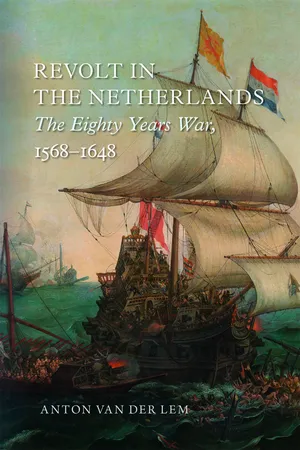
- English
- ePUB (mobile friendly)
- Available on iOS & Android
eBook - ePub
About this book
Information
1
The ‘Lands Over Here’
The Netherlands under Burgundian
and Habsburg Rule until 1555
The House of Burgundy
Anyone interested in how the Revolt led to the Netherlands dividing in two will first need to know how those lands came together in the first place. The driving force that brought together what we can now call the Low Countries was the House of Burgundy, originally a branch of the French royal House of Valois. The Duchy of Burgundy, with Dijon as its capital, was a fief of the French crown. Jean II, King of France, ceded the duchy to his son Philip (known as ‘the Bold’) in 1363 as a source of revenue. Philip married the wealthy heiress of the Count of Flanders and Artois, thus acquiring these rich counties in the north. The marriage also meant that he acquired the Free County of Burgundy, the Franche-Comté, to the east of the Duchy of Burgundy, strengthening his position in the south. Their grandson, Philip the Good, who came to power in 1419, succeeded in increasing his domains mainly to the north, acquiring first Namur, then Brabant and Limburg-Overmaas, followed by Holland and Zeeland, and finally Luxembourg. And in the bishoprics, where it was impossible to acquire a domain through succession, he had his illegitimate sons elected as bishops. These various domains did not yet have a collective name. Philip was known as the Duke of Burgundy and Brabant, and the Count of Flanders, Artois, Hainaut, Holland, Zeeland, Namur and so on. The name ‘the Low Countries by the sea’ was only geographically correct, but even then did not apply to his land of origin, Burgundy. Philip’s domains were thus described from the perspective of the duke himself, who usually resided in Flanders or Brabant, as les pays de par deça, the ‘lands over here’. Burgundy itself was referred to as les pays de par delà, the ‘lands over there’. The word pays (land) could refer to a duchy (Brabant, Gelre), county (Flanders, Holland) or a lordship like Mechelen or Friesland. This remarkable combination of widely varying domains clearly shared no common language. Those in the south spoke French, while those in the north spoke Flemish or Dutch. ‘The lands over here’ was not a name that could easily be used as a battle cry. Soldiers on the battlefield need a short, concise cry, like ‘Bourgogne, Bourgogne!’, ‘Ghent, Ghent!’ or ‘Holland, Holland!’ ‘The lands over here’ was simply too much of a mouthful. Philip the Good’s prosperous patrimonial domains lacked nothing, except a collective name for the whole.1
All of these different domains had only the modest beginnings of a joint state structure. The main factor that united them was that they shared the same sovereign lord. There were also certain similarities in their social structure. Nearly all of them comprised the three estates: clergy, nobility and the ‘third estate’ (burghers and peasants). The duke chose his advisers and the commanders of his armies from the nobility. He endowed them with low-ranking positions, such as bailiff, governor of a citadel, or as his deputy or stadtholder,2 in domains where he could not regularly be present in person. For nobles from the oldest and most prominent families, the sovereign had a special honour: the Order of the Golden Fleece. This was a very exclusive club to which the highest-ranking nobles were very keen to belong and through which the duke was able to assure himself of their loyalty.
The rich burghers in the cities, who had accumulated their wealth by trade and industry, could lend the duke money to finance his wars and the luxurious life at court. If he needed money he would submit a request, known as an ‘aid’, to the States, in which the three estates of his subjects were represented. The States in each domain would meet at the duke’s invitation. In exceptional circumstances, the duke could call the States together at the same time in the States General. The States General met for the first time in Bruges in 1464. The richest provinces were Flanders, Brabant, Holland and Zeeland, which had often been in conflict with each other in the past.3 Under the House of Burgundy they were now ruled by the same sovereign lord, averting much of the friction between them. The representatives of these four wealthy provinces met regularly to discuss trade disputes, traffic over land and water, and problems with tolls and currency. The merchants had much to gain from a stable and powerful government that kept the currency strong. Even more important was the protection they enjoyed against foreign competitors. The duke supported them, for example, in disputes with the Danish king or the Hanseatic League in the Baltic region. Map 1 (see p. 215) shows the core area of the Low Countries. These provinces together were the economic heart of the Burgundian state and accounted for 80 per cent of the taxes collected within it. Those in the north, east and south were less important, economically and politically.
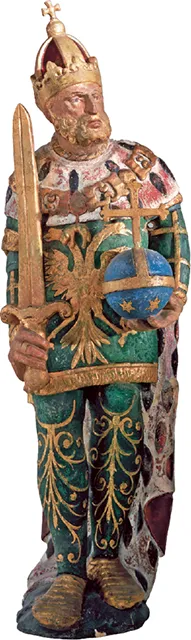
4 Sandstone gable relief showing Emperor Charles V. Utrecht, c. 1550–60.
Under the rule of Philip the Good, through cooperation with the duke and with each other, a sense of solidarity – still far too vague and intangible to be called national awareness – gradually evolved in the Low Countries. It first developed around the ducal dynasty and was especially prevalent among the upper layers of the bureaucracy and the Church, which had regular contact with the duke’s court. Philip fostered good relations with the individual provinces by respecting their privileges as much as possible. He pursued political unification only very slowly, by, for example, introducing general rules separately in each province. He assured himself of the loyalty of the nobility and burghers by making cautious changes in influential positions. In his turn, the duke had to solemnly swear at his investiture to respect the rights of his subjects. The document that imposed the most restrictions on his own rights was known as the Blijde Inkomst, or Joyous Entry. It was on this document that he swore his oath at his investiture in Brabant. (This tradition has survived to the present day, with the monarchs of Belgium and the Netherlands being invested rather than crowned. They now swear their oaths on the Constitution, in the same way that the Dukes of Brabant did on the Joyous Entry.4) The document stipulated, for example, that the lord was not permitted to wage war or impose taxes without the States’ permission. By agreeing to this, he recognized the right of his subjects no longer to obey him if he knowingly did anything to harm their interests. This article could, however, be interpreted very differently by the lord and by his subjects. Many provinces could not fall back on such a charter giving the inhabitants freedom to escape their obligations to the ruler. More than a century later, however, the terms of the Joyous Entry were invoked to justify ceasing to recognize the authority of King Philip II.
The son of Philip the Good, Duke Charles the Bold, who was in power from 1467 to 1477, waged war almost continually to expand his territories. He also had the ambition of incorporating all these lands into a single kingdom, of which he would be the king. Only the pope or the Holy Roman Emperor had the power to ‘elevate’ domains to the status of kingdom. The Holy Roman Empire is sometimes referred to as the German Empire, and its head of state as the German emperor, but this is actually incorrect. Besides the German territories, the empire also included Austria, parts of northern Italy and, until 1648, the Low Countries, too. We will therefore speak here consistently of the Holy Roman Empire. The emperor came from the House of Habsburg, also known as the House of Austria. Charles the Bold had only one child, Mary of Burgundy. Charles proposed to the emperor, Frederick III, a marriage between Mary and Frederick’s son Maximilian, in exchange for elevation of the Burgundian domains to a kingdom. The negotiations had reached an advanced stage and the marriage agreed when the emperor suddenly took off, leaving the duke behind without a kingdom.
Charles the Bold died on the battlefield in 1477. His daughter was only seventeen years old and had little political experience. It was therefore good, in terms of preserving the state structure of the Netherlands, that the States had several decades’ experience of sharing responsibility for government. That experience led the States to take two important decisions. First, they resolved to keep all the lands together. That was necessary because the French king was reuniting the Duchy of Burgundy with the French crown. He also invaded the Netherlands, to take advantage of the absence of a male ruler. Second, the States General increased their own influence on government. They compelled the young duchess not only to consent to a Joyous Entry, but also to approve what were known as Groot-Privileges (Great Privileges), which would limit her authority even more compared to her father and grandfather. The States could, for example, now convene on their own initiative, that is, without having to wait for a summons from the ruler. Under Mary’s more powerful successors, the Great Privileges fell again into disuse. Of lasting importance was that the Burgundian complex of duchies and counties survived the shock of 1477, largely due to the response of the States, so that the ties between the ‘lands over here’ remained intact. But the Duchy of Burgundy would from then on belong to France.
How the Netherlands and the Spanish Kingdoms Came to be Governed by the Same Ruler
Today it is almost impossible to imagine just how closely, in medieval and early modern society, the fate of a county, duchy or kingdom was linked to that of their ruling dynasty. A marriage, a birth or a death could determine whether they merged or separated. Of course, in their charters and the Joyous Entry, their people protected themselves against alliances that would not be in their interests, for example, by explicitly insisting that princely marriages require their consent. For a long time, in the prominent noble families of Europe, it had not been unusual to seek a bride or groom from another country, sometimes even from a far-off land. Philip the Good had married a Portuguese princess, and Charles the Bold an English one.
As mentioned above, the engagement of Mary and Maximilian had already been agreed by their fathers. After Charles the Bold’s premature death, it seemed sensible to proceed with the marriage without delay. Maximilian’s power could offer an effective counterbalance to the ambitions of the French king. It proved impossible, however, for Maximilian to pursue a purely ‘national’ policy, and certainly after he had been elected King of the Romans – that is, heir apparent to the Holy Roman Emperor – in 1486. Although Louis XI had seized the Duchy of Burgundy for the French crown, Franche-Comté remained a territory of the House of Burgundy, which, after the marriage of Mary and Maximilian, could also be called the House of Habsburg. Franche-Comté would now be governed from Brussels. From this time, we see the States developing their own ‘Netherlands policy’. Maximilian had his own agenda, which often clashed with the interests of his subjects in the Low Countries. Under his government, the States learned how to cooperate with a lord who also had interests elsewhere. After Mary’s unexpected death in 1482, the States thus succeeded in keeping Maximilian’s regency for his young son Philip the Fair (1482–1506) to a minimum. In 1494, they declared Philip of age and capable of taking over government of the Netherlands as a ‘natural prince’. Of course, the young ruler was closely supervised by a number of indigenous advisers.
Maximilian would settle for nothing less than the daughter of a king as a bride for Philip. Consequently, in 1496, Philip the Fair married Joanna, a daughter of Ferdinand, King of Aragon and Isabella, Queen of Castile, the two most important Spanish kingdoms. The chances that the marriage would lead to a merger of the domains of the bride and groom were extremely slim, as Joanna was preceded by a brother and an older sister in the line of succession. But, with a degree of improbability only to be found in real history, both siblings died prematurely. From the moment that Philip and Joanna – who would later suffer from mental illness – had the prospect of acceding to the thrones of Castile and Aragon, Philip’s ‘Netherlands policy’ was as good as finished. Only his early death in 1506 may have prevented an inevitable clash between the ruler and his subjects in the Netherlands – and possibly with his Spanish kingdoms, whose wrath he had incurred by favouring nobles from the Low Countries.
Once again, the ‘natural prince’ was still too young to govern: Philip’s first son, Charles, had been born in Ghent on 24 February 1500. As had happened with his father, the States decided to declare Charles of age while he was still very young, and in 1515 he accepted the role of ruler of the Netherlands. After the death of his grandfather Ferdinand of Aragon in 1516, he inherited the Spanish crowns of Aragon and Castile. Habsburg gold – borrowed from the German banking family Fugger – ensured his election in 1519 as Holy Roman Emperor, after which he became known as Charles V. Half of Europe fell under his rule or within his sphere of influence: the Spanish kingdoms, including half of Italy, the rich Low Countries, Austria and the bordering territories. Columbus’s voyages of discovery had led to South and Central America being seized for the Spanish crown (that is, Castile), giving it access to the gold and silver from the mines of Peru and Mexico. Such a state, made up of a number of totally different component parts, is known as a composite monarchy.5 Charles V’s coat of arms could only reflect the most important of these territories: of his domains in the Netherlands, it featured only the lions of Brabant and Flanders. In order to be represented in all of his domains, he was replaced in the Spanish kingdoms by regents, in Naples by a viceroy and in the Netherlands by a governor-general. Charles delegated his authority in the Netherlands first to his aunt, Margaret of Austria (who was governor-general from 1507 to 1530), and later to his sister, Mary of Hungary (who took over from 1531 to 1555). Their family pride was even greater than that of the emperor himself, if that was possible, and while they had no political ambitions whatsoever, they were very dedicated to preserving Habsburg interests. However, both also defended the interests of the Netherlands, which they governed with a resolute hand.6
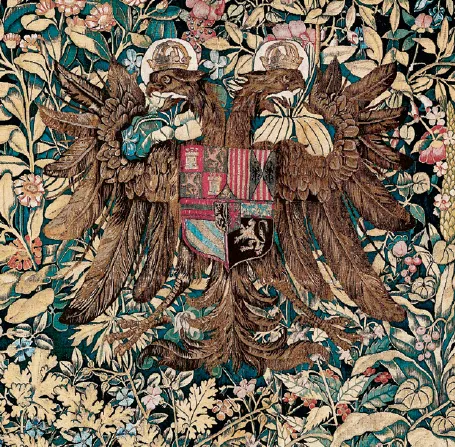
5 The arms of Charles V, bearing the most important of his many domains. The upper half shows the Spanish kingdoms; at bottom left are Austria and Burgundy. The golden lion against a black background is Brabant, and the black lion on a gold background is Flanders. Tapestry, c. 1540–55.
Lutherans and Anabaptists
The rule of Charles V became a succession of wars. The old rivalry with France continued unabated. The emperor and the French king disputed the principalities in northern Italy, and for Charles, reconquering the Duchy of Burgundy – no matter how unrealistic an ambition – was a matter of honour. These wars cost enormous amounts of money, all of which had to be collected from Charles’s subjects in the Netherlands and elsewhere in his realm. No less formidable was the other traditional enemy, the Ottoman Empire, who had to be fought from time to time. The Christians considered the Muslim Ottomans to be unbelievers, and the Muslims felt the same way about the Christians. For the Catholic Charles, the fight against the Ottomans was essentially a crusade.
After 1520, however, an unexpected enemy reared its head, more dangerous than any worldly prince: the Reformation, which emerged in Germany. For many centuries, the Roman Catholic Church had been the only Christian church in western Europe. It professed – and still professes – to be the only universal church, outside which there is no salvation. Throughout almost its entire history, the Church had been under fire from critics who disagreed with the lifestyle of the clergy or with certain articles or practices of the faith. They were especially censorious of the Church’s excessive material wealth. But, time and again, the Church had succeeded in absorbing reform movements, or getting the secular government to punish the reformers. In the first half of the sixteenth century, Erasmus of Rotterdam and, in Germany, Martin Luther w...
Table of contents
- Front Cover
- Half Title
- Title Page
- Copyright
- Contents
- Foreword to the English-language Edition
- Introduction
- 1 The ‘Lands Over Here’: The Netherlands under Burgundian and Habsburg Rule until 1555
- 2 The Troubles: Loyal Opposition against Philip II: 1555–1567
- 3 Loyalty Tested: Under Alba’s Repression: 1567–1573
- 4 The Netherlands, or Belgium Nostrum: From War to Pacification: 1573–1576
- 5 The Netherlands Divided: The Short-lived Success of the Moderate Centre: 1576–1584
- 6 An Offensive War: The North against the South: 1584–1609
- 7 The Twelve Years Truce: Division in the North, Recovery in the South: 1609–1621
- 8 The Long Road from Truce to Peace: The North Victorious, the South between Hammer and Anvil: 1621–1648
- Epilogue: By Way of Conclusion
- Chronology of Main Events
- Maps
- References
- Bibliography
- List of Illustrations
- Acknowledgements
- Index
Trusted by 375,005 students
Access to over 1.5 million titles for a fair monthly price.
Study more efficiently using our study tools.
Frequently asked questions
Yes, you can cancel anytime from the Subscription tab in your account settings on the Perlego website. Your subscription will stay active until the end of your current billing period. Learn how to cancel your subscription
No, books cannot be downloaded as external files, such as PDFs, for use outside of Perlego. However, you can download books within the Perlego app for offline reading on mobile or tablet. Learn how to download books offline
Perlego offers two plans: Essential and Complete
- Essential is ideal for learners and professionals who enjoy exploring a wide range of subjects. Access the Essential Library with 800,000+ trusted titles and best-sellers across business, personal growth, and the humanities. Includes unlimited reading time and Standard Read Aloud voice.
- Complete: Perfect for advanced learners and researchers needing full, unrestricted access. Unlock 1.5M+ books across hundreds of subjects, including academic and specialized titles. The Complete Plan also includes advanced features like Premium Read Aloud and Research Assistant.
We are an online textbook subscription service, where you can get access to an entire online library for less than the price of a single book per month. With over 1.5 million books across 990+ topics, we’ve got you covered! Learn about our mission
Look out for the read-aloud symbol on your next book to see if you can listen to it. The read-aloud tool reads text aloud for you, highlighting the text as it is being read. You can pause it, speed it up and slow it down. Learn more about Read Aloud
Yes! You can use the Perlego app on both iOS and Android devices to read anytime, anywhere — even offline. Perfect for commutes or when you’re on the go.
Please note we cannot support devices running on iOS 13 and Android 7 or earlier. Learn more about using the app
Please note we cannot support devices running on iOS 13 and Android 7 or earlier. Learn more about using the app
Yes, you can access Revolt in the Netherlands by Anton van der Lem, Andy Brown in PDF and/or ePUB format, as well as other popular books in History & Early Modern History. We have over 1.5 million books available in our catalogue for you to explore.