Samsara, Nirvana, and Buddha Nature
eBook - ePub

Samsara, Nirvana, and Buddha Nature

  1. 440 pages
  2. English
  3. ePUB (mobile friendly)
  4. Available on iOS & Android
eBook - ePub

Samsara, Nirvana, and Buddha Nature

About this book

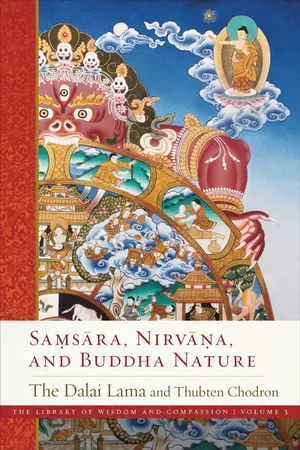
Samsara, Nirvana, and Buddha Nature takes up centrally important premises of Buddhism: the unsatisfactoriness ( duhkha ) of cyclic existence ( samsara ), the determination to be free of cyclic existence, and the mind as the basis for both the extreme duhkha of samsara and the bliss of nirvana. This volume shows us how to purify our minds and cultivate awakened qualities. Knowledge of buddha nature reveals and reconciles the paradox of how the mind can be the basis for both the extreme duhkha of samsara (the unpurified mind) and the bliss and fulfillment of nirvana (the purified mind). To illustrate this, Samsara, Nirvana, and Buddha Nature first takes readers through Buddhist thought on the self, the Four Noble Truths, and their sixteen attributes. Then, the Dalai Lama explains afflictions, their arising and antidotes, followed by an examination of karma and cyclic existence and, finally, a deep and thorough elucidation of buddha nature. This is the third volume in the Dalai Lama's definitive and comprehensive series on the stages of the Buddhist path, The Library of Wisdom and Compassion. Volume 1, Approaching the Buddhist Path, contained introductory material that sets the context for Buddhist practice. Volume 2, The Foundation of Buddhist Practice, describes the important teachings that help us establish a flourishing Dharma practice. Samsara, Nirvana, and Buddha Nature can be read as the logical next step in this series or enjoyed on its own.
Frequently asked questions

Yes, you can cancel anytime from the Subscription tab in your account settings on the Perlego website. Your subscription will stay active until the end of your current billing period. Learn how to cancel your subscription.
No, books cannot be downloaded as external files, such as PDFs, for use outside of Perlego. However, you can download books within the Perlego app for offline reading on mobile or tablet. Learn more here.
Perlego offers two plans: Essential and Complete
  • Essential is ideal for learners and professionals who enjoy exploring a wide range of subjects. Access the Essential Library with 800,000+ trusted titles and best-sellers across business, personal growth, and the humanities. Includes unlimited reading time and Standard Read Aloud voice.
  • Complete: Perfect for advanced learners and researchers needing full, unrestricted access. Unlock 1.4M+ books across hundreds of subjects, including academic and specialized titles. The Complete Plan also includes advanced features like Premium Read Aloud and Research Assistant.
Both plans are available with monthly, semester, or annual billing cycles.
We are an online textbook subscription service, where you can get access to an entire online library for less than the price of a single book per month. With over 1 million books across 1000+ topics, we’ve got you covered! Learn more here.
Look out for the read-aloud symbol on your next book to see if you can listen to it. The read-aloud tool reads text aloud for you, highlighting the text as it is being read. You can pause it, speed it up and slow it down. Learn more here.
Yes! You can use the Perlego app on both iOS or Android devices to read anytime, anywhere — even offline. Perfect for commutes or when you’re on the go.
Please note we cannot support devices running on iOS 13 and Android 7 or earlier. Learn more about using the app.
Yes, you can access Samsara, Nirvana, and Buddha Nature by Dalai Lama, Thubten Chodron in PDF and/or ePUB format, as well as other popular books in Philosophy & Eastern Philosophy. We have over one million books available in our catalogue for you to explore.

Information

1
The Self, the Four Truths, and Their Sixteen Attributes
THE FOUR TRUTHS of the āryas are four facts that āryas — beings who directly see the ultimate nature of all persons and phenomena — know as true. These four truths establish the fundamental framework of the Buddhadharma, so a good understanding of them is essential. In this chapter we will look at the four truths in general, and in subsequent chapters will examine each one in detail.
The four truths describe the unawakened and awakened experiences of this merely designated self, so to begin with I would like to share some reflections on the self — the person who is reborn in cyclic existence, practices the path, and attains awakening.

Three Questions about the Self

I enjoy interfaith gatherings and appreciate the genuine in-depth dialogue and cooperation that result from them. At one such gathering in Amritsar, India, each participant was asked three questions: Is there a self? Is there a beginning to the self? Is there an end to the self? Here are my thoughts.

Is There a Self?

Most non-Buddhists assert an independent self — an ātman or soul — that takes rebirth. What leads them to say this? Although we know that our adult bodies did not exist at the time of our births, when we say, ā€œAt the time I was born . . .ā€ we feel there was a self that was born and that this same self exists today. We also say, ā€œToday my mind is calm,ā€ indicating that our mind is different today than yesterday when it was disturbed. But we feel the I is the same as yesterday. When we see a flower, we think, ā€œI see,ā€ and it feels that there is a real person who sees it.
In all these cases, although we know that the body and mind change, we still have the sense of an enduring I that is the owner of the body and mind. This is the basis for believing there is a permanent, unitary, independent self that goes to heaven or hell or is reborn in another body after death. From this comes the conclusion that there must be an unchanging, independent I that is present throughout our lives and remains the same although the mental and physical aggregates change. This I is the agent of all actions such as walking and thinking.
While both Buddhists and non-Buddhists accept the existence of the self, our ideas of what the self is differ radically: most non-Buddhists accept the existence of a permanent, unchanging soul or independent self, while Buddhists refute it. Although no Buddhist philosophical school asserts a permanent, unitary, independent self, these schools have various ideas of what the self is: the mental consciousness, the continuum of consciousness, the collection of aggregates, or the mere I that is merely designated. The Prāsaį¹…gika Madhyamaka, which is generally accepted as the most refined system of tenets, says the self is merely designated in dependence on the body and mind. Because the self is merely imputed, we can say, ā€œI am young or oldā€ and ā€œI think and feel.ā€ If the person were a completely different entity from the body and mind, it would not change when either the body or mind changes.

Is There a Beginning to the Self?

Those who believe in an external creator assert an autonomous intelligence that does not depend on causes and conditions. This being, they say, created the world and the sentient beings in it. For many people the notion that God created life fosters the feeling of being close to God and willingness to follow God’s advice to be kind and refrain from harming others. Their belief in a creator spurs them to live ethically and to help others.
Some faiths such as Jainism and Sāṃkhya do not assert a creator, but I do not know if they believe the ātman has a beginning.
A repeated theme in Buddhism is dependent arising, one aspect of which is that functioning things arise due to causes and conditions. When explaining the twelve links of dependent origination, the Buddha said, ā€œBecause of this, that exists. Because this has arisen, that arises.ā€ Because of this, that exists points out that things come into existence due to causes and conditions; they do not appear without a cause. If something has no causes, what makes it arise? If things do not depend on causes and conditions, why does a seed grow into a plant in the spring but not in the winter? If our lunch came into being without a cause, it would arise without groceries, pots, or cooks! Therefore everything — the body, the mind, and the external universe — depends on causes and conditions.
Because this has arisen, that arises illustrates that causes, like their results, are impermanent. If causes did not change, they would continue to exist even after producing their results. However, for a result to arise, its cause must cease; for an apple tree to grow, the apple seed must cease. It is not possible for a permanent creator or prior intelligence to create the universe and beings in it without itself changing. Each person, thing, and event arises due to its own causes, which in turn have come about in dependence on their causes. There is no discernable beginning.
Furthermore, things are produced by their own unique causes, not by discordant causes — things that do not have the capability to produce them. It is not the case that anything can produce anything. A daisy grows from daisy seeds, not from metal. Our bodies and minds each have their own unique causes.
Causes depend on conditions to produce their results. If conditions were unnecessary, a sprout could grow in the dead of winter or in parched soil; it would not depend on warmth and moisture to grow. Multiple causes and conditions are necessary to bring a result.
Each cause not only produces its own results but also arose due to the causes that produced it. The sprout is the cause of the tree that grows from it as well as the result of the seed from which it grew. If an external creator were the cause of the universe, he or she would also have to be the result of a previous cause. He would be a caused phenomenon and could not exist independent of causes.
If Buddhists do not accept a self, who takes rebirth? Although the Buddha refutes a self that exists independent of all other factors, he accepts a conventional self that is dependent on causes, conditions, and parts. This self is designated in dependence on the body and mind, so the question of whether the self has a beginning depends on if the body and mind have beginnings. The body is material in nature. Scientists currently say that all matter can be traced back to the Big Bang. How did the Big Bang occur? There must have been some material substances, energy, or potential for matter that existed before the Big Bang, and conditions must have been such that it exploded. Here, too, we see that things must have causes that are affected by other conditions and therefore change and give rise to something new.
Our minds change moment by moment; the mind is impermanent and arises due to causes that have the ability to produce each moment of mind. The first moment of mind in this life has a cause, because without a cause it could not exist. The cause of our minds was not our parents’ minds, because both of our parents have their own individual continuity of consciousness, as do we. The substantial cause (upādānakāraṇa) of our minds — the cause that turns into the mind — cannot be our bodies or the sperm and egg of our parents, because the mind and body have different natures: the mind is formless and has the nature of clarity and cognizance, while the body has physical and material characteristics. The only thing we can point to as the cause of the first moment of mind in this life is the previous moment of that mind in the previous life. This continuity can be traced back infinitely, with one moment of mind producing the next moment of mind; there is no beginning.

REFLECTION

Consider:
1. Everything that is produced arises from causes; nothing can arise causelessly.
2. Causes are impermanent; they must cease in order for their result to arise.
3. There is concordance between a cause and its result. A specific result can only arise from the causes and conditions that are capable of producing it.
4. Apply this understanding to the existence of the physical universe and of your mind.

Is There an End to the Self?

Within Buddhism there are two positions regarding this question. Some Vaibhāṣikas say that when an arhat (someone who has attained liberation from saṃsāra) passes away (attains nirvāṇa without remainder of the polluted aggregates), the continuum of the person ceases to exist, like the flame of a lamp going out due to lack of fuel. Because the polluted aggregates are produced by afflictions and karma, when arhats pass away there is no continuity of their aggregates, since their causes — afflictions and polluted karma — have been ceased. Because the aggregates are necessary for the existence of a person, they say that the person no longer exists.
There are difficulties with this assertion: when the person is alive, there is no nirvāṇa without remainder of the polluted aggregates, and when this nirvāṇa has been attained, there is no person who attained it. In that case, how could we say, ā€œThis person attained this nirvāṇa?ā€
Furthermore, there is nothing that can eradicate the mindstream — the continuity of mind. The wisdom realizing selflessness eradicates afflictive obscurations, but it cannot destroy the clear and cognizant nature of the mind. For this reason Mādhyamikas and most Cittamātrins assert that after a person attains parinirvāṇa — the nirvāṇa after death — the continuum of the purified aggregates exists. These purified aggregates are the basis of designation of that arhat; thus the person does not cease to exist when he or she attains parinirvāṇa. Motivated by compassion, bodhisattvas who have overcome afflictive obscurations continue to take rebirth in cyclic existence. The continuity of buddhas’ mindstreams also remain forever.
From the viewpoint of Tantrayāna, after an arhat passes away the subtlest mind-win...

Table of contents

  1. Cover Page
  2. Title Page
  3. Publisher’s Acknowledgment
  4. Contents
  5. Preface by Bhikį¹£uṇī Thubten Chodron
  6. Abbreviations
  7. Introduction by His Holiness the Dalai Lama
  8. 1. The Self, the Four Truths, and Their Sixteen Attributes
  9. 2. Revolving in Cyclic Existence: The Truth of Duįø„kha
  10. 3. True Origins of Duįø„kha
  11. 4. Afflictions, Their Arising, and Their Antidotes
  12. 5. Afflictions and Karma, Their Seeds and Latencies
  13. 6. Karma, the Universe, and Evolution
  14. 7. Revolving in Cyclic Existence: The Twelve Links of Dependent Origination
  15. 8. Dependent Origination: Cycling in Saṃsāra
  16. 9. The Determination to Be Free
  17. 10. Seeking Genuine Peace
  18. 11. Freedom from Cyclic Existence
  19. 12. The Mind and Its Potential
  20. 13. Buddha Nature
  21. 14. Going Deeper into Buddha Nature
  22. Notes
  23. Glossary
  24. Further Reading
  25. Index
  26. About the Authors
  27. Copyright