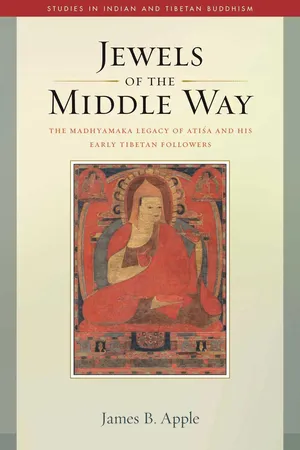
Jewels of the Middle Way documents an important tradition of Madhyamaka and provides insight into both the late Indian Buddhist blend of Madhyamaka and tantra and the Kadampa school founded by the Indian Buddhist master Atisa. This book presents a detailed contextualization of the Madhyamaka (Middle Way) school in India and Tibet, along with translations of several texts in the Bka' gdams gsung 'bum ( Collected Works of the Kadampas ), recently recovered Tibetan manuscripts that are attributed to Atisa and Kadampa commentators. These translations cohere around Atisa's Madhyamaka view of the two realities and his understanding of the practice and the nature of the awakening mind.The book is organized in three parts based on the chronology of Atisa's teaching of Madhyamaka in India and Tibet: (1) Lineage Masters, the Mind of Awakening, and the Middle Way; (2) Articulating the Two Realities; and (3) How Madhyamikas Meditate. Each part focuses on a specific text, or set of texts, specifically related to Atisa's Middle Way. The authorship and date of composition for each work is discussed along with an outline of the work's textual sources followed by an analysis of the content.
eBook - ePub
Jewels of the Middle Way
The Madhyamaka Legacy of Atisa and His Early Tibetan Followers
- 474 pages
- English
- ePUB (mobile friendly)
- Available on iOS & Android
eBook - ePub
Jewels of the Middle Way
The Madhyamaka Legacy of Atisa and His Early Tibetan Followers
About this book
Information
Topic
PhilosophieSubtopic
BouddhismeTable of contents
- Cover Page
- Title Page
- Dedication
- Contents
- Preface
- Introduction: Atiśa’s Middle Way in India and Tibet
- Part 1. Lineage Masters, the Mind of Awakening, and the Middle Way
- Part 2. Articulating the Two Realities
- Part 3. How Mādhyamikas Meditate
- Appendix of Translated Passages
- Table of Tibetan Transliteration
- Abbreviations
- Notes
- Bibliography
- Index
- About the Author
- Copyright
Trusted by 375,005 students
Access to over 1.5 million titles for a fair monthly price.
Study more efficiently using our study tools.
Frequently asked questions
Yes, you can cancel anytime from the Subscription tab in your account settings on the Perlego website. Your subscription will stay active until the end of your current billing period. Learn how to cancel your subscription
No, books cannot be downloaded as external files, such as PDFs, for use outside of Perlego. However, you can download books within the Perlego app for offline reading on mobile or tablet. Learn how to download books offline
Perlego offers two plans: Essential and Complete
- Essential is ideal for learners and professionals who enjoy exploring a wide range of subjects. Access the Essential Library with 800,000+ trusted titles and best-sellers across business, personal growth, and the humanities. Includes unlimited reading time and Standard Read Aloud voice.
- Complete: Perfect for advanced learners and researchers needing full, unrestricted access. Unlock 1.5M+ books across hundreds of subjects, including academic and specialized titles. The Complete Plan also includes advanced features like Premium Read Aloud and Research Assistant.
We are an online textbook subscription service, where you can get access to an entire online library for less than the price of a single book per month. With over 1.5 million books across 990+ topics, we’ve got you covered! Learn about our mission
Look out for the read-aloud symbol on your next book to see if you can listen to it. The read-aloud tool reads text aloud for you, highlighting the text as it is being read. You can pause it, speed it up and slow it down. Learn more about Read Aloud
Yes! You can use the Perlego app on both iOS and Android devices to read anytime, anywhere — even offline. Perfect for commutes or when you’re on the go.
Please note we cannot support devices running on iOS 13 and Android 7 or earlier. Learn more about using the app
Please note we cannot support devices running on iOS 13 and Android 7 or earlier. Learn more about using the app
Yes, you can access Jewels of the Middle Way by James B. Apple in PDF and/or ePUB format, as well as other popular books in Philosophie & Bouddhisme. We have over 1.5 million books available in our catalogue for you to explore.