Arranged as a twenty-four week retreat in four phases, this edition is a guide to The Spiritual Exercises of St. Ignatius Loyola. It incorporates "centering" exercises of awareness patterned on Eastern or Buddhist meditation practices and devotional exercises similar to or drawn from those found in Sadhana, by the late Anthony de Mello, SJ. Poems and prayers by Rainer Maria Rilke, Rabindranath Tagore, T.S. Eliot, Ezra Pound, Edith Sitwell, and others are also included, as well as materials from Teilhard de Chardin's Divine Milieu.
eBook - ePub
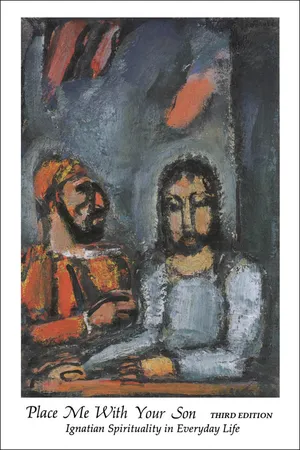
Place Me With Your Son
Ignatian Spirituality in Everyday Life, Third Edition
- 176 pages
- English
- ePUB (mobile friendly)
- Available on iOS & Android
eBook - ePub
About this book
Information
PHASE ONE OF THE EXERCISES: Weeks 1 to 4
Week 1: Soul of Christ, sanctify me!
My attitude: As I enter this approximately six-month period of grace, I desire to dispose myself in a special way during the first week so as to experience the loving God as he chooses to give himself to me. To this end I recall his love and his grace in my own history and in that of my ancestors. Moreover, I am determined to seek and to find him so that he may love me anew, that I may return from exile and slavery to share more fully God’s life and spirit in the land he promised.
What I seek: That I may find God in all things and always. That God may give me a more profound experience of his love, a deeper awareness of how I can respond to it, and a joyous freedom which comes from seeking God’s will for me.
Day 1 of Week 1: Isaiah 43:1–7
“I have called you by name. Fear not! I have redeemed you. You are mine!”
This beautiful poem begins and ends with the key verbs: create, form, and name; and it celebrates the return of Israel from exile as a new creation of Yahweh. This is accomplished as a result of the obligation of blood relationship. “Fear not, for I am with you. You are precious in my eyes … I love you.” So completely do Yahweh’s children share divine life that they are henceforth to be addressed by no other name than the Lord’s. Today, in similar fashion, the children of God’s own Son have their special name, Christian, and their Father is God, the Father, the same Yahweh who has called us by name.
Day 2 of Week 1: John 14: 16–17, 19
Finding God in All Things
The Spiritual Master met the disciple who told him that he had been searching for God for five years but had been unable to find him. “Where have you looked for him?” asked the Master. “I have searched in the desert; I have looked for him on the mountains; I have searched everywhere—in the country, in the villages, everywhere— and I have been unable to find him.” What the Master knew, but the disciple had not yet learned is that God can be found anywhere—everywhere. God has a thousand eyes, a million or more faces, even though a Spirit. God can be found everywhere if one is prepared to find him. One must know, not so much where to find God but how to do so.
What must I do to discover what the Master really means by saying that God can be found anywhere and everywhere? It is a secret that Ignatius had discovered and that he wished to pass on to each of us who engage in the Spiritual Exercises. Egan’s comment about Ignatius Loyola the Mystic should encourage us in our practice, because he tells us that Ignatius’ “ease in finding God was always increasing.… At whatever time or hour he wanted to find God, he found him” (p. 60). Such a practice is central to Ignatian spirituality.
In order to find God in all things, however, I must develop new eyes so that I can peer beyond the appearances of things; I must recognize that the world of the spirit is at least as real, though not as tangible, as the physical world in which my everyday life is lived. Part of that world is within me; and part of that world is all around me. John the Evangelist speaks to this point: “I will ask the Father, and he will give you another Advocate to be with you always, the Spirit of truth which the world cannot accept, because it neither sees nor knows it; but you know him, because it remains with you, and will be in you.… In a little while the world will no longer see me; but you will see me.” What a magnificent promise and statement of confidence that I can find and recognize the living Spirit within me (Jn 14: 16–17, 19).
Day 3 of Week 1: Awareness Meditation
A Buddhist-Christian Method of Prayer.
To learn to meditate we must learn to listen to the silent voice of the great teacher whom St. Augustine called “the Master Within.” If you listen to his voice you will learn to pray. Our Judaeo-Christian tradition offers many helps to meditation and we will, of course, make use of these. But the Buddhist tradition provides us with a practice that can facilitate and enrich our Christian meditation practice. That is awareness meditation, an important practice that has profound implications for assisting our Christian prayer and for improving many aspects of everyday life as well.
Awareness meditation is a powerful means for cultivating the emotional silence necessary for satisfactory prayer. In and of itself it is not necessarily prayer, but there can be little sustained prayerfulness and actual prayer without awareness or mindfulness. Let us now begin the practice of awareness meditation and you will quickly see what I mean. Sustained practice of awareness meditation from time to time will improve the quality of your Christian meditation.
Begin this first awareness meditation by taking a comfortable posture that you can maintain without moving for the period indicated, or at least without a conscious decision to do so. This may require a bit of discipline at first, but you will come to appreciate its value as time goes on.
1. While sitting still in as deep a silence as possible for ten minutes, make your breathing in and then out the focus of your attention throughout the period, noting whether it is shallow or deep, rapid or slow, soundless or wheezing, and any other features that you become aware of. As the period progresses, does your breathing slow down perceptibly? Don’t try to control your breathing—this is an awareness exercise—meant only to observe what happens not to control the results.
2. If your thoughts wander, take note of the fact and gently guide your wandering attention back to the breathing as often as necessary.
3. If you had some success in attaining interior silence such that you could focus for most of the period on the breathing, try to describe the qualities of that silence. Repeat this exercise two or three times in a row from time to time and you will become aware of an improvement in your ability to focus your mind on whatever you choose.
However, the chief importance of this exercise to your spiritual life ultimately is twofold: First, over time, as you repeat this and related breathing exercises, you will become aware that your interior silence, your ability to focus and to concentrate, will increase greatly as you let go of anxiety, fear, laziness, etc. You will gain controlled energy. Second, the important objective of this kind of exercise is to develop an awareness of what influences are operative in your mind and in your activities. You will find that increased awareness and perception will be very significant in the “discernment of spirits” and in the examination of consciousness discussed earlier in the Introduction (see page 11).
Day 4 of Week 1: Isaiah 55: 1–13
God lovingly invites me to come to Him.
I have the opportunity to come out of slavery as part of a new Exodus. Yahweh is my shepherd in this retreat, as in all of life. He is forever intent on bringing me, one of his chosen people, back to the “Promised Land” from exile and slavery. These verses from Isaiah are the conclusion to the Book of Comfort, as it is called (chaps. 40–55). Nearly every major theme here is blended into this magnificent finale. Chapter 55, an invitation to grace, comes full circle echoing many key words or themes of Chapter 40. These include a new exodus (40:1–11; 55:12–13), a new covenant (55:3); the way (40:3, 27; 55:7–9), forgiveness (40:2; 55:6–7), and a call to pasture or to eat (40:11; 55:1–2). In verse 6 the phrase, “seek the Lord”, normally was used to invite people to the sanctuary but here is used to exhort Yahweh’s people to seek God elsewhere as well, indeed everywhere. So I too am called to find God in all things. Verses 12 and 13 recall the Exodus theme: all the world finds peace and bursts into song as God brings Israel—and me—back from exile and slavery.
Day 5 of Week 1: Luke 12: 22–31
“If God so clothes the grass in the field that grows today and is thrown into the oven tomorrow, will he not much more provide for you!”
Jesus tells his followers, including me, to let go of worrying, to give up grasping for things that are of lesser importance, such as what I am to eat, what I am to wear, how long I am to live. Jesus looks to nature, to the ravens, to the lilies to help me to learn how I am to live my life. His message is “Stop worrying. The unbelievers of this world are always running after these things. Your Father knows that you need such things. Seek out instead his kingship over you, and the rest will follow in turn” (NAB).
It is not enough, even if I should be devout, to tell myself not to worry—I well know how “that” works at times—I must practice letting go of cares, of anger, of greed through awareness or insight meditation practice. Thus will I be able to keep the demons of worry at bay and be able with peace of mind and energy to “seek instead his Kingship.… and the rest will follow in turn.”
Day 6 of Week 1: Psalm 104: 1–35
“O Lord, my God, you are great indeed!”
Some three thousand years ago, about the time of King David, the exuberant psalmist sang this hymn in praise of Yahweh, the creator of the visible universe. This song of the psalmist—and it was meant to be sung—proclaims God’s power and provident care in his role as creator (vv. 3–10). His enthusiasm can be matched today as we sing that glorious anthem How Great Thou Art! Yahweh’s providential concern in supplying the needs of wild animals, birds, creatures large and small, and of mankind points up the dependence of all creation on the generosity of God’s hand. In verse 29, David describes what can happen if Yahweh does not maintain his providential care. The utter dependence of so many on their herds, or crops, and these in turn on sources of water, then as today in many parts of the world, helps us to appreciate the depth of gratitude expressed by God’s people living on the fringes of the treacherous desert.
How beautiful the sentiment of the psalmist as he concludes his song in heartfelt gratitude:
May the glory of the Lord endure forever;
may the Lord be glad in his works!
He who looks upon the earth, and it trembles;
who touches the mountains, and they smoke!
I will sing to the Lord all my life;
I will sing praise to my God while I live!
Pleasing to him be my theme;
I will be glad in the Lord
May sinners cease from the earth,
and may the wicked be no more.
Bless the Lord, O my soul! Alleluia.
Day 7 of Week 1: Repetition
Lord, show me again what Your gifts to me have been during this week.
During this last day of the first week of retreat it may be helpful to return to one or more of the meditations which has proved especially meaningful to you—as long as it remains fruitful. Sometimes, however, it is helpful to return to a meditation that was difficult or not fruitful long enough to see if on this occasion it may become more meaningful. Another approach is to use the examination of consciousness and review your experiences in prayer throughout the week to date to discern the movement of spirits. That is, examine the ways in which God, Our Father, is drawing you in the ways of Jesus, and those ways in which the evil spirit may be attempting to undermine those efforts.
Time after time I came to your gate
Time after time I came to your gate
with raised hands, asking for more and yet more.
You gave and gave, now in
slow measure, now in sudden excess.
I took some, and some things I let
drop; some lay heavy on my hands;
some I made into playthings and broke
them when tired; till the wrecks and
the hoard of your gifts grew immense,
hiding you, and the ceaseless expectation
wore my heart out.
Take, oh take—has now become my cry.
Shatter all from this beggar’s bowl;
put out this lamp of the importunate
watcher; hold my hands, raise me from
the still-gathering heap of your gifts
into the bare infinity of your uncrowded
presence.
RABINDRANATH TAGORE
Week 2: The Principle and Foundation
My attitude: Spiritual freedom is mine when I am seized so completely by the love of God that all the desires of my heart and all the actions, affections, thoughts and decisions which flow from them are directed to God, my Father, and his service and praise. My attitude is that of Samuel, “Here I am Lord, send me.”
What I seek: I beseech you, Lord, to direct all my actions by your inspiration, to carry them on by your gracious help, that every prayer and work of mine may always begin from you and through you be happily ended.
Day 1 of Week 2: On Our Spiritual Freedom
The Foundation: Fact and Practice.
Because of the importance of this principle and foundation to our spiritual freedom, you the retreatant should read over the “foundation” a few times each week during Phase One of the retreat. These statements express the basic Christian formulation that responds to the young man in the Gospel, who asked Jesus “What must I do to have eternal life?” They are taken from Fleming’s reading of the Spiritual Exercises.
God freely created us so that we might know, love, and serve him in this life and be happy with him forever. God’s purpose in creating us is to draw forth from us a response of love and service here on earth, so that we may attain our goal of ev...
Table of contents
- Cover Page
- Title Page
- Copyright Page
- Contents
- Preface to the Third Edition
- Introduction to the Spiritual Exercises
- Preparation for Phase One Prayer
- Phase One of the Exercises: Weeks 1 to 4
- Transition From Phase One to Phase Two
- Preparation for Phase Two Prayer
- Phase Two of the Exercises: Weeks 6 to 16
- Preparation for Phase Three Prayer
- Phase Three of the Exercises: Weeks 17 to 19
- Preparation for Phase Four Prayer
- Phase Four of the Exercises: Weeks 20 to 24
- Resources for the Study of the Spiritual Exercises
- Calendar for the Spiritual Exercises as an ISEL Retreat
- Footnotes
Trusted by 375,005 students
Access to over 1.5 million titles for a fair monthly price.
Study more efficiently using our study tools.
Frequently asked questions
Yes, you can cancel anytime from the Subscription tab in your account settings on the Perlego website. Your subscription will stay active until the end of your current billing period. Learn how to cancel your subscription
No, books cannot be downloaded as external files, such as PDFs, for use outside of Perlego. However, you can download books within the Perlego app for offline reading on mobile or tablet. Learn how to download books offline
Perlego offers two plans: Essential and Complete
- Essential is ideal for learners and professionals who enjoy exploring a wide range of subjects. Access the Essential Library with 800,000+ trusted titles and best-sellers across business, personal growth, and the humanities. Includes unlimited reading time and Standard Read Aloud voice.
- Complete: Perfect for advanced learners and researchers needing full, unrestricted access. Unlock 1.5M+ books across hundreds of subjects, including academic and specialized titles. The Complete Plan also includes advanced features like Premium Read Aloud and Research Assistant.
We are an online textbook subscription service, where you can get access to an entire online library for less than the price of a single book per month. With over 1.5 million books across 990+ topics, we’ve got you covered! Learn about our mission
Look out for the read-aloud symbol on your next book to see if you can listen to it. The read-aloud tool reads text aloud for you, highlighting the text as it is being read. You can pause it, speed it up and slow it down. Learn more about Read Aloud
Yes! You can use the Perlego app on both iOS and Android devices to read anytime, anywhere — even offline. Perfect for commutes or when you’re on the go.
Please note we cannot support devices running on iOS 13 and Android 7 or earlier. Learn more about using the app
Please note we cannot support devices running on iOS 13 and Android 7 or earlier. Learn more about using the app
Yes, you can access Place Me With Your Son by James W. Skehan in PDF and/or ePUB format, as well as other popular books in Theology & Religion & Christian Denominations. We have over 1.5 million books available in our catalogue for you to explore.