Science and Religion is a record of the 2009 Building Bridges seminar, a dialogue between leading Christian and Muslim scholars convened annually by the Archbishop of Canterbury. The essays in this volume explore how both faith traditions have approached the interface between science and religion and throw light on the ongoing challenges posed by this issue today. The volume includes a selection of relevant texts together with commentary that illuminates the scriptures, the ideas of key religious thinkers, and also the legacy of Charles Darwin.
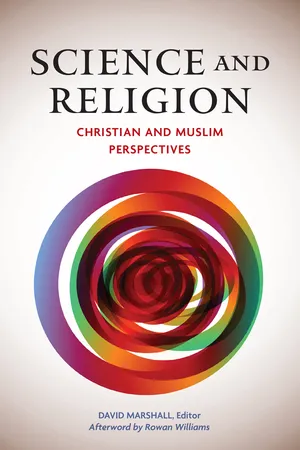
- 208 pages
- English
- ePUB (mobile friendly)
- Available on iOS & Android
eBook - ePub
About this book
Information
Topic
Theology & ReligionSubtopic
Religion & ScienceSurveys
Science and the Christian Tradition
A Brief Overview
TWO STORIES ARE COMMONLY TOLD about the relations between science and Christianity. At one extreme the story is all about conflict.1 The trial of Galileo by the Roman Catholic Church and continuing battles between Darwinians and creationists often make the headlines. At the other extreme we find the contrary claim that there would have been no modern science without Christianity.2 This sometimes surprising argument has taken different forms, but it depends on a simple idea: that a search for laws of nature only makes sense if creation has been ordered by a rational Creator, by a transcendent lawgiver. Isaac Newton saw this connection when he suggested that science had only prospered in monotheistic cultures. The mathematics of the solar system pointed to a deity no less brilliant than Newton himself, or in Newton’s own words a “deity very well skilled in mechanics and geometry.”3
The many fine achievements of Muslim scientists from the ninth to the sixteenth centuries, recently discussed by Ahmad Dallal, are consistent with Newton’s remark.4 Understanding the universe as a creation certainly did regulate thinking in much of early modern science. But the view that Christianity alone provided the necessary presuppositions is an exaggeration, recently classified as a “myth” in the book Galileo Goes to Jail and Other Myths about Science and Religion.5 For historians of science there is a wonderful richness and diversity in the relations between different sciences and different religious traditions. There is no such thing as the relationship between science and religion, and there has certainly been no such thing as the relationship between science and Christianity.6 It has been constructed and reconstructed in many different ways within different Christian traditions and in many different social and political contexts.
Diversity is found, for example, among the fathers of the Christian church. Some like Tertullian saw little value in the study of nature and in the achievements of the Greek natural philosophers: “Away with all attempts to produce a mottled Christianity of Stoic, Platonic, and dialectic composition!” Tertullian wanted “no curious disputation after possessing Christ Jesus, no inquisition after enjoying the gospel!” Having that faith, “we desire no further belief.”7 Tertullian was not typical of the church fathers, although all believed there were higher priorities than the investigation of nature. One of the reasons given by Basil of Caesarea for disregarding pagan scientific speculations was grounded in the observation that the Greek philosophers disagreed among themselves: no sooner was one theory proposed than it was succeeded by another and then another. What confidence, then, could be placed in them?8 Interestingly, that argument from the history of science still surfaces from time to time in critiques of realist philosophies of science.
In St. Augustine, however, there is a more positive estimate of the value of physical science. There will always be more urgent matters for the Christian disciple than the study of nature, but Augustine also warns that it would be embarrassing and disgraceful for Christians to be caught out talking nonsense on scientific topics. In his commentary on Genesis, Augustine even drew on Stoic philosophy to solve an exegetical problem. The Stoic concept of “seeds” allowed him to say that, when the world was first created, it was complete—and yet not completely complete. It would take time for living things to develop from the seeds implanted by the Creator. With reference to the origins of humankind, he put it like this: God “created man in the sense that he made the man who was to be, that is, the causal principle of man to be created, not the actuality of man already created.”9 A consequence of this approach was that the six “days” of the Creation narrative were not to be taken literally.10 In Augustine’s understanding of potentiality in the world, there is a greater subtlety than we sometimes find among the young-earth creationists of today. The critical point, however, is that Augustine illustrates an attitude toward the sciences that has reappeared many times in the history of Western Christianity. It manifests itself in what I like to call the selective role of religious belief because Christians (and they are not alone in this) have usually been happy to select from current bodies of science those features that reinforce their faith, dispensing with the rest. As Augustine himself put it, “if those who are called philosophers, especially the Platonists, have said things that are indeed true and are well accommodated to our faith, they should not be feared; rather what they have said should be taken from them as from unjust possessors and converted to our use.”11 In this respect even pagan knowledge could be the handmaiden of the Christian religion.
A critical moment for the development of Christian theology came in the thirteenth century when European scholars had to meet the intellectual challenge enshrined in the works of Aristotle. It was clear from Arabic translations recently translated into Latin that, more than any other ancient thinker, Aristotle offered a comprehensive system of knowledge that embraced the physical and life sciences. Medieval Christian scholars such as Roger Bacon, who argued that mathematics and science were essential for the church’s mission to infidels, were full of admiration. But there was a problem—one that had already been faced by Muslim scholars. Aristotle argued for at least three propositions that were theologically unacceptable: the mortality of the soul, the eternity of the universe, and the planting of all causal agency within nature itself. In response, one of the greatest Christian theologians, Thomas Aquinas, drew from Aristotle all that could lend support to the faith, at the same time rejecting Aristotle’s conclusions when they conflicted with what Christians believed from revelation. But Aquinas went further. He aimed to show that Aristotle’s reasoning—on the eternity of motion, for example—was not a danger to faith in a Creator. Because the ultimate cause of motion was God, the source of all being, Aquinas could present his theology as a completion of Aristotle’s physics. The ends or final causes, which Aristotle placed within nature, could only be fully understood if they were also grounded in a transcendent Providence.
There is a particularly interesting critique of Aristotle that one finds in both Christian and Muslim scholars. This concerns the nature of Aristotle’s proofs for propositions about nature. According to Aristotle, the Earth had to be at the center of the cosmos because that was its natural place. Move it away and it would return to where it belonged. Similarly, for Aristotle it was impossible that there could be more than one cosmos because if there were two there would have to be two centers. And this would lead to absurdity because a falling object, which must always fall to the center, would be caught between incompatible demands. It would not know which way to turn. If, however, one believed in the omnipotence of God, there was an unwelcome dogmatism in saying that anything had to be the case. The argument that nature is organized as it is because it cannot be otherwise surely overlooks the fact that an omnipotent Creator could have chosen to organize the creation differently. In 1277, protesting against arguments that he believed were putting constraints on God’s power, the bishop of Paris, Étienne Tempier, famously condemned no fewer than 219 propositions allegedly taught in the arts faculty of the University of Paris.12 In principle, such theological critiques created the space for a more critical science of nature, and they were to have echoes in seventeenth-century Europe when empirical methods for the study of nature achieved a higher profile.
An example is the French Catholic scholar Marin Mersenne, who in the 1630s was a kind of one-man “Internet,” in touch with leading scientists across Europe. Mersenne specifically objected to the idea that the Earth must be at the center of the universe. It could have been placed wherever God wished, and it was no use sitting and philosophizing in an armchair to discover where that was.13 Mersenne showed a willingness to countenance the alternative Copernican system. In England, when Francis Bacon defended the need for experimental methods in science, he attacked the learning of the universities precisely because such learning was too preoccupied with philosophical commentaries on ancient thinkers. If God had been free to make any number of different worlds, then empirical methods were indispensable for discovering which of the many possibilities had actually been instantiated.14 In Bacon’s vision, Christian humility and experimental methods went hand in hand in opposition to the arrogance and practical sterility of scholastic philosophy.
By the seventeenth century, when Bacon and Mersenne were writing, Christianity had been divided by the Reformation associated with Martin Luther and John Calvin. In many ways the expansion of Protestantism favored the expansion of the natural sciences. A critical attitude to the authority of the Catholic Church could lead to greater freedom of thought in the interpretation of nature. Luther had been no friend to Aristotle, describing him as a “Greek buffoon” who had “befooled the Church,” “a cursed arrogant, rascally heathen,” and “truly a devil … a most horrid impostor on mankind.”15 He really liked him! Not surprisingly, Luther attacked Aquinas for having introduced Aristotle’s “unchristian, profane, meaningless babblings” into theology.16 And although Luther was no friend to the astronomical system of Copernicus, it is striking how many of the key players in moving the Earth were Lutherans, including the famous astronomer Johannes Kepler.17 Catholic scholars sometimes complained of the “Calvinist-Copernican” system, indicating that they saw an unhappy parallel between reformed science and reformed religion.18
The Protestant Reformation also brought new approaches to the interpretation of scripture. Biblical texts had often been understood to carry several levels of meaning—symbolic and allegorical as well as literal. Disagreement between Catholics and Protestants over ultimate sources of authority, and the search for “proof texts” in disputes over doctrine, encouraged literal over symbolic readings. This change of emphasis when interpreting the book of God’s word had consequences for the interpretation of God’s other book, the book of his works. Nature ceased to be a deposit of unconnected religious symbols and became instead an ordered system, designed for human benefit, in which the connections between phenomena could be explored.19 So we find Isaac Newton, who happened to be born on Christmas day, dedicating himself to a radical Christian mission having two parallel aims—to uncover single definitive meanings of each biblical text, just as he searched for a single definitive explanation for each natural phenomenon. Newton prescribed set rules for the reading of the two books, drawing an explicit analogy between them in a quest for the simplest interpretations.20 This “two books” analogy had already served Francis Bacon well when he argued that because it was the duty of the Christian to study the Bible, it was also a religious duty to study the book of nature.
This by no means exhausts the connections that were made between Protestant Christianity and the importance of scientific study. The biblical doctrine of the Fall of man featured prominently in Bacon’s vision. Through disobedience Adam had lost dominion over nature that God had intended for humankind. Bacon’s thesis was that the practical application of scientific knowledge could go some way at least to restoring that lost dominion.21 Among the intellectual leaders of the puritan revolution in seventeenth-century England, another Christian motif helped to motivate a search for knowledge that would bring glory to God and relief to suffering humanity. This was the doctrine of Christ’s second coming, when, on one reading of scripture, he would reign over the Earth for one thousand years. Bacon argued that to improve the world through the application of science was an appropriate way to prepare for the millennium. The Western dream of a science-based utopia owes much to the secularization of that millenarian vision.22
Conflict between Catholic and Protestant Christianity had some negative consequences for scientific innovation. Galileo suffered because his defense of a moving Earth coincided with attempts by the Catholic Church in Rome t...
Table of contents
- Cover Page
- Title Page
- Copyright Page
- Contents
- Participants
- Introduction
- Building Bridges in Istanbul
- Part I: Surveys
- Part II: Texts and commentaries
- Afterword
- Index
Trusted by 375,005 students
Access to over 1.5 million titles for a fair monthly price.
Study more efficiently using our study tools.
Frequently asked questions
Yes, you can cancel anytime from the Subscription tab in your account settings on the Perlego website. Your subscription will stay active until the end of your current billing period. Learn how to cancel your subscription
No, books cannot be downloaded as external files, such as PDFs, for use outside of Perlego. However, you can download books within the Perlego app for offline reading on mobile or tablet. Learn how to download books offline
Perlego offers two plans: Essential and Complete
- Essential is ideal for learners and professionals who enjoy exploring a wide range of subjects. Access the Essential Library with 800,000+ trusted titles and best-sellers across business, personal growth, and the humanities. Includes unlimited reading time and Standard Read Aloud voice.
- Complete: Perfect for advanced learners and researchers needing full, unrestricted access. Unlock 1.5M+ books across hundreds of subjects, including academic and specialized titles. The Complete Plan also includes advanced features like Premium Read Aloud and Research Assistant.
We are an online textbook subscription service, where you can get access to an entire online library for less than the price of a single book per month. With over 1.5 million books across 990+ topics, we’ve got you covered! Learn about our mission
Look out for the read-aloud symbol on your next book to see if you can listen to it. The read-aloud tool reads text aloud for you, highlighting the text as it is being read. You can pause it, speed it up and slow it down. Learn more about Read Aloud
Yes! You can use the Perlego app on both iOS and Android devices to read anytime, anywhere — even offline. Perfect for commutes or when you’re on the go.
Please note we cannot support devices running on iOS 13 and Android 7 or earlier. Learn more about using the app
Please note we cannot support devices running on iOS 13 and Android 7 or earlier. Learn more about using the app
Yes, you can access Science and Religion by David Marshall in PDF and/or ePUB format, as well as other popular books in Theology & Religion & Religion & Science. We have over 1.5 million books available in our catalogue for you to explore.