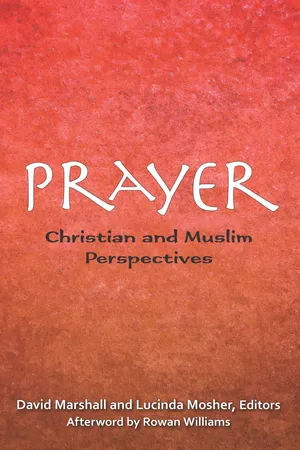
Prayer: Christian and Muslim Perspectives is a rich collection of essays, scriptural texts, and personal reflections featuring leading scholars analyzing the meaning and function of prayer within their traditions. Drawn from the 2011 Building Bridges seminar in Doha, Qatar, the essays in this volume explore the devotional practices of each tradition and how these practices are taught and learned. Relevant texts are included, with commentary, as are personal reflections on prayer by each of the seminar participants. The volume also contains a Christian reflection on Islamic prayer and a Muslim reflection on Christian prayer. An extensive account of the informal conversations at the seminar conveys a vivid sense of the lively, penetrating, but respectful dialogue that took place.
eBook - ePub
Prayer
Christian and Muslim Perspectives
- 232 pages
- English
- ePUB (mobile friendly)
- Available on iOS & Android
eBook - ePub
About this book
Information
Topic
Theology & ReligionSubtopic
ReligionPART I
Surveys
Lived Prayer
Some Examples from the Christian Tradition
MICHAEL PLEKON
Anthony called his two companions … and said to them, “Always breathe Christ.”
Athanasius of Alexandria1
The Long Search, a world religions documentary series, included an episode focused on Christianity in which the host, Ronald Eyre, asked a Benedictine monk, Father Miguel, “What is prayer?” They were at the monastery of Montserrat, surrounded by pilgrims lighting candles, attending the services, singing hymns, and kissing the image of the Virgin Mary long revered there. The pilgrims were also laughing, enjoying the sun and picnic lunches outside the monastery church. The host observed that it seemed like a summer day at the beach or in a park: what did all this have to do with prayer? The monk smiled at the question and said that there was no such thing as prayer, or for that matter, faith, hope, or love. These did not exist in the abstract, in theory, in definitions, although there were thousands of pages of efforts to describe and define prayer.
I very much agree with Father Miguel. As he went on to say, “There are only people who pray, have faith, hope, and love, and live accordingly.” Since, in recent years, my writing has consisted of listening to the voices of individuals looking for God, trying to live holy lives, I will do the same here with some favorite persons of faith.2 Of course, much has been said about prayer in more formal theology, from the scriptures through the teachers of the early church and the desert mothers and fathers and many other writers. The procession of writers marches through history—from Augustine to Basil the Great, from Benedict to Teresa of Avila, from Julian of Norwich to Newman. In the twentieth century the cloud of witnesses includes figures such as Charles de Foucauld, Simone Weil, Etty Hillesum, Dietrich Bonhoeffer, Anthony Bloom, Mother Teresa of Calcutta, and Henri Nouwen.3
There are so many voices to which we could listen, but here I will propose only a few, some of whom may be less known but all of them persons of faith who have spoken very powerfully about life with God and prayer, and who lived what they said, incarnated what they prayed. The first is St. Seraphim of Sarov (1759–1833), one of the most beloved of Russian saints, in many ways very much like Francis of Assisi, and of a similar stature. He is reported to have said,
The true aim of our Christian life is the acquisition of the Holy Spirit. As for fasts, and vigils, and prayer, and almsgiving, and every good deed done because of Christ, they are only means of acquiring the Holy Spirit…. This Holy Spirit, the All-Powerful, is given to us … he takes up his abode in us and prepares in our souls and bodies a dwelling place for the Father…. Of course, every good deed done because of Christ gives us the grace of the Holy Spirit, but prayer gives it to us most of all, for it is always at hand, so to speak, as an instrument for acquiring the grace of the Spirit. For instance, you would like to go to church, but there is no church or the service is over; you would like to give alms to a beggar, but there isn’t one, or you have nothing to give…. You would like to do some other good deed in Christ’s name, but either you have not the strength or the opportunity is lacking. This certainly does not apply to prayer. Prayer is always possible for everyone, rich and poor, noble and humble, strong and weak, healthy and sick, righteous and sinful.4
What Seraphim says here has been cited numerous times because of the clarity and simplicity he brings not only to prayer but to living life in, with, and for God and our neighbor. While we cannot go into the details of Seraphim’s biography, suffice it to say he practiced what he preached and became what he prayed. The words quoted here come from his well-known conversation with a friend, Motovilov, in a snowy forest. Seraphim was filled with joy and was radiant from within with a light that warmed and calmed.5 But he told his friend that the same radiance was emanating from him too. It was of no significance that Seraphim was a monk and priest and his friend a layperson, for the Spirit dwells in us all. Every day of the year Seraphim would use the Easter greeting, “Christ is risen!” and would call every person he met “My joy.” He also said, “Acquire peace within and a multitude of people around you will find their salvation in you.”
Seraphim takes for granted that the whole point of our spiritual life is living in the Spirit of God. As he says often in the conversation, we are given the Spirit from the start, and as the Eastern Church prayer says, the Spirit “is everywhere, filling all things.” We are always in the Spirit or, better, the Spirit and therefore the Father and Christ are in us, with us. Notice the ease with which the Spirit, Christ, and the Father are mentioned. The Spirit is given and makes his home in us; the Father thus dwells in us, and Christ is wherever the Father and the Spirit are. Father, Son, and Spirit are one and always present to us, prayer being our presence before God and God’s being present to us. Or, following St. Paul, whom Seraphim cites frequently, he says: “The grace of the Holy Spirit, given at baptism in the name of the Father and of the Son and of the Holy Spirit, continues to shine in our heart as divine light in spite of our falls and the darkness of our soul. It is this grace that cries in us to the Father: ‘Abba, Father!’ and who reclothes the soul in the incorruptible garment woven for us by the Holy Spirit.”6
If prayer is always possible for everyone, then prayer must be like our very breathing, it must be our living in and with and for God and our neighbor. Thus, whether we are praying in a church service or not, whether we are giving to those in need or not, prayer is always possible. There is no single reason for praying, any more than there is one reason for living. And if prayer is a way of life, is there anything that cannot be prayed about or prayed for except something evil? The seventh-century saint Isaac the Syrian says that prayer gives us “a merciful heart … the heart’s burning for the sake of the entire creation, for men, for birds, for animals, for demons, and for every created thing; and by the recollection and sight of them the eyes of a merciful man pour forth abundant tears. From the strong and vehement mercy which grips his heart and from his great compassion, his heart is humbled and he cannot bear to hear or to see any injury or slight sorrow in creation.”7 Prayer puts us in communion not only with God but with all others, with all of God’s children and all of God’s creatures.
Perhaps it is a surprise that for these two spiritual fathers, one from more than a thousand years ago and the other from the recent past, the point of prayer is love—God’s limitless, forgiving, wildly compassionate love is given to each of us.8 And in turn, you and I are to love that way—as God loves. No mention of enemies or heretics, no anxiety over rules and law and rubrics—so very different from the practice of “religion” we often encounter, so open and free. Prayer always opens us up to God, to ourselves, and to others. It is a caricature to consider others or the world around us as distractions, intrusions of something profane into what is sacred. Prayer linked every one of the persons of prayer we are listening to here with many sisters and brothers, near and far away, with those in need, as well as those needing prayer because of their power.
Coming even closer to our time, we can listen to a lay theologian, a married man and father, who worked with the French Resistance to save people during the Second World War and later administered hostels for the homeless, the poor, and foreign students. Paul Evdokimov (1901–70), a Russian émigré who made his home in France, argued that in the context of the United Nations, the richer nations of the world should tax themselves so their impoverished sisters and brothers in the Third World could eat, work, and live. A teacher and writer unafraid to comment on global economics, he was uniquely able to write the following:
A saint is not a superman, but one who discovers and lives his truth as a liturgical being. The best definition of a human being comes from the liturgy … “I will sing to the Lord as long as I live”…. It is not enough to say prayers; one must become, be prayer, prayer incarnate. It is not enough to have moments of praise. All of life, each act, every gesture, even the smile of the human face, must become a hymn of adoration, an offering, a prayer. One should offer not what one has, but what one is.9
For Evdokimov, prayer is not only participation in the liturgy in church but a living out of that liturgy afterward, in all of one’s everyday life. He sees liturgy as essential. It is like the embrace and kiss of the beloved, eating and conversing and being with the friend, the spouse, the lover, the beloved child. Evdokimov knew John Chrysostom’s powerful statement that after celebrating the sacrament on the altar in church, we must continue to celebrate it in the heart of every sister or brother we meet. Just as the two great commandments bring together love of God and love of neighbor, so too the Eucharist, the heart of Christian worship, involves not only receiving the bread and cup of Christ’s body and blood but venerating the neighbor in whom God dwells. As we shall see later, Mother Maria Skobtsova wrote eloquently on the indivisibility of these great loves.
Evdokimov follows the biblical vision in seeing prayer as cosmic, extending the presence and praise of God into all corners of life. Further, while prayer connects us with God and others, our prayer is the means by which God transforms us, mends that which is broken, heals that which is infirm, and makes of us an encounter with God for those around us.10 This is indeed the universal teaching of the Christian tradition, whether in the Catholic, Orthodox, or Reformation churches, in the East or the West, or in the northern or southern hemispheres.
Our next example of lived prayer, Mother Maria Skobtsova (1891–1945), is a woman of our time. Poet, wife, mother, intellectual, and activist for the suffering, her personality and her work embody the diversity, the creativity, and the critical spirit of the modern and postmodern eras. Again, time prevents delving into her fascinating life, full of twists and turns almost worthy of dramatization. Swept up and almost executed twice in the Russian revolution, her exile landed her in Paris in the miseries of the Great Depression and then the Nazi occupation during the Second World War. The last years she spent as a professed nun, not cloistered but running a hostel for the poor, unemployed, and suffering. An...
Table of contents
- Cover Page
- Title Page
- Copyright Page
- Contents
- Participants and Contributors
- Introduction
- Preface
- Part I: Surveys
- Part II: Prayer and Scripture
- Part III: Learning to Pray
- Afterword
- Personal Reflections on Prayer
- Index
Trusted by 375,005 students
Access to over 1.5 million titles for a fair monthly price.
Study more efficiently using our study tools.
Frequently asked questions
Yes, you can cancel anytime from the Subscription tab in your account settings on the Perlego website. Your subscription will stay active until the end of your current billing period. Learn how to cancel your subscription
No, books cannot be downloaded as external files, such as PDFs, for use outside of Perlego. However, you can download books within the Perlego app for offline reading on mobile or tablet. Learn how to download books offline
Perlego offers two plans: Essential and Complete
- Essential is ideal for learners and professionals who enjoy exploring a wide range of subjects. Access the Essential Library with 800,000+ trusted titles and best-sellers across business, personal growth, and the humanities. Includes unlimited reading time and Standard Read Aloud voice.
- Complete: Perfect for advanced learners and researchers needing full, unrestricted access. Unlock 1.5M+ books across hundreds of subjects, including academic and specialized titles. The Complete Plan also includes advanced features like Premium Read Aloud and Research Assistant.
We are an online textbook subscription service, where you can get access to an entire online library for less than the price of a single book per month. With over 1.5 million books across 990+ topics, we’ve got you covered! Learn about our mission
Look out for the read-aloud symbol on your next book to see if you can listen to it. The read-aloud tool reads text aloud for you, highlighting the text as it is being read. You can pause it, speed it up and slow it down. Learn more about Read Aloud
Yes! You can use the Perlego app on both iOS and Android devices to read anytime, anywhere — even offline. Perfect for commutes or when you’re on the go.
Please note we cannot support devices running on iOS 13 and Android 7 or earlier. Learn more about using the app
Please note we cannot support devices running on iOS 13 and Android 7 or earlier. Learn more about using the app
Yes, you can access Prayer by David Marshall, Lucinda Mosher, David Marshall,Lucinda Mosher in PDF and/or ePUB format, as well as other popular books in Theology & Religion & Religion. We have over 1.5 million books available in our catalogue for you to explore.