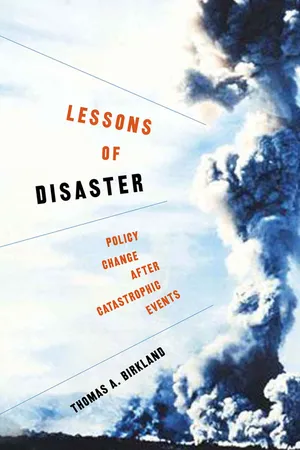
<p>Even before the wreckage of a disaster is cleared, one question is foremost in the minds of the public: "What can be done to prevent this from happening again?" Today, news media and policymakers often invoke the "lessons of September 11" and the "lessons of Hurricane Katrina." Certainly, these unexpected events heightened awareness about problems that might have contributed to or worsened the disasters, particularly about gaps in preparation. Inquiries and investigations are made that claim that "lessons" were "learned" from a disaster, leading us to assume that we will be more ready the next time a similar threat looms, and that our government will put in place measures to protect us. </p><p>In <I>Lessons of Disaster</I>, Thomas Birkland takes a critical look at this assumption. We know that disasters play a role in setting policy agendas—in getting policymakers to think about problems—but does our government always take the next step and enact new legislation or regulations? To determine when and how a catastrophic event serves as a catalyst for true policy change, the author examines four categories of disasters: aviation security, homeland security, earthquakes, and hurricanes. He explores lessons learned from each, focusing on three types of policy change: change in the larger social construction of the issues surrounding the disaster; instrumental change, in which laws and regulations are made; and political change, in which alliances are created and shifted.
Birkland argues that the type of disaster affects the types of lessons learned from it, and that certain conditions are necessary to translate awareness into new policy, including media attention, salience for a large portion of the public, the existence of advocacy groups for the issue, and the preexistence of policy ideas that can be drawn upon. </p><p>This timely study concludes with a discussion of the interplay of multiple disasters, focusing on the initial government response to Hurricane Katrina and the negative effect the September 11 catastrophe seems to have had on reaction to that tragedy.</p>
- 240 pages
- English
- ePUB (mobile friendly)
- Available on iOS & Android
eBook - ePub
About this book
Information
Publisher
Georgetown University PressYear
2006Print ISBN
9781589011212
9781589011205
eBook ISBN
9781589013599
Table of contents
- Cover Page
- Title Page
- Copyright Page
- Contents
- Illustrations
- Preface
- Acknowledgments
- one Theories and Models of Policy Change and Learning
- two September 11, Learning, and Policy Change
- three Learning from Aviation Security Disasters
- four Learning from Earthquakes and Hurricanes
- five Disaster, Learning, and the Possibility of Change
- Notes
- References
- Index
Trusted by 375,005 students
Access to over 1.5 million titles for a fair monthly price.
Study more efficiently using our study tools.
Frequently asked questions
Yes, you can cancel anytime from the Subscription tab in your account settings on the Perlego website. Your subscription will stay active until the end of your current billing period. Learn how to cancel your subscription
No, books cannot be downloaded as external files, such as PDFs, for use outside of Perlego. However, you can download books within the Perlego app for offline reading on mobile or tablet. Learn how to download books offline
Perlego offers two plans: Essential and Complete
- Essential is ideal for learners and professionals who enjoy exploring a wide range of subjects. Access the Essential Library with 800,000+ trusted titles and best-sellers across business, personal growth, and the humanities. Includes unlimited reading time and Standard Read Aloud voice.
- Complete: Perfect for advanced learners and researchers needing full, unrestricted access. Unlock 1.5M+ books across hundreds of subjects, including academic and specialized titles. The Complete Plan also includes advanced features like Premium Read Aloud and Research Assistant.
We are an online textbook subscription service, where you can get access to an entire online library for less than the price of a single book per month. With over 1.5 million books across 990+ topics, we’ve got you covered! Learn about our mission
Look out for the read-aloud symbol on your next book to see if you can listen to it. The read-aloud tool reads text aloud for you, highlighting the text as it is being read. You can pause it, speed it up and slow it down. Learn more about Read Aloud
Yes! You can use the Perlego app on both iOS and Android devices to read anytime, anywhere — even offline. Perfect for commutes or when you’re on the go.
Please note we cannot support devices running on iOS 13 and Android 7 or earlier. Learn more about using the app
Please note we cannot support devices running on iOS 13 and Android 7 or earlier. Learn more about using the app
Yes, you can access Lessons of Disaster by Thomas A. Birkland in PDF and/or ePUB format, as well as other popular books in Politics & International Relations & Public Policy. We have over 1.5 million books available in our catalogue for you to explore.