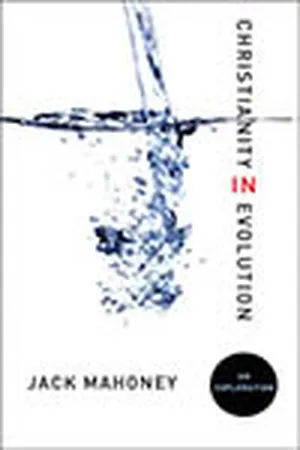
<p>Evolution has provided a new understanding of reality, with revolutionary consequences for Christianity. In an evolutionary perspective the incarnation involved God entering the evolving human species to help it imitate the trinitarian altruism in whose image it was created and counter its tendency to self-absorption. Primarily, however, the evolutionary achievement of Jesus was to confront and overcome death in an act of cosmic significance, ushering humanity into the culminating stage of its evolutionary destiny, the full sharing of God’s inner life.
Previously such doctrines as original sin, the fall, sacrifice, and atonement stemmed from viewing death as the penalty for sin and are shown not only to have serious difficulties in themselves, but also to emerge from a Jewish culture preoccupied with sin and sacrifice that could not otherwise account for death. The death of Jesus on the cross is now seen as saving humanity, not from sin, but from individual extinction and meaninglessness. Death is now seen as a normal process that affect all living things and the religious doctrines connected with explaining it in humans are no longer required or justified. Similar evolutionary implications are explored affecting other subjects of Christian belief, including the Church, the Eucharist, priesthood, and moral behavior.</p>
- 208 pages
- English
- ePUB (mobile friendly)
- Available on iOS & Android
eBook - ePub
About this book
Information
Topic
Theology & ReligionSubtopic
Christian DenominationsCHAPTER ONE
Accepting Evolution
THE RELATIONSHIP BETWEEN science and religion has long been a topic of debate and dispute, and nowhere more markedly in modern times than as it concerns the scientific account of evolution. Considerable attention is regularly given to the question of whether Darwinism and religion are in principle compatible, and in recent times distinguished contributions have been made by Peacocke, Ward, Polkinghorne, McGrath, Pope, Haught, and others that defend religion against polemical attacks in the claimed name of modern evolutionary theory.1 In a comprehensive article on evolution in the encyclopedic Christianity: The Complete Guide, Gerd Theissen explains and comments on the threats that evolution is considered to pose to theology with the opening remark that “for many people the notion of evolution is an argument against Christian faith, but for others it is a challenge to formulate that faith more credibly.”2 By contrast, James Patrick Mackey is of the view that the popular animosity between evolution and religion is overrated and exaggerated, constituting nothing more than a false myth of a war to the death between science and religion. The disputes, he roundly declares in words that have a ring of truth, go back as far as Leucippus and Democritus and more recently surround Galileo and Darwin and “were not in fact disputes between religion and science at all. Rather were they disputes between, on the one hand, current establishment views representing that inextricable mixture of science and theology which has . . . been shown to be the norm in Western philosophy as a whole and, on the other hand, emerging views that, as part and parcel of the normal advance of knowledge, challenged some important part of the establishment view in each case.”3
So far as concerns the predominance of evolution in this tension between science and religion, however this is conceived, Antje Ackelén notes that “the evolutionary perspective is today taken for granted in many respects and applied in many different areas, including epistemology, psychology and religion.”4 It should be noted, however, that her inclusion here of religion does not refer to the introduction of an evolutionary perspective into the study of religion, but rather to examining in evolutionary terms the causes for the development, survival, or decline of religion in different cultures or, put more simply in the words of John Durant, examining the idea “that religious beliefs may have biologically useful consequences.”5 There appears, indeed, an apparent unwillingness to consider the theological consequences that result from accepting the idea of evolution, apart from the issues identified by Celia Deane-Drummond in observing that “Darwin’s theory seemed to remove all need for a Creator God, diminish any sense of divine providence in the wake of evolutionary ills and suffering, and qualify the importance of humans by situating human life as a brief episode in a long and complex evolutionary history,” an agenda that helps to explain why “most of the debates [about religion and evolution] have focused on how far evolutionary theory is compatible with theological concepts of God as Creator, divine providence over creation, and theological anthropology, whereby humanity is perceived as being in a special sense the image of the Creator.”6 John Polkinghorne identifies several further reasons why, as he expresses it, “too many theologians fail to treat what science has to offer with the appropriate degree of seriousness,” including the reluctance to become involved in an area of detailed technical knowledge and expertise with which theology is not intrinsically connected, and in some cases, influenced by Barth, “an ideological disinclination” to find truth, or general revelation, outside the pages of divine revelation.7
CATHOLIC RESPONSES TO EVOLUTION
As Durant noted, religious discussions and controversies raised by the new doctrine of biological evolution focused on three issues: the interpretation of scripture, the relationship between God and nature in terms of creation and providence, and the status of human beings.8 Karl Rahner comments on early Catholic views of the new hypothesis of biological evolution: “From the middle of the [nineteenth] century until the first decades of the twentieth, the theory of evolution was almost unanimously rejected by theologians and by some it was explicitly declared to be heretical.”9 Zoltan Alszeghi chronicled the stages in the official Catholic response to the new science, beginning in 1860 with the condemnation by a local church synod in Cologne of evolution in any form as “completely contrary to Scripture and the faith.”10 That same year the First Vatican Council planned to condemn any theory involving polygenism, or the descent of the human race from more than one original pair, but the hasty conclusion of the council due to the Franco-Prussian War prevented any formal consideration being given to the subject. In 1909 the Pontifical Biblical Commission issued a detailed statement (DS 3512-19) that stressed the literal historical and factual truth of the first three chapters of the book of Genesis. In 1941, Pope Pius XII addressed the Pontifical Academy of Sciences on the subject of creation and observed that the many riches of paleontology, biology, and morphology had not to date contributed anything clear and certain on the problems concerning the origins of humanity. “Therefore,” he concluded, “all we can do is leave to the future the reply to the question whether one day science, enlightened and guided by revelation, will be able to provide safe and definitive results on such an important subject.”11
Returning in 1948 to the historical status of the early chapters of Genesis, the Biblical Commission observed more guardedly that their literary genre was quite unusual and problematic and judged that “to state a priori that their narratives do not contain history in the modern meaning of the word would easily lead to thinking they were not at all historical, whereas they relate basic truths presupposed in the economy of salvation in a simple and figurative language adapted to the understanding of a less developed people, at the same time as the popular description of the origins of the human race and of the chosen people” (DS 3864).
The first major Catholic statement on biological evolution was issued two years later in 1950 in the encyclical letter Humani generis of Pope Pius XII. This included a wide-ranging criticism of modern theological tendencies in which the pope approved of numerous requests for religion to respect the sciences, provided that this applied to demonstrable scientific facts. Caution, however, he observed, was required regarding “hypotheses” or “conjectural opinions” even if they relied on science in some measure, which affected doctrine contained in the Bible, or “tradition.” Hence, the pope continued, “the Church’s teaching authority does not forbid that the doctrine of ‘evolution,’ so far as it enquires into the origin of the human body from already existing and living matter—for the catholic faith bids us hold that souls are immediately created by God—be treated in investigations and discussions of experts in each field in accordance with the modern state of human sciences and sacred theology” (DS 3895–96).
The pope, however, went on to consider and to reject another conjectural opinion, that of polygenism. For the faithful, he warned, cannot accept the view that states that after Adam true human beings existed on earth who were not descended from him by natural generation as the universal protoparent, or that Adam refers to a number of protoparents,since it does not in the least appear how this view can be reconciled with what the sources of revealed truth and the actions of the church’s teaching authority state on original sin, which proceeds from a sin truly committed by a single Adam and which has been transmitted to everyone by generation and exists personally within everyone (DS 3897).
In an allocution in 1966, Pope Paul VI referred to evolution no longer as a hypothesis but as a “theory,” but he repeated the teaching of Humani generis that concerned what was termed by Karl Rahner a “moderate theory of evolution.”12 The most recent authoritative church statement on the subject was the observation of Pope John Paul II, in a message to the Pontifical Academy of Sciences on October 22, 1996, that, although Pope Pius XII had in his 1950 encyclical Humani generis referred to evolution only as “a serious hypothesis,” it was now the case that “some new findings lead us towards the recognition of evolution as more than a hypothesis.”13
It is remarkable that in its twentieth-century treatment of creation and human origins the 1994 Catechism of the Catholic Church makes no reference whatever to evolution, an omission that led Gabriel Daly to accuse it of “a near total disregard for the difficulties and doubts which beset the average modern believer of good will and critical intelligence.”14 In dealing with the creation of humans and their fall from divine grace, as derived from the narrative of the book of Genesis, the Catechism moves confusedly, he charges, between describing the language as often symbolic and accepting it as literal historical fact, to such a degree that he does not shrink from describing such a procedure as a way to “fudge the biblical issues.”15 Sharper than Daly’s criticism is that of Joan Acker, who explains why she considers the Catechism’s approach as an embarrassment in presenting its contents in “a Tridentine fundamentalist light.”16 In addition, Daryl P. Domning describes the Catechism’s treatment of Adam and Eve as “a theological scandal to one and all.”17
The absence of any reference to evolution in the Catechism was explained, however, by Bishop (now Cardinal) Christoph Schönborn, who had served as secretary to the Catechism’s editorial committee and who subsequently coauthored with the chair of the commission preparing the Catechism, then Cardinal Ratzinger, a shared Introduction to the Catechism of the Catholic Church. Commenting on the presentation of creation in the Catechism, Schönborn described it as a theme that “has often been passed over for fear of entering into conflict with scientific opinions and theories regarding the origins of the universe.” He added that “a particularly delicate subject is original sin,” which had occupied the attention of a special commission for some time. On their deliberations and conclusions he reports only that “it cannot be the task of the Catechism to represent novel theological theses which do not belong to the assured patrimony of the church’s faith. Consequently, the Catechism limits itself to setting forth the sure doctrine of faith.”18
By referring to “novel theological theses,” Schönborn seemed to have in m...
Table of contents
- Cover Page
- Title Page
- Copyright Page
- Dedication
- Contents
- Introduction
- Chapter One Accepting Evolution
- Chapter Two Evolution, Altruism, and the Image of God
- Chapter Three The Evolutionary Achievement of Jesus
- Chapter Four Incarnation without the Fall
- Chapter Five Seeking a New Paradigm
- Chapter Six The Church and the Eucharist in Evolution
- Chapter Seven Theology in Evolution
- Bibliography
- General Index
- Scriptural Index
Trusted by 375,005 students
Access to over 1.5 million titles for a fair monthly price.
Study more efficiently using our study tools.
Frequently asked questions
Yes, you can cancel anytime from the Subscription tab in your account settings on the Perlego website. Your subscription will stay active until the end of your current billing period. Learn how to cancel your subscription
No, books cannot be downloaded as external files, such as PDFs, for use outside of Perlego. However, you can download books within the Perlego app for offline reading on mobile or tablet. Learn how to download books offline
Perlego offers two plans: Essential and Complete
- Essential is ideal for learners and professionals who enjoy exploring a wide range of subjects. Access the Essential Library with 800,000+ trusted titles and best-sellers across business, personal growth, and the humanities. Includes unlimited reading time and Standard Read Aloud voice.
- Complete: Perfect for advanced learners and researchers needing full, unrestricted access. Unlock 1.5M+ books across hundreds of subjects, including academic and specialized titles. The Complete Plan also includes advanced features like Premium Read Aloud and Research Assistant.
We are an online textbook subscription service, where you can get access to an entire online library for less than the price of a single book per month. With over 1.5 million books across 990+ topics, we’ve got you covered! Learn about our mission
Look out for the read-aloud symbol on your next book to see if you can listen to it. The read-aloud tool reads text aloud for you, highlighting the text as it is being read. You can pause it, speed it up and slow it down. Learn more about Read Aloud
Yes! You can use the Perlego app on both iOS and Android devices to read anytime, anywhere — even offline. Perfect for commutes or when you’re on the go.
Please note we cannot support devices running on iOS 13 and Android 7 or earlier. Learn more about using the app
Please note we cannot support devices running on iOS 13 and Android 7 or earlier. Learn more about using the app
Yes, you can access Christianity in Evolution by Jack Mahoney in PDF and/or ePUB format, as well as other popular books in Theology & Religion & Christian Denominations. We have over 1.5 million books available in our catalogue for you to explore.