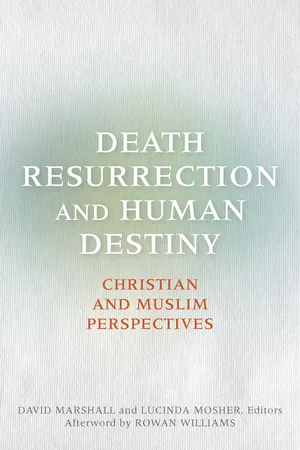
Death, Resurrection, and Human Destiny: Christian and Muslim Perspectives is a record of the 2012 Building Bridges seminar for leading Christian and Muslim scholars, convened by Rowan Williams, then Archbishop of Canterbury. The essays in this volume explore what the Bible and Qur?n—and the Christian and Islamic theological traditions—have to say about death, resurrection, and human destiny. Special attention is given to the writings of al-Ghazali and Dante. Other essays explore the notion of the good death. Funeral practices of each tradition are explained. Relevant texts are included with commentary, as are personal reflections on death by several of the seminar participants. An account of the informal conversations at the seminar conveys a vivid sense of the lively, penetrating, but respectful dialogue which took place. Three short pieces by Rowan Williams provide his opening comments at the seminar and his reflections on its proceedings. The volume also contains an analysis of the Building Bridges Seminar after a decade of his leadership.
eBook - ePub
Death, Resurrection, and Human Destiny
Christian and Muslim Perspectives
- 312 pages
- English
- ePUB (mobile friendly)
- Available on iOS & Android
eBook - ePub
Death, Resurrection, and Human Destiny
Christian and Muslim Perspectives
About this book
Information
Topic
Theology & ReligionSubtopic
ReligionPART I
Surveys
Death, Resurrection, and Human Destiny in the Bible
Introduction
The classic Christian belief about God’s ultimate destiny for his human creatures is the resurrection of the body. Many are therefore surprised to discover that belief in resurrection hardly features in the Old Testament at all. By the time of Jesus it was, in fact, a topic of controversy among different Jewish parties, with the conservative Sadducees rejecting it, the more radical Pharisees embracing it, and other Jewish groups and individuals remaining ambiguous or opting for some form of Platonism.1
The controversy between Pharisees and Sadducees highlights a key element in the biblical vision of life beyond the grave, and of God’s ultimate purpose for his human creatures. The present world is the good Creation of the God of justice and mercy. Resurrection is the point at which God’s Creation and God’s justice meet; together these themes affirm that the present world, and what humans do in it, matters. Resurrection was always an implicitly political doctrine. That was the main reason for the first-century Jewish controversy.
The ancient Israelite vision of God’s world and his people was not, after all, so very different from that of the later Christians and Rabbis, even though there was no developed vision of what happened after death. The ancient Israelites believed that after death God’s people were laid to rest in “Sheol,” a shadowy subterranean location.2 They were “asleep with their ancestors”; but the nature of that sleep and the chance of anything beyond it were not discussed. This was not because the earlier biblical writers were at a more “primitive” stage in which questions of “life after death,” so important in the modern West, had not yet impinged but because they laid powerful emphasis on the goodness of the this-worldly creation of land, family, seasons, and harvests, and on the importance of a human and earthly justice that reflected and embodied God’s own concern for things to be put right, especially in relation to the poor and needy. It was out of that passion for God to put things right that the biblical doctrine of resurrection began to emerge.
Resurrection in the Old Testament
Resurrection itself appears first in the Old Testament as a metaphor. Hosea and Ezekiel both speak of Israel’s God raising people up; these passages, originally metaphors for national restoration after disaster, were interpreted already by the first century in terms of actual resurrection.3 Many other texts were similarly interpreted. “When your days are fulfilled and you lie down with your ancestors,” promises YHWH to David, “I will raise up your offspring after you … and I will establish his kingdom” (II Sam. 7:12).4 The early Christians took the verse as a prophecy that confirmed their view that Jesus’s resurrection established him as the Davidic Messiah.5
Then there is the sudden strange passage in Isaiah, promising the abolition of death itself:
And he will destroy on this mountain the shroud that is cast over all people, the sheet that is spread over all nations; he will swallow up death for ever. … (Isa. 25:7–8a.)
Your dead shall live, their corpses shall rise. O dwellers in the dust, awake and sing for joy! For your dew is a radiant dew, and the earth will give birth to those long dead. (Isa. 26:19)
These passages echo the most famous Old Testament prediction of resurrection: Daniel 12. Set at the time of the revolt led by Judas Maccabaeus against the Syrian tyrant Antiochus Epiphanes in the 160s BC, the book offers hope for persecuted Jews, reaching a climax in the promise of ultimate deliverance:
Many of those who sleep in the dust of the earth shall awake, some to everlasting life, and some to shame and everlasting contempt. Those who are wise shall shine like the brightness of the sky, and those who lead many to righteousness, like the stars forever and ever. (Dan. 12:2–3)6
This was the passage that strengthened resurrection faith among subsequent Jewish generations, and that was dismissed by the Sadducees as a late innovation. The Maccabean period also gave rise, of course, to some of the most explicit expressions of ancient Jewish resurrection faith, notably in II Maccabees.7
The Early Christians and Jesus
It was to the book of Daniel that the early Christians went, as well, to understand who Jesus was and what he had accomplished in his life, his death, and his resurrection. Nobody was expecting a crucified Messiah. There is, however, massive, incontrovertible evidence that after his death Jesus’s first followers did indeed come to regard him as Israel’s Messiah, but this is inexplicable unless they believed that God had raised him bodily from the dead. It is not my present task to argue that this was true, though of course I think it was.8 My task is to show the remarkable way in which this belief colored and shaped the New Testament’s vision of life beyond the grave and of God’s ultimate destiny for his human creatures.
The first Christians put together their knowledge of Jesus with their fresh reading of the Old Testament scriptures to claim not just that in Jesus there was a new ethic or spirituality, nor even that in Jesus there was a new and definite hope for life after death. Their claim was that, in and through Jesus, Israel’s God had become king of the whole world. With Jesus’s resurrection, then, the early Christians believed that the world was, as it were, under new management, though the style of that management was unlike anything imagined before. When Paul concludes his greatest argument, he quotes Isaiah 11 to this effect, referring to Jesse, the father of King David, and seeing the coming Messiah as his “root,” the one who sustains his whole family: “There shall be the root of Jesse, the one who rises up to rule the nations; the nations shall hope in him” (Rom. 15:12).9 Rising and ruling go together.
This is important not just as background but also as formative context. Early Christianity was not nearly as interested in “life after death” as the modern world has been. In none of the four gospels, nor in the first chapter of Acts, does Jesus’s resurrection cause anyone to speculate about their own ultimate future. The emphasis is on the present: Jesus is raised, therefore he is the world’s true Lord, and therefore we have a job to do. Jesus’s resurrection does of course point to the future, which his people may one day share, but that is not seen as its primary purpose. Jesus’s resurrection is about what Jesus’s whole public career was about: God’s kingdom arriving, however paradoxically, “on earth as in heaven.” An overconcentration on “life after death” in its various forms is, I think, a medieval corruption, distracting attention from the horrible parody of God’s kingdom on earth offered by the ill-named Holy Roman Empire.
The early Christians were in fact not nearly as interested as we today are in “life after death,” the condition or location of people immediately after they died. That was, to be sure, a topic of discussion in the first century, but the New Testament has very little to say about it. They were much more interested in “life after life after death”: the ultimate resurrection, after a period of being bodily dead. Like Jesus in the tomb prior to Easter, there would be a two-stage sequence, and it was the final stage that mattered far more.
Fascinatingly, Jesus himself had very little to say on all this—another indication that the question of life after death was not, in itself, the central point of his aim and mission. We have a couple of incidental references to God’s new world, and to the righteous shining like stars within it.10 There is then the brief discussion with the Sadducees.11 This passage is often misunderstood, and we must look at it more closely.
The Sadducees pose a trick question to Jesus, apparently undermining the very idea of resurrection. The Levirate law of marriage indicated that when a husband died childless, his brother should marry the widow to raise up children for the dead man. Supposing this happens seven times over; which brother will be the husband in the resurrection?12 This was not simply an abstract theological question. “Resurrection” was part of radical Pharisaic belief, looking for Israel’s God to overturn the present order (represented by the aristocratic Sadducees) and to replace it with his own kingly rule. Jesus’s dramatic action in the temple, in which he acted out symbolically God’s coming judgment on that temple and its destruction, seemed to have indicated that he too believed in just such a drastic turnaround. So what did Jesus think about the resurrection? Was he too among the revolutionaries?
Since the Sadducees were suspicious of the later biblical books (not least the revolutionary Daniel), the challenge was to demonstrate the doctrine from the Pentateuch.13 But before Jesus answers them exegetically, he clarifies a vital point. This is where the greatest misunderstandings occur.
It has been assumed in Western Christianity that the ultimate aim is to leave this present world and to “go to heaven.” Even the word “resurrection” itself, which in the first century always referred to new bodily life, is seen by many as denoting its opposite, namely disembodied immortality. For Jesus and his first followers, as for the Pharisees, belief in “resurrection” meant belief in a twostage postmortem reality—such as we find also, I understand, within classic Islamic belief. One did not go straight from death into new bodily life. After death there would be a period of being physically dead. But if there was resurrection to come, that could not be the whole story. People used to say that Greeks believed in immortality while Jews believed in resurrection, but that is highly misleading. Some Greeks (not all) followed Plato in looking for an ultimate disembodied immortality. Some Jews—namely, the Pharisees and perhaps the Essenes—believed in a resurrection that would be to an immortal physicality, a new sort of body beyond the reach of death. There must then be some kind of continuity between bodily death and bodily resurrection. They had various ways of expressing this continuity. The Apocryphal book called The Wisdom of Solomon speaks of “the souls of the righteous” as being “in the hand of God,” and of being “at peace” (Wisdom 3:1–3). As John Polkinghorne once put it, God will download our software onto his hardware until he gives us new hardware again so that we can run the software for ourselves. But this state is temporary. A few verses later, Wisdom declares that “in the time of their visitation they will shine forth, and will run like sparks through the stubble. They will govern nations and rule over people, and the Lord will reign over them for ever” (Wisd. of Sol. 3:7–8). This, as I and others have argued, must indicate the hope of resurrection in God’s kingdom of ultimate justice.14
The intermediate state could be spoken of in different ways, indicating that there was no dogmatic concern in the early period to tidy the matter up. Some, it seems, could speak of the continuance of a “spirit” or ...
Table of contents
- Cover Page
- Title Page
- Copyright Page
- Contents
- Participants
- Acknowledgments
- Introduction
- Preface
- Part I: Surveys
- Part II: Texts and Commentaries
- Index
Trusted by 375,005 students
Access to over 1.5 million titles for a fair monthly price.
Study more efficiently using our study tools.
Frequently asked questions
Yes, you can cancel anytime from the Subscription tab in your account settings on the Perlego website. Your subscription will stay active until the end of your current billing period. Learn how to cancel your subscription
No, books cannot be downloaded as external files, such as PDFs, for use outside of Perlego. However, you can download books within the Perlego app for offline reading on mobile or tablet. Learn how to download books offline
Perlego offers two plans: Essential and Complete
- Essential is ideal for learners and professionals who enjoy exploring a wide range of subjects. Access the Essential Library with 800,000+ trusted titles and best-sellers across business, personal growth, and the humanities. Includes unlimited reading time and Standard Read Aloud voice.
- Complete: Perfect for advanced learners and researchers needing full, unrestricted access. Unlock 1.5M+ books across hundreds of subjects, including academic and specialized titles. The Complete Plan also includes advanced features like Premium Read Aloud and Research Assistant.
We are an online textbook subscription service, where you can get access to an entire online library for less than the price of a single book per month. With over 1.5 million books across 990+ topics, we’ve got you covered! Learn about our mission
Look out for the read-aloud symbol on your next book to see if you can listen to it. The read-aloud tool reads text aloud for you, highlighting the text as it is being read. You can pause it, speed it up and slow it down. Learn more about Read Aloud
Yes! You can use the Perlego app on both iOS and Android devices to read anytime, anywhere — even offline. Perfect for commutes or when you’re on the go.
Please note we cannot support devices running on iOS 13 and Android 7 or earlier. Learn more about using the app
Please note we cannot support devices running on iOS 13 and Android 7 or earlier. Learn more about using the app
Yes, you can access Death, Resurrection, and Human Destiny by David Marshall, Lucinda Mosher, David Marshall,Lucinda Mosher in PDF and/or ePUB format, as well as other popular books in Theology & Religion & Religion. We have over 1.5 million books available in our catalogue for you to explore.