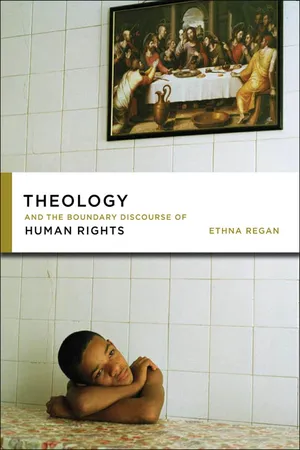
Theology and the Boundary Discourse of Human Rights
eBook - PDF

Theology and the Boundary Discourse of Human Rights

  1. 256 pages
  2. English
  3. PDF
  4. Available on iOS & Android
eBook - PDF

Theology and the Boundary Discourse of Human Rights

About this book

What are human rights? Can theology acknowledge human rights discourse? Is theological engagement with human rights justified? What place should this discourse occupy within ethics?

Ethna Regan seeks to answer these questions about human rights, Christian theology, and philosophical ethics. The main purpose of this book is to justify and explore theological engagement with human rights. Regan illustrates how that engagement is both ecumenical and diverse, citing the emerging engagement with human rights discourse by evangelical theologians in response to the War on Terror. The book examines where the themes and concerns of key modern theologians—Karl Rahner, J. B. Metz, Jon Sobrino, and Ignacio Ellacuría—converge with the themes and concerns of those committed to the advancement of human rights. Regan also critically engages with the “disdain” for rights discourse that is found in the postliberal critiques of John Milbank and Stanley Hauerwas.

This interdisciplinary volume will be of interest to students and scholars in the fields of systematic theology, theological ethics, human rights, religion and politics, and political theory.

Frequently asked questions

Yes, you can cancel anytime from the Subscription tab in your account settings on the Perlego website. Your subscription will stay active until the end of your current billing period. Learn how to cancel your subscription.
No, books cannot be downloaded as external files, such as PDFs, for use outside of Perlego. However, you can download books within the Perlego app for offline reading on mobile or tablet. Learn more here.
Perlego offers two plans: Essential and Complete
  • Essential is ideal for learners and professionals who enjoy exploring a wide range of subjects. Access the Essential Library with 800,000+ trusted titles and best-sellers across business, personal growth, and the humanities. Includes unlimited reading time and Standard Read Aloud voice.
  • Complete: Perfect for advanced learners and researchers needing full, unrestricted access. Unlock 1.4M+ books across hundreds of subjects, including academic and specialized titles. The Complete Plan also includes advanced features like Premium Read Aloud and Research Assistant.
Both plans are available with monthly, semester, or annual billing cycles.
We are an online textbook subscription service, where you can get access to an entire online library for less than the price of a single book per month. With over 1 million books across 1000+ topics, we’ve got you covered! Learn more here.
Look out for the read-aloud symbol on your next book to see if you can listen to it. The read-aloud tool reads text aloud for you, highlighting the text as it is being read. You can pause it, speed it up and slow it down. Learn more here.
Yes! You can use the Perlego app on both iOS or Android devices to read anytime, anywhere — even offline. Perfect for commutes or when you’re on the go.
Please note we cannot support devices running on iOS 13 and Android 7 or earlier. Learn more about using the app.
Yes, you can access Theology and the Boundary Discourse of Human Rights by Ethna Regan in PDF and/or ePUB format, as well as other popular books in Theology & Religion & Human Rights. We have over one million books available in our catalogue for you to explore.

Table of contents

  1. Cover
  2. Contents
  3. Acknowledgments
  4. Introduction
  5. CHAPTER ONE: A Dialectical Boundary Discourse: Secular and Religious
  6. CHAPTER TWO: Theological Anthropology and Human Rights: Karl Rahner’s Concentration on the Human
  7. CHAPTER THREE: Human Rights in Time: Realism between Memory and Hope
  8. CHAPTER FOUR: Liberation Theology and Human Rights: From Interruptive Realism to the Centrality of La Realidad
  9. CHAPTER FIVE: Rights-Holders or Beggars? Responding to the Postliberal Critique
  10. Conclusion
  11. Select Bibliography
  12. About the Author
  13. Index