Raffaella A. Del Sarto examines the creation of Israel's neo-revisionist consensus about security threats and regional order, which took hold of Israeli politics and society after 2000 and persists today. The failed Oslo peace process and the trauma of the Second Palestinian Intifada triggered this shift to the right; conflicts with Hamas and Hezbollah and the inflammatory rhetoric of Iranian President Ahmadinejad additionally contributed to the creation of a general sense of being under siege. While Israel faces real security threats, Israeli governments have engaged in the politics of insecurity, promoting and amplifying a sense of besiegement. Lively political debate has been replaced by a general acceptance of the no-compromise approach to security and the Palestinians. The neo-revisionist right, represented by Benjamin Netanyahu and the Likud, has turned Israel away from the peace process and pushes maximalist territorial ambitions. But they have failed to offer a vision for an end to conflict, and there has been little debate about whether or not the hardline policies toward the region are counterproductive. Del Sarto explains this disappearance of dissent and examines the costs of Israel's policies. She concludes that Israel's feeling of being under siege has become entrenched, a two-state solution with the Palestinians is highly unlikely for the foreseeable future, and Israel's international isolation is likely to increase. Del Sarto's analysis of this tense political situation will interest scholars and students of the Israeli-Palestinian conflict, Middle East Studies, and International Relations.
eBook - ePub
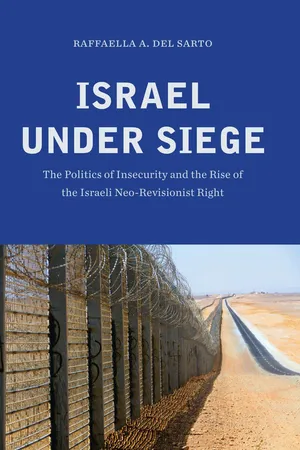
Israel under Siege
The Politics of Insecurity and the Rise of the Israeli Neo-Revisionist Right
- 296 pages
- English
- ePUB (mobile friendly)
- Available on iOS & Android
eBook - ePub
Israel under Siege
The Politics of Insecurity and the Rise of the Israeli Neo-Revisionist Right
About this book
Information
1
Feeling under Siege
Conflicts, Threats, and Regional Order
Israel is undoubtedly facing a number of significant external security threats, together with an enduring regional hostility. Among the populations of many of Israel’s neighbors, animosity and hatred toward Israel are often a blind reflex. But while disagreements over the desirable policy toward “the Arabs” have been a constant feature of Israeli politics, after the end of the Oslo peace process a remarkable shift took place: the country’s politicians now increasingly concurred on one specific vision of regional politics. In fact, it was the Zionist Left that converged toward the positions of Israel’s political center and right-of-center, with the vast majority of the Israeli public sharing its assessments.
Three major themes came to define the regional foreign policy agenda and public discourse in Israel after the collapse of the Oslo process. The first is the issue of terrorism, a topic that was particularly predominant during the first years of the Second Intifada. Terrorist attacks—mainly in the form of suicide bombings in Israeli buses and shopping malls—deeply affected the Israeli collective psyche and impacted how Israeli governments henceforth portrayed the nature of the Israeli–Palestinian conflict. Second, there was a growing conviction that there “is no partner for peace” on the Palestinian side. This notion would remain predominant during the 2000s and beyond. Third, Israel’s political establishment and the public came to view the regional environment through the lens of the rising power of Iran, a country that also supported hostile nonstate actors in the immediate neighborhood.
The three core elements of the new foreign policy consensus are interlinked, forming a rather coherent understanding of Israel’s regional environment and strategic position. They also convey a strong sense of besiegement. This chapter looks closely at the new consensus by focusing in particular on the first decade after the demise of the Oslo process, from 2000 to 2010. What is the material basis of the domestic consensus? Which features characterized Israel’s security situation and its regional environment in that period? What exactly do the main elements of the consensus mean and imply? Which lines of policy did these themes inform, and what are the political implications of these choices? And who were the main actors contributing to the emergence of Israel’s hegemonic vision on threats and regional order? While hegemonic notions are, by definition, axiomatic for those who maintain them, the discussion here assumes that at least some aspects of Israel’s hegemonic vision post-Oslo can be challenged.
Terrorism, on All Fronts
Against the background of the numerous Israeli victims created by the terrorist attacks of the second Palestinian intifada, the preoccupation with terrorism took center stage in Israeli politics in the first post-Oslo decade (and beyond). Together with the involvement in the violence of Fatah security forces—which Israel had helped arming—and other gruesome events, such as the lynching of two Israeli soldiers in Ramallah in early October 2000, the suicide attacks left Israelis in shock, fear, and anger. Repeated rocket attacks from Hamas and Hizballah across the southern and northern border, respectively, also forged a broad agreement across Israel’s political elite and the public on the need to fight the phenomenon of terrorism forcefully.
However, before proceeding, a note on the notion of terrorism is necessary. Perhaps unsurprisingly, there is no universally accepted definition of who is a terrorist. In legal terms, virtually all forms of terrorism are prohibited by one of twelve international counterterrorism conventions, international customary law, the Geneva Conventions, or the Rome Statutes of the International Criminal Court. Yet, in spite of this scattered list of conventions and little-known provisions in specific treaties, a compelling normative framework surrounding the question of terrorism is lacking. A particularly contested issue is the legitimacy of means adopted by liberation movements and by people living under occupation; the expression “one’s terrorist is another’s freedom fighter” clearly conveys this state of affairs.1 The question of whether states may be considered as engaging in terrorism is disputed as well.
However, a number of primary factors have been identified as bearing on terrorism. These include the systematic and intentional use of violence with the aim of creating fear, not just among the direct victims but also among a wider audience, with the objective of achieving political goals. In this vein, the UN Secretary-General High Level Panel on Threats, Challenges and Change suggested in 2004 that terrorism should be defined as any action “that is intended to cause death or serious bodily harm to civilians or non-combatants, when the purpose of such act, by its nature or context, is to intimidate a population, or to compel a Government or an international organization to do or to abstain from doing any act.”2
The argument that acts of terrorism solely involve the intentional killing of civilians and noncombatants (as opposed to combatant security personnel) is disputed as well. The 1983 barracks bombing in Beirut that targeted US and French soldiers, who were not engaged in any fighting, was widely defined as an act of terrorism. Those disputing this definition would point to their role as a foreign “occupation force,” thus designating them as a legitimate target of “resistance.” What is undisputed is that the deliberate killing of civilians violates international humanitarian law and counts as a war crime. According to these criteria, this book adopts the position that suicide bombings targeting civilians, as well as the deliberate firing of rockets on town and cities, violate international law and can be considered as acts of terrorism. When perpetrated in a systematic way and with the clear objective of creating fear as a means to achieve political goals, attacks carried out by Israeli settlers on the Palestinian population in the territories can also be considered as acts of terrorism. Provided that the same conditions are met, actions of the Israeli army against unarmed Palestinian civilians may fall into the same category.
It should also be mentioned that Israeli governments officially espouse a rather broad definition of terrorism: attacks on Israeli security personnel are considered as terrorist acts. Israel also defines Hamas and Hizballah as terrorist organizations—a position it shares with the United States, the European Union, and the governments of many other states. It goes without saying that these positions are contested by others, with Israel being sometimes accused of engaging in “state terrorism.”
Background: Terrorist Attacks Before and During the Second Intifada
Terrorism was not a new phenomenon that emerged with the Second Intifada. In fact, terrorist incidents have accompanied the entire history of the Israeli–Palestinian conflict. Significantly, attacks against Israeli civilians and security personnel carried out by different Palestinian factions—particularly Hamas and Islamic Jihad—also marked the period in which Israel negotiated the Oslo agreements with the Palestine Liberation Organization (PLO) in the 1990s. The novelty of the attacks starting in 1993 was that they targeted civilian population centers and were directed at central locations in major cities.3 From the signing of the Declaration of Principles on September 13, 1993, to the outbreak of the Second Intifada in late September 2000, Palestinian organizations that opposed the Oslo Accords carried out fourteen suicide bombings against Israeli civilians. Together with shooting, axing, and stabbing attacks, more than 180 Israeli civilians and over 80 soldiers were killed in that period.4
Under the interim premiership of Shimon Peres from 1995 to 1996, which followed Yitzhak Rabin’s assassination in November 1995, Hamas unleashed a series of suicide attacks within the pre-1967 Green Line, that is, within the internationally recognized borders of the State of Israel.5 Against the advice of some of his security advisers, Peres had ordered the assassination of Yehia Ayyash, the popular chief bomb maker of Hamas. Also known as “the engineer,” Ayyash had built several suicide bombs that had caused the deaths of about ninety Israelis. Hamas’s retaliation, the bloody series of attacks during Israel’s electoral campaign in the spring of 1996, had a major impact on the voting results, with Binyamin Netanyahu winning over Peres (albeit narrowly). This was exactly what Hamas had wanted: a Likud victory that would slow down or derail the peace process it detested.
During the Oslo process the question of how to handle Palestinian terrorism was a highly divisive issue in Israeli politics. The Rabin government declared that it would fight terror as if there was no peace process and that it would pursue the peace process as if there was no terror. Repeated many times by the Rabin government, this principle paraphrases David Ben-Gurion’s famous dictum at the outbreak of World War II, stipulating that the Jewish community in Palestine should fight the British government’s 1939 White Paper (which limited Jewish immigration to Mandatory Palestine) as if there was no war against the Nazis, and that it should fight the Nazis on the side of Great Britain as if there was no White Paper. Peres, on the other hand, coined the phrase that Israelis killed in Palestinian suicide attacks were the “victims of peace,” a notion that the Israeli public was reluctant to accept. While continuing to negotiate with the PLO, the governments of Rabin and Peres imposed closures on the Palestinian territories and restricted the movement of people and goods in response to repeated attacks.6 The subsequent government under Netanyahu (1996–99) had a very different approach to Palestinian terror. Netanyahu decided to suspend the implementation of the Oslo Accords and to renew it subject only to the complete cessation of Palestinian violence.
If this was the situation during the Oslo process, the worst was still to come. In the decade following the eruption of the Second Intifada, the number of Israeli fatalities from Palestinian terrorist attacks almost tripled. Between the end of September 2000 and the end of October 2010, different Palestinian factions carried out over eighty suicide bombings against Israeli civilians. Together with shootings, stabbings, or intentional killing by other means, these attacks claimed the life of more than 700 Israeli civilians in that period. In addition, over 330 members of the Israeli security forces were killed in Palestinian attacks, bringing the total number of Israeli fatalities to over 1,000.7 In January 2002 Israel captured a ship, the Karine A, with fifty tons of concealed weapons—including Katyusha rockets, antitank missiles, assault rifles, and explosives—that were most probably destined for Arafat’s Palestinian Authority. From 2001 different Palestinian factions in Gaza also started firing rockets into southern Israel as well as on Israeli settlements in the Gaza Strip.
Ariel Sharon, who became prime minister after the 2001 Israeli elections and had repeatedly declared that the Oslo Accords were null and void, reverted to the Likud approach to Palestinian terrorism, stressing that no negotiations would be held “under fire.”8 Sharon’s prime concern of seeking to crush terrorism witnessed the adoption of particularly repressive policies toward the Palestinians, marked by vast military operations in the West Bank and the Gaza Strip and, from 2002 on, the reoccupation of territories from which the Israeli army had withdrawn under the Oslo Accords. Thus, following a suicide bombing during Passover in Netanya in 2002 that killed twenty-eight Israeli civilians, the Israeli army undertook the lar...
Table of contents
- Cover
- Half title
- Title
- Copyright
- Dedication
- Contents
- Preface
- A Note on Transliteration
- Abbreviations
- Introduction: Israel’s New Foreign Policy Consensus after the Oslo Peace Process, 2000–2010
- 1. Feeling under Siege: Conflicts, Threats, and Regional Order
- 2. Israel’s Foreign Policy Consensus: Impact and Implications
- 3. A New Domestic Hegemony: Factors and Explanations
- 4. The Return of Dissent? 2010 to the Present
- Conclusions: Insecurity and the Power of Neo-Revisionist Hegemony
- Appendix A: Key Political Figures
- Appendix B: Chronology
- Bibliography
- Index
- About the Author
Trusted by 375,005 students
Access to over 1.5 million titles for a fair monthly price.
Study more efficiently using our study tools.
Frequently asked questions
Yes, you can cancel anytime from the Subscription tab in your account settings on the Perlego website. Your subscription will stay active until the end of your current billing period. Learn how to cancel your subscription
No, books cannot be downloaded as external files, such as PDFs, for use outside of Perlego. However, you can download books within the Perlego app for offline reading on mobile or tablet. Learn how to download books offline
Perlego offers two plans: Essential and Complete
- Essential is ideal for learners and professionals who enjoy exploring a wide range of subjects. Access the Essential Library with 800,000+ trusted titles and best-sellers across business, personal growth, and the humanities. Includes unlimited reading time and Standard Read Aloud voice.
- Complete: Perfect for advanced learners and researchers needing full, unrestricted access. Unlock 1.5M+ books across hundreds of subjects, including academic and specialized titles. The Complete Plan also includes advanced features like Premium Read Aloud and Research Assistant.
We are an online textbook subscription service, where you can get access to an entire online library for less than the price of a single book per month. With over 1.5 million books across 990+ topics, we’ve got you covered! Learn about our mission
Look out for the read-aloud symbol on your next book to see if you can listen to it. The read-aloud tool reads text aloud for you, highlighting the text as it is being read. You can pause it, speed it up and slow it down. Learn more about Read Aloud
Yes! You can use the Perlego app on both iOS and Android devices to read anytime, anywhere — even offline. Perfect for commutes or when you’re on the go.
Please note we cannot support devices running on iOS 13 and Android 7 or earlier. Learn more about using the app
Please note we cannot support devices running on iOS 13 and Android 7 or earlier. Learn more about using the app
Yes, you can access Israel under Siege by Raffaella A. Del Sarto in PDF and/or ePUB format, as well as other popular books in Politics & International Relations & Middle Eastern Politics. We have over 1.5 million books available in our catalogue for you to explore.