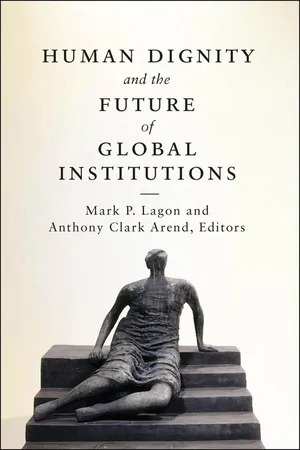
<p>What does human dignity mean and what role should it play in guiding the mission of international institutions? In recent decades, global institutions have proliferated—from intergovernmental organizations to hybrid partnerships. The specific missions of these institutions are varied, but is there a common animating principle to inform their goals? Presented as an integrated, thematic analysis that transcends individual contributions, <I>Human Dignity and the Future of Global Institutions</I> argues that the concept of human dignity can serve as this principle.</p><p>Human dignity consists of the agency of individuals to apply their gifts to thrive, and requires social recognition of each person's inherent value and claim to equal access to opportunity. Contributors examine how traditional and emerging institutions are already advancing human dignity, and then identify strategies to make human dignity more central to the work of global institutions. They explore traditional state-created entities, as well as emergent, hybrid institutions and faith-based organizations. Concluding with a final section that lays out a path for a cross-cultural dialogue on human dignity, the book offers a framework to successfully achieve the transformation of global politics into service of the individual.
</p>
eBook - ePub
Human Dignity and the Future of Global Institutions
- 384 pages
- English
- ePUB (mobile friendly)
- Available on iOS & Android
eBook - ePub
Human Dignity and the Future of Global Institutions
About this book
Information
Publisher
Georgetown University PressYear
2014Print ISBN
9781626161207
9781626161191
eBook ISBN
9781626161214
PART I
TRADITIONAL INSTITUTIONS
When one reflects upon institutions poised to promote human dignity, the work of traditional institutions comes most readily to mind. As the term is used in this book, “traditional institutions” refers to intergovernmental institutions—international organizations that states join in their official capacity. Part I of this book explores several such institutions, including the United Nations Security Council, the United Nations Secretary-General, the International Criminal Court (ICC), regional organizations, and international financial institutions.
Not surprisingly, one of the main roles these institutions play in promoting human dignity is norm creation. In chapter 1, Nancy Soderberg discusses the role of the Security Council in promoting and developing the norm relating to the “responsibility to protect.” Similarly, in chapter 3, Abiodun Williams explores how Secretary-General Kofi Annan acted to advance both that norm and others in service of human dignity. In a slightly different direction, Tod Lindberg, in chapter 2, explores the unique role of the ICC in developing what he calls the “responsibility to respect” the victims of atrocities by providing them with restitution. Likewise, in chapter 6, Mark P. Lagon and Ryan Kaminski examine a broad range of norms developed by a variety of global institutions that form the “human rights architecture.” And, finally, in chapter 7 Anthony Clark Arend discusses the need for clearer norms relating to the treatment of terrorism suspects.
But these chapters also explore another critical role of traditional institutions: norm implementation. Not only is it necessary to develop norms, human dignity demands that norms be made real in practice. Lagon and Kaminski stress the gap between rights norms and implementation. Soderberg, Williams, Lagon and Kaminski, and Lindberg explore in detail the implementation of several norms aimed at advancing dignity. Chester Crocker in chapter 4 pays special attention to the role of regional organizations as norm implementers in the area of conflict resolution. And in chapter 5, Anoop Singh examines the vital role of international financial institutions—including the International Monetary Fund—in promoting strong domestic institutions needed to realize the economic opportunity that is critical to human dignity.
CHAPTER 1
The United Nations Security Council
In August 2000, I sat in the informal Security Council room at UN headquarters in Turtle Bay pressing my colleagues for broader language in a draft UN resolution establishing a war criminals tribunal for Sierra Leone. Serving as the Alternate US Representative, I wanted to make sure that the war crimes tribunal we were authorizing could target the Liberian dictator Charles Taylor. Since 1991, through the sale of blood diamonds, Taylor had supported a ruthless rebel force fighting the democratic government. These rebels were responsible for tens of thousands of random killings, mutilations, rapes, and recruitment of child soldiers. Chopping off hands and eventually limbs had become a particularly sadistic practice, initially designed to scare people from voting as their fingers were dipped in indelible ink. The war had killed an estimated 50,000 out of a population of six million.
Talking back and forth by phone with then assistant secretary of state for African Affairs Susan Rice, we agreed to keep pressing Russia and China to accept language that would go beyond citizens of Sierra Leone. They and others had concerns over sovereignty and legitimacy for prosecuting foreign war criminals. The resolution formally requested the creation of an independent special court to bring to justice those responsible for the horrific war crimes committed during the civil war. With strong support from Britain, the former colonial power in Sierra Leone, I secured language that included “crimes under relevant Sierra Leonean law committed within the territory of Sierra Leone.” That would include Charles Taylor. The United Nations Security Council (UNSC) Resolution 1315 passed 15-0 on August 14, 2000 (UNSC 2000).
This was personal to me. The summer before, I had traveled to Sierra Leone and visited a shelter for victims of the war. One of the most searing moments in my nearly thirty years in conflict prevention was holding a two-year-old girl—wide grin, sparkly eyes, a pretty flowered dress—missing both her arms. What kind of human barbarity could propel another human to chop off both a little girls’ arms? I vowed then to do all I could to bring the perpetrator to justice. I had regretted not acting more forcefully to stop the 1994 genocide in Rwanda while serving as the third-ranked official on the National Security Council. The scene I visited in December 1994 in the western village of Nyarbuye in Rwanda still haunts me. Entering a church, there were still bodies everywhere of men, women, and children strewn over the floor. Little girls in dresses, men in suits, still lying where the killers had struck them down with machetes. An estimated 800,000 men, women, and children had died from April to July 1994.
Thus, it was particularly gratifying when in April 2012 former Liberian president Charles Taylor was finally brought to justice for his role in the Sierra Leone civil war—the first former head of state since Nuremberg to face such justice. The Special Court for Sierra Leone found Taylor guilty of eleven counts of war crimes and crimes against humanity, including murder, rape, and conscripting child soldiers. Expressing no remorse for his role in the atrocities, Taylor was sentenced on May 30, 2012, to fifty years in prison—essentially a life sentence for the sixty-four-year-old former dictator.
Others, too, have been brought to justice through courts set up by the UNSC. Have these prosecutions saved lives? No. They all occurred after the killings. Are they a deterrent to future killers? Probably not, yet. In fact, in the short term, the indictments might push leaders to cling to power longer, as may well be the case today in Syria. But in eventually bringing justice, they have helped support reconciliation and the peace processes that follow the violence. This represents real progress for the UNSC in standing up for human rights and dignity around the world. Its words do matter.
While the process of justice is important, so is actual intervention to stop the killing. But the UNSC has failed to prevent the slaughter in Syria, the killings in the Democratic Republic of the Congo and in Somalia, the crisis in Mali, and other conflicts around the world. What more should and can the UNSC do to protect lives and maintain human dignity in the twenty-first century?
The UN was set up in 1945 to maintain international peace and security and is based on the principle of the sovereign equality of all its Members. The Security Council’s purpose is to determine the existence of any threat to the peace and to make recommendations to maintain or restore international peace and security. The protection of human dignity does not appear in the Charter as a function of the Security Council. And yet today, we look increasingly to the UN—and especially to the Security Council—to do just that.
This chapter explores the state of play in the role of the UNSC in promoting human dignity and offers recommendations on how to improve its capacity and performance in that important realm.
The Security Council
After two world wars that witnessed the greatest human tragedies the world has seen, the global powers met in 1945 to establish an institutional structure to prevent another such war. Previous attempts to institutionalize global peace and security after the First World War, such as the League of Nations and the Kellogg-Briand pact, proved to be failures when World War II broke out in 1939. The UN was founded to replace these efforts with a lasting structure to prevent another world war.
The UN Charter—created in 1945 and amended in 1965—established a fifteen-member Security Council, the principal organ of the UN charged with maintaining peace and security.1 This body is charged as the premier international watchdog and guarantor of global peace with the authority to impose binding decisions on all UN member states. The great powers that were the victors of the Second World War received the most coveted positions as permanent members on the Security Council, with the all-powerful veto. The Charter designates five permanent members, the P-5—China, France, the Soviet Union (with Russia as its successor), the United Kingdom, and the United States—which were seen as the primary guardians of global security.
In addition to the permanent members, ten additional members are elected for two-year terms based on their contributions to peace and security and regional representation. While the Charter does not designate seats on a geographical basis, in practice the nonpermanent seats have been divvied up among regional blocs (McDonald and Patrick 2010). The regional groups include Asian, African, Latin American and Caribbean, Eastern European, Western European, and Others (which includes the United States and Israel).
Once established, the Security Council quickly got wrapped up in the great power politics of the Cold War and often became a showcase for the US-Soviet rivalry. Today, however, the debate is more diffuse, often focusing more on the question of sovereignty than on some ideological debate. The P-5 largely have the power to block any issue of their choosing. Thus, today when the P-5 disagree, the UNSC is hamstrung and largely ineffective. That means Russia will block interference in the crisis in Chechnya, China will do the same regarding human rights in Taiwan and Tibet, and both will water down any efforts to sanction their allies, such as Sudan, Syria, and Iran. The United States uses the veto to protect Israel from unbalanced resolutions, and disagreements continue on the issue of terrorism, where some members continue to defend the use of terrorism by Hezbollah and Hamas against Israel.
The principle of sovereignty on which the UN is based has come under increasing challenge, however, through the development of a new norm in 2001 called the Responsibility to Protect (dubbed R2P or RtoP). Led by then UN secretary-general Kofi Annan, it was a response to the genocides of the late twentieth century, which resulted from internal conflicts not interstate conflict. There was a growing recognition that the world had a responsibility to intervene to save lives if a state failed to do so, and a groundbreaking report by the International Commission on Intervention and State Sovereignty (ICISS) argued that “the principle of non-intervention yields to the international responsibility to protect” (International Commission on Intervention and State Sovereignty 2001). In 2005, due in large part to the persistence of one of the ICISS co-chairs, Gareth Evans, the UN General Assembly finally agreed to the principle, although in a watered-down version, pledging to take collective action to help a population at risk (UN General Assembly 2005). In the end, many member states accepted the language only grudgingly. But, in some ways, this proposed new norm can be considered a neomedieval revival of a world in which borders are no longer sacrosanct.
Putting it into practice, however, demonstrates that we are still very much in the Westphalian phase of international norms in which the protection of sovereignty is placed above all other interests. The Responsibility to Protect has yet to be institutionalized or systematized at the UN or even within member states. For instance, it failed to overcome objections by Sudan to stop the genocide in Darfur. Thousands continue to die each month in the Democratic Republic of the Congo. It failed to intervene to stop the crisis in Mali, which erupted in the spring of 2012. The UNSC authorized the protection of civilians in Libya but has largely stood by while over 100,000 have died in the crisis in Syria since 2011.
How can we address this inconsistency and better institutionalize the protection of human life and dignity by the UNSC? First, it is important to understand the challenges of legitimacy, legality, and sovereignty in protecting human dignity.
Legitimacy of the UNSC
One key challenge for the members of the UN is the increasing lack of legitimacy of the UNSC. How is it today that the P-5 retain a privileged role among nations, both with permanent seats and a veto? How is it that France and the United Kingdom (UK)—which contribute far less to the global institutions than do Japan and Germany—retain their permanent privilege? How can Africa, Latin America, and the Arab states remain on the sidelines? When the current system was established six decades ago, 142 of today’s 193 member states did not yet exist and were either under colonial control or considered part of another state. Today’s Security Council’s decisions increasingly lack legitimacy in the eyes of many of those member states that are denied a voice in the process. Certainly, the UNSC remains the most authoritative international institution on international peace and security issues, although states often defy the sanctions against rogue regimes (McDonald and Patrick 2010). The lack of a more representative Security Council offers an excuse to those seeking to avoid implementing fully the Security Council’s decisions. A better balance would help get other nations invested in tackling today’s global challenges.
The institution has failed to adapt to changes to the postwar global order that occurred either concurrently with or following the Cold War, such as decolonization, the rise of the BRICS (Brazil, Russia, India, China, and South Africa), and globalization. As such, the Security Council today represents an outdated structure that is not responsive enough to the concerns of peace and security in the twenty-first century. As the role and mission of the Security Council have grown more important in meeting today’s challenges, modernizing its structure will be an essential part of improving its ability to protect and defend human dignity through increased legitimacy.
It is well past time to bring the Security Council into the twenty-first century and recommendations on how to do so are offered below. But even with such institutional changes, the challenge of deciding whether and when to intervene to protect civilians will remain.
Peacekeeping-When to Intervene against a State’s Will to Protect Civilians
For the UNSC’s first four decades, state-to-state relations dominated the Security Council agenda. The Council’s defining actions included the authorization for and conduct of the Korean War—a conflict between the United States with allied forces under UN auspices and North Korea with Chinese support—and the coalition forces against Saddam Hussein in 1991 following his invasion of Kuwait. The UNSC authorized just under twenty peacekeeping missions between 1948 and 1989, largely between states; a peacekeeping observer force has been in Kashmir since 1949 and a truce supervisory force in Israel since 1948. But the rise of intrastate conflict following the collapse of the Berlin wall in 1989 posed new challenges for the Security Council, which has authorized nearly fifty peacekeeping operations since 1989. Each has struggled with the challenges of threats to human dignity not just from states but also from nonstate actors. The UN has gotten better at combatting nonstate actors—more, better trained forces, security sector reform, better policing, and better intelligence on the ground. But the UNSC remains reluctant to challenge the sovereignty of a state abusing its population. The issue remains one of the most divisive issues in the UN today.
Therein lies the major dilemma faced today by the UNSC: how, when, and whether to intervene in the internal affairs of a state to protect civilians. In the two decades since the end of the Cold War, the UNSC has done so rarely and largely poorly. The UN Charter authorizes the use of force in only two instances: Article 51 for self-defense and Article 42 to address threats to international peace and security, both under Chapter VII. Since the end of the Cold War, preventing atrocities has been of increasing concern to the Security Council, but the Charter is silent on the issue. As threats to civilian lives came increasingly to the attention of the Council after the Cold War, the P-5 nations have often disagreed on the appropriate course of action. Differences in the willingness to intervene in the affairs of other states have driven the UNSC to make inconsistent decisions in its interventions to protect life and human dignity.
From Kosovo to East Timor, atrocity prevention has become one of the primary functions of the Council. Recent developments in Libya and Syria have brought this role to the forefront. A short review of some of these interventions can illuminate lessons for improving the response of the UNSC to threats to civilians and for addressing the challenges of legitimacy, legality, and sovereignty.
The case of Côte d’Ivoire offers key lessons on how to conduct an intervention in a civil war.
Kosovo: UNSC Legitimacy versus Legality; the Role of Regional Organizations
In early 1998, Serbian president Slobodan Milosevic accelerated a policy of repression and intimidation of Kosovo-Albanians in Kosovo, a province that had enjoyed large autonomy until the end of the Cold War. During the 1990s, Belgrade’s violent measures in the small province fueled aspirations for independence and fostered the emergence of the Kosovo Liberation Army, a small insurgency group. Serb forces drove some 300,000 Kosovar Albanians from their homes, and refugees began pouring over the borders as Serb forces ethnically cleansed the province. As the Serb obstruction continued, one Serb diplomat even joked, “a village a day keeps NATO away.” On January 15, 1999, following three days of artillery shelling, Serb forces entered a village in southern Kosovo, Racak, and executed forty-five people.
In September 1998, as a response to the violence in Kosovo, the Security Council passed Resolution 1199, which recognized that the situation constituted a threat to regional peace and security. It demanded a ceasefire, a withdrawal of Serb forces attacking civilians, and a negotiated solution to Kosovo. The vote was 14–0, with China abstaining, fearing a precedent that might lead to international interference in its...
Table of contents
- Cover Page
- Title Page
- Copyright Page
- Contents
- Acknowledgments
- Preface
- Introduction: Human Dignity in a Neomedieval World
- Part I. Traditional Institutions
- Part II. Emerging Institutions
- Part III: Institutions and Values: The Future
- Contributors
- Index
Trusted by 375,005 students
Access to over 1.5 million titles for a fair monthly price.
Study more efficiently using our study tools.
Frequently asked questions
Yes, you can cancel anytime from the Subscription tab in your account settings on the Perlego website. Your subscription will stay active until the end of your current billing period. Learn how to cancel your subscription
No, books cannot be downloaded as external files, such as PDFs, for use outside of Perlego. However, you can download books within the Perlego app for offline reading on mobile or tablet. Learn how to download books offline
Perlego offers two plans: Essential and Complete
- Essential is ideal for learners and professionals who enjoy exploring a wide range of subjects. Access the Essential Library with 800,000+ trusted titles and best-sellers across business, personal growth, and the humanities. Includes unlimited reading time and Standard Read Aloud voice.
- Complete: Perfect for advanced learners and researchers needing full, unrestricted access. Unlock 1.5M+ books across hundreds of subjects, including academic and specialized titles. The Complete Plan also includes advanced features like Premium Read Aloud and Research Assistant.
We are an online textbook subscription service, where you can get access to an entire online library for less than the price of a single book per month. With over 1.5 million books across 990+ topics, we’ve got you covered! Learn about our mission
Look out for the read-aloud symbol on your next book to see if you can listen to it. The read-aloud tool reads text aloud for you, highlighting the text as it is being read. You can pause it, speed it up and slow it down. Learn more about Read Aloud
Yes! You can use the Perlego app on both iOS and Android devices to read anytime, anywhere — even offline. Perfect for commutes or when you’re on the go.
Please note we cannot support devices running on iOS 13 and Android 7 or earlier. Learn more about using the app
Please note we cannot support devices running on iOS 13 and Android 7 or earlier. Learn more about using the app
Yes, you can access Human Dignity and the Future of Global Institutions by Mark P. Lagon, Anthony Clark Arend, Mark P. Lagon,Anthony Clark Arend in PDF and/or ePUB format, as well as other popular books in Politics & International Relations & Human Rights. We have over 1.5 million books available in our catalogue for you to explore.