UPDATED EDITION WITH OVER FIFTY NEW STORIES
'A FIRST-RATE BOOK' -
THE OBSERVER
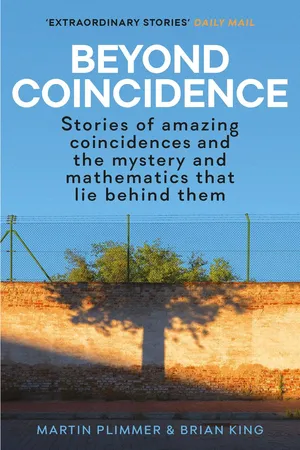
Laura Buxton, aged ten, releases a balloon from her garden. It lands 140 miles away in the garden of another Laura Buxton, aged ten. Coincidence? Or something beyond coincidence?
Is someone playing snap with our lives? Could it be the hand of God? Or are we, as some scientists have suggested, being granted an insight into a hyper-connected universe whose ubiquitous web-like workings we can only dimly discern?
Beyond Coincidence is a celebration of the universe's most beguiling phenomenon, containing more than 250 amazing stories of coincidence. From sympathetic magic to the science of probability, from the vicissitudes of gamblers to the mysterious communions of subatomic particles, this book chases coincidence in all its many guises, analysing how it affects every aspect of our lives and why it means so much to even the most sceptical of us.
- 320 pages
- English
- ePUB (mobile friendly)
- Available on iOS & Android
eBook - ePub
Beyond Coincidence
About this book
Information
Print ISBN
9781785785016
Subtopic
Probability & StatisticsPART 1

Coincidence under
the microscope
Chapter 1
The cosmic YES!
I know we’ve met before.
Let’s talk. I’m sure we’ll find things in common – broad strokes first: language, race, nationality, gender, front door colour, love of Italian food, the desire to jump in puddles … this book!
Soon we’ll narrow the focus: places we have both visited, times we have nearly met, events at which we were separated only by people we didn’t know, people we know in common …
The more we look the more we’ll find. Before long we’ll discover we have lived in the same town, or attended the same school, were born in the same hospital, had the same accountant, the identical dream … Perhaps we travelled on a London bus together – perhaps we have rubbed shoulders on a bus!
The idea makes us shiver. Why? Does it mean anything? Not objectively. After all, we rub shoulders with strangers on buses every week and it doesn’t make us shiver.
But now we are no longer strangers. And now, knowing each other, we can see that we have always known each other. If, after this meeting, we become friends, we will think those former meetings and almost meetings very significant indeed. We will call them coincidences, but we will think them more than that. The trick of being personal is in the nature of coincidence. It is always particular, always subjective, always to do with us. Fate has singled us out. You and me. It’s that specialness which makes us shiver.
We all do this, especially if we want to like each other. We frisk each other for links. We’re like synchronised swimmers in search of a routine. We relish connections, and we’re a highly connected species. If it were possible to map all human activity, drawing lines between friends and relatives, departures and arrivals, messages sent and received, desires and objects, you would soon have a planet-sized tangle of lines, growing ever denser, with trillions of intersections.
Each intersection is an association waiting to be noticed as a coincidence, either for its own sake or when yet another intersecting line passes through it. Coincidence is commonplace. It’s everywhere. But we are only aware of those intersections that are meaningful to us. Paul Kammerer, an Austrian biologist of the early 20th century, said that these are manifestations of a much larger cosmic unity, a force as powerful as gravity, but which acts selectively, bringing things together by affinity. We only notice its peaks, which are like the ripples on the surface of a pond.
Just what this force affecting us all might be, we don’t know. Suggestions include a higher universal intelligence, gods and aliens (both mischievous and benign), a psychomagnetic field, the controlling power of our own thoughts, or a universal system of parallel universes operating in different dimensions from ours. That’s easy to say, hard to understand and impossible to prove.
Back on the ground, all that most of us are aware of when we notice a coincidence is that it provokes one of those shivers. It might be just a tremor of the imagination, but the more unlikely the coincidence, the more the sensation of invisible fingers running down the back.
Bolt-from-the-blue coincidences involving events or material objects – like bumping into a long-lost friend in a foreign town, or finding a toy in a jumble sale that you once owned as a child – can move even the most sceptical in ways that are difficult to define.
What is it about coincidences that grabs at the emotions? It’s the frisson of being touched by something outside of yourself. It’s a sense of being chosen. One minute you are stumbling through quotidian chaos, trying to find a phone that is ringing or manoeuvre a pushchair up the stairs of a bus, the next you are in a lacuna of clarity, where every disparate thing – events, objects, your own thought processes – appears to be bent to the same end. For a second the suspicion that you are tiny and insignificant, and the universe arbitrary and terrifying, disappears. You are part of a great cosmic YES!!!
Research has been done suggesting that people who are most alert to coincidences tend to be more confident and at ease with life. Every coincidence they experience – even the minor ones – confirms their optimism. They know that things will happen to them, that somewhere in a second-hand Guadalupe bookshop there is likely to be the one remaining signed copy of their father’s only novel, that in an apartment in Hong Kong, waiting to be found, very likely lives the sister they have not been told about, that the signet ring they lost in Holland is sitting right now on the bottom of the Zuyder Zee awaiting the astonished angler’s casual hook. They are routinely alert to coincidence, certain that at any moment, in the raffle of infinite possibilities, their lucky number will be called. For these people the world really is a smaller place.
Let’s think about that book in Guadalupe for a second. Let’s say it was written by my father. If you came across it as you were browsing books, you wouldn’t think anything of it; after all, rare bookshops are full of rare books – it’s in their nature. But if I were to find that book, open it and recognise the signature of my late father, carelessly scrawled there when he was a younger man than me, with the world and all its manifold possibilities lying at his feet, the experience would be loaded with poignant significance. Just what it signified exactly, I would be hard pressed to explain, nevertheless my world would look very different from what it had looked like a few moments before. I might even have to sit down.
Laurens van der Post says in his book, Jung and the Story of Our Time (about Carl Jung, the Swiss psychologist who defined the concept of synchronicity): ‘Coincidences, instinctively, have never been idle for me, but as meaningful, I was to find, as they were to Jung. I had always had a hunch that coincidences were a manifestation of a law of life of which we are inadequately aware … [Coincidences], in terms of our short life, are unfortunately incapable of total definition, and yet, however partial the meaning we can extract from them, we ignore them at our peril.’
When coincidences resonate personally and intimately it becomes hard to dismiss them as mere chance, events slung together by the wind. That was certainly how the person at the centre of this following story felt.
US serviceman Dylan was relieved when his posting in Kirkuk in Iraq came to an end. The tour had been hell on earth, with the constant threat of attack by suicide bombers. The one saving grace had been the friendship he had struck up with a local youngster called Brahim who was working as a janitor at the military base. Brahim reminded Dylan of his younger brother Rory back in California. As Dylan was waiting to be airlifted out, Brahim came up to say goodbye and to tell him he’d been given a job as translator. Dylan flew out, worrying that Brahim was risking his life working for the occupying military force.
It was several years later, after Dylan had left the US air force, that he got the terrible news that his brother Rory had been murdered in a carjacking incident near their family home. Dylan couldn’t believe that he had survived Iraq and his brother had died in the safest place he knew. He was devastated.
Heading home for the funeral, Dylan first flew to Arizona to collect some personal items. At the airport he jumped into a taxi. The driver struck up a conversation, explaining that he was from Iraq … from Kirkuk.
The driver turned round. His voice was deeper, he was a foot taller, but it was Brahim. They were both overwhelmed to have found each other again. Dylan felt that he had lost one brother, but found another.
Recalling the events in a radio interview in 2018, Dylan said: ‘I’m not a spiritual or religious person; I’ve seen too many bad things to believe in a higher power, but it seems like the universe put Brahim there at this worst time in my life. That moment probably saved my life. It helped me immensely. It gave me hope.’
Dylan’s experience may or may not have had a deeper meaning in any truly objective sense, but it was meaningful to him.
Here’s another curious fact: the coincidence is meaningful to the reader as well. The reason we respond positively to accounts of coincidence, ever eager to give them the benefit of the doubt, is because they make such good stories. They have the resonance of myth and fairy tale, with their dramatic shifts of fortune, their spectacular life and death events and their many enchanted objects and preoccupations: crossword clues, rings, keys, addresses, numbers and dates. There is a ritualistic quality to them because of their complex storylines: the histories, character traits, dream and thought processes which have to be established and explained in the correct sequence before the coincidence climax can be appreciated. A good coincidence story has the gravitas of Greek drama, the difference being that it is true.
We, the authors of this book, have been acutely aware of this quality while writing it. So we have not stinted on stories. There are over 200 in Part 2 and others scattered liberally through the book. Some are old classics that wouldn’t let us leave them out (and which, like myths, thrive on the retelling); many are told here for the first time.
Carl Jung called coincidences ‘acts of creation in time’. The sheer potency of the stories, and the emotional catharses and transformations they wrought in some of their subjects, testify to that.
All writers have a working arrangement with coincidence. Few novelists are too proud to insert a dramatic coincidence in order to tart up a lacklustre plot. Without coincidence comedy routines would be deadly serious. Allegory and metaphor work by linking together two normally unconnected ideas in order to startle the reader into seeing something they thought they knew in a different light. When poet Stephen Spender describes electricity pylons crossing a valley as ‘bare like nude, giant girls that have no secrets’ he is utilising the visual energy of something entirely unrelated to pylons in order to shock the reader into a sense of blatant and gauche vulgarity. Metaphors aren’t coincidences, as they are man-made, but they work the same trick: fusing unrelated entities to power a revelation.
An interviewer once asked the writer Isaac Bashevis Singer how he could possibly work in such an untidy study. The interviewer had never seen such a cramped and confusing place. Every ledge in the room was taken up with teetering stacks of paper and books piled up on top of each other. It was perfect, said Singer. Whenever he needed inspiration a pile of papers would fall off a shelf and something would float to the floor that would give him an idea.
There is one kind of coincidence for which all writers have a healthy respect. It manifests itself when you are researching a subject and relevant facts appear everywhere you look. Carl Jung called it the Library Angel and grateful writers leave offerings to it by their bookshelves at night.
When Martin Plimmer was researching the first edition of this book, he started looking for information about neutrinos – particles so small scientists have never seen them. He was interested in ways we might connect, not just with each other, but also with the physical world and the universe beyond. Neutrinos, which originate in stars and shower the Earth constantly, seemed to suggest a medium for universal intimacy, as they pass right through us, and then through the Earth beneath us, without stopping for the lights, flitting through the empty space in atoms as though there were nothing there. Martin had never heard of neutrinos, but pretty soon the air was thick with them.
He opened a newspaper at random and there was a story about neutrino research. A novel he was reading offered an interesting neutrino theory. When he turned on the television, there was former president Bill Clinton talking about them in a speech. When he looked down at his fingertip, a billion of them were passing through it every second. Funny how he’d never noticed them before. It was as though the whole world had gone neutrino flavour.
Again, you could say that all this stuff is always out there waiting to be noticed, part of the barrage of information which passes before our overloaded senses every day. Our attention is selective; we see only what preoccupies us at the time. That week neutrinos were big, so neutrinos were everywhere. The world appeared to be bent to Martin’s current obsession, and the search engine of the gods was suggesting ideas, links and information.
None of this theory about the barrage effect of information applied to novelist and historian Dame Rebecca West when she was searching for a single entry in the transcripts of the Nuremberg trials. She had gone to the library of the Royal Institute of International Affairs for the purpose and was horrified to discover hundreds of volumes of material. Worse, they were not indexed in a way that enabled her to look up her item. After hours leafing through them in vain, she explained her desperation to a passing librarian.
‘I can’t find it’, she said. ‘There’s no clue.’ In exasperation she pulled a volume down from the shelf. ‘It could be in any of these.’ She opened the book and there was the passage she needed.
It would be nice to think that something less fickle than chance was at work here. Did the item want to be found? Did her mind, with the right concentration of psychic energy, ‘read’ which volume it was in? Or did the Library Angel lend her a helping hand? Whatever helped her, it distributes its blessings impartially: for Rebecca West, a session transcript out of thousands from a trial of mass murderers; for a devout Muslim fisherman in Zanzibar eager for evidence of God’s greatness, a fish with the old Arabic words ‘There is no God but Allah’ discernible in the patterning on its tail.
If coincidences cluster around preoccupations, imagine how they fall over to please you when the subject is coincidence itself. This book’s origins lie in a five-part radio series, Beyond Coincidence, made by Testbed Productions for BBC Radio 4. No sooner had we started our research than so many coincidences happened around us that we began to feel like we were being stalked. Newspapers fell open at accounts of coincidences, potential contributors, at the moment we rang them, were interrupted in the act of writing about coincidence (or so they told us, but then they were in the coincidence business too).
On the way back from Portsmouth one day after interviewing a woman who was doing psychic research, we pulled off the road to lunch in a pub. Suddenly Martin began talking about the design of a car he had seen in London. This was unusual because, uniquely among men, Martin is not interested in cars. Normally he can’t differenti...
Table of contents
- Cover
- Praise
- Title Page
- Dedication
- Acknowledgements
- Epigraph
- Contents
- Introduction
- Part 1: Coincidence under the microscope
- Part 2: Coincidence on the rampage
- The ultimate coincidence
- Index
- About the Authors
- Copyright
Trusted by 375,005 students
Access to over 1.5 million titles for a fair monthly price.
Study more efficiently using our study tools.
Frequently asked questions
Yes, you can cancel anytime from the Subscription tab in your account settings on the Perlego website. Your subscription will stay active until the end of your current billing period. Learn how to cancel your subscription
No, books cannot be downloaded as external files, such as PDFs, for use outside of Perlego. However, you can download books within the Perlego app for offline reading on mobile or tablet. Learn how to download books offline
We are an online textbook subscription service, where you can get access to an entire online library for less than the price of a single book per month. With over 1.5 million books across 990+ topics, we’ve got you covered! Learn about our mission
Look out for the read-aloud symbol on your next book to see if you can listen to it. The read-aloud tool reads text aloud for you, highlighting the text as it is being read. You can pause it, speed it up and slow it down. Learn more about Read Aloud
Yes! You can use the Perlego app on both iOS and Android devices to read anytime, anywhere — even offline. Perfect for commutes or when you’re on the go.
Please note we cannot support devices running on iOS 13 and Android 7 or earlier. Learn more about using the app
Please note we cannot support devices running on iOS 13 and Android 7 or earlier. Learn more about using the app
Yes, you can access Beyond Coincidence by Brian King,Martin Plimmer in PDF and/or ePUB format. We have over 1.5 million books available in our catalogue for you to explore.