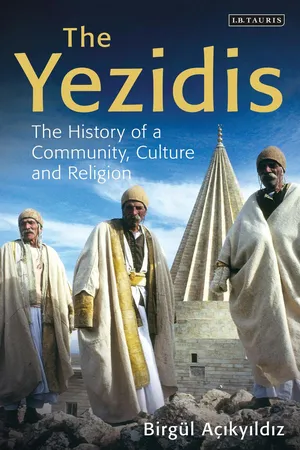
Yezidism is a fascinating part of the rich cultural mosaic of the Middle East. The Yezidi faith emerged for the first time in the twelfth century in the Kurdish mountains of northern Iraq. The religion, which has become notorious for its associations with 'devil worship', is in fact an intricate syncretic system of belief, incorporating elements from proto-Indo-European religions, early Iranian faiths like Zoroastrianism and Manichaeism, Sufism and regional paganism like Mithraism. Birgül Açikyildiz here offers a comprehensive appraisal of Yezidi religion, society and culture.
Written without presupposing any prior knowledge about Yezidism, and in an accessible and readable style, her book examines Yezidis not only from a religious point of view but as a historical and social phenomenon. She throws light on the origins of Yezidism, and charts its development and changing fortunes - from its beginnings to the present- as part of the general history of the Kurds. Her book is the first to place Yezidism in its complete geographical setting in Northern Iraq, Turkey, Syria and Transcaucasia. The author describes the Yezidi belief system (which considers Tawûsî Melek - the 'Peacock Angel' - to be ruler of the earth) and its religious practices and observances, analysing the most important facets of Yezidi religious art and architecture (including funerary monuments and zoomorphic tombstones) and their relationship to their neighbours throughout the Middle East. Açikyildiz also explores the often misunderstood connections between Yezidism and the Satan/Sheitan of Christian and Muslim tradition.
Richly illustrated, with accompanying maps, photographs and illustrations, this pioneering book will have strong appeal to all those with an interest in the culture of the Kurds, as well as the wider region.
The religion of the Yezidis was transmitted orally, and its characteristic elements derive from its oral character. Myths, folk legends and hymns memorised by the men of religion or qewwals have been transmitted from generation to generation since time immemorial. Although some sacred texts were first published at the beginning of the twentieth century,12 and although some Arabic13 and Syriac14 sources refer to events at the time when the Yezidi community first emerged, almost nothing is recorded about the history and beliefs of the first Yezidis. Thus, their origins are still uncertain and scholars have various and contradictory theories about the roots of the Yezidi religion.
Yezidis define themselves as Êzîd, Êzî or Izid. This may derive from Yazad, Yazd or Yazdān in Middle Persian and Kurdish, meaning (
) Yazdān ‘God’ or (
) Izid/Izad ‘Angel’ in New Persian. The verbal root Yaz- means ‘to worship, to honour, to venerate’ and becomes the noun Yazata, ‘a being worthy of worship’ or ‘a holy being’ or ‘a being worthy of sacrifice’.15
Some scholars have thought that the Yezidis derive their name from the Zoroastrian city of Yazd in Iran, where fire is still worshipped, a reference to ‘Ahura Mazdā/Ohrmazd’, the principle of Good in opposition to ‘Angra Mainyu/Ahriman’, the principle of Evil.16 Moreover, a current popular etymology derives the term Yazdan from ez da, meaning ‘I was created’ in Kurdish.
Many Yezidis believe that Yezidism is the most ancient Middle Eastern religion, one whose origins are lost in antiquity. They believe that the entire Kurdish population was once Yezidi, until repression and massacres forced them to convert to Islam, so that only a small number resisted and remained faithful to their original religion, Yezidism.
15 Women making bread, Derik, Aparan (Armenia)
Arabic speakers, however, derive the word Yezidi from the name of the Umayyad caliph Yazid ibn Mu’āwiya. Some western scholars support this theory.17 Yazid, who reigned in 680–83, is associated with the murder of the Prophet’s grandson Hussein ibn ‘Ali in 680 and also with the sack of Medina, where he is said to have killed eighty Companions of the Prophet. He is, therefore, little appreciated by Sunnis and detested by Shi’ites. It is suggested that Yezidis took his name in order to protect themselves from persecution by Muslims by claiming to be the descendants of a noble family.18 Some scholars19 assert that the name of Yazid was given by orthodox Muslims to renegade tribes as a sign of reproach, and it is also said that the Yezidis are murtaddūn – apostates, infidels or renegades – because they first accepted Islam and afterwards renounced it.
Some western writers have suggested that the Yezidis were the followers of the Kharijite Yazid ibn ‘Unaysah, who were attracted by Sheikh ‘Adī’s reputation and took him as their religious chief.20 Alternatively, the Yezidis were said to derive their name from Jabir b. Yazid al-Ju’fi (d. 128/745), a Shi’ite scholar from Kufa, also known as Abū Sabrah Yazid, who played a crucial role in the Arab conquests of Iraq during the reign of ‘Umar and who probably settled in northern Iraq.21
Some Yezidis called themselves Dāsinī or Dāsin, a name derived from a Kurdish dynasty of the Hakkari region; today they are entirely Yezidi. According to one eastern Christian tradition, Dāsenī or Dāsaniyat is the name of one of the churches of the East (Nestorian) dioceses, a church which disappeared when the Yezidis first appeared. Another Christian tradition suggests that the Yezidis were originally Christian but were reduced to their present condition at the beginning of the twentieth century by ignorance.22 It may be that the eastern Christians came to this conclusion because, like them, Yezidis practise baptism and consume wine and other alcoholic drinks. In order to support their claims, local people of the Church of the East assert that Sheikh ‘Adī was Addaï, the legendary Christian Apostle of Mesopotamia. This idea may correspond to the tradition that the sanctuary of Sheikh ‘Adī at Lalish was originally a monastery.23
Yezidis in Mesopotamia and Anatolia
The Kitāb al-Ansāb24 of ‘Abd al-Karīm al-Sam‘ānī (d. 563/1167), a contemporary of Sheikh ‘Adī, is the earliest source to mention a community called al-Yazīdiyya in the region of Ḥulwān25 in northern Mosul in the twelfth century.
... A large group of them whom I met in Iraq in the mountains of Ḥulwān and in the vicinity of al-Yazid. They lead an ascetic life in the villages of those mountains. They live on al-hāl.26 Rarely do they associate with other people. They believe in Yazid ibn Mu’āwiya and that he was righteous. I saw a group of them also in the mosque of al-Marj. I heard that al-Ḥasan ibn Bandār al-Bardajūdī, a learned man who had travelled widely, visited them once in Sinjar and went into a mosque of theirs. One of the Yazidis asked him ‘What do you think of Yazid?’ ‘What would I say (but good) of a man who was mentioned several times in God’s book where it is said “he increases unto people as he pleases” and God increases the righteousness of those who have found the right path’, said I. They showed great generosity toward me and gave me plenty of food. There is another group, a Khārijite one, also called Yazīdīyah. They are the followers of Yazid ibn ‘Unaissa, who, as it is said, preceded Nāfi being at the head of the first Mahkamah ...
Furthermore, in 1324 Abū Firās ‘Abd Allāh ibn Shibl described Yezidis as lovers of Yazid in his manuscript Al-Radd ‘Alā al-Rāfidah wa’l-Zaidiyyeh.27
A righteous group of the Sunnis who live in the Furāt (Euphrates) district ... had visited me and informed me that various misleading innovations had been introduced in their district such as those who adhered to the Rafiḍa and to the Zaidiyyeh. Another sect adopted the idea of the ignorant Adawite Yezidis and each of the latter two sects stand in the extreme in their opposition to this one ... These Yezidis were misled by Satan who whispered to them that they must love Yazid, to such an extent that they say we are justified in killing and taking the property of whoever does not love Yazid, and that to pray under the leadership of an imam is a forbidden act; so they ceased to join Friday prayer, but most deviant one of them was Ḥasan bin ‘Adī ... I had argued with them about their false claim of the love of Yazid.
This would suggest that a movement known as the Yazīdiyya, whose followers supported the Umayyad cause and sympathised with Yazid ibn Mu’āwiya, already existed in the Kurdish mountains before Sheikh ‘Adī.
The last Umayyad ruler, Marwan II (744–50), was half-Kurdish28 and ruled the region of Jazirat ibn ‘Omar. After the fall of the dynasty, some of its descendants remained in the Kurdish mountains and were welcomed by the Kurds, who had an excessive devotion for this dynasty.29 The Sufi sheikhs ‘Uqayl al-Manbijī and Abū’l-Wafā al-Ḥulwānī, whom Kreyenbroek identifies as descendants of the Umayyads, came from this region and four centuries later formed the mystical religious movement that attracted Sheikh ‘Adī.30
There were also local tribes who continued to practise pre-Islamic Iranian religions in the same region at the same time. Gregorius Bar Hebraeus (d. 1286) gives a description of the Taïrahite Kurds and their beliefs in his Chronicon Syriacum.31
In the year of 602 of the Arabs (18 August 1205–8 August 1206), the race of those Kurds who are in the Mountain of Maddaï (near Ḥulwān) and who are called Taïrahites came down from the mountains and caused much destruction in those lands (near Mosul). The Persian troops united against them and killed many of them. Taïrahites did not follow Islam but persisted in their original idolatry and the religion of Zoroaster.32 Besides, there was mortal enmity between them and the Muslims.
The same source differentiates Yezidis from Muslim followers of Sheikh ‘Adī.33
... When, in the beginning of November, Yezidis on the way from Zozan passed by ‘Adī, the son of their emîr, with rich presents and gifts, ‘Adī rewarded with food and drink and every kind of festivity. These people liked to drink excessively. They numbered about 650 tents, not counting the men of ‘Adī, who were Muslims, and the Taïrahite Kurds who numbered more than 1,000 tents.
The Shafi’i scholar Ibn Kathīr (1301–73) mentions the presence of a people called Tirhiye, who were Magians, in the territories where the Yezidis live today. According to him, the new generation had forgotten their ancient religion, Magism, and begun to accept another religion, a hybrid with Islam.34
The ‘Adī mentioned by Bar Hebraeus was the descendant of Sheikh ‘Adī, a learned Muslim intellectual of the twelfth century who studied with many famous mystics in Baghdad. Amongst them were ‘Uqayl al-Manbijī and Abū’l Wafā al-Ḥulwānī who, as we have seen earlier, came from the Kurdish region. This connection may explain why Sheikh ‘Adī left Baghdad in the early twelfth century and established his own zāwiya (convent of dervishes) at Lalish. On their arrival, the ‘Adawis found a peasant community, whose beliefs may have been a mixture of ancient Iranian beliefs, such as Zoroastrianism, and veneration for Yazid ibn Mu’āwiya, and who were in need of a saviour. With time, the Miracles and the ascetic lifestyle of Sheikh ‘Adī and his disciples established the reputation and status of his order. Just as the ‘Adawis influenced the local peasantry, so did their heterodox beliefs and practices little by little impregnate the doctrine and teaching of Sheikh ‘Adī. After the death of Sheikh ‘Adī in 557/1162, his tomb became a place of pilgrimage for both Muslims and non-Muslims. His descendants continued to venerate him and turned the qibla towards Lalish, away from Mecca.35 Continuing syncretism between Sufi Islam and ancient Iranian religions developed into a kind of synthesis of belief which definitively distanced the religion of Sheikh ‘Adī’s followers from orthodox Islam. This process of transformation and affirmation seems to have lasted for some three centuries, from the death of Sheikh ‘Adī (1162) until the fifteenth century, when Yezidism is first represented as a religion distinctly different from Islam.
The question is why were the members of the ‘Adawiyya order influenced by local Kurdish practices and attitudes. According to scholars,36 several factors explain this development: the dominant influence exercised on the community at Lalish by a significant number of Kurdish adherents of an older faith; the isolation of the remote Lalish valley, which cut off the ‘Adawiyya community from the teaching centres of orthodox Islam; and the tendency of Sufi orders to emphasise the experiential, emotional side of religion rather than dogma.
However, according to a Yezidi tradition, when Sheikh ‘Adī arrived in the region, there was a group of local people called Shamsani, from whom the current Sheikhly family of Shamsanis traces its descent and who were originally Manichaeans37 and worshippers of the sun.38 They were attracted by Sheikh ‘Adī’s (d. 1162) influential personality and his mystical ideas, which were in tune with their own beliefs. Thus, they developed mutual co-operation and defended against their common enemy, the Abbasids.39 The disciples of Sheikh ‘Adī, ‘Adawis, were practising Islam, while Shamsanis were practising...
Table of contents
Cover
About the Author
Title Page
Copyright Page
Dedication Page
Contents
List of Illustrations
Acknowledgements
List of Abbreviations
Introduction
Meeting the Yezidis
Geographical Location and Distribution
1 Origins, History and Development
Yezidis in Mesopotamia and Anatolia
Yezidis in Syria
Yezidis in Transcaucasia
2 Religious Belief System
God, Angels and the Trinity
God (Xwedê)
Angels
The Peacock Angel (Tawûsî Melek)
Sultan Êzi
Sheikh ‘Adī
Yezidi Mythology
The Creation of the Cosmos and the Universe
The Creation of Human Beings
The Flood
Holy Books
Religious Hierarchy
3 Religious Practices, Observances and Rituals
Haircut, Baptism, Circumcision, Brother of the Hereafter, Marriage, Death
Prayer
Fasting
Pilgrimage
Festivals and Ceremonies
Taboos
4 Material Culture
Homeland, Landscape, Sacred Places
Places of Worship
The Sanctuary
Mausoleums
Shrines
The Baptistery
Caves
Tombstones
5 Conclusion
Appendices
Appendix I: Yezidi Saints
Appendix II: Genealogy of the Umayyads and Sheikh ‘Adī’s Family
Appendix III: Genealogy of the Early Shamsani Family
Appendix IV: Yezidi Mausoleums in Northern Iraq
Appendix V: Typology of Mausoleums in Northern Iraq
Appendix VI: Typology of Mausoleums in the Republic of Armenia
Glossary
Notes
Interviews
Bibliography
Trusted by 375,005 students
Access to over 1.5 million titles for a fair monthly price.
Study more efficiently using our study tools.
Frequently asked questions
Yes, you can cancel anytime from the Subscription tab in your account settings on the Perlego website. Your subscription will stay active until the end of your current billing period. Learn how to cancel your subscription
No, books cannot be downloaded as external files, such as PDFs, for use outside of Perlego. However, you can download books within the Perlego app for offline reading on mobile or tablet. Learn how to download books offline
Perlego offers two plans: Essential and Complete
Essential is ideal for learners and professionals who enjoy exploring a wide range of subjects. Access the Essential Library with 800,000+ trusted titles and best-sellers across business, personal growth, and the humanities. Includes unlimited reading time and Standard Read Aloud voice.
Complete: Perfect for advanced learners and researchers needing full, unrestricted access. Unlock 1.5M+ books across hundreds of subjects, including academic and specialized titles. The Complete Plan also includes advanced features like Premium Read Aloud and Research Assistant.
Both plans are available with monthly, semester, or annual billing cycles.
We are an online textbook subscription service, where you can get access to an entire online library for less than the price of a single book per month. With over 1.5 million books across 990+ topics, we’ve got you covered! Learn about our mission
Look out for the read-aloud symbol on your next book to see if you can listen to it. The read-aloud tool reads text aloud for you, highlighting the text as it is being read. You can pause it, speed it up and slow it down. Learn more about Read Aloud
Yes! You can use the Perlego app on both iOS and Android devices to read anytime, anywhere — even offline. Perfect for commutes or when you’re on the go. Please note we cannot support devices running on iOS 13 and Android 7 or earlier. Learn more about using the app
Yes, you can access The Yezidis by Birgül Açikyildiz in PDF and/or ePUB format, as well as other popular books in Theology & Religion & Middle Eastern History. We have over 1.5 million books available in our catalogue for you to explore.