Engaging with fiction films devoted to heroic tales from the decade and a half between 1949 and 1966, this book reconceives state propaganda as aesthetic experiments that not only radically transformed acting, cinematography and screenwriting in socialist China, but also articulated a new socialist film theory and criticism. Rooted in the interwar avant-garde and commercial cinema, Chinese revolutionary cinema, as a state cinema for the newly established People's Republic, adapted Chinese literature for the screen, incorporated Hollywood narration, appropriated Soviet montage theory and orchestrated a new, glamorous, socialist star culture. In the wake of decolonisation, Chinese film journals were quick to project and disseminate the country's redefined self-image to Asia, Africa and Latin America as they helped to create an alternative vision of modernity and internationalism. Revealing the historical contingency of the term 'propaganda', Chan uncovers the visual, aural, kinaesthetic, sexual and ideological dynamics that gave rise to a new aesthetic of revolutionary heroism in world cinema.
Based on extensive archival research, this book's focus on the distinctive rhetoric of post-war socialist China will be of value to East Asian Cinema scholars, Chinese Studies academics and those interested in the history of twentieth-century socialist culture.
eBook - ePub
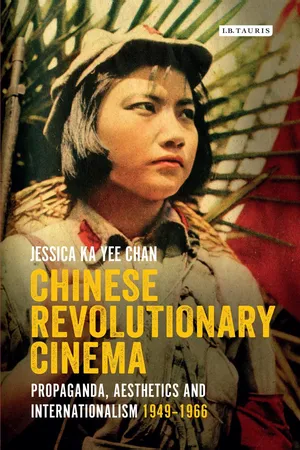
Chinese Revolutionary Cinema
Propaganda, Aesthetics and Internationalism 1949–1966
- 288 pages
- English
- ePUB (mobile friendly)
- Available on iOS & Android
eBook - ePub
Chinese Revolutionary Cinema
Propaganda, Aesthetics and Internationalism 1949–1966
About this book
Information
1
Propaganda and Film Aesthetics
A Newsweek article published on 30 September, 1957, ‘Red China’s Big Push’, demonstrates how Chinese film was portrayed by the American media during the Cold War. The article was illustrated with a film still featuring a Chinese soldier loading his gun, captioned ‘A Chinese Communist movie: In Asia, the movies are Redder than ever’.1 ‘Red’ movies as ‘an instrument of political propaganda’ were ‘socialist’ and ‘anti-American’: ‘Almost all Communist movies exalt China’s “socialist” experiment and many carry a pointed anti-American message.’2 While the language and visual representation of the article reinforced the idea of ‘Red’ as socialist, militant and anti-American, a worried undertone of competition and crisis permeated the text. American movies were ‘losing out’ to those made by the Chinese in the burgeoning Southeast Asian market: ‘In Cambodia […] Peking’s movies have moved into second place in popularity, close behind the Indian films that have dominated the market for years. The traditional runners-up, French and American films are now farther behind than ever.’3 The article described the ‘Reds’ as ‘pushing hard’ and ‘winning an important ideological battle’.4
During the interwar period and throughout the Cold War, the highly contested and historically contingent term ‘propaganda’ was often mobilised to describe the art of the enemy other. In her study of the development of propaganda film theory in wartime Chongqing (1937–45), Weihong Bao points out that the ‘othering’ of propaganda was partly a Cold War construction:
Propaganda is probably the worst nightmare of cinema and media, popularly conceived as manipulations of mass affect and public opinions, a terrifying brainwashing in support of authoritarian rules. Yet propaganda should not be considered a distinct genre belonging to enemy others or a nightmarish past, the concept of which is a postwar construction during the Cold War era […] Instead of relishing the radical promise of cinema as an antithesis of propaganda, we should be mindful of the dialectical relationship between them.5
Propaganda is often seen as an ideological weapon mobilised by the propaganda state; but it should also be understood as an aesthetic experiment, involving trial and error and critical and theoretical evaluation by intellectuals and film-makers who also served as cultural bureaucrats. Between 1949 and 1966, various campaigns were initiated as part of the Chinese propaganda state’s aesthetic experiment: the Rectification Campaign (1951–2), the First Five-Year Plan (1953–7), the Hundred Flowers Campaign (1956–7) and the Great Leap Forward Campaign (1958–61). At the heart of these campaigns, aesthetic experiments in screenwriting, cinematography, screen acting and the representation of heroic characters were proposed, discussed and vehemently debated in Party speeches, conferences, discussion sessions and film journals. In these campaigns, a new socialist culture of film criticism that included self-criticism and the ideological remoulding of film artists emerged, together with a new socialist film theory that negotiated the relationship between aesthetics and politics.
The Visual Age of Propaganda in the Interwar Period
Is it possible to trace and locate a theory of propaganda film? An emerging key term in Chinese film studies, ‘propaganda film’ queries the relationship between propaganda and film aesthetics. Matthew Johnson defines it broadly, as referring to ‘all films produced by the state, particularly during the era of high socialism’; institutionally speaking, the film industry was part of the wider ‘propaganda system’.6 For instance, film censorship was undertaken by the Film Bureau, the Ministry of Culture and the Propaganda Department of the CCP Central Committee.7 ‘Propaganda’ thus refers to the institutional context for a wide range of artistic and film-making activities related to ideological education.8 It is in this sense, Johnson notes, that the term is employed most widely by researchers and cultural observers today.
Propaganda film theory in Chinese cinema can, however, be traced back to Lu Xun’s 1930 translation of the Japanese Marxist film critic Iwasaki Akira’s ‘Film as a Tool of Propaganda and Provocation’ (宣傳、煽動手段としての映畫, a chapter of Iwasaki’s 1931 work Film and Capitalism). Lu Xun critiqued Hollywood cinema as hegemonic, capitalist and commercial propaganda that reinforced colonial subjugation and dependency on transnational capitalism. Likewise, Iwasaki’s chapter title drew attention to the interdependent relationship between propaganda and provocation.9 In Chinese, the term xuanchuan refers not only to propaganda, but also to publicity and advertising. In the afterword to his translation, Lu Xun pointed to the circulation of Hollywood movies and their advertising phrases in semi-colonial Shanghai:
Every day in Shanghai newspapers, there are two gigantic film advertisements, bragging about their casts of over ten thousand actors and budgets of several millions – ‘flirtation, romance, seduction, sex, humour, love, passion, adventure, bravery, knight errantry, gods and ghosts […] the biggest blockbusters of all time’ – as if one would die with regret if one didn’t make it to the movies.10
At stake was not only money (the concentration of the means of mechanical reproduction in the hands of colonial powers and transnational capital), but also representation and reception, as seductive and provocative advertising language and images restructured spectatorial desire and reinforced colonial subjugation:
Having watched a war film about a ‘valorous knight errant’, one unconsciously admires the martial look of the master and cannot help but remain a lackey. Having watched a ‘very flirtatious and romantic’ blockbuster, one is aroused by the sexy bodies of young women and cannot help but feel inferior – though it is possible to console oneself by chasing after a white Russian prostitute.11
Lu Xun drew attention to the corporeal effects of advertising phrases to dramatise how film enacted civilisational competition in flesh and blood. War films reinforced unconscious admiration of the master, whereas romance fed sexual desire and reinforced the inferiority of the Chinese. In an interesting rhetorical move, Lu Xun described cinematic affect in racial, civilisational and gendered terms and spoke of the power of Hollywood movies to release and restructure repressed desire in a way that is pleasurable and seductive to the senses. In doing so, Lu Xun echoed Iwasaki’s description of film as a ‘tool of propaganda and provocation’. Lu Xun saw this tool of propaganda and provocation as being in the hands of the ‘propertied class’ (youchan jieji) in the politically and economically hegemonic capitalist world order dominated by the United States.12
The very choice of translation suggests Lu Xun’s interest in film as an ideological form perpetuating the economic and cultural hegemony of capital-driven Hollywood cinema. Iwasaki, a prominent Japanese film-maker and film critic who organised the Proletarian Filmmaker’s League (Prokino) in 1929, was the ‘house theorist’ at Prokino, with a stake in theory and a ‘desire to stress its inextricable connection to practice’.13 Activists from Prokino often filmed demonstrations and strikes and screened their work illegally in Japan. Film and Capitalism was Iwasaki’s second book, intended for those with an interest in proletarian culture. The chapter ‘Film as a Tool of Propaganda and Provocation’ was published separately in Shinko geijutsu in 1930, a year before the publication of Film and Capitalism.
In translating Iwasaki’s essay, Lu Xun redirected Iwasaki’s Marxist critique of film to his local audience in Shanghai. Lu Xun considered the circulation of Hollywood movies in semi-colonial Shanghai as first and foremost a problem of political economy. Accordingly, he retitled his translation ‘Modern Film and the Bourgeoisie’ (Xiandai dianying yu youchan jieji) and added an afterword targeting the consumption of Hollywood movies in semi-colonial Shanghai by ‘petty urbanites’ (xiao shimin) – a broadly and vaguely defined social class whose emergence intersected with the rise of cinema as a new mass medium in Shanghai and beyond. According to Zhang Zhen, xiao shimin included traditional and modern non-agrarian workers, small merchants, an emerging class of white-collar workers, and the petty bourgeoisie:
The majority of them occupying lower or lower-middle class positions are xiao or ‘petty’ because of their non-elite socio-economic status (not, however, at the bottom of society), young age (often because of their immigrant origins) and limited education and outlook (yet endowed with a measure of cosmopolitan spirit).14
Some of the May Fourth intellectuals regarded petty urbanites as an ‘anarchic social body corrupted by both “feudal” values (because of the rural origin of many migrants) and modern evils of the city’, because petty urbanities were both ‘fostered and exploited by consumerism’.15 In his afterword, Lu Xun called attention to the mutual dependence between petty urbanites and Hollywood movies in semi-colonial Shanghai: the latter articulated spectatorial desire, while the former facilitated American capital accumulation.
In official Chinese historiography, Lu Xun’s translation and afterword are canonised as important works of film criticism in the left-wing cinema movement. Xia Yan described Lu Xun as a pioneer who had the ‘prescience’ to see the intricate link between imperialism, capitalism and film.16 Similarly, Hong Dao, writing in 1956, applauded Lu Xun’s ‘rare foresight’ and described his translation and afterword as the earliest and most important works of film criticism.17 Writing in 1979, Gu Yuanqing and Gao Jinxian called Lu Xun a ‘heroic revolutionary, thinker, and writer’, who made an ‘irrefutable contribution to Chinese cinema’.18 In singling out Lu Xun’s translation, my intention is not to resuscitate Lu Xun as a forerunner of the left-wing cinema movement, as the official historiography suggests; rather, my intent is to situate his translation and film criticism within interwar Marxism and the international discourse on film and capitalism in the age of mechanical reproduction.
For Lu Xun, the appeal of Iwasaki’s essay lies in its poignant observation of the specificity of film as a medium due to its immediacy, international reach and popular appeal in the age of mechanical reproduction. Iwasaki described film as an ‘international text’ (kokusai-teki katsuji) because he considered film a ‘new print technology’ that ‘imprints moving pictures on celluloid’.19 In his translation, Lu Xun retained the Japanese kanji in Chinese: guoji de huozi. Huozi can be translated as ‘movable type’ (a system of printing and typography that uses movable type to reproduce elements of a document) or ‘moving script’, denoting film as a new medium comparable to and yet distinct from verbal and written language. As Lu Xun translates:
Instead of transmitting concepts to readers, the moving script transmits concepts using image and motion. Because of the immediacy of the visual, the moving script is the most popular and the most impressive form. It is an international moving script because of the principle absence of language.20
The adjective ‘moving’ captures what Iwasaki described as the motion, immediacy, straightforwardness and even transparency of film in making images appeal at the level of the senses, overcoming the mediation of verbal or written languages as well as their untranslatability.
To Iwasaki, the international reach and popular appeal of the moving image were particularly well-suited to propagating imperial ideology in maintaining a capitalist world order. Iwasaki described the American Civil War film The Birth of a Nation (D.W. Griffith, 1915) as a ‘double deception’, a ‘hypnotising pill’ that promulgated the ‘dignity of the national flag’ and ‘individual heroism’ to the petty bourgeoisie, who willingly paid for deceptive and hypnotic entertainment at the movie theatre.21 He considered film a highly malleable ideological form in the hands of the economic and cultural hegemon: ‘The massive audience that film has control over, and the immediacy and international reach of film, mean that film, in terms of both quantity and quality, is a superb tool for mass propaganda and provocation.’22 Like Iwasaki and many of his other contemporaries, Lu Xun considered film an ideological and economic tool due to its international reach and mass appeal.
Lu Xun’s critique of Hollywood cinema as a form of capitalist and commercial propaganda within consumer culture was published during the interwar period, when post-Russian Revolution Soviet aesthetic experiments and Fascist aesthetics (in film, literature, theatre, painting, sculpture, architecture, etc.) alike were part of state propaganda. The twentieth century, in particular the interwar period, was an age of visual propaganda. The interwar period witnessed the rise of totalitarian regimes that organised mass support...
Table of contents
- Front Cover
- Title Page
- Copyright
- Contents
- List of Illustrations
- Acknowledgements
- Introduction
- 1 Propaganda and Film Aesthetics
- 2 Literature on Screen: Recasting Classical Hollywood Narration in Family Melodrama
- 3 Translating Soviet Montage
- 4 Socialist Glamour: The Socialist Star Craze, Stanislavski’s System and Cinematic Iconography of the Gaze
- 5 Visions of Internationalism in Chinese Film Journals
- Conclusion
- Notes
- Glossary
- Filmography
- Bibliography
Trusted by 375,005 students
Access to over 1.5 million titles for a fair monthly price.
Study more efficiently using our study tools.
Frequently asked questions
Yes, you can cancel anytime from the Subscription tab in your account settings on the Perlego website. Your subscription will stay active until the end of your current billing period. Learn how to cancel your subscription
No, books cannot be downloaded as external files, such as PDFs, for use outside of Perlego. However, you can download books within the Perlego app for offline reading on mobile or tablet. Learn how to download books offline
Perlego offers two plans: Essential and Complete
- Essential is ideal for learners and professionals who enjoy exploring a wide range of subjects. Access the Essential Library with 800,000+ trusted titles and best-sellers across business, personal growth, and the humanities. Includes unlimited reading time and Standard Read Aloud voice.
- Complete: Perfect for advanced learners and researchers needing full, unrestricted access. Unlock 1.5M+ books across hundreds of subjects, including academic and specialized titles. The Complete Plan also includes advanced features like Premium Read Aloud and Research Assistant.
We are an online textbook subscription service, where you can get access to an entire online library for less than the price of a single book per month. With over 1.5 million books across 990+ topics, we’ve got you covered! Learn about our mission
Look out for the read-aloud symbol on your next book to see if you can listen to it. The read-aloud tool reads text aloud for you, highlighting the text as it is being read. You can pause it, speed it up and slow it down. Learn more about Read Aloud
Yes! You can use the Perlego app on both iOS and Android devices to read anytime, anywhere — even offline. Perfect for commutes or when you’re on the go.
Please note we cannot support devices running on iOS 13 and Android 7 or earlier. Learn more about using the app
Please note we cannot support devices running on iOS 13 and Android 7 or earlier. Learn more about using the app
Yes, you can access Chinese Revolutionary Cinema by Jessica Ka Yee Chan in PDF and/or ePUB format, as well as other popular books in Medien & darstellende Kunst & Kunst Allgemein. We have over 1.5 million books available in our catalogue for you to explore.