The combined effect of the welfare state and medical advances means that more people now live longer lives than ever before in history. As a consequence, the experience of ageing has been transformed. Yet our cultural and social perceptions of ageing remain governed by increasingly dated images and narratives.
Growing Old with the Welfare State challenges these stereotypes by bringing together eight previously unpublished stories of ordinary British people born between 1925 and 1945 to show contemporary ageing in a new light. These biographical narratives, six of which were written as part of the Mass Observation Project, reflect on and compare the experience of living in two post-war periods of social change, after the first and second world wars.
In doing so, these stories, along with their accompanying contextual chapters, provide a valuable and accessible resource for social historians, and expose both historical and contemporary views of age and ageing that challenge modern assumptions.
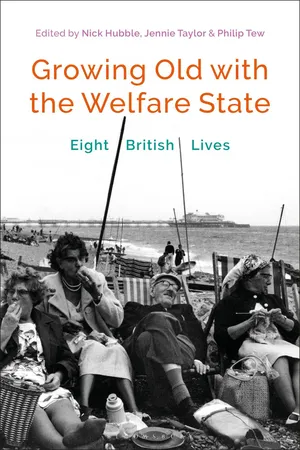
eBook - ePub
Growing Old with the Welfare State
Eight British Lives
- 176 pages
- English
- ePUB (mobile friendly)
- Available on iOS & Android
eBook - ePub
Growing Old with the Welfare State
Eight British Lives
About this book
Information
PART ONE
The Interwar Generation
1
Introducing the Interwar Generation
Significantly the first four respondents whose extracted diary entries appear in the following four chapters were all born in the period between the world wars. The first three manifest aspects of a nostalgic outlook, defining themselves by the values of the interwar and war years, bemused by the changing values after the 1960s. The last seems to be more in tune with what Clare Langhamer calls the emotional revolution of the mid-century years, detailing her relationships from a liberal perspective which also informs her perspective as a social worker. However, by 2008 she worries of the financial profligacy of the young, echoing at least implicitly a return of some of the values of her youth, complaining of rising house prices which make her feel complicit with the awful dynamics of the financial system in crisis, although insisting nevertheless: ‘But most of us bought houses as homes not investments!’
Born in 1921, the oldest respondent featured in this volume, George Borrows, despite going to a grammar school, still reflects in the MO autumn 2001 directive: ‘I had no opportunity to go to a university as I was not bright enough for a scholarship and my parents could not afford to support me’. In the winter 2008 directive he records that ‘as a child it was instilled in me that debt should be avoided. If you want something, save up for it’. In the summer 2006 directive, despite his liberal stance ideologically he still reflects positively on certain British values and yet stating of his youth that he was well aware of the terrible poverty faced by relatives in the 1920s during his infancy:
Was I taught core values when I was at school in Britain? Not at school, at home by the family and old fashioned values they were, like always to show respect to my elders. Always remove my hat when entering some one’s home. Never allow a lady to stand when I had a seat on a bus. Working class families did not travel by car in those days. Women were to be respected. On no account did a man offer violence to women. Men who did so were not worthy to be called a man.
In 1936, he went to work, ruminating in autumn 1997, ‘When I was 15, I obtained my first job in the local Town Hall. In congratulating me my father said “And it’s a job with a pension.” He had his own small business without one. Planning for the future was impressed on me even then!’ As he writes in the spring 2010 directive, ‘I was in the pre-war T.A. [Territorial Army],’ which he joined in 1939, aged eighteen. He also remembers the war clearly, describing in the spring 1992 directive how his father lost his business during that period. In the autumn 2001 directive he notes: ‘In 1945 I parachuted into lower Burma and organised levies for intelligence work and sabotage against the Japanese.’ And elsewhere in the spring 1994 directive, he stresses his limited experience of bodies during the war, and according to his own account, he faced only one in seven years, although still he does recollect the callousness inculcated by the conflict towards the news of another death, entirely unmoved by the demise of a fellow soldier killed by the Japanese, an Anglo-Indian officer in Burma. As he records, he had an earlier familiarity with death, writing, ‘my first experience of death was as a schoolboy aged about 8 or 9. A boy in our class died of scarlet fever’ followed by another classmate at 11. George adds:
I don’t think I have ever had a fear of dying. During the war my greatest worry – when I was at risk in Burma – was that if I was killed my parents would never really know what had happened to me and I knew this would add very much to their grief.
Later, however, he recalls in the autumn 2000 directive a cousin killed during the war and notes three others who were all ‘regular soldiers’. In winter 2008, responding to the world financial crisis, he says: ‘Let us hope it doesn’t take massive rearmament to reduce unemployment as happened in the 30s.’ George concludes in the summer 2006 directive, despite his liberal outlook that core British values mean, one belief is ‘to be wary of change – conservative until there is overwhelming evidence that change is in fact long overdue’. Another significant set of values affecting his attitude reflective of the period of his upbringing is found in the spring 1998 directive when he recollects the familial silence concerning sex. He remembers a girlfriend at eighteen (in 1939) whose breasts he fondled: ‘I would love to have gone further but was not allowed to and the great fear in those days was having an illegitimate baby,’ knowing little about contraception. In the summer 1990 directive he adds of his experience: ‘I knew very little about women; with brother officers on leave I’d visited the Calcutta brothels to find out what women’s anatomy was like and to make sure that if we got killed at least we’d “Had a woman.”’ He adds that post-war he lost a fiancée after being reticent about sex with a young woman who later met someone while sailing out to Singapore: ‘Even at the age of 27 [1948] I thought that “nice” girls did not want sex unless they were married and I was very concerned about an illegitimate child.’ He records in spring 1998 meeting a young woman in 1953 of whom he was keen: ‘However she had a fiancé who was out in Singapore and I would have thought it dishonourable to have pinched another chap’s girl.’ He also concludes of the marriage vows that breaching them represents a betrayal: ‘The state of society today would be much happier if people had remembered that – from the Royal Family upwards. […] Society ought to be based on trust, honesty, integrity, on things of value, not sordid hole-in-corner liaisons just to gratify one’s senses.’ He adds while noting the pain caused by affairs that ‘I am of the generation that had settled and had growing families before the liberation of the pill in the 60s gave freedom for a different kind of morality.’ One might perhaps trace a touch of envy, although he reasserts a sense of moral probity and stability that he finds desirable. He adds in summer 1990 that ‘because divorce is easy people take marriage far too lightly’.
Born an only child in 1927 to a father aged fifty-three and a forty-two-year-old mother, Margaret Christopher was aged twelve to eighteen during the war, before which, from the ages of six to eleven, she had attended a boarding school. Her life was relatively affluent, and middle class in its values, although she found growing up in the countryside stultifying in certain ways. In the spring 2012 directive those rural years are evoked strongly by a photograph of her parents she reconsiders and which she had taken aged twelve. The same album featured a picture of their servants: ‘They all look jolly and happy and were with us for years. By today’s standards it was such a primitive world these pictures represented. I often think of it now that I have become old and feel almost a piece of history.’ And, in spring 1992 she recalls that ‘[as] a country person, the shooting of pheasants, pigeons, rabbits and wild duck for food, especially during the war, provided the most down to earth illustration of the fact that we who are not vegetarians must kill to eat’. She adds:
You might think that, growing up during war I would be affected by the casualties of battle and bombing raids. But only one cousin was killed in action, and he not one I knew well. And of course then, all descriptions of wartime events were verbal and not visual, thus less graphic.
Much like George Borrows, she too reflects on an unease with cultural attitudes and behaviour in the autumn 1998 directive (having herself survived breast cancer treatment in 1990), saying: ‘Although seriously dismayed about a number of aspects of modern life, because I can choose how to conduct my own I enjoy my days and my work and I feel this must have a bearing on my good health.’ Having grown up in Wales, she recollects in the autumn 2000 directive that her family rarely visited relatives, but:
this changed during the war when at various times we sheltered several younger relatives, my mother’s twin sister, her daughter, and later a cousin. Along with all the problems of living in the country with food and petrol rationing and the difficulties of running a large estate except for one clerk (he was a land agent), this was a severe strain for my father.
Her response to her father’s death at which she was present when he was aged seventy-two in 1946 features in the spring 1994 directive, where she describes its suddenness, her devastation, her response in being physically sick, the loss of the house that was tied to his job and her estrangement from her mother. In autumn 2000 she again records his death, detailing how as a consequence she lost touch with his relatives in Yorkshire, including his seven brothers and sisters and their offspring, apart from a theatrically inclined aunt in Pinner whom she visited frequently after marrying in 1950 and relocating to London. She reflects: ‘My parents and I were very much products of that distant past when stiff upper lips and carefully controlled emotions, at least in public, were the norm, partly I suppose because we had servants and one mustn’t be undignified in front of them.’ Nevertheless, in spring 2012, she recollects that ‘my father loved the late Victorian music halls and very occasionally when he felt happy he would sing snatches of songs by Marie Lloyd and others; but my mother had felt it a handicap in her youth not to be able to play the piano at all well, or to sing’. She remembers playing the Blue Danube waltz on a wind-up gramophone, which ‘seemed to hint at exotic worlds for which I longed, deep in rainy, wartime rural Wales’. In the summer 2011 directive, thinking of her mother’s death alone in hospital on Christmas Eve when Margaret was herself forty-two, she admits that ‘I look back with shame on my neglect of my mother in her old age. I was her only child and should have been aware of how much help and support she needed; but somehow I never grasped what is now obvious to me’.
As she relates in autumn 2000 after divorce in around 1980, her more prosperous relative, ‘my mother’s niece, who is single, has given me £24,000 when I most needed it to buy a house I now live in with my daughter’. She is bemused by the child-centric aspects of contemporary culture:
My mother was a very loving person, but clueless when it came to child-rearing and I suspect her mother must have been the same. I myself didn’t take happily to motherhood because children are so totally self-centred for the first few years and although I made huge self-denials for my husband in terms of the way we lived our lives, I didn’t, and still can’t see why children today are so much the centre of attention. Secretly I believe (as my brother-in-law used to say) that they should be ‘seen and not heard,’ and that their lives should fit with ours rather than the other way round.
While worrying about the impact of circumstances on her own pension and savings, in winter 2008, she reacts to the world financial crisis, labelling it a recession, and comments: ‘Being a frugal person who has never taken any form of loan, I look on financiers who made their piles by tempting financially innocent people into taking loans and mortgages they could not afford with loathing. […]. Older people who haven’t grown up with the idea of instant gratification do find it easier to resist temptations.’
In autumn 2001, she deplores the Americanization of the media, with its ‘gossip about totally uninteresting people, consumerism, waste, greed, “spin,” false values and everything which is contributing to the ruin of the world as people of my generation knew it’. She adds of the mass media or ‘gutter press’ that ‘they seem to pander to the two saddest trends (after “political correctness”) “dumbing down” and fostering a short attention span by discussing nothing at length or in depth’, opining the focus on greed and sensationalism. She notes that even Radio 4’s Today programme indulges in ‘sound bites!’ rather than extended coverage. In winter 2008 she blames American malls, consumerism and overproduction for contributing to the world financial crisis, citing evidence that both food and resources more generally are being wasted wilfully, again blaming the media for ‘spreading the culture of greed’. In winter 2009 she objects to the culture the media fosters in putting oneself first, which in the case of women is leading to the ‘destruction of family life in the process’. In spring 2012 she opines people’s disinterestedness in any concept such as the Big Society, their lack of involvement socially and politically.
Discounting myself as too old to be involved, take my daughter who, at 60 is active and fit but completely uninterested in doing any formal voluntary work or taking an active part in community policy-making. My younger grand-daughter, age 24, when asked if she would vote in the forthcoming mayoral elections declared herself to be totally uninterested in politics. This is of course very worrying for the long term.
Despite her liberal values, membership of CND from 1958, work with seekers of asylum at a Citizens Advice Bureau in London, and four years as committee member and company secretary for a West Indian Pensioners’ club, in autumn 2001 she concludes: ‘Now, any discussion of race is a minefield, largely dominated by political correctness, which means dispassionate colloquy is virtually impossible,’ a fact she attributes to blaming colonialism for all current problems, before deciding that the post-war media ‘was much more “responsible” than it is today’. In spring 1998 she admits an affair for a year during her marriage with a ‘reckless, irresponsible’ formerly bisexual younger builder which she admits her then husband found painful, as she did when her husband had sex with a house guest who had visited them when they lived in France. Nevertheless she writes: ‘What puzzles me about the modern attitude to sex is what appears to be a total lack of any connection between it and tenderness, let alone romantic love,’ still regarding sex as a sacred, almost mystical act. On a personal level in spring 1992 she states that ‘I never replace anything (except clothes) because it has become dated!’ – a clear rejection of current consumerism for its own sake. And in spring 1994 she suggests that contemporary society respects very little, neither the living nor even the dead, and she concludes that ‘I see the world in Manichean terms of good and evil forces, with evil uppermost throughout most of this century’.
Born in Tottenham in 1930, moving to Enfield in 1937, Dick Turpin was aged nine to fifteen during the war years and, at the outbreak, was on holiday in Stockport with paternal grandparents where he remained for three years. At this time Dick in the spring 2012 directive remembers listening to Gracie Fields’s songs ‘Sing as You Go’ and ‘The Biggest Aspidistra in the World’ on a wind-up gramophone. His father was directed to war work in Dartford, where the family including Dick joined him in 1942.
When reflecting on death in the spring 1994 directive he describes one consequence of having been born so soon after the First World War as growing up with a sense of the solemnity of the two-minute silence on Armistice Day and the sense of loss accompanying that. Remembering the newsreel footage of the liberation of Belsen, he adds that ‘when the Second World War began I was soon aware of man’s seemingly endless capacity for mass slaughter’. In 2012 he recalls ‘singing solo in the 1940 carol service. It was the night Hitler blitzed Manchester’. In the autumn 2000 directive he remembers the many moves in childhood until the end of the war, attending five different schools. However, ‘after the war just as it seemed we were settled in our home at Enfield [in 1944], north of London, my mother got the urge to open a guest house in Brighton. A notion that was not at all popular with the rest of the family’. His father moved to a job in Hayward’s Heath, Sussex, and in 1949 they moved to Brighton which he disliked, so, aged nineteen, Dick joined the army for five years to support himself. After military service (during which his brother committed suicide, aged twenty in 1956), Dick married in 1957, aged twenty-seven, having remained celibate until the night of his wedding. The couple had three sons born in 1957, 1959 and 1962. He frequently confirms his home life has been happy, believing faithfulness being important to a marriage’s well-being, although he does admit in autumn 2000 that his ‘by the standards of to-day [was] not very prosperous’. He regards the younger generation as irresponsible, identifying several root causes, one of which was changes to education:
Another difficult age began when my sons started at school, in the early sixties. A time when so-called progressive and enlightened ideas had begun to dominate education and teaching, Ideas that were a total disaster and are indeed the cause of so many social problems today. Mine was a constant battle with trendy head teachers and an educational establishment that was failing to teach my sons the basic rules of mathematics or how to write a simple letter.
He records the loss of his middle son, aged twenty, who was knocked off a motorcycle in France by a drunken driver, as leaving a permanent scar and making him angry at the lenient joke sentence. He details his surviving sons’ divorces and failed relationships, suggesting, ‘the young women they have partnered have been truly incredible, irresponsible beyond belief’, living on debts and claiming almost every one of his generation known to him has had to bail out their offspring financially. He believes women must shoulder much of the burden of responsibility and argues that feminism has led mothers to neglect their children. He argues that fault should still be judged regarding divorce, because there is still the...
Table of contents
- Cover
- Halftitle Page
- Title Page
- Dedication Page
- Contents
- Acknowledgements
- Introduction
- Part One: The Interwar Generation
- Part Two: The Wartime Generation
- Afterword
- Appendix: FCMAP, MO and the U3A
- Bibliography
- Index
- Imprint
Trusted by 375,005 students
Access to over 1.5 million titles for a fair monthly price.
Study more efficiently using our study tools.
Frequently asked questions
Yes, you can cancel anytime from the Subscription tab in your account settings on the Perlego website. Your subscription will stay active until the end of your current billing period. Learn how to cancel your subscription
No, books cannot be downloaded as external files, such as PDFs, for use outside of Perlego. However, you can download books within the Perlego app for offline reading on mobile or tablet. Learn how to download books offline
Perlego offers two plans: Essential and Complete
- Essential is ideal for learners and professionals who enjoy exploring a wide range of subjects. Access the Essential Library with 800,000+ trusted titles and best-sellers across business, personal growth, and the humanities. Includes unlimited reading time and Standard Read Aloud voice.
- Complete: Perfect for advanced learners and researchers needing full, unrestricted access. Unlock 1.5M+ books across hundreds of subjects, including academic and specialized titles. The Complete Plan also includes advanced features like Premium Read Aloud and Research Assistant.
We are an online textbook subscription service, where you can get access to an entire online library for less than the price of a single book per month. With over 1.5 million books across 990+ topics, we’ve got you covered! Learn about our mission
Look out for the read-aloud symbol on your next book to see if you can listen to it. The read-aloud tool reads text aloud for you, highlighting the text as it is being read. You can pause it, speed it up and slow it down. Learn more about Read Aloud
Yes! You can use the Perlego app on both iOS and Android devices to read anytime, anywhere — even offline. Perfect for commutes or when you’re on the go.
Please note we cannot support devices running on iOS 13 and Android 7 or earlier. Learn more about using the app
Please note we cannot support devices running on iOS 13 and Android 7 or earlier. Learn more about using the app
Yes, you can access Growing Old with the Welfare State by Nick Hubble, Jennie Taylor, Philip Tew, Nick Hubble,Jennie Taylor,Philip Tew in PDF and/or ePUB format, as well as other popular books in History & 20th Century History. We have over 1.5 million books available in our catalogue for you to explore.