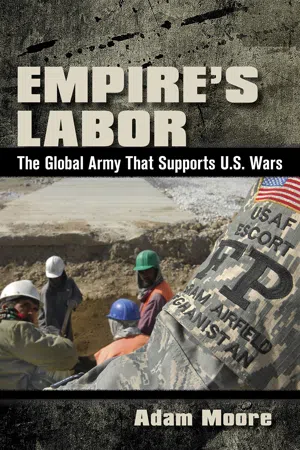
In a dramatic unveiling of the little-known world of contracted military logistics, Adam Moore examines the lives of the global army of laborers who support US overseas wars.Empire's Labor brings us the experience of the hundreds of thousands of men and women who perform jobs such as truck drivers and administrative assistants at bases located in warzones in the Middle East and Africa. He highlights the changes the US military has undergone since the Vietnam War, when the ratio of contractors to uniformed personnel was roughly 1:6. In Afghanistan it has been as high as 4:1. This growth in logistics contracting represents a fundamental change in how the US fights wars, with the military now dependent on a huge pool of contractors recruited from around the world. It also, Moore demonstrates, has social, economic, and political implications that extend well beyond the battlefields.
Focusing on workers from the Philippines and Bosnia, two major sources of "third country national" (TCN) military labor, Moore explains the rise of large-scale logistics outsourcing since the end of the Cold War; describes the networks, infrastructures, and practices that span the spaces through which people, information, and goods circulate; and reveals the experiences of foreign workers, from the hidden dynamics of labor activism on bases, to the economic and social impacts these jobs have on their families and the communities they hail from. Through his extensive fieldwork and interviews, Moore gives voice to the agency and aspirations of the many thousands of foreigners who labor for the US military.
Thanks to generous funding from UCLA and its participation in TOME (Toward an Open Monograph Ecosystem), the ebook editions of this book are available as Open Access volumes from Cornell Open (cornellpress.cornell.edu/cornell-open) and other repositories.
Telling the story of the United States in the world from the perspective of labor … remaps our interpretation of empire building by demonstrating its deep connection to the migratory routes and protean life strategies of the global working class.
—Julie Greene
This book is about the U.S. military’s overseas operations, both recognized wars and clandestine campaigns. Or rather, it is about the labor required to sustain such operations, and the experiences of people from around the world that do it. For the present-day U.S. military empire is profoundly dependent upon a global army of labor that comes from countries as diverse as Bosnia, the Philippines, Turkey, India, Kenya, the United Kingdom, Sierra Leone, and Fiji.
Such a state of affairs represents a profound shift in how the U.S. fights its wars, with social, economic, and political implications that extend well beyond the battlefields. Consider the following events that took place a year and a half after the invasion of Iraq. On September 1, 2004, thousands of enraged Nepalese took to the streets of Kathmandu. Their target was the small Muslim community in the country. By the end of the night the city’s largest mosque, along with a number of Muslim-owned businesses and dozens of labor-recruiting agencies, had been set on fire, and the offices of Pakistani and Gulf-based airlines ransacked. Seven people died, including three individuals killed by rioters who mistakenly identified them as Muslims.1
The precipitant of this outburst of violence was the execution the previous day of twelve Nepalese men by the rebel group Ansar al-Sunna in Iraq. The men had left Nepal a month earlier, lured by a local recruiting agency with promises of employment at a luxury hotel in Jordan. Instead, when they reached that country their passports were confiscated and they were told that they were being sent to Iraq to work on a U.S. military base for a Jordanian-based military logistics subcontractor, Daoud & Partners. If they refused to go they would be sent back to Nepal, still owing thousands of dollars in brokerage fees to the recruiting agency. On the way to their destination the convoy was attacked and they were kidnapped. Less than two weeks later they were killed, and the execution video posted online.2
The twelve men were in Iraq due to a remarkable change in how the U.S. supports overseas military operations. Since 2001 it has relied on a legion of private military companies (PMCs) that employ workers from around the world. The scale of this phenomenon is extraordinary. According to a November 2008 contracting census conducted by U.S. Central Command (CENTCOM), for instance, there were more than 266,000 contractors supporting military operations in its area of responsibility (AOR), which includes the Middle East and Afghanistan. This was just short of the number of troops deployed there during the same period. The total included roughly 163,000 people working in Iraq and 68,000 in Afghanistan, with the remainder located at various bases and logistics support hubs elsewhere in the region.3
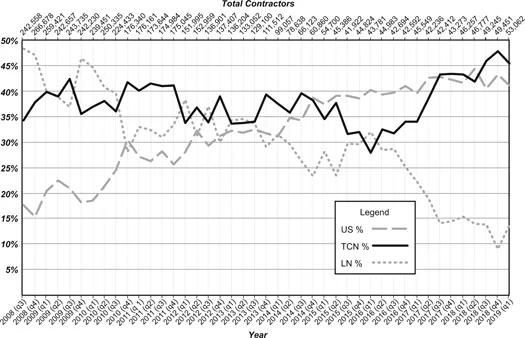
There are several details from this report that are worth highlighting here. First, the data represented only a partial accounting of the U.S. military’s reliance on contractors to support operations in Iraq and Afghanistan at the time as it did not include thousands of private security and support staff working for the Department of State (DoS), or those employed by the United States Agency for International Development (USAID), which has also grown more dependent on contractors to carry out its reconstruction and development projects in recent years.4 Second, 2008 was the high-water mark for military contracting in the region due to the “surge” in Iraq that began the previous year.5 But it was in no way anomalous. As figure 1.1 indicates, the number of contractors working in CENTCOM stayed above 200,000 from the beginning of 2008—when AOR-wide censuses were first tabulated—until late 2010.6 At the end of 2013 nearly 100,000 were still at work in the region. The contracting workforce in CENTCOM bottomed out at roughly 42,000 in summer 2015. Since then it has increasing again, to more than 50,000, as the wars in Afghanistan and the Middle East drag on.
The third point concerns the composition of the contractor workforce. According to the military’s estimate, only 15 percent of contractor personnel in 2008 were U.S. citizens. Much more numerous—at 47 percent—were what it refers to as Local Nationals (LNs). LNs are citizens of the country in which the work is performed, such as Afghan truck drivers delivering goods to forward operating bases (FOBs) in Afghanistan. Occasionally military documents also refer to this class of workers as Host Country Nationals (HCNs), though this is a rather less common term. The remaining contractors—roughly 100,000 people at the time—consisted of what the military calls either Third Country Nationals (TCNs) or Other Country Nationals (OCNs), the latter an alternative nomenclature that has gained some ground in recent years. This catch-all category refers to any workers that are neither LNs nor U.S. citizens. The prevalence of TCN labor in 2008 was also not anomalous. As figure 1.1 shows, TCNs have represented roughly 30–45 percent of CENTCOM’s contract workforce from 2008 to 2019.
The fourth important detail to consider is that just 8 percent of the military’s contracting workforce was involved in providing security. This may come as a surprise to most readers because to date writing on military contracting has focused on companies that provide armed security for convoys, military bases, and government personnel such as Department of State employees. Private security companies are frequently labeled mercenaries or hired guns by critics, who highlight their role in the perpetuation of human rights abuses and killings of innocent civilians.7 One of the most notorious such incidents was the Nisour Square massacre in 2007, where Blackwater guards providing security for a U.S. embassy convoy shot and killed seventeen civilians in Baghdad. The voluminous academic literature on armed security PMCs tends to be state-centric and focused on policy relevance. Prominent themes include the impact security contracting has upon state sovereignty and the monopoly of violence; analyses of its effectiveness; the ethical and moral implications of its use by states; and concerns about states’ ability to control and hold armed contractors accountable for their actions in war.8
Despite the focus on privatized security in the media and academia, employees of armed security PMCs have constituted but a fraction of the military’s contractor contingent in the wars in the Middle East and Afghanistan. In late 2008, for example, over 75 percent of CENTCOM’s contractor workforce performed tasks related to logistics such as transportation, construction, maintenance, and base support. This corresponds with a 2010 military analysis of contracting data from Iraq that estimated that the ratio of contractors to uniformed personnel in the field of logistics was nearly 5:1, leading to the conclusion that “on the whole, the military is most dependent on contracted support for logistics operations.”9 Logistics workers are often employed by massive U.S. corporations like Kellogg, Brown & Root (KBR), Fluor, and DynCorp—or the multitude of subcontracting firms from around the world that they in turn rely on.
Military Contracting and the Everywhere of War
The growth of military contracting in recent years is an important development because it represents a fundamental change in how the U.S. fights it wars. What is new is not the reliance on private companies and labor to support military campaigns, which has a long history in both the U.S. military and among other armed forces, but rather the scale and scope of the phenomenon. In World War II the ratio of contractors to uniformed personnel was roughly 1:7. In Vietnam it was 1:6. In contrast, in the three largest overseas contingency operations in the past two decades—the peacekeeping missions in the Balkans (Bosnia and Kosovo) and the wars in Iraq and Afghanistan—the number of contractors has been roughly equal to or greater than the number of uniformed personnel in the theaters of operation.10 And in Africa, where the military’s presence has grown rapidly over the past decade, contractors play a central role in supporting an expanding network of drone bases, logistics nodes and clandestine Special Operations Forces (SOF). Put simply, the U.S. is now dependent on contracted labor, especially in the realm of logistics, to fight its wars.11
I would argue, in fact, that the U.S. military’s increasing reliance on private companies and foreign labor to provide logistics support for operations around the world is as significant as the various technological innovations toward network-centric warfare over the past two decades that have been dubbed a “revolution in military affairs,” or RMA.12 Especially since, as one military analysis from 2001 notes, “RMA is predicated on a revolution in military logistics” that centers on the increasing use of private contractors.13 Or as former army chief of staff Eric Shinseki put it in 2002, “Without a transformation in logistics there will be no transformation in the Army.”14
The transformation of military logistics through contracting is not just operationally linked to RMA. Both have also profoundly impacted the spatiality of war, though in different ways.15 A key claim made by political geographers and other social scientists is that RMA, combined with the U.S. response to 9/11, has led to a blurring of the traditional geographies of warfare: from defined battlefields to multidimensional and fluid urban “battlespaces”; from officially recognized combat zones to shadowy campaigns against nonstate actors in “borderlands,” “ungoverned spaces,” and undisclosed locations; and the development of novel forms of “lawfare” that radically redefine legal jurisdictions, detention policies, and the different classes of people that are considered “lawful targets.”16 In the evocative words of Derek Gregory, we are living in the age of “the everywhere war.”17
Military contracting is also reshaping the geography of war by generating new political and economic entanglements, the effects of which often extend well beyond the immediate spaces of violence. These entanglements profoundly impact livelihoods, politics, and social relations in numerous communities and states around the world that are not directly involved in the various U.S. wars and military operations. Nepal’s deadly violence in 2004 dramatically illustrates these distance-spanning entanglements. Put another way, the expansion of military contracting is producing what may be called the “everywhere of war.”18
The following examples illustrate this claim. According to the Department of Labor, more than 3,380 civilians working for the U.S. military or various PMCs supporting the wars in Iraq and Afghanistan died between September 2001 and June 2018. This compares with roughly 6,950 U.S. military casualties in those wars.19 While contractor deaths and injuries—especially foreign ones—barely register in the U.S., the same is not true of the countries that they are from. Following the deaths of the twelve workers from Nepal, the Nepalese government declared a national day of mourning. In the Philippines incidents involving workers, such as the deaths of ten men whose helicopter crashed in Afghanistan in 2009, are regularly given prominent coverage by national TV networks and newspapers.20 Perhaps it is not surprising, then, that the plight of workers in Iraq and Afghanistan has also impacted domestic and international politics around the world. In 2004, for instance, insurgents began targeting truck convoys carrying food, fuel, and materials from Kuwait and Turkey to U.S. bases in Iraq. As deadly attacks and hostage taking of drivers mounted, India and the Philippines declared travel bans to Iraq for their citizens. They were joined by Nepal immediately following the execution of its trafficked citizens.
In each case the countries’ decision to impose a ban on travel to Iraq for work was driven by domestic political considerations. Nepalese diplomats stated that the government felt “very vulnerable” following the anti-Muslim riots in the country, owing to fears about both further domestic unrest and potential reprisals against the hundreds of thousands of Nepalese working in Muslim countries in the Middle East.21 For the Philippines the tipping point was the kidnapping of a truck driver, Angelo de la Cruz, in July. His hostage takers threatened to kill him if the Philippines did not remove its small contingent of troops from the country. Initially defiant, President Gloria Macapagal Arroyo, who had just won a controversial election dogged by allegations of vote rigging, eventually acquiesced to this demand following massive protests across the country. Shortly afterward de la Cruz was released, followed by the imposition of a travel ban.
The travel bans immediately set off alarm bells within the U.S. military due to its dependence on workers from these labor-exporting states. It also prompted a flurry of urgent behind the scenes diplomacy by the DoS. To give a sense of just how dependent on TCN labor for logistical support the military was at the time, one DoS analysis written shortly after the India and Philippines bans were announced stated:
Coalition forces are heavily dependent on Filipino and Indian drivers and other logistical support personnel for the humanitarian fuels, military food supply and mission critical programs in Iraq. Contractors and U.S. military report that a fully enforced ban would cripple these operations. There are no readily implemented short-term workarounds to ameliorate the effect of a travel ban.… For example, Public Warehouse Company (PWC), the prime vendor for the supply of water and food to U.S. forces in Iraq, confirmed on 3 August that fully 48 percent of the firm’s 1,500 drivers are Indian and that at least 10 percent more are Filipino.22
Three days later the U.S. embassy in Kuwait reported that over 1,000 trucks were stuck at the Kuwait-Iraq border, through which roughly 75 percent of goods entered Iraq at the time. It also noted that...
Table of contents
List of Illustrations
Abbreviations
1. Military Contracting, Foreign Workers, and War
Part 1: Histories
Part 2: Routes
Part 3: Base Life
Acknowledgments
Notes
Bibliography
Index
Trusted by 375,005 students
Access to over 1.5 million titles for a fair monthly price.
Study more efficiently using our study tools.
Frequently asked questions
Yes, you can cancel anytime from the Subscription tab in your account settings on the Perlego website. Your subscription will stay active until the end of your current billing period. Learn how to cancel your subscription
No, books cannot be downloaded as external files, such as PDFs, for use outside of Perlego. However, you can download books within the Perlego app for offline reading on mobile or tablet. Learn how to download books offline
Perlego offers two plans: Essential and Complete
Essential is ideal for learners and professionals who enjoy exploring a wide range of subjects. Access the Essential Library with 800,000+ trusted titles and best-sellers across business, personal growth, and the humanities. Includes unlimited reading time and Standard Read Aloud voice.
Complete: Perfect for advanced learners and researchers needing full, unrestricted access. Unlock 1.5M+ books across hundreds of subjects, including academic and specialized titles. The Complete Plan also includes advanced features like Premium Read Aloud and Research Assistant.
Both plans are available with monthly, semester, or annual billing cycles.
We are an online textbook subscription service, where you can get access to an entire online library for less than the price of a single book per month. With over 1.5 million books across 990+ topics, we’ve got you covered! Learn about our mission
Look out for the read-aloud symbol on your next book to see if you can listen to it. The read-aloud tool reads text aloud for you, highlighting the text as it is being read. You can pause it, speed it up and slow it down. Learn more about Read Aloud
Yes! You can use the Perlego app on both iOS and Android devices to read anytime, anywhere — even offline. Perfect for commutes or when you’re on the go. Please note we cannot support devices running on iOS 13 and Android 7 or earlier. Learn more about using the app
Yes, you can access Empire’s Labor by Adam D. Moore in PDF and/or ePUB format, as well as other popular books in Politica e relazioni internazionali & Economia del lavoro. We have over 1.5 million books available in our catalogue for you to explore.