A wide-ranging exploration of the creative power of literary tradition, from Chaucer to the present
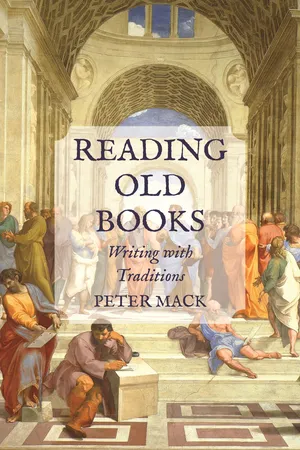
In literary and cultural studies, "tradition" is a word everyone uses but few address critically. In Reading Old Books, Peter Mack offers a wide-ranging exploration of the creative power of literary tradition, from the middle ages to the twenty-first century, revealing in new ways how it helps writers and readers make new works and meanings.
Reading Old Books argues that the best way to understand tradition is by examining the moments when a writer takes up an old text and writes something new out of a dialogue with that text and the promptings of the present situation. The book examines Petrarch as a user, instigator, and victim of tradition. It shows how Chaucer became the first great English writer by translating and adapting a minor poem by Boccaccio. It investigates how Ariosto, Tasso, and Spenser made new epic meanings by playing with assumptions, episodes, and phrases translated from their predecessors. It analyzes how the Victorian novelist Elizabeth Gaskell drew on tradition to address the new problem of urban deprivation in Mary Barton. And, finally, it looks at how the Kenyan writer Ng?g? wa Thiong'o, in his 2004 novel Wizard of the Crow, reflects on biblical, English literary, and African traditions.
Drawing on key theorists, critics, historians, and sociologists, and stressing the international character of literary tradition, Reading Old Books illuminates the not entirely free choices readers and writers make to create meaning in collaboration and competition with their models.
- 240 pages
- English
- ePUB (mobile friendly)
- Available on iOS & Android
eBook - ePub
About this book
Information
Publisher
Princeton University PressYear
2019Print ISBN
9780691205151
9780691194004
eBook ISBN
9780691195353
CHAPTER ONE
Petrarch, Scholarship, and Traditions of Love Poetry
PETRARCH (1304–1374) ENJOYED a very strong relationship, but also a paradoxical one, with traditions which led up to him and those continuing vigorously after him. He has long been regarded as a founder of traditions, but his poetry has also become a victim of the tradition his followers established. Petrarch was one of the first great writers of the Italian language, but he made his poetry largely out of earlier poets in other languages. He took forms and patterns from the troubadours and introduced ideas, motifs, and even translated phrases from classical Latin poetry. Petrarch was immensely influential on later poets. His love poetry gave expression to ideas and expectations about the male lover’s adoration of the beloved which can be traced back through around two thousand years of Greek, Latin, and vernacular poetry and philosophy. Petrarch also passed on a repertory of attitudes, ideas, motifs, phrases, and vocabulary to later Italian and European poets, and his vocabulary became the standard poetic dialect of the Italian language. Because his poetry formed a point of departure for so much European love lyric of the following three centuries, it became almost impossible to read Petrarch’s own poetry without expectations derived from the work of his sometimes rather slavish and mediocre followers. One aim of this chapter is to focus on Petrarch’s own poetry in order to articulate what he achieved and how he used his sources. In returning to the source, we shall rediscover how good Petrarch’s poems are and how much their excellence owes to his subtle and restrained exploitation of the tradition of his poetic predecessors.
Petrarch also played an important role in European culture more generally. He served later scholars as an example of what conscious cultivation of knowledge about the classical world might become. He was among the first to gather and disseminate hidden Latin texts, such as letters and orations of Cicero and books of Livy’s history of Rome. He inspired later humanists to restore classical levels of Latin prose composition and to learn Greek. He wrote considerable portions of a Latin epic poem in imitation of his favorite poet Virgil and collected moral exempla from Roman history and Latin literature.1 In his letters, as we shall see, he became a significant theorist of the art of imitation: how a writer uses material from reading as a resource from which to write better.2 In his Italian poetry, he drew both on the major Augustan poets (Virgil, Ovid, Horace, and Propertius) and on the vernacular poetry of the troubadours, the dolce stil novo, and Dante himself, to create a synthesis which became a sort of encyclopedia of the images and ideas of love poetry for Italian, French, English, and German poets of the following three centuries.3 These poets no longer needed to read Petrarch’s predecessors (though they sometimes did) because Petrarch had provided them with a heritage of images which they could imitate and vary. His influence on later European poets was very substantial.4 We need to understand the term “Petrarchism” as a sort of shorthand for Petrarch’s combination of gathering materials from earlier traditions and transmitting them to later poets. When we speak of an image (such as the ship tossed in the storm or the sun melting the snow) or a phrase as Petrarchan, we often mean not that Petrarch invented the phrase, but that he gathered it from his reading and transmitted it to later writers.
I shall begin by considering the advice which Petrarch gives scholars and writers about imitation and the ways of using one’s reading in order to write. He was aware of the role which his own work might play as a model for other writers, and he advised them on how to use their reading. Drawing on previous scholarship, I shall make some connections between his Italian poems and what he tells us about his life in the collections of letters which he constructed and in his Secretum.5 Then I shall look at some examples of Petrarch’s poems, both to substantiate my claim about their excellence and to show how that excellence derives from his creative use of his reading. Finally, I shall consider his attitude to Dante, his immediate and overwhelming forerunner, and discuss the ways in which later writers used Petrarch’s work.
Reading and Imitation
Alongside his constantly rewritten portrayal of his struggle with love in the Canzoniere, Petrarch also constructed portraits of his life and internal struggles in his Secretum and in his collections of letters, notably the Rerum familiarum liber, assembled around 1366, and the Rerum senilium liber, which collected 128 later letters. In both these collections we see that, as in the Canzoniere, Petrarch did not hesitate to rewrite letters or to write new letters supposedly sent earlier in his life. All these collections were self-consciously constructed by Petrarch.6 The letters tell us many things about Petrarch’s life which we are glad to know and which can sometimes be corroborated independently, but the texts, the selection, and the ordering were subject to Petrarch’s editorial intervention.
Petrarch in his letters uses his reading to think with and to persuade his correspondents. Scholars have shown that the reading of Saint Augustine so much constructs the experience depicted in his letter on the climbing of Mount Ventoux (Familiares IV.1) that we may even doubt whether the climb itself actually took place.7 When he consoles his correspondents and when he urges them to a course of action, he always backs up his points with quotations from classical literature and Christian authors.8 In the same way quotations from Virgil and Horace propel the exposition of his internal struggle in the Secretum.9 Reading was intrinsic to everything which Petrarch wrote, and many of the letters concern his attempts to find and obtain copies of books.10 In the letters he reflects a good deal on his reading and on the relationship between reading and writing, and that is what I shall examine next, beginning with three letters from the Rerum familiarum liber.
In Familiares VI.4, Petrarch defends himself to Giovanni Colonna against the charge that he uses too many examples. He first explains that he uses examples in his writing because in his own reading he finds that he is most moved and impressed by examples of what outstanding people have done. His experience of the effect of reading prompts his approach to writing. He tells us that when he writes he looks to the greatest writers of the past because they portray for him the magnificent deeds of outstanding men. He uses examples from antiquity in his writing because he knows that these examples have profited him when he read them and he hopes that they will benefit his readers.11 Later in the same letter, he connects this point to literary imitation. Imitation improved the quality of Latin literature. Virgil and Cicero imitated Homer and Demosthenes; Virgil equaled Homer, while Cicero surpassed Demosthenes. In the same way, the examples of Antonius the Egyptian and Victorinus the rhetorician inspired Augustine to convert to Christianity.12 Seeing how examples inspire men to emulation and lead them to success and to virtue, and feeling the same result in himself, Petrarch hopes that the examples he cites or retells will inspire his readers.
Familiares XXII.2 addresses Petrarch’s friend Giovanni Boccaccio on a range of issues related to copying texts, imitation, and borrowing. The whole letter leads up to two paragraphs in which he admits to two accidental thefts from Virgil and Ovid in his Bucolicum carmen, which he asks Boccaccio to rephrase in his copy in order to avoid the copying of words.13 He begins the letter by explaining that a really slow reading of a text, even by an unskillful reader, helps him see more easily where a phrase needs to be revised. When writing, we sometimes make errors with the material which is most familiar.14 There are some writers, such as Ennius, Plautus, Martianus Capella, and Apuleius, whom he has read only once and in a hurry. When he happens to use something from writers like these, he is immediately aware of it. But there are other writers, like Virgil, Horace, Boethius and Cicero, whom he has read countless times and whose writings he has so thoroughly absorbed that he no longer knows that a particular phrase is theirs rather than part of his own thinking. In general, where he embellishes his writings with phrases from other authors, he claims that he acknowledges the debt or that he changes the idea in reaching his own expression, in the manner of the bees. Occasionally he borrows without acknowledgment either because of intellectual kinship (with an unfamiliar author) or because of an accident (with a familiar author).15 Generally, however, he prefers his style to be his own.
I am a man who delights to follow the path of earlier poets, but not the actual footsteps of these others. I would wish to use other men’s writings not stealthily but by begging from time to time, but while I may, I would prefer my own; I am a man pleased by resemblances, but not identity, and the resemblance itself should not be too close, in which the brilliance of the follower’s mind should appear, not its blindness or poverty.16
He will be inspired by what he reads. He will follow it up to a point, but he will also try to add something of his own. Finally, he mentions Virgil, who consciously borrowed and translated much from Greek literature, not to steal it but rather to compete with it.17
Familiares XXIII.19, also to Boccaccio, returns to the topic of the use of reading in discussing the progress of a young writer whom Petrarch is recommending to his friend. Petrarch hopes that this young man will eventually create a personal style from his reading, not necessarily avoiding imitation but concealing it so that what he writes resembles no one else’s writing and appears to be new. At the moment, unfortunately, he delights in imitation, is incapable of freeing himself from the writers he tries to follow—Virgil above all— and inserts parts of Virgil’s work into his own.18 This leads to a general statement on imitation: one must try to write something similar but not identical to the original; the resemblance should be more like that of a son to a father than that of a painting to the subject depicted. The imitator may use the coloring and the ideas of the original but should avoid using the same words. This advice can be summarized by using Horace’s and Seneca’s image of the bee gathering flowers but turning them into something different.19 One day when Petrarch was admonishing his pupil along these lines, the pupil pointed out to him another phrase from his own Bucolicum carmen identical to one in Aeneid VI.20
Petrarch’s construction and preservation of these collections of letters leads us to think that he was consciously advising contemporary and later poets about how they should learn to write and about the right way to use earlier poetry. These comments and his broader practice make it possible to establish Petrarch’s position on the use of reading earlier writers in one’s own writing. First, it seems that for Petrarch reading is a requirement in order to write. He sometimes remarks that he cannot write a proper reply because he has not got his books with him.21 Second, he believes that writers should aim to forge their own way of writing out of what they read. They should not imitate other writers too closely or use their same words. They should gather from many sources with the aim of making something new or something similar to, but different from, what they have been reading. Younger writers may find that the authors they imitate dominate them too much. Third, he refers with approval to writers (like Virgil) who have reused and rephrased material from their reading deliberately, with the intention of competing with previous excellent writers. Fourth, he suggests that some apparent similarities between writers may be a consequence of similarities of thought or subject matter rather than of imitation. He first me...
Table of contents
- Cover Page
- Title Page
- Copyright Page
- Contents
- Preface
- Introduction: Ideas of Literary Tradition
- CHAPTER 1. Petrarch, Scholarship, and Traditions of Love Poetry
- CHAPTER 2. Chaucer and Boccaccio’s Il Filostrato
- CHAPTER 3. Renaissance Epics: Ariosto, Tasso, and Spenser
- CHAPTER 4. Reading and Community as a Support for the New in Elizabeth Gaskell’s Mary Barton
- CHAPTER 5. European and African Literary Traditions in Ngũgĩ wa Thiong’o’s Wizard of the Crow
- Conclusion: Writers’ and Readers’ Traditions
- Notes
- Select Bibliography
- Index
Trusted by 375,005 students
Access to over 1.5 million titles for a fair monthly price.
Study more efficiently using our study tools.
Frequently asked questions
Yes, you can cancel anytime from the Subscription tab in your account settings on the Perlego website. Your subscription will stay active until the end of your current billing period. Learn how to cancel your subscription
No, books cannot be downloaded as external files, such as PDFs, for use outside of Perlego. However, you can download books within the Perlego app for offline reading on mobile or tablet. Learn how to download books offline
Perlego offers two plans: Essential and Complete
- Essential is ideal for learners and professionals who enjoy exploring a wide range of subjects. Access the Essential Library with 800,000+ trusted titles and best-sellers across business, personal growth, and the humanities. Includes unlimited reading time and Standard Read Aloud voice.
- Complete: Perfect for advanced learners and researchers needing full, unrestricted access. Unlock 1.5M+ books across hundreds of subjects, including academic and specialized titles. The Complete Plan also includes advanced features like Premium Read Aloud and Research Assistant.
We are an online textbook subscription service, where you can get access to an entire online library for less than the price of a single book per month. With over 1.5 million books across 990+ topics, we’ve got you covered! Learn about our mission
Look out for the read-aloud symbol on your next book to see if you can listen to it. The read-aloud tool reads text aloud for you, highlighting the text as it is being read. You can pause it, speed it up and slow it down. Learn more about Read Aloud
Yes! You can use the Perlego app on both iOS and Android devices to read anytime, anywhere — even offline. Perfect for commutes or when you’re on the go.
Please note we cannot support devices running on iOS 13 and Android 7 or earlier. Learn more about using the app
Please note we cannot support devices running on iOS 13 and Android 7 or earlier. Learn more about using the app
Yes, you can access Reading Old Books by Peter Mack in PDF and/or ePUB format, as well as other popular books in Literatur & Literaturkritik für Vergleichende Literaturwissenschaft. We have over 1.5 million books available in our catalogue for you to explore.