Shackleton
eBook - ePub

Shackleton

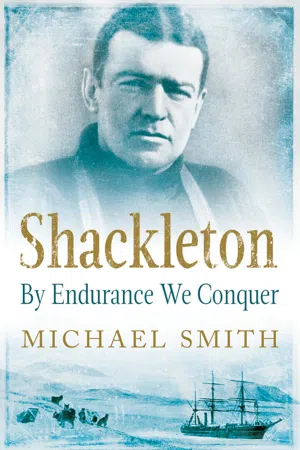
By Endurance We Conquer

  1. 464 pages
  2. English
  3. ePUB (mobile friendly)
  4. Available on iOS & Android
eBook - ePub

Shackleton

By Endurance We Conquer

About this book

Ernest Shackleton is one of history’s great explorers, an extraordinary character who pioneered the path to the South Pole over 100 years ago and became a dominant figure in Antarctic discovery. A charismatic personality, his incredible adventures on four expeditions have captivated generations and inspired a dynamic, modern following in business leadership. None more so than the Endurance mission, where Shackleton’s commanding presence saved the lives of his crew when their ship was crushed by ice and they were turned out on to the savage frozen landscape. But Shackleton was a flawed character whose chaotic private life, marked by romantic affairs, unfulfilled ambitions, overwhelming debts and failed business ventures, contrasted with his celebrity status as a leading explorer.

Drawing on extensive research of original diaries and personal correspondence, Michael Smith's definitive biography brings a fresh perspective to our understanding of this complex man and the heroic age of polar exploration.
Frequently asked questions

Yes, you can cancel anytime from the Subscription tab in your account settings on the Perlego website. Your subscription will stay active until the end of your current billing period. Learn how to cancel your subscription.
No, books cannot be downloaded as external files, such as PDFs, for use outside of Perlego. However, you can download books within the Perlego app for offline reading on mobile or tablet. Learn more here.
Perlego offers two plans: Essential and Complete
  • Essential is ideal for learners and professionals who enjoy exploring a wide range of subjects. Access the Essential Library with 800,000+ trusted titles and best-sellers across business, personal growth, and the humanities. Includes unlimited reading time and Standard Read Aloud voice.
  • Complete: Perfect for advanced learners and researchers needing full, unrestricted access. Unlock 1.4M+ books across hundreds of subjects, including academic and specialized titles. The Complete Plan also includes advanced features like Premium Read Aloud and Research Assistant.
Both plans are available with monthly, semester, or annual billing cycles.
We are an online textbook subscription service, where you can get access to an entire online library for less than the price of a single book per month. With over 1 million books across 1000+ topics, we’ve got you covered! Learn more here.
Look out for the read-aloud symbol on your next book to see if you can listen to it. The read-aloud tool reads text aloud for you, highlighting the text as it is being read. You can pause it, speed it up and slow it down. Learn more here.
Yes! You can use the Perlego app on both iOS or Android devices to read anytime, anywhere — even offline. Perfect for commutes or when you’re on the go.
Please note we cannot support devices running on iOS 13 and Android 7 or earlier. Learn more about using the app.
Yes, you can access Shackleton by Michael Smith in PDF and/or ePUB format, as well as other popular books in History & Historical Biographies. We have over one million books available in our catalogue for you to explore.

Information

CHAPTER 1
Touching History
The fingerprints of history can be found in the deep family roots of Ernest Henry Shackleton. Tracing the line back almost 1,000 years, the Shackletons emerge as an intriguing mixture of religious pioneers and aristocrats, adventurers and rebels, blended with a stock of respectable folk drawn from the ranks of doctors, teachers and writers.
The name Shackleton is almost certainly derived from the old Anglo-Saxon English word scacol or scacoldenu meaning ‘tongue of land’. It was combined with tun, the Anglo-Saxon for enclosure or settlement, and is believed to spring from a hamlet now called Shackleton near Heptonstall, West Yorkshire.
The earliest recorded inhabitants were socage (feudal) tenants and yeomanry who were mentioned in the Wakefield Court Rolls from 1198 onwards. It is believed they held land in the area and may have been foresters and local law enforcers on the wooded estates of the Earl of Surrey, a descendant of the Norman nobleman William de Warenne who fought at the Battle of Hastings.1
Early variations of the name from the 12th century included Scachelden, Scackleton, Shackletun, de Shakeldene and Shakeltune. Richard Shackylton of Keighley was a bowman at Flodden in 1513, the largest ever battle between the English and Scots. The modern version appeared more consistently by the 15th and 16th centuries and, in 1588, Henry Shackleton of Darrington, near Pontefract, married into the family of Martin Frobisher, the colourful Elizabethan pirate-explorer from Wakefield made famous by three early attempts to navigate the icy waterways of the North-West Passage.
The immediate line to Ernest Shackleton can be traced to communes around the West Yorkshire settlements of Heptonstall and Keighley where in 1591 members of the family bought a home at Harden, a richly forested vale of land close to the town of Bingley. The property was subsequently called Shackleton House and was to remain in the family’s hands for some 200 years.
In 1675, during the decades of political and social upheaval after the English Civil War, Shackleton House passed to Richard Shackleton. It was an age of aggressive religious dissent which produced factions such as the Diggers, Puritans and Ranters who defied the established Church and sought enlightenment in their own assorted and often extreme spiritual sects. Richard Shackleton, a deeply religious man, was swept up in the fervour and became an early convert to the Society of Friends, better known as the Quakers.
Formed in 1647 during the Civil War, the Quakers were the radical wing of the Puritans who provided the spiritual backbone to Cromwell’s armies pitted against King Charles. But re-establishment of the Church of England in 1660, following the death of Cromwell, left the obdurate Quakers isolated and their refusal to pay tithes and take oaths inevitably brought them into conflict with mainstream society. Persecution and harassment were commonplace and Quaker meeting houses were attacked by mobs and many followers imprisoned for their beliefs.
Richard Shackleton was among the casualties, once serving three years in York prison for not attending church and holding Quaker meetings at Shackleton House. It was at Shackleton House in 1696 that Richard’s wife, Sarah Briggs, produced the last of their six children. Named Abraham, he went on to establish the Shackleton dynasty in Ireland.
Abraham, a pious young man, was orphaned by the age of eight and drifted into teaching at David Hall, a Quaker school in Skipton. He was later invited to teach in Ireland where the Quaker movement was in the early stages of spreading the Nonconformist message at a new settlement formed at Ballitore, County Kildare.
Ballitore, founded in 1685 by Abel Strettel and John Barcroft, was the first planned Quaker settlement in Ireland and the nascent community flourished in the open fields beside the River Greese, developing the rich farmland, building flour mills and laying the foundations for a thriving merchant class. It was the ideal setting for aspiring teacher Abraham Shackleton and his new wife, Margaret Wilkinson.
Abraham, now 30 years old, opened the Ballitore School for boys in March 1726. The school, about 40 miles to the west of Dublin near the border of Kildare and Wicklow, was subsequently run by generations of Shackletons and emerged as a beacon of learning that became synonymous with the ideals of the Quaker brethren.
Ballitore’s success – it was non-denominational at times – also helped dilute some anti-Quaker prejudice in Ireland during the 18th century and the school’s illustrious pupils included the statesman-philosopher Edmund Burke and the revolutionary James Napper Tandy. Richard Shackleton, the son of Abraham, who took over the running of the school, became close friends with Burke. It was said that Ballitore helped shape Burke’s strong civil and religious libertarian values. ‘If I am anything,’ Burke said, ‘it is the education I had there [Ballitore] that has made me so.’
Other notable predecessors of Ernest Shackleton included the prolific writer and historian Mary Shackleton Leadbeater who was a friend of Burke and memorably chronicled the affairs of the Ballitore community in late 18th and early 19th centuries. Another member of the Leadbeater line was the pioneering mountaineer Charles Barrington, the Quaker merchant from Wicklow who in 1858 made the first ascent of the Eiger, the most notorious of the Alpine peaks.
A century passed before the Shackleton family parted company with the Quakers and moved onto more traditional religious ground. Ebenezer Shackleton, the great-grandson of the school’s founder, became disenchanted with the Quakers in the early years of the 19th century and ushered the family into the mainstream Church of Ireland. It was a step which took the Shackleton family from one tiny and unpopular minority to the larger and most loathed minority of all – the powerful Anglo-Irish landowners and aristocrats who dominated Ireland, often as absentee landlords, for centuries.
Successive generations of landowners – the Protestant Ascendancy – flourished in the area known as the Pale, the ancient and rarefied enclave which marked the old territorial boundaries extending out from Dublin where the ruling class of Anglo-Irish lived apart from the wholesale poverty existing elsewhere. They owned Ireland’s banks, businesses and legal offices and turned out a succession of prominent soldiers, statesmen, politicians, businessmen and writers – including Wellington, Swift, Parnell and Arthur Guinness – in blissful isolation from the majority.
Survivors by nature, the ruling minority successfully withstood repeated rebellions and even the horrors of the Great Famine of the 1840s when an estimated 1 million died and another 2 million fled the country. Some of the detested landlords exported food at the height of the humanitarian crisis in what one observer called an ‘epic of English colonial cruelty’. A.J.P. Taylor, the distinguished English historian, said: ‘The English governing class had the blood of two million Irish people on their hands.’
After withdrawing from the Quaker fold, Ebenezer Shackleton developed a life away from the immediate sphere of Ballitore. He opened a mill at nearby Moone and in 1831, at the age of 47, married his second wife, 25-year-old Ellen Bell from Abbeyleix. It was a fertile union which produced nine children and, at Ellen’s wishes, the children were brought up as Anglicans, the first Shackleton children in well over a century to be raised outside the Quaker faith.
The eighth child, born at Moone on 1 January 1847 – at the height of the Famine – was named Henry. By the time Henry reached the age of nine, his father was dead and his widowed mother decided that the youngster should pursue a career in the army. Henry was subsequently sent to Old Hall School, Wellington, in England, but his studies were interrupted by illness and he returned to Ireland. After abandoning plans for a military career, Henry went to Dublin’s Trinity College where in 1868 he earned a degree in the Arts.
Henry Shackleton was 25 in 1872 when he married Henrietta Laetitia Sophia Gavan, the 26-year-old daughter of Henry Gavan from nearby Carlow. Together they had 10 children, including Ernest Shackleton.
image
Shackleton’s parents. Dr Henry Shackleton came from Anglo-Irish and Quaker roots and Henrietta Shackleton (née Gavan) was a member of the long-established Fitzmaurices from Kerry. COURTESY: ATHY HERITAGE MUSEUM
Henrietta, a bubbly, good-humoured woman, came from deeply rooted Irish stock which provided a strong Irish bloodline to the Anglo-Irish and Quaker lineage of Henry Shackleton. As an adult, Ernest Shackleton would proudly boast of his Irish heritage and usually listed his nationality as Irish. However, as one of his sisters later observed: ‘We were never Irish till Mother [Henrietta Gavan] married into the family.’2
The link to old Irish ancestry came from Henrietta’s mother, Caroline Fitzmaurice, who was descended from the long-established Fitzmaurice clan whose Irish origins can be sketched back to the Norman invasion and may have links to medieval kings Louis VIII of France and John of England. It was a lineage which featured an assortment of aristocratic dukes and earls, eminent politicians and flamboyant landed gentry. Luminaries included the first Earl of Kerry in the 13th century and some who rebelled against English rule and others who supported the Crown.
One notable figure among the Fitzmaurices was the multifaceted Sir William Petty, a founding member of the Royal Society and physician general to Oliver Cromwell, whose skilful surveying of Ireland in the 1650s – the controversial Down Survey – was instrumental in the wholesale confiscation of Irish lands in the 17th century. Another was William Petty-Fitzmaurice who, as Prime Minister in 1782, signed the peace treaty which ended the War of Independence and British rule in America. Through the Huguenot Daniel Boubers de Bernatre, the Fitzmaurice line shared a common ancestor with Sir Leopold McClintock, the prominent 19th-century Arctic explorer who lived long enough to witness Ernest Shackleton depart for the ice at the opening of the 20th century.
Henry Gavan, Henrietta’s father, came from more modest stock. His father was Rector of Wallstown, Cork. Henry qualified as a doctor but abandoned medicine in favour of a commission in the Royal Irish Constabulary and was dead soon after.
Henry and Henrietta Shackleton settled in the familiar landscape of Kildare. The couple rented a 500-acre farm from the Duke of Leinster at Kilkea, a remote hamlet in the lush, fertile pastures a few miles south of the old market town of Athy. It is among the richest farmland in Ireland. Through the trees could be seen the 12th-century stronghold of Kilkea Castle and on a clear day it is possible to pick out the gentle curves of Wicklow’s mountains. Ebenezer’s mill at Moone was a handful of miles away and Henrietta’s family home lay a short distance to the south. Ballitore, the ancestral home of the Shackletons of Kildare, was within easy reach.
image
The house at Kilkea, near Athy in Kildare, where Shackleton was born on 15 February 1874. MICHAEL SMITH.
The comfortable family home was a substantial Georgian farmhouse called Kilkea House, overlooking the easy slopes of Kildare. Henry and Henrietta Shackleton’s first child, Gertrude, was born at the end of 1872. The second child was born at Kilkea House on 15 February 1874. The blue-eyed boy was named Ernest Henry Shackleton. He shared a birthday with Galileo.
CHAPTER 2
The Lonely Sea and the Sky
Ernest Shackleton grew up in a rural idyll, surrounded by open countryside and close to the meandering waters of the River Greese. It was a happy and secure household on the upper slopes of Irish society. While Henrietta radiated kindness and good humour, Henry Shackleton was a cultured man with a fashionably full beard who provided stability, warm benevolence and a solid income. The rapid procession of six new children – Gertrude, Ernest, Amy, Francis, Ethel and Eleanor were born in a seven-year spell at Kilkea House – added to the sense of well-being in the Shackleton household.
Unfortunately for Henry Shackleton, circumstances elsewhere were disturbing the idyllic milieu. Irish farming faced critical economic problems in the 1870s. Incomes were in decline and, for the first time in centuries, the Catholic majority had begun to chip away at the bedrock of the Ascendancy’s power base – the land. Major democratic reforms gave more power to tenants from the old peasant class and the mostly Anglo-Irish landlords received a significant blow to their privileged status with the disestablishment of the Church of Ireland in 1871.
Image
Ernest Shackleton aged 11, in 1885, at around the time the family moved from Ireland to London. As a child he dreamed of sea-going adventures.
Image
Where rebellion had failed, basic economics and creeping democracy were fomenting a revolution in land ownership and political agitators seized the opportunity to press for more far-reaching reforms to end the dominance of the landlords. The revolt gained fresh momentum in 1879 with the onset of another famine – the last significant famine in Ireland – and the founding of the rebellious National Land League, which sparked the bitter and bloody Land War.
In the changed political climate, farming suddenly looked unappealing to Henry Shackleton who looked around for a career in a safer, more stable field. An uncle, Dr William Bell, practised medicine nearby and had developed an interest in alternative remedies like homeopathy. Within a...

Table of contents

  1. Cover
  2. Title
  3. Copyright
  4. Contents
  5. Acknowledgements
  6. Author’s Note
  7. Introduction
  8. 1 Touching History
  9. 2 The Lonely Sea and the Sky
  10. 3 Love and Ambition
  11. 4 Laying the World at Her Feet
  12. 5 Fortune Hunting
  13. 6 A Hunger
  14. 7 Baptism by Ice
  15. 8 A Step into the Unknown
  16. 9 A Beeline
  17. 10 Rejection
  18. 11 Two Characters
  19. 12 Finding a Niche
  20. 13 Looking South
  21. 14 Dreams and Realities
  22. 15 Broken Promise
  23. 16 Ice and Men
  24. 17 Making Ready
  25. 18 South
  26. 19 Penniless
  27. 20 Gateway
  28. 21 ‘Death on his pale horse …’
  29. 22 Home is the Hero
  30. 23 Arise, Sir Ernest
  31. 24 A Man of Parts
  32. 25 Unrest
  33. 26 Towering Ambition
  34. 27 Into the Pack
  35. 28 Imprisoned
  36. 29 Death of a Ship
  37. 30 Defiance
  38. 31 Into the Boats
  39. 32 A Dark Episode
  40. 33 Bleak Refuge
  41. 34 Scattered to the Winds
  42. 35 Epic Journey
  43. 36 South Georgia
  44. 37 Rescue
  45. 38 The Ross Sea Party
  46. 39 Adrift Again
  47. 40 The Last Quest
  48. 41 At Rest
  49. Notes
  50. Select Bibliography
  51. Index